
Australian healthcare providers keep asking us for an ada compliance medical website. Fair enough, since the phrase is everywhere. The catch is that the ADA is United States law, and what binds a medical practice in Sydney or Perth is the Disability Discrimination Act 1992. Same technical target, different regulator, different path to a claim. Here’s how website accessibility works under the local rules.
Does ADA Compliance Apply to an Australian Clinic?
Short answer: no. The Americans with Disabilities Act binds US entities, so a healthcare practice in Melbourne can’t be sued under it.
Your duty still exists though. It comes from the DDA 1992, the Disability Discrimination Act, and the Australian Human Rights Commission administers it. Section 24 makes it unlawful to discriminate in the way goods, services and facilities are provided. A booking page is a service. So is a results portal, and so are the digital services a healthcare team wraps around them.
One case changes the picture: if you treat US patients, hold a US entity, or take US federal funds through a partner, then ADA compliance and the website accessibility lawsuits that come with it can reach you. That’s rare for a suburban medical practice and common for telehealth groups.
So the practical read is simple. Build to the same technical bar, but understand the local process, because that’s where the cost and the timeline come from. ADA compliance and DDA compliance ask for the same code; only the paperwork changes.
What the DDA Asks of Healthcare Providers
Oddly, the DDA doesn’t name a version of anything. It sets a duty and leaves the method open, which frustrates people who want a checklist.

Guidance fills the gap. AHRC staff publish the World Wide Web Access Advisory Notes, now at version 4.1, and those notes point at the Web Content Accessibility Guidelines at Level AA. Those guidelines come from the World Wide Web Consortium, so Australian accessibility standards and global ones ask for the same web content in practice. Two newer instruments push further. Canberra’s Digital Service Standard asks for WCAG 2.1 AA, and Standards Australia adopted AS EN 301 549:2020 for buying accessible technology.
Defences matter too. A healthcare provider can argue unjustifiable hardship, which weighs cost, disruption and benefit. It’s a real defence and a weak one for healthcare websites, because the fix is usually cheap next to a rebuild. Legal risk sits mostly in the delay, not the code.
Disability sits behind the largest share of complaints the Commission handles under federal discrimination law, and about 5.5 million Australians, or 21.4 percent of us, live with disability according to the ABS Survey of Disability, Ageing and Carers 2022. Many of them reach a healthcare service through assistive technology. That’s the pool of patients your booking form either serves or turns away.
Australia Compared With the United States
Both systems chase the same outcome and get there by very different roads. This is the part healthcare providers get wrong when they buy US advice off the shelf, and it’s an expensive mistake to unwind later. ADA compliance advice written for Ohio rarely fits a practice in Adelaide.
| Australia | United States | |
|---|---|---|
| Main law | DDA 1992, section 24 | Americans with Disabilities Act 1990, plus the Rehabilitation Act |
| Who acts first | The person affected, via an AHRC complaint | The person affected, via a court filing |
| Standard named | WCAG 2.0 AA in the AHRC notes; WCAG 2.1 AA in the Digital Service Standard and AS EN 301 549:2020 | WCAG 2.1 AA named in the 2024 DOJ and HHS rules |
| Usual first step | Free, private conciliation | Demand letter from a law firm |
| Volume | Complaint driven, no filing industry | 4,605 digital accessibility lawsuits in 2023 |
| Money at risk | Damages with no statutory cap, plus costs | Settlement plus legal fees on both sides |
| Privacy law alongside | Privacy Act 1988 and the Australian Privacy Principles | HIPAA |
Notice the second row. In Australia nothing lands in court on day one, so the early compliance cost is time and goodwill rather than legal fees. That’s a gift, as long as you use it. US accessibility laws move faster and cost more, which is why lawsuits shape the American conversation and conciliation shapes ours.
What Maguire v SOCOG Still Teaches Clinics

Bruce Maguire is blind. In 2000 he complained that the Sydney Olympics website locked him out of results, schedules and ticketing.
Maguire won. Commissioners found unlawful discrimination and awarded 20,000 dollars. Organisers had run an unjustifiable hardship defence, arguing the work was too big and too late, and that argument was rejected.
Twenty five years on, the lesson holds for a medical practice. Cost arguments fail when the accessibility barriers are an unlabelled field or an image with no alt text. Reputational damage from an accessibility finding also outlives the payment by a long way, which is the part practice owners tend to worry about most.
Warning: Unjustifiable hardship is judged against the size of your operation and the cost of the fix. For a website, that maths rarely goes the clinic’s way.
How an AHRC Complaint Actually Unfolds
Knowing the steps takes some of the fear out of it. Here’s the shape of a typical matter:
- Someone lodges a written complaint with the Commission, usually at no cost and without a lawyer.
- Commission staff notify your practice and ask for a response, often within a few weeks.
- Both sides are invited to conciliation, which is private, free and run by a Commission officer.
- Most matters settle here, with an agreed fix list, a timeline and sometimes a payment.
- If conciliation fails, the complaint can be terminated and taken to the Federal Court or the Federal Circuit and Family Court.
That window between step two and step three is where preparation pays. A practice that can hand over an accessibility audit, a fix log and an accessibility statement looks very different from one scrambling to explain itself. Honestly, that gap decides most outcomes.
Pro Tip: Keep dated audit exports. Evidence of steady work is your strongest card in conciliation.
Which WCAG Checks Fail Most on Clinic Sites
We audit these sites for a living, so let’s use real numbers rather than a vibe.

When we ran a page by page audit for one client, a 37 page medical site, we found 213 WAVE errors and an average AIM score of 4.1 out of 10. Over 30 clinician portraits carried no alt text. Not a single page met the AA bar. Our team cut errors by 77 percent, and the homepage went from 57 errors to 9. A residue of 50 errors stayed, baked into the site builder itself, so we documented it rather than pretending it was gone. Most healthcare websites we see follow that shape: cheap wins first, platform limits last. Full numbers sit in our ADA and AHRC compliance case study.
That pattern matches the global picture. WebAIM’s Million study for 2024 found detectable WCAG failures on 95.9 percent of home pages, led by low contrast text at 81 percent, missing alt text at 54.5 percent and missing form labels at 48.6 percent.
Five fixes clear most of it on healthcare websites:
- Give every image a description that says what it shows, not just the file name.
- Tie a visible label to each form field, and write error text that says what to do next.
- Raise text contrast to at least 4.5 to 1 for body copy, which lifts user experience for every patient, not only those with low vision.
- Test booking with a keyboard alone, since third party widgets are the usual trap.
- Check that accessibility features you already pay for, such as a portal’s text resizing, survive each template update.
Our ADA and AHRC compliance service works through exactly that list, page by page, with before and after evidence. Level AAA gets discussed, though few clinics need it; Level AA plus clean content covers the accessibility requirements that come up in practice.
Portals, Privacy and the Australian Privacy Principles

Health information is sensitive information under the Privacy Act 1988. That raises the bar for anything you bolt onto a patient portal, and it changes how an ada compliant website gets built in Australian healthcare.

Accessibility overlays are the common misstep. They load an outside script into a page that handles Medicare numbers and clinical notes, they claim to patch code they can’t see, and they leave the source markup broken underneath. If a breach follows, the notifiable data breaches scheme puts you in front of the OAIC.
Do it the boring way instead. Fix the markup, test with a keyboard, run a screen reader over the login and the forms, and only then consider a widget as a comfort layer for patients who want font and contrast controls. An accessible website earns trust with patients long before it satisfies a regulator.
Where SEO and AI Answers Come In
Accessible markup and machine readable markup are close to the same thing. Headings that describe sections, links that say where they go, tables with real headers.
That’s why web accessibility work shows up in traffic. Clean structure feeds answer engine optimisation, so AI assistants can lift a straight answer out of your page instead of a competitor’s. It also helps a healthcare website rank for the plain questions patients actually type, because the main content is finally readable by machines as well as people.
Practical steps sit in our broader piece on healthcare website accessibility, which walks through audits, governance and ongoing monitoring.
Serving US Patients as Well?
Telehealth groups often straddle both markets, and then two rule sets apply at once. US rules bring named deadlines in 2026 and 2027, under the DOJ Title II rule and the HHS Section 504 rule.
For that half of the picture, read our US guide to ADA compliance for medical websites. Build to WCAG 2.1 AA once, and both regulators are answered.
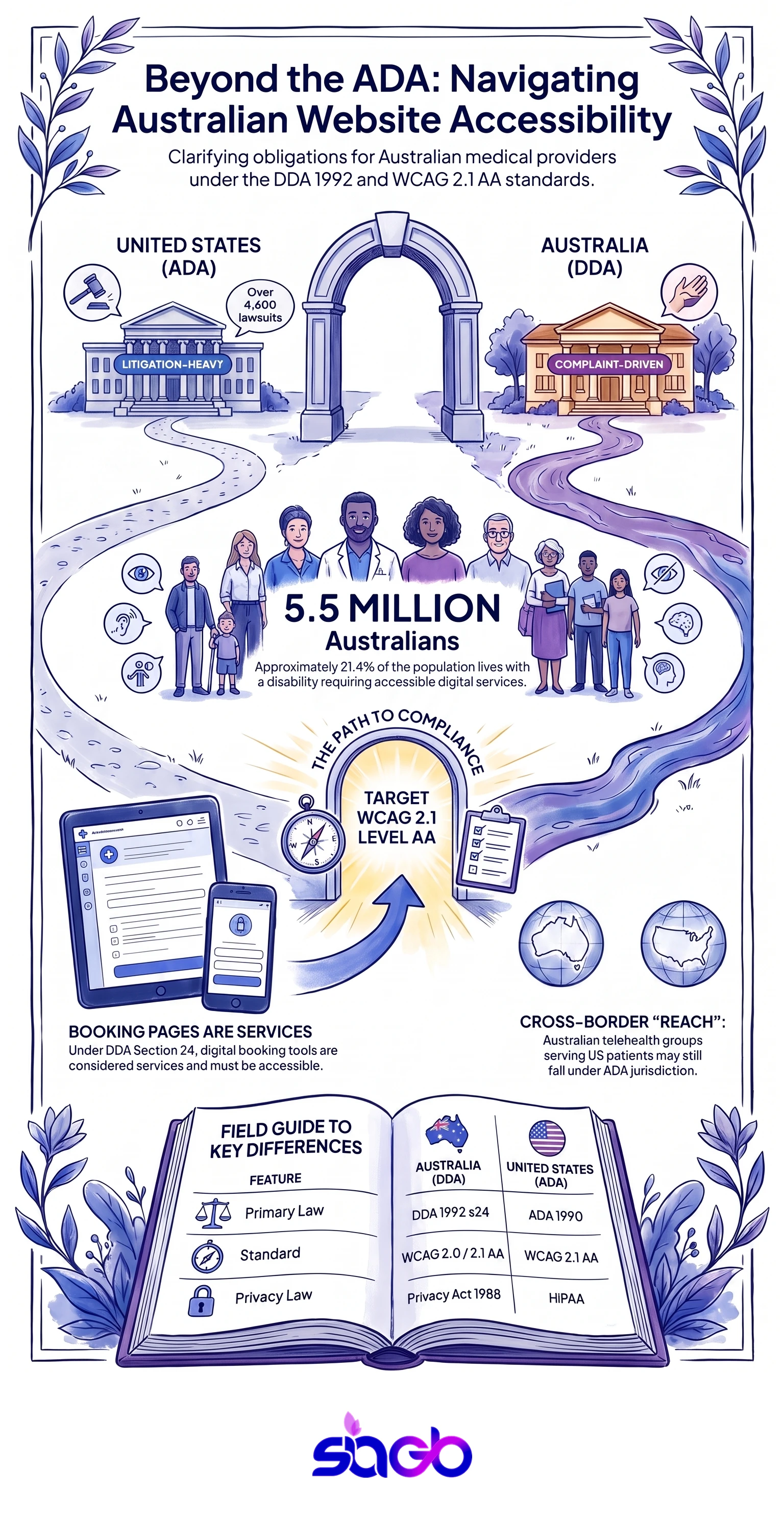
Infographic: How Compliance, AI and Trust Connect
This infographic maps the Australian path end to end: DDA duty, AHRC complaint route, WCAG 2.1 AA checks, Privacy Act controls and the search visibility that follows accessible structure.
Infographic: Website Accessibility for Australian Clinics
Frequently Asked Questions
Does ADA compliance apply to an Australian clinic site?
No. That law is American. An Australian clinic answers to the DDA 1992 and to the AHRC. Technical targets are close, but the regulator, the process and the remedies differ.
Which accessibility standard should an Australian clinic build to?
WCAG 2.1 Level AA. The AHRC notes set 2.0 AA as the floor, while the Digital Service Standard and AS EN 301 549:2020 point at 2.1 AA. Building to 2.1 AA covers both.
What happens when someone lodges an AHRC complaint?
Commission staff notify you, ask for a response, then invite both sides to free, private conciliation. Most matters settle there. If they don’t, the complaint can move to the Federal Court.
Has an Australian website ever lost an accessibility case?
Yes. Maguire v SOCOG in 2000 found unlawful discrimination over the Sydney Olympics website and awarded 20,000 dollars. Cost arguments failed there.
Do Australian privacy rules change how we fix accessibility?
They shape the tooling. Health data is sensitive information under the Privacy Act 1988, so scripts added to a portal fall under the Australian Privacy Principles and the breach scheme.
Key Takeaways for Australian Practice Owners
- The Americans with Disabilities Act doesn’t bind you. The DDA 1992 does, through section 24 and the AHRC.
- Build to WCAG 2.1 AA. It clears the AHRC advisory floor, the Digital Service Standard and AS EN 301 549:2020 at once.
- Complaints start with free conciliation, so a web accessibility audit trail and a fix log are worth more than a lawyer on day one.
- Maguire v SOCOG shows cost arguments fail. A 20,000 dollar award over an inaccessible site still sets the tone.
- Keep privacy in the room. Overlay scripts on a patient portal risk both the Privacy Act and the web accessibility outcome you wanted.
Sources
- AHRC World Wide Web Access Advisory Notes - the Australian guidance and the WCAG Level AA floor.
- DDA 1992, section 24 - the goods and services duty for healthcare providers.
- ABS Survey of Disability, Ageing and Carers 2022 - 5.5 million Australians, 21.4 percent.
- WebAIM Million 2024 accessibility report - failure rates across a million home pages.

Thinking about how this applies to your business?
Start a Conversation