
An ada compliance medical website lets every patient book, read and act online without hitting a wall. In US healthcare that isn’t a side project. It shapes legal risk, patient access and how well AI tools can read your pages. Here’s what the rules ask for, what triggers claims, and what we found when we audited a real 37 page clinic site.
Why Does ADA Compliance Matter for Medical Websites?
Your website is often the first point of care. People book there, read results there and decide there. When a page breaks for someone using a screen reader, trust drops fast. Website accessibility decides whether that first step works for a patient with disability, and for the carer helping them.
The Americans with Disabilities Act is a civil rights law from 1990. It bans discrimination by places of public accommodation. Courts have applied that idea to websites for two decades, and a medical practice draws attention faster than most, because care is an essential service and the digital services around it now carry real clinical weight.
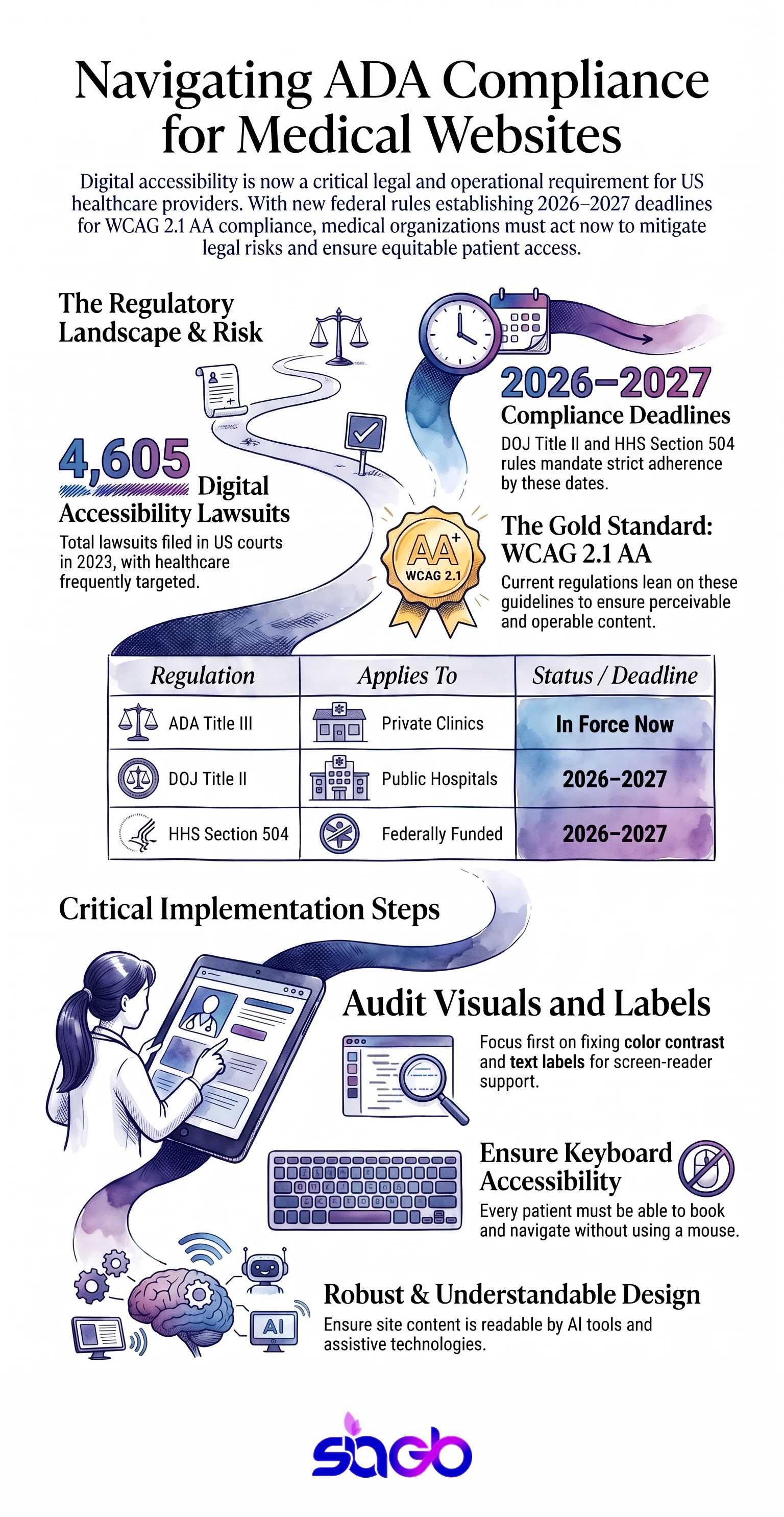
UsableNet counted 4,605 digital accessibility lawsuits in US courts in 2023, and healthcare sits near the top of the list each year. The pattern is steady. Small faults, big bills.
Look, I’ve watched a practice lose bookings because one form field had no label. Not an outage. One tiny gap, and people using assistive technology could not finish the booking. Frustrating, and cheap to fix if you catch it early.
What Do US Accessibility Rules Actually Require?
There isn’t one rule. Four sets of accessibility laws overlap, and which ones bind you depends on how your practice is funded and who owns it. Section 504 of the Rehabilitation Act sits behind the newest of them.
| Rule | Who it binds | Standard named | Date that matters |
|---|---|---|---|
| ADA Title III (1990) | Private clinics and practices open to the public | None in the text; courts lean on WCAG 2.1 AA | In force now |
| DOJ Title II rule (April 2024) | Public hospitals, state and county health services | WCAG 2.1 AA | 24 April 2026 for large bodies, 26 April 2027 for small |
| HHS Section 504 rule (May 2024) | Providers that take federal funds, including most that bill Medicaid | WCAG 2.1 AA | 11 May 2026 at 15+ staff, 10 May 2027 below that |
| Section 508 (Revised 2017) | Federal agencies and the vendors who sell to them | WCAG 2.0 AA | In force now |
Two things stand out in that table. The 2024 rules name a version number, which older law never did. And the deadlines land in 2026 and 2027, so the planning window is short. Both trace back to the Rehabilitation Act and the Disabilities Act rather than to any new statute.
Private practices sit in the trickiest spot. Title III names no standard, so the bar gets set by settlements and judges, and they keep landing on WCAG 2.1 AA. Building to that level is simply the safe read.
WCAG 2.1 Level AA in Plain English
WCAG is the Web Content Accessibility Guidelines, published by the World Wide Web Consortium. Version 2.1 came out in 2018 and version 2.2 followed in 2023. Level AA is the middle tier, and it’s the one accessibility standards bodies and courts keep pointing at.
Four ideas hold the whole thing up:
- Perceivable. People can see or hear what’s on the page, so images carry alt text and video carries captions.
- Operable. Every task works with a keyboard alone, and focus never gets stuck in a widget.
- Understandable. Labels, error messages and reading level make sense the first time.
- Sturdy. Code is clean enough that screen readers and voice tools can read it.
Healthcare adds two hard spots: PDFs and third party booking tools. A scanned referral form is an image, so it reads as nothing to assistive technology. A booking widget from an outside vendor is often the weakest link on the site, and you inherit its accessibility barriers along with its features.
Which Website Problems Trigger ADA Lawsuits?

Website accessibility claims rarely turn on exotic code. They turn on the same short list of accessibility barriers, year after year.

The WebAIM Million study for 2024 tested a million home pages and found detectable WCAG failures on 95.9 percent of them. Low contrast text hit 81 percent of pages. Missing alt text hit 54.5 percent. Missing form labels hit 48.6 percent.
Now read that list against a medical practice site. Low contrast body copy. A phone icon with no label. A booking form where the date field is unnamed. Each one is a claim waiting to happen, and each one blocks a patient with disability from the main content they came for.
Fixing after a demand letter costs more than building it right. Legal fees stack up, the work gets rushed, and rushed rebuilds break other things. Staff time goes to lawyers instead of patients, and the user experience rarely improves in the scramble.
What We Found on a Real 37 Page Clinic Site
Numbers beat theory here, so here are ours. All Health Medical asked us to audit every page of their site, one at a time. No sampling.

We found 213 WAVE errors across 37 pages and an average AIM score of 4.1 out of 10. Over 30 clinician portraits had no alt text at all, so a screen reader read nothing where a doctor’s name should be. Not one page met WCAG 2.1 Level AA. Four vendors had already tried and failed to get accessibility features running on that platform.
We cut errors by 77 percent. The homepage went from 57 errors to 9. Fifty errors stayed, baked into the site builder’s own code, and we wrote those up so the client knew exactly what a platform move would buy them. The full breakdown sits in our ADA compliance case study.
That last point matters. An honest web accessibility audit tells a healthcare team what it cannot fix on the current stack, not just what it can. An ada compliant website is the goal, and sometimes the platform is what stands in the way.
Building an Accessible Patient Portal Without Breaking HIPAA
The portal carries the highest risk on both fronts. It holds health data, and it holds the tasks people most need to finish.
Start with the flows, not the theme. Log in, book, upload, read a result, ask a question. Test each one with a keyboard only, then with a screen reader. Issues show up in minutes, and they map straight onto the accessibility requirements auditors check.
Build these in from the start:
- Labels tied to every field, plus error text that says what to do next.
- One clear focus outline, visible on every control, on every page.
- Documents offered as real HTML, with the PDF as a backup rather than the only option.
- A skip link so keyboard users can jump past the menu on each visit.
Skip the overlay widgets as a first move. They sit on top of broken code, they load third party scripts near patient data, and they don’t fix the source. Repair the markup, then decide whether a widget still adds anything for a patient with disability. A healthcare website built this way keeps both the security team and the compliance team calm.
How Does Accessibility Change SEO and AI Answers?

Search crawlers and AI models read pages much the way a screen reader does. Clean headings, real link text and labelled tables all help both.
That overlap is why web accessibility work lifts other numbers for a medical practice. Clear structure feeds answer engine optimisation, because a model can lift a clean answer out of a clean page. Alt text gives image search something to index. Fast, simple pages hold people who are on a phone in a waiting room, which is the everyday healthcare use case.
The reverse is true too. A booking flow that traps the keyboard also blocks the crawler, and a page of unlabelled images tells AI systems nothing. AI SEO work on a broken page is money spent on sand.
Working in Australia Instead?
The ADA is a US law, so it doesn’t bind an Australian clinic. Your obligation comes from the Disability Discrimination Act 1992 and the Australian Human Rights Commission, with a different complaint path and a different regulator.
The technical target is nearly the same, which is why the confusion sticks around. For the local rules, the AHRC process and the case law, read our companion piece on ADA compliance for medical websites in Australia.
Infographic: How Accessibility, Security and AI Connect
This infographic maps ADA duties, WCAG levels, HIPAA controls and search visibility onto one patient journey, from first search to follow up, and shows where AI monitoring keeps the work from drifting.

Infographic: ADA Compliance for Medical Websites at a Glance
Frequently Asked Questions
Does the ADA apply to medical websites?
Courts have treated clinic websites as part of a place of public accommodation under Title III, so booking pages, forms and portals are in scope. Two newer federal rules name WCAG 2.1 AA outright: the DOJ Title II rule of April 2024 and the HHS Section 504 rule of May 2024.
What WCAG level should a medical website meet?
WCAG 2.1 AA is the working bar. It’s the level named in the 2024 rules, the level most settlements ask for, and the level judges cite. Level AAA suits a few pages, not a whole clinic site.
How many web accessibility lawsuits are filed each year?
UsableNet counted 4,605 web accessibility claims in US courts in 2023, with healthcare among the most targeted sectors. Most claims start with an unlabelled field, a keyboard trap or a missing alt text.
Can a patient portal be accessible and still meet HIPAA?
Yes, and the two goals rarely clash. Trouble starts with quick fixes such as overlay scripts that read form data. Treat any new script as a vendor risk, check what it loads, then test login and forms with a keyboard.
Is an accessibility statement required by law?
No US law demands one, though it helps. Name the standard you work to, give people a phone number and an email for help, and record the date of your last audit.
Key Takeaways for Healthcare Providers
- Four US rules can apply at once, and the 2024 ones name WCAG 2.1 AA with deadlines in 2026 and 2027.
- Claims start with basics: contrast, alt text, form labels, keyboard traps. WebAIM found faults on 95.9 percent of home pages in 2024.
- Real audits produce real numbers. Ours took one clinic from 213 errors to 49, a 77 percent cut, with the residue named and explained.
- Portals need website accessibility and privacy planned together, because bolt on scripts weaken both.
- An accessible website carries the same structure search engines and AI answer tools prefer, so the work pays twice across healthcare marketing and care delivery.
Sources
- UsableNet 2024 Digital Accessibility Lawsuit Report - 4,605 lawsuits filed in 2023.
- WebAIM Million 2024 annual accessibility report - WCAG failures on 95.9 percent of home pages.
- US Department of Justice ADA Title II web rule, April 2024 - WCAG 2.1 AA and compliance dates.
- W3C Web Content Accessibility Guidelines 2.1 - the standard itself.

Want to explore this further?
Book a Free Consultation