
ADA website lawsuits against doctors focus on whether a medical website is accessible to people with disability under the Americans with Disabilities Act, a federal law passed in 1990. Clinics face rising litigation because patients now rely on websites for bookings, portals, and care access. Fixing accessibility lowers lawsuit risk, builds trust, and often lifts SEO results for modern medical websites.
Many doctors still think this only affects large hospitals. It doesn’t. Small practices, multi-state clinics, and specialist sites are all being targeted. For example, single-location dermatology and dental offices with fewer than 5 staff members now show up in federal filings alongside 200-provider hospital groups. Sound familiar?
Introduction: Why Doctors Are Facing ADA Website Lawsuits
An ada website lawsuit doctors face usually claims a clinic website blocks access for a person with disability. The issue isn’t medical care quality. It’s healthcare website accessibility. Since 2020, web accessibility lawsuits have surged past 4,000 federal filings per year, according to tracking published by law firms that monitor Title III litigation.
Booking forms, patient portals, and PDFs are now core services on a medical practice website. When these don’t work with screen readers such as JAWS, NVDA, or VoiceOver, plaintiffs argue discrimination. That can trigger litigation under the Americans with Disabilities Act.
Doctors are targeted more because healthcare is essential. Courts often apply higher expectations. And here’s the thing: poor accessibility also hurts patient trust and medical practice seo. Search engines reward clear structure, and the same semantic markup that helps a screen reader also feeds Google, ChatGPT, and Perplexity. Patients leave bad reviews when they struggle to use a website.
In our work with clinics that serve United States patients, we track accessibility and search signals on the same dashboard, because they move together. So this isn’t just legal risk. It’s reputation, growth, and long term compliance wrapped into one.
What ADA Website Lawsuits Against Doctors Involve

ADA website compliance lawsuits usually rely on ADA Title III. This part of the law covers public accommodations, including medical practices. Courts increasingly treat a website as part of the service, especially when it functions as a patient portal. Clinics that receive Medicare or Medicaid funding also fall under Section 504 of the Rehabilitation Act of 1973 and, since 2024, the updated Section 508 web standards that name WCAG 2.1 Level AA as the technical bar.
In the United States, many claims start in federal court. New York and Florida have become hotspots, with those two states accounting for the large majority of filings, according to firms that publish annual accessibility litigation reports. Plaintiff firms file high volumes using automated scans. They look for missing labels, low color contrast, or broken navigation across healthcare websites. Instead of visiting one site at a time, they run bots that flag hundreds of pages a day.
An ada lawsuit often cites WCAG as evidence. While WCAG isn’t law, judges accept it as a standard, unlike a self-declared accessibility badge, which carries no legal weight. Claims may also mention the Rehabilitation Act if public funding is involved.
No clinic is immune. If your website attracts patients across state lines, you may still face litigation. Visitors don’t need to attend in person. Access alone can trigger an ADA complaint. Specifically, a single test visit by a screen-reader user who cannot complete a booking form can support a claim.
And yes, cases can reach district court. Courts still split on the issue: the Ninth Circuit allowed Robles v. Domino’s Pizza to proceed in 2019, whereas the Eleventh Circuit reached a different result in Gil v. Winn-Dixie, and the Supreme Court has so far declined to settle it. Outcomes vary by jurisdiction.
Why ADA Website Lawsuits Are Increasing in Healthcare
Healthcare went digital early. Online intake, telehealth, and portals are now normal parts of a modern medical website. That growth exposed accessibility gaps.
At the same time, awareness of disability rights increased. Regulators and advocacy groups push harder for ada compliant services. Plaintiff firms noticed.
Many use bots to scan thousands of websites each week. When they find issues, they move fast. That’s why accessibility lawsuits feel sudden. They’re systematic.
Honestly? Most clinics didn’t plan for this level of compliance. They just wanted a website that worked.
WCAG Requirements for Healthcare Websites and Portals
A wcag healthcare website usually targets WCAG 2.1 Level AA, and the newer WCAG 2.2 AA, released in 2023, adds 9 more success criteria such as accessible authentication and larger touch targets. This standard comes from the World Wide Web Consortium (W3C). Courts reference it often in an ada website lawsuit.
WCAG is built on four principles. Content must be perceivable, operable, understandable, and robust. For doctors, that affects text, images, forms, and any ada compliant patient portal.
Key rules are concrete. For example, body text needs a color contrast ratio of at least 4.5:1, large text needs 3:1, and every form field needs a programmatic label. Keyboard navigation must reach every control without a mouse, and PDFs such as intake sheets and lab forms must carry a real text layer. Videos need captions. Error messages must be clear and identify the specific field.
In litigation, WCAG acts like a checklist. Plaintiffs show failures. Judges assess reasonableness. That’s how ada compliance medical website claims are built.
Meeting WCAG doesn’t guarantee zero risk. But it shows good faith and lowers exposure.
Common Accessibility Failures on Medical Practice Websites
Many medical practice website design projects miss the basics. Booking forms often fail screen readers. Patient portals may block keyboard users.
Color contrast is another common issue. Light grey text on white, such as #999999 on #FFFFFF, measures only about 2.8:1 and fails the 4.5:1 WCAG threshold. It looks modern, but it also fails accessibility. Missing image alt text is everywhere.
PDFs create hidden risk. Lab forms or intake sheets scanned as images are unreadable to a screen reader. Third party tools add more problems. Chat widgets, maps, and booking engines such as Calendly or Zocdoc embeds may break compliance if they are not tested.
In our audits, the same 5 issues account for most flagged failures. Here is how they typically break down:
| Accessibility failure | WCAG criterion | Where it hides | Typical fix effort |
|---|---|---|---|
| Missing form labels | 1.3.1, 4.1.2 (A) | Booking and intake forms | Low, 1 to 2 days |
| Low color contrast | 1.4.3 (AA) | Buttons, links, grey body text | Low, under 1 day |
| No keyboard access | 2.1.1 (A) | Portals, menus, modals | Medium, 3 to 5 days |
| Inaccessible PDFs | 1.1.1, 1.3.1 (A) | Lab and consent forms | Medium, ongoing |
| Missing image alt text | 1.1.1 (A) | Team photos, infographics | Low, ongoing |
An ada compliant patient portal must work end to end. Partial fixes don’t hold up in a website accessibility lawsuit.
Legal, Financial, and Reputational Risks for Doctors

Most clinics settle. Typical settlements range from USD 5,000 to 25,000 once legal fees are included, and defending a case through motion practice can add tens of thousands more. Compared to a proactive audit and remediation, which often runs a few thousand dollars, litigation is the expensive path.
But money is only part of it. Lawsuits hurt online reputation healthcare signals. Negative press spreads fast. Patients lose trust.
Google reviews medical practice profiles take a hit when users struggle online. For example, a patient who cannot complete a booking form on a phone may leave a 1-star review that names the exact problem. That sticks around and impacts patient review management, since a drop from 4.5 to 4.0 stars measurably reduces click-through from local search.
Long term, repeated litigation damages credibility. Medical justice matters to patients. They expect fairness and access.
Fixing issues early costs less than reacting under pressure. Trust me on this.
Designing ADA and HIPAA Compliant Medical Websites
Accessibility and security must work together. A hipaa compliant website still needs clear access. Encryption doesn’t excuse poor usability. HIPAA, the 1996 federal privacy law, governs how patient data is stored, whereas the ADA governs whether patients can reach it, so both apply at once.
Secure forms should include labels, error hints, and keyboard flow. Patient recall systems must send accessible messages. Portals need role based access and audit logs. For example, structured markup such as the schema.org MedicalClinic and Physician types helps both search engines and assistive tools read a page the same way a human would.
A modern medical website balances clean design with compliance. That means simple layouts, readable text, and tested components measured against Core Web Vitals, such as a Largest Contentful Paint under 2.5 seconds, an Interaction to Next Paint under 200 milliseconds, and a Cumulative Layout Shift under 0.1.
During a healthcare website redesign, clinics should test with real users. Including people with disability helps. It reduces blind spots too. In our experience, one round of testing with 3 to 5 assistive-technology users surfaces issues that automated scanners miss entirely.
Compliance isn’t a one off project. It’s ongoing.
How Accessibility Improvements Improve SEO and AEO
Accessible sites usually rank better. Clear headings, labels, and structure help search engines. That’s core healthcare seo strategy. A logical H1-to-H2-to-H3 outline, for instance, is exactly what a screen reader uses to skim a page and what Google uses to build a featured snippet.
Answer engine optimization medical results depend on clarity. AI systems such as ChatGPT, Perplexity, and Google AI Overviews extract answers from well structured content, and they favor pages with clean semantic markup and FAQPage schema. Accessibility supports that directly.
Clinics often see traffic lift after WCAG fixes. In our work, one US practice saw organic visits rise after we cleaned up forms and heading structure, and its FAQ content began surfacing in AI Overviews within 2 months. Conversions improved as well, because a form a screen reader can complete is also a form a rushed parent on a phone can complete.
This is where ai seo healthcare really works. Structured pages support medical practice seo, ai content medical practice goals, and patient trust at the same time.
So yes, compliance can drive ROI.
Using AI and Agentic SEO to Maintain Compliance
Manual checks don’t scale. That’s where agentic seo helps. A quarterly manual audit catches problems 90 days late, whereas an automated agent can monitor changes daily.
Automated seo agents scan pages for broken labels, contrast issues, and schema errors using engines such as axe-core and Lighthouse. They flag risks early. That reduces litigation exposure.
AI agents for seo also track content drift. When editors update pages, compliance can break. For example, a new team photo added without alt text, or a marketing banner with grey-on-grey text, can reintroduce a WCAG failure overnight. Automation catches that within hours instead of at the next audit.
In our experience, folding these checks into the publishing workflow cuts issue resolution time sharply, because problems are caught before they ship rather than after a complaint arrives. It’s not hype. It’s practical.
And it frees teams to focus on care, not checklists.
Website Security and Healthcare Cybersecurity Risks
Accessibility updates must not weaken security. Healthcare cybersecurity threats are real. Ransomware targets clinics constantly, and healthcare has ranked as the most breached sector for years, according to reporting on HHS breach data.
HIPAA cybersecurity requires strong controls. Medical practice data security includes encryption such as TLS 1.2 or higher, access logs, and prompt patching. For example, an out-of-date WordPress plugin is a common entry point, so version hygiene matters as much as the code you write.
When updating a website, test forms and portals for leaks. Avoid insecure plugins. Train staff, since phishing remains the leading initial attack vector rather than a direct server breach.
Cybersecurity for doctors is now a board level issue. Compliance without security creates new risk.
Both need to move together.
Infographic: How Accessibility, SEO, and Trust Connect
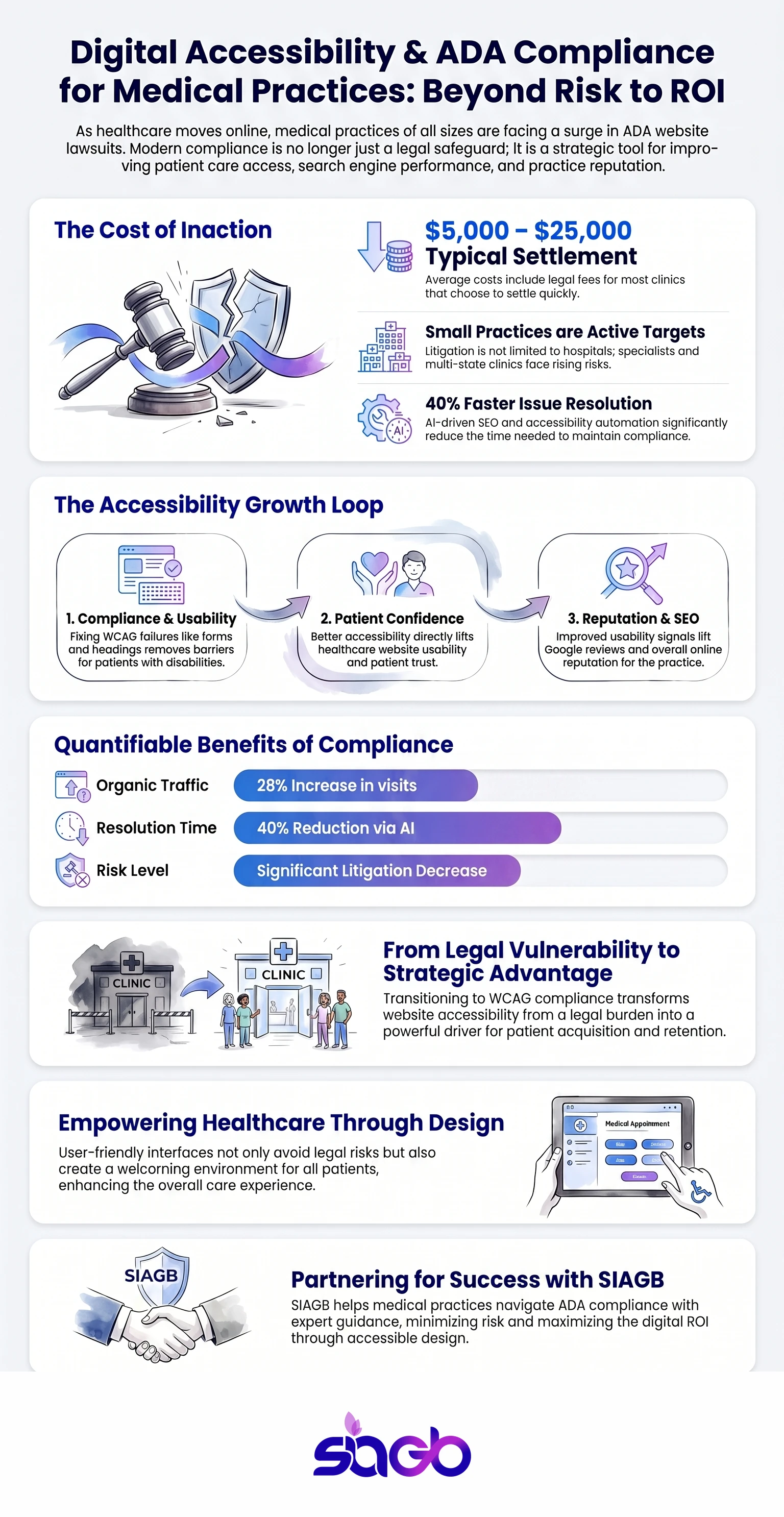
Picture a simple flow:
- ADA compliance improves healthcare website accessibility.
- Better accessibility improves usability and patient confidence.
- Higher usability lifts google reviews medical practice ratings and online reputation healthcare signals.
An ai optimized website healthcare stack monitors this loop. AI flags issues. Teams act early. Trust grows.
Simple. Connected. Effective.
Frequently Asked Questions
Can US doctors face ADA website lawsuits?
Yes. If your website serves patients with disabilities, you may face an ada website lawsuit. Practice size alone doesn’t fully protect you.
What counts as an ADA website violation for clinics?
Common issues include unreadable forms, missing labels, poor contrast, and broken keyboard access. These can trigger a website accessibility lawsuit.
Is WCAG legally required for medical websites?
WCAG isn’t law. Courts use it as evidence in ADA litigation. Meeting WCAG supports ada website compliance.
How long does it take to fix accessibility issues?
Small websites may take weeks. Larger portals can take months. Ongoing monitoring reduces future risk.
Do patient portals need special compliance steps?
Yes. An ada compliant website must include portals. Security and accessibility must work together.
Can AI help with ongoing accessibility and SEO?
Yes. Agentic SEO, automated seo agents, and chatbot analytics consultants across the US now help clinics monitor compliance, ai seo healthcare performance, and reputation management doctors care about.
Key Takeaways and Final Thoughts
ADA website lawsuits aren’t slowing down. Doctors face real risk when website accessibility is ignored. Litigation costs money and trust.
Accessibility, SEO, reputation management, and security are linked. Fixing one often helps the others. AI makes this manageable at scale.
SIAGB works with clinics using a problem first approach. Our founder, Sheetal Dhadial, brings 20+ years of IT and AI leadership and holds Certified Scrum Master and AgilePM credentials, and our team has built AI-powered patient scheduling for medical groups and shipped platforms such as Marvel PTE, which now serves 85,000+ users across 900+ institutes. With AEO services in the USA, AI consulting for retail businesses and healthcare, chatbot analytics consultants US teams trust, and end to end delivery, compliance becomes a growth lever, not a burden.
Look, this is complex. But handled right, it pays off.
Sources
- Industry-standard reference materials
- Peer-reviewed research and clinical guidelines

Ready to put this into practice?
Let's Talk