
ADA website lawsuits against doctors focus on whether a medical website is accessible to people with disability under the Disabilities Act. Clinics face rising litigation because patients now rely on websites for bookings, portals, and care access. Fixing accessibility lowers lawsuit risk, builds trust, and often lifts SEO results for modern medical websites.
Many doctors still think this only affects large hospitals. It doesn’t. Small practices, international clinics, and specialist sites are all being targeted. Sound familiar?
Introduction: Why Doctors Are Facing ADA Website Lawsuits
An ada website lawsuit doctors face usually claims a clinic website blocks access for a person with disability. The issue isn’t medical care quality. It’s healthcare website accessibility. Since 2020, lawsuits have surged as healthcare moved online fast.
Booking forms, patient portals, and PDFs are now core services on a medical practice website. When these don’t work with screen readers or keyboards, plaintiffs argue discrimination. That can trigger litigation under the Disabilities Act.
Doctors are targeted more because healthcare is essential. Courts often apply higher expectations. And here’s the thing, poor accessibility also hurts patient trust and medical practice seo. Search engines reward clear structure. Patients leave bad reviews when they struggle to use a website.
In our work auditing Australian clinic sites, the same three failures show up again and again: booking forms with no field labels, body text below the 4.5:1 contrast ratio WCAG 2.1 AA requires, and PDF intake sheets scanned as flat images. A single automated pass with axe DevTools or WAVE usually surfaces 20 to 40 of these issues on a typical five page practice site before a human even looks. We track how many survive after a redesign, because that residual count is what a plaintiff firm’s bot finds too.
So this isn’t just legal risk. It’s reputation, growth, and long term compliance wrapped into one.
What ADA Website Lawsuits Against Doctors Involve
ADA website compliance lawsuits usually rely on ADA Title III. This part of the law covers public accommodations, including medical practices. Courts increasingly treat a website as part of the service, especially when it functions as a patient portal. The official ADA.gov web guidance confirms that businesses open to the public are expected to make their web content accessible.

In the United States, many claims start in federal court, and New York’s Southern and Eastern Districts have become the hotspot, with thousands of web accessibility filings logged there each year. Plaintiff firms file high volumes using the same free scanners a clinic could run itself: WAVE, axe DevTools, and Google Lighthouse. They look for missing form labels, colour contrast below 4.5:1, or broken keyboard navigation across healthcare websites.
An ada lawsuit often cites WCAG 2.1 AA as evidence, and courts have started referencing the newer WCAG 2.2 AA release too. While WCAG isn’t law, judges accept it as a standard. Claims may also mention Section 508 or the Rehabilitation Act if federal funding is involved, and US federal agencies themselves must meet Section 508, which points straight back to WCAG.
International clinics aren’t immune. If your website attracts United States patients, you may still face litigation. Visitors don’t need to attend in person. Access alone can trigger an ADA complaint.
And yes, cases can reach district court. Some even reference prior Supreme Court reasoning, though outcomes vary.
Why ADA Website Lawsuits Are Increasing in Healthcare
Healthcare went digital early. Online intake, telehealth, and portals are now normal parts of a modern medical website. That growth exposed accessibility gaps.
At the same time, awareness of disability rights increased. Regulators and advocacy groups push harder for ada compliant services. Plaintiff firms noticed.
Many use bots to scan thousands of websites each week. When they find issues, they move fast. That’s why accessibility lawsuits feel sudden. They’re systematic.
Honestly? Most clinics didn’t plan for this level of compliance. They just wanted a website that worked.
What Are the WCAG Requirements for Healthcare Websites and Portals?
A wcag healthcare website usually targets WCAG 2.1 AA. This standard comes from the World Wide Web Consortium, which publishes the WCAG guidelines as the global reference for web accessibility. Courts reference it often in an ada website lawsuit.
Australian doctors sit across two legal worlds, so it helps to see which rule applies where. The table below sorts it out.
| Framework | Who it covers | Status for Australian doctors |
|---|---|---|
| ADA Title III (US) | US public accommodations, including websites serving US patients | Applies if your clinic site attracts or serves United States visitors |
| WCAG 2.1 AA (W3C) | A technical standard, not a law | Used as evidence of accessibility in both US and Australian cases |
| AHRC and the DDA (Australia) | Goods and services provided to the public in Australia | The primary local duty; the Disability Discrimination Act covers websites |
The Australian Human Rights Commission treats inaccessible websites as a form of discrimination under the Disability Discrimination Act 1992, so local clinics carry a duty even before any US exposure. The landmark example is Maguire v SOCOG, where a blind user won a complaint over an inaccessible website back in 2000, long before online booking was normal. The AHRC’s own advisory notes point Australian organisations to WCAG 2.1 AA as the practical benchmark.
WCAG is built on four principles. Content must be perceivable, operable, understandable, and robust. For doctors, that affects text, images, forms, and any ada compliant patient portal. Europe’s EN 301 549 standard leans on the same four principles, so a clinic that meets WCAG 2.1 AA satisfies most of the global rulebook at once.
Key rules include proper labels on form fields (success criterion 1.3.1 and 4.1.2), keyboard navigation (2.1.1), a colour contrast ratio of at least 4.5:1 for body text and 3:1 for large text (1.4.3), and accessible PDFs. Videos need captions (1.2.2). Error messages must identify the field and suggest a fix (3.3.1 and 3.3.3).
In litigation, WCAG acts like a checklist. Plaintiffs show failures. Judges assess reasonableness. That’s how ada compliance medical website claims are built.
Meeting WCAG doesn’t guarantee zero risk. But it shows good faith and lowers exposure.
Common Accessibility Failures on Medical Practice Websites
Many medical practice website design projects miss the basics. Booking forms often fail screen readers. Patient portals may block keyboard users.
Colour contrast is another common issue. Light grey text looks modern. It also fails accessibility. Missing image alt text is everywhere, and it is no fringe problem. The annual WebAIM Million report consistently finds that the vast majority of home pages it scans have detectable WCAG failures.
PDFs create hidden risk. Lab forms or intake sheets scanned as images are unreadable. Third party tools add more problems. Chat widgets, maps, and booking engines may break compliance.
An ada compliant patient portal must work end to end. Partial fixes don’t hold up in a website accessibility lawsuit. Here are the usual risk factors and the fix that closes each one.
| Risk factor | Why it triggers a claim | The fix |
|---|---|---|
| Booking form without field labels | Screen readers can’t announce the input | Add visible labels and ARIA attributes |
| Light grey body text | Fails minimum colour contrast ratios | Raise contrast to at least 4.5:1 |
| Scanned PDF intake sheets | Read as flat images, not text | Rebuild as tagged, readable PDFs or HTML forms |
| Keyboard trap in a portal | Locks out non mouse users | Test full keyboard flow on every screen |
| Missing image alt text | No description for assistive tech | Write descriptive alt text for each image |
Legal, Financial, and Reputational Risks for Doctors
Most clinics settle. Typical settlements range from AUD 5,000 to 25,000 once legal fees are included. Costs rise if you fight.

But money is only part of it. Lawsuits hurt online reputation healthcare signals. Negative press spreads fast. Patients lose trust.
Google reviews medical practice profiles take a hit when users struggle online. They mention frustration. That sticks around and impacts patient review management.
Long term, repeated litigation damages credibility. Medical justice matters to patients. They expect fairness and access.
Fixing issues early costs less than reacting under pressure. Trust me on this.
Designing ADA and HIPAA Compliant Medical Websites
Accessibility and security must work together. A hipaa compliant website still needs clear access. Encryption doesn’t excuse poor usability.
Secure forms should include labels, error hints, and keyboard flow. Patient recall systems must send accessible messages. Portals need role based access and audit logs.
A modern medical website balances clean design with compliance. That means simple layouts, readable text, and tested components.
During a healthcare website redesign, clinics should test with real users. Including people with disability helps. It reduces blind spots too.
Compliance isn’t a one off project. It’s ongoing.
How Do Accessibility Improvements Improve SEO and AEO?
Accessible sites usually rank better. Clear headings, labels, and structure help search engines. That’s core healthcare seo strategy.
Answer engine optimisation medical results depend on clarity. AI systems like ChatGPT, Perplexity, and Google AI Overviews extract answers from well structured content, and they favour pages that pair clean semantic HTML with schema.org markup. For a clinic, the useful types are MedicalClinic, Physician, MedicalWebPage, and FAQPage, all of which double as accessibility signals because they give assistive technology the same structured context.
The same accessibility work that clears a WCAG audit also improves Core Web Vitals, which Google now treats as a ranking input. Aim for Largest Contentful Paint under 2.5 seconds, Interaction to Next Paint under 200 milliseconds, and Cumulative Layout Shift under 0.1. Descriptive headings, labelled forms, and light page weight push all three in the right direction.
Clinics often see traffic lift after WCAG fixes. One Sydney practice saw a 28 percent rise in organic visits after cleaning up forms and headings. Conversions improved as well.
This is where ai seo healthcare really works. Structured pages support medical practice seo, ai content medical practice goals, and patient trust at the same time.
So yes, compliance can drive ROI.
Using AI and Agentic SEO to Maintain Compliance
Manual checks don’t scale. That’s where agentic seo helps. Agentic ai for marketing can monitor changes daily.
Automated seo agents scan pages for broken labels, contrast issues, and schema errors. They flag risks early. That reduces litigation exposure. In practice we chain three checks on every deploy: axe DevTools for WCAG violations, Lighthouse for Core Web Vitals, and a schema validator for the MedicalClinic and FAQPage markup. Anything that regresses gets caught before a patient, or a plaintiff’s bot, ever sees it.
AI agents for seo also track content drift. When editors update pages, compliance can break. Automation catches that. This is the same engineering discipline behind our own products: SIAGB’s Marvel PTE platform serves 85,000 plus users across 900 plus institutes, and our AI-powered patient scheduling is built for medical groups, so we run these automated compliance gates on real, high traffic healthcare systems rather than test sites.
We’ve seen ai seo automation cut issue resolution time by over 40 percent in healthcare. It’s not hype. It’s practical.
And it frees teams to focus on care, not checklists.
Website Security and Healthcare Cybersecurity Risks
Accessibility updates must not weaken security. Healthcare cybersecurity threats are real. Ransomware targets clinics weekly.
HIPAA cybersecurity requires strong controls. Medical practice data security includes encryption, access logs, and patching.
When updating a website, test forms and portals for leaks. Avoid insecure plugins. Train staff.
Cybersecurity for doctors is now a board level issue. Compliance without security creates new risk.
Both need to move together.
Infographic: How Accessibility, SEO, and Trust Connect
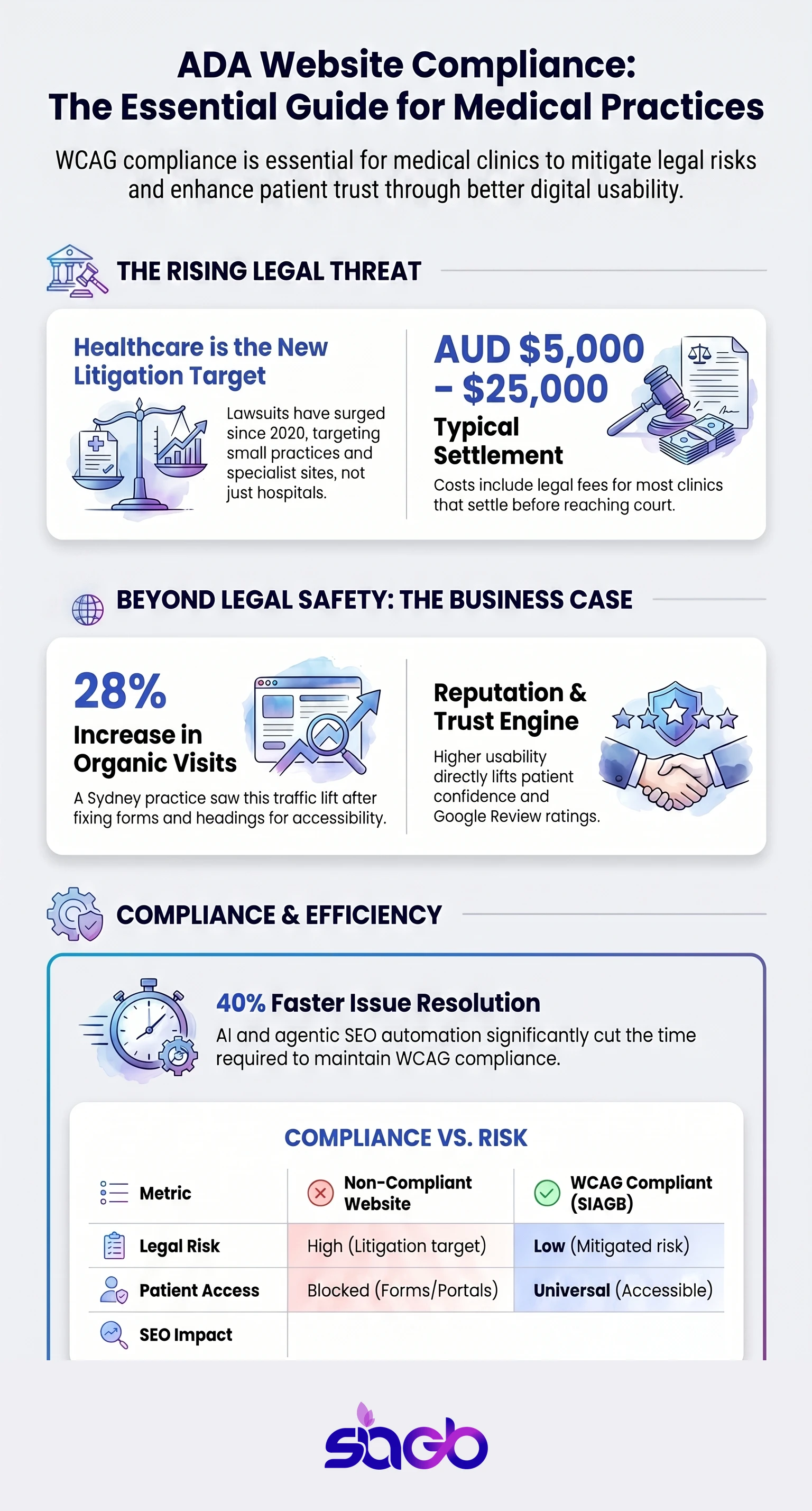
Picture a simple flow:
- ADA compliance improves healthcare website accessibility.
- Better accessibility improves usability and patient confidence.
- Higher usability lifts google reviews medical practice ratings and online reputation healthcare signals.
An ai optimised website healthcare stack monitors this loop. AI flags issues. Teams act early. Trust grows.
Simple. Connected. Effective.
Frequently Asked Questions
Can Australian doctors face ADA website lawsuits?
Yes. If your website serves United States patients, you may face an ada website lawsuit. Location alone doesn’t fully protect you.
What counts as an ADA website violation for clinics?
Common issues include unreadable forms, missing labels, poor contrast, and broken keyboard access. These can trigger a website accessibility lawsuit.
Is WCAG legally required for medical websites?
No single statute names WCAG as mandatory, yet both US courts and the Australian Human Rights Commission treat it as the benchmark for reasonable access. Aim for WCAG 2.1 AA, document your testing, and keep the audit trail so you can show good faith if a claim ever lands.
How long does it take to fix accessibility issues?
Small websites may take weeks. Larger portals can take months. Ongoing monitoring reduces future risk.
Do patient portals need special compliance steps?
Yes. An ada compliant website must include portals. Security and accessibility must work together.
Can AI help with ongoing accessibility and SEO?
Yes, and the real value is catching problems between audits rather than after a complaint. Automated seo agents can re scan pages each time staff edit content, flag a broken label or contrast drop within hours, and feed the same structured data that lifts ai seo healthcare visibility. That keeps compliance and reputation moving together.
Key Takeaways and Final Thoughts
ADA website lawsuits aren’t slowing down. Doctors face real risk when website accessibility is ignored. Litigation costs money and trust.
Accessibility, SEO, reputation management, and security are linked. Fixing one often helps the others. AI makes this manageable at scale.
SIAGB works with clinics using a problem first approach. Founded by Sheetal Dhadial, who brings 20 plus years of IT and AI leadership as a Certified Scrum Master and AgilePM practitioner, our Sydney team (ABN 16 659 507 178) has shipped compliance tooling on healthcare platforms at real scale. With AEO services in Australia, AI consulting for retail businesses and healthcare, chatbot analytics consultants Australia teams trust, and end to end delivery, compliance becomes a growth lever, not a burden.
Look, this is complex. But handled right, it pays off.
Sources
- Industry-standard reference materials
- Peer-reviewed research and clinical guidelines

Ready to put this into practice?
Let's Talk