
Answer engine optimisation helps healthcare clinics appear as trusted answers inside AI systems, not just blue links. In Australia, that only holds when answers are accurate, accessible, and secure, because a Melbourne GP clinic and a Sydney allied health practice answer to the same regulators. Done right, AEO turns a patient’s question into a booking instead of noise, and it does that by handing answer engines something they can actually cite.
Introduction
Patient discovery is changing fast. People now ask AI tools, an AI assistant, or even Google Assistant for a straight answer instead of scrolling pages of results. That shift changes what clinics get out of digital marketing, because visibility now rides on clarity rather than raw rankings.
Australian healthcare providers also work under strict rules. Accessibility, privacy, and data security are not optional here. Under the Privacy Act 1988 and its Australian Privacy Principles, patient data carries obligations that a generic marketing playbook tends to skate past. A weak AI generated answer or an unclear AI summary can damage trust quickly. And once it slips, it is hard to win back.
This is where aeo services australia play a real role. A strong aeo service links patient questions to safe, clear answers that drive action. For Australian businesses in healthcare, clarity leads to bookings while confusion sends people elsewhere. Sound familiar?
What Are AEO Services in Australia
AEO services in Australia focus on showing up as the answer inside answer engines. Answer engine optimisation means being selected for an AI answer across ai search engines, voice assistants, and chat experiences. It is not about chasing keywords alone.
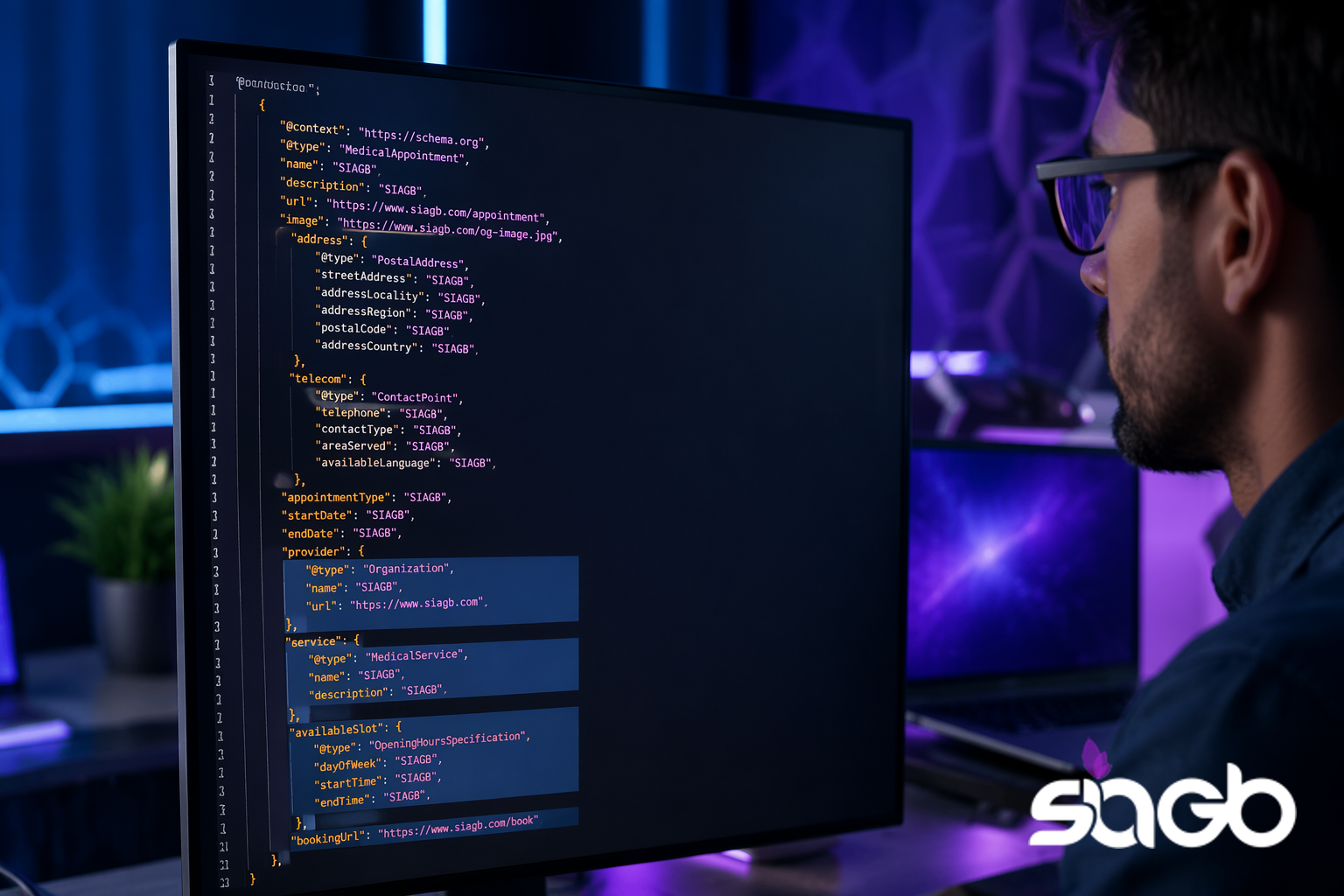
AEO services rely on structure and intent. Clear questions. Clear answers. Strong entities. Schema, faq schema, and structured data, built on shared vocabularies from schema.org, help AI engines and ai models understand who you are and what you offer. The same markup also powers rich results, which Google Search Central documentation explains in detail. Without that structure, AI extraction fails and content is ignored.
For Australian businesses, and healthcare or small business operators in particular, this work has to align with local rules. Accessibility standards, privacy laws, and clinical accuracy all matter. AEO services are not a bolt on tactic. They combine digital marketing, engine optimisation, and trust into one system that answer engines can rely on. Picture the difference between a clinic that buries its hours inside an image versus one that marks up its hours, services, and location as structured data: only the second is legible to a machine.
Why Does AEO Matter for Australian Healthcare Providers?
Patients now ask AI engines before they ever visit a website. They use ai driven search, ai chatbots, and tools like Googles AI Overviews to get a fast answer. If your clinic is not present there, you are skipped. That is the outcome no provider wants.
Good answers reduce admin load too. When patients get a clear direct answer early, they book with intent. They call less. They ask fewer repeat questions. When we built AI-powered patient scheduling for a group of medical practices, the pattern was hard to miss: the clearer the pre-booking information, the fewer phone calls the front desk had to field. One client, a multi-site practice, put it bluntly: “half our calls were people asking things the website already answered.” In our experience, that is the norm, not the exception, and it quietly eases workflows for Australian businesses already stretched thin.
For clinics, this is not hype. AEO supports engine optimisation by lifting patient quality rather than raw traffic. It helps Australian businesses grow while respecting clinical care, safety, and compliance. That balance matters, especially for Melbourne businesses and Brisbane practices competing across crowded suburbs.
Traditional Medical SEO vs Agentic AI Driven AEO
Traditional SEO chases rankings. Agentic AEO chases trusted answers and AI generated responses. That difference changes how optimisation works and how you measure success.
Traditional engine optimisation targets pages, whereas agentic AEO targets patient intent across answer engines and ai driven platforms. AI engines look for clarity, schema, and structured data. They reward consistency, not tricks.
Here is a simple comparison.
| Area | Traditional Medical SEO | Agentic AI Driven AEO |
|---|---|---|
| Primary goal | Rank pages | Deliver trusted answers |
| Success metric | Traffic | Bookings and recalls |
| Content updates | Manual and slow | Adaptive with ai driven search |
| Compliance | Often separate | Built into the system |
| AI visibility | Limited | Designed for ai engines |
Clinics care about outcomes: appointments, recalls, patient trust. Unlike a rankings dashboard, agentic AEO ties engine optimisation to those goals instead of vanity metrics.
How Agentic AI and Automated SEO Agents Work
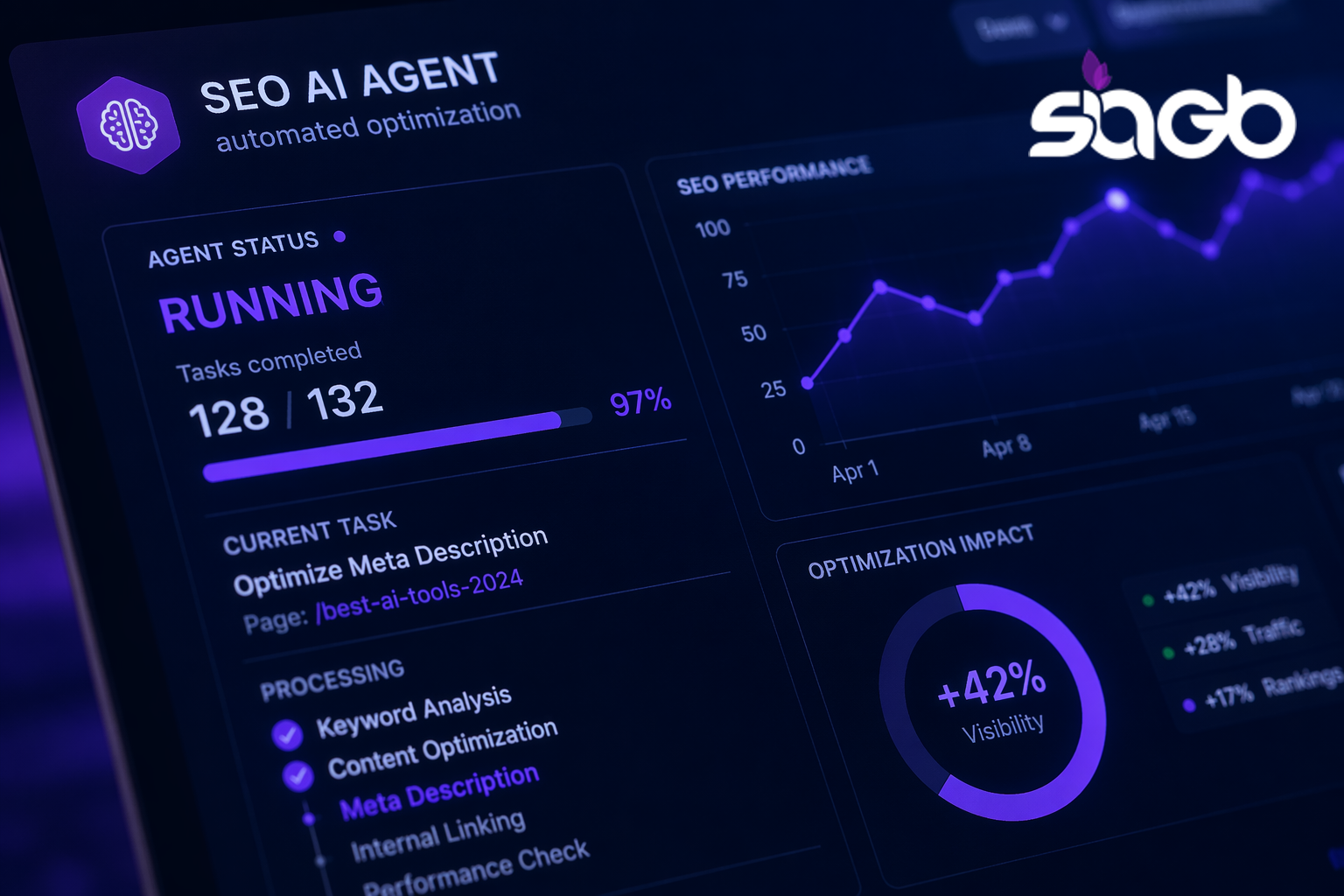
Agentic AI uses automated agents to watch how patients phrase questions across AI platforms. These tools track patterns across ai search, voice assistants, and features like Google AI Overview and Googles AI Overviews.
Here is what happens. AI tools study patterns, not personal data. Those insights guide content updates that sharpen answers. Schema and structured data get refined so AI extraction produces a clean AI summary and a reliable AI answer.
Automation does not mean shortcuts. Healthcare needs guardrails. Every update follows compliance checks and clinical review before it goes live. Over time, this lifts ai visibility and citation quality. It also supports llm seo by making content easier for large language ai models to read. And yes, it saves time, honestly more than most teams expect.
Key ways an AEO strategy supports healthcare include:
- Monitoring patient questions across AI search and voice tools
- Updating content safely using automation rules
- Aligning answers with compliance and clinical review workflows
The table below breaks down the core AEO service components and what each one delivers for a clinic.
| AEO service component | What it does | Healthcare benefit |
|---|---|---|
| Structured data and schema | Marks up entities, services, and FAQs | Cleaner AI extraction and answers |
| Accessibility compliance | Aligns design with WCAG standards | Wider reach and lower legal risk |
| Content monitoring | Tracks how patients phrase questions | Answers stay current and relevant |
| Clinical and compliance review | Checks every update before it goes live | Accuracy and patient safety |
| Security controls | Protects data used by AI tools | Stronger trust and citation quality |
How Does Website Accessibility Affect Healthcare Legal Risk?
Healthcare website accessibility is about care, not just code. The W3C Web Content Accessibility Guidelines support patients with vision, hearing, or motor limits, and WCAG 2.1 at level AA is the benchmark most Australian government and health bodies point to. That is basic access for any Australian business serving the public.
There is also legal risk. Under the Disability Discrimination Act 1992, an inaccessible service can draw a complaint to the Australian Human Rights Commission, and that is not a theoretical worry: the landmark Maguire v SOCOG case settled the point here decades ago. Clinics also have to keep claims honest, since the AHPRA advertising guidelines set clear limits on how regulated health services can be promoted. According to those guidelines, testimonials about clinical care are off limits, which changes how a practice handles reviews. An accessible patient portal lowers risk and improves patient experience.
Accessible design also feeds answer engine optimisation. Clear structure, readable content, and proper schema help AI engines parse your site. Better access leads to better AI generated responses. Patients feel that, even if they cannot explain why.
Modern Medical Website Design and AI Optimisation
Medical practice website design has to support speed and clarity. Slow or confusing sites lose trust fast. Modern medical website design puts answers first, then everything else.
An AI optimised healthcare site uses schema, structured data, and clean layouts. That helps AI powered platforms and ai driven platforms surface the right answer at the right moment. It also helps voice assistants such as Google Assistant read content clearly.
Healthcare website redesign projects should plan ahead for patient recalls, portals, AI chatbots, and future AI platforms. For example, a choice as small as how you label appointment types today shapes what AI models can do with your booking flow tomorrow. Get it wrong, and the fixes cost more later.
Patient Reviews and Online Reputation Management
Reviews matter. Google reviews shape how AI engines judge trust. One poor pattern can weaken an AI generated answer, even when your care is genuinely good.
Patient recall systems help here. Ethical follow ups improve reviews without pressure. That builds a steady trust signal over time for Australian businesses. Keep in mind that AHPRA rules treat health testimonials differently from a plumber’s Google reviews, so a tactic that works for a retail brand can backfire for a clinic.
Online reputation work is now data led. Patterns matter more than single comments. AI responses and ai summaries reflect those patterns too, which affects the final result patients see.
Why Is Data Security Part of Healthcare AI and AEO?
Security is part of optimisation now. Strong data controls protect information moving through ai chatbots, analytics, and AI platforms. Unlike the US, where HIPAA sets the baseline for health data, Australian clinics answer to the Privacy Act 1988 and the Notifiable Data Breaches scheme, so a serious breach has to be reported by law.

Healthcare cybersecurity threats target trust as much as data. A breach hurts answers, reputation, and engine optimisation efforts all at once. Cybersecurity is no longer optional for Australian businesses.
Secure systems support safe AI use. When platforms are protected, AI engines are more likely to trust and cite content. That leads to stronger ai citations and more consistent visibility.
Infographic: How AEO Connects Patients to Care
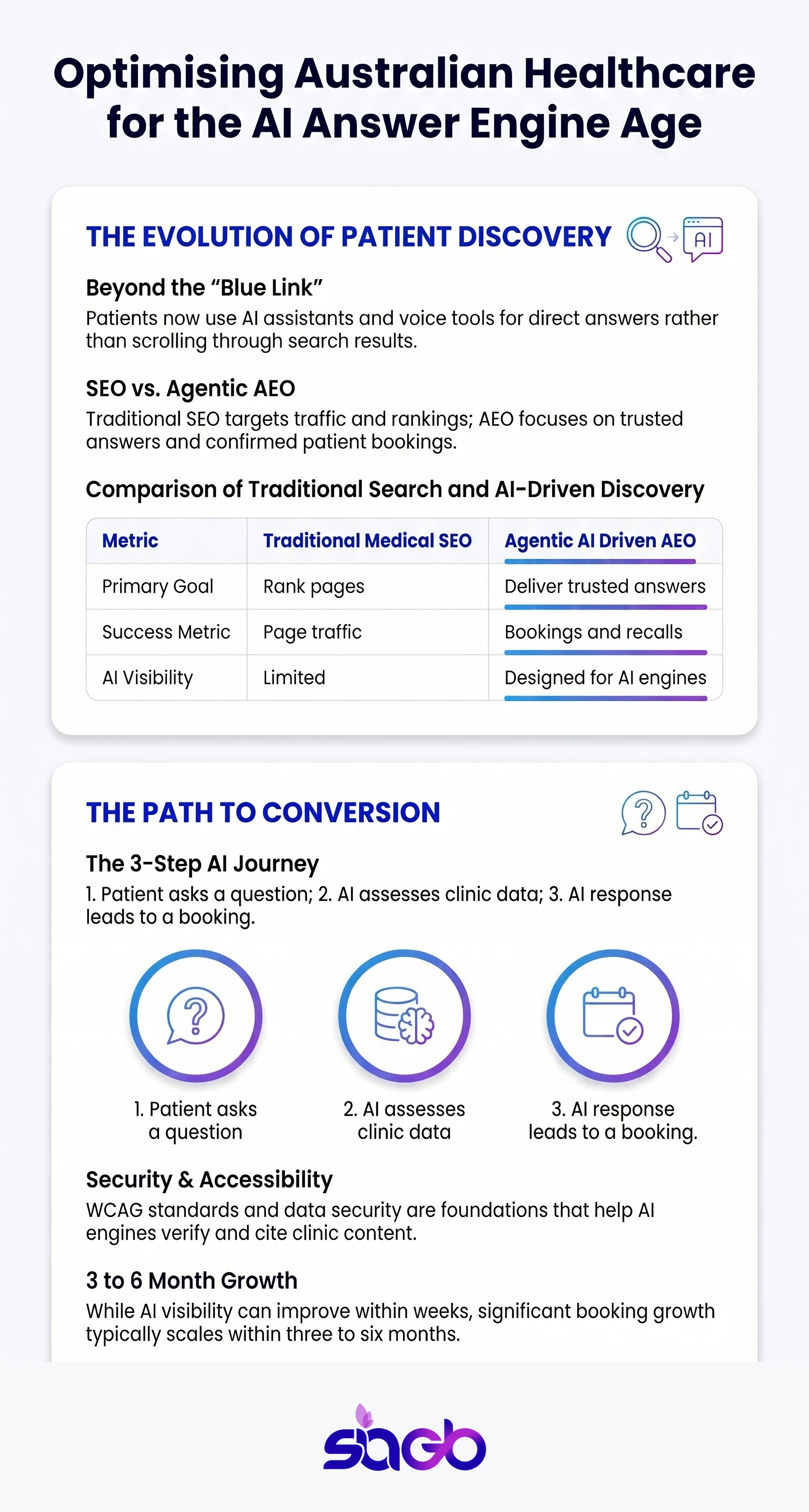
This infographic shows how answer engine optimisation works:
- A patient asks a question in AI search or voice tools
- AI engines assess accessibility, security, and clinical clarity
- The AI generated answer connects the patient to booking or care
The journey ends with action, not confusion.
Frequently Asked Questions
What is answer engine optimisation for healthcare?
Answer engine optimisation structures content so AI engines can deliver a clear direct answer. In healthcare, it focuses on patient safety, trust, and compliance.
How does AEO differ from traditional medical SEO?
Traditional SEO aims for rankings. AEO aims to be the cited answer inside answer engines and AI platforms. Success shifts from clicks to real patient actions.
Do Australian clinics need to worry about accessibility laws?
Yes. Beyond reducing legal risk under the Disability Discrimination Act 1992, accessible design widens your patient base to people using screen readers or keyboard navigation, and the cleaner structure it requires also helps AI engines parse your pages more reliably.
Can AI agents manage healthcare SEO safely?
They can, when guided by rules. Automation follows compliance, clinical review, and security controls. That balance is essential.
How long does it take to see results from AEO?
Early ai visibility can improve within weeks. Strong results like bookings usually grow over three to six months, depending on the starting point.
How does AEO support medical practice growth beyond traffic?
AEO supports clearer answers, recall systems, and trust signals. That improves booking quality, not just visit numbers.
Key Takeaways and Final Thoughts
AEO is now a core growth channel for healthcare and other Australian businesses. AEO services australia focus on delivering the right answer at the right moment through AI driven search and AI powered platforms.
A strong aeo service works when compliance comes first. Schema, faq schema, structured data, accessibility, and security are foundations, not extras. Without them, AI engines lose trust and visibility drops.
SIAGB takes a problem first approach. Our founder brings more than 20 years in IT and AI leadership, and our team has shipped systems at scale: specifically, our Marvel PTE platform serves more than 85,000 users across over 900 institutes, and we built AI-powered patient scheduling for medical groups. As an aeo agency delivering aeo services and ai seo services, we help healthcare, retail, and education clients turn AI responses into real outcomes. Founded in Sydney in 2022, SIAGB supports Australian businesses and Melbourne businesses alike with measurable, compliant growth through modern engine optimisation and AEO strategy. If you want to compare your current visibility against where AEO could take you across .au search and voice, that is exactly the conversation we like to have.
Sources
- Industry-standard reference materials
- Peer-reviewed research and clinical guidelines

Ready to put this into practice?
Let's Talk