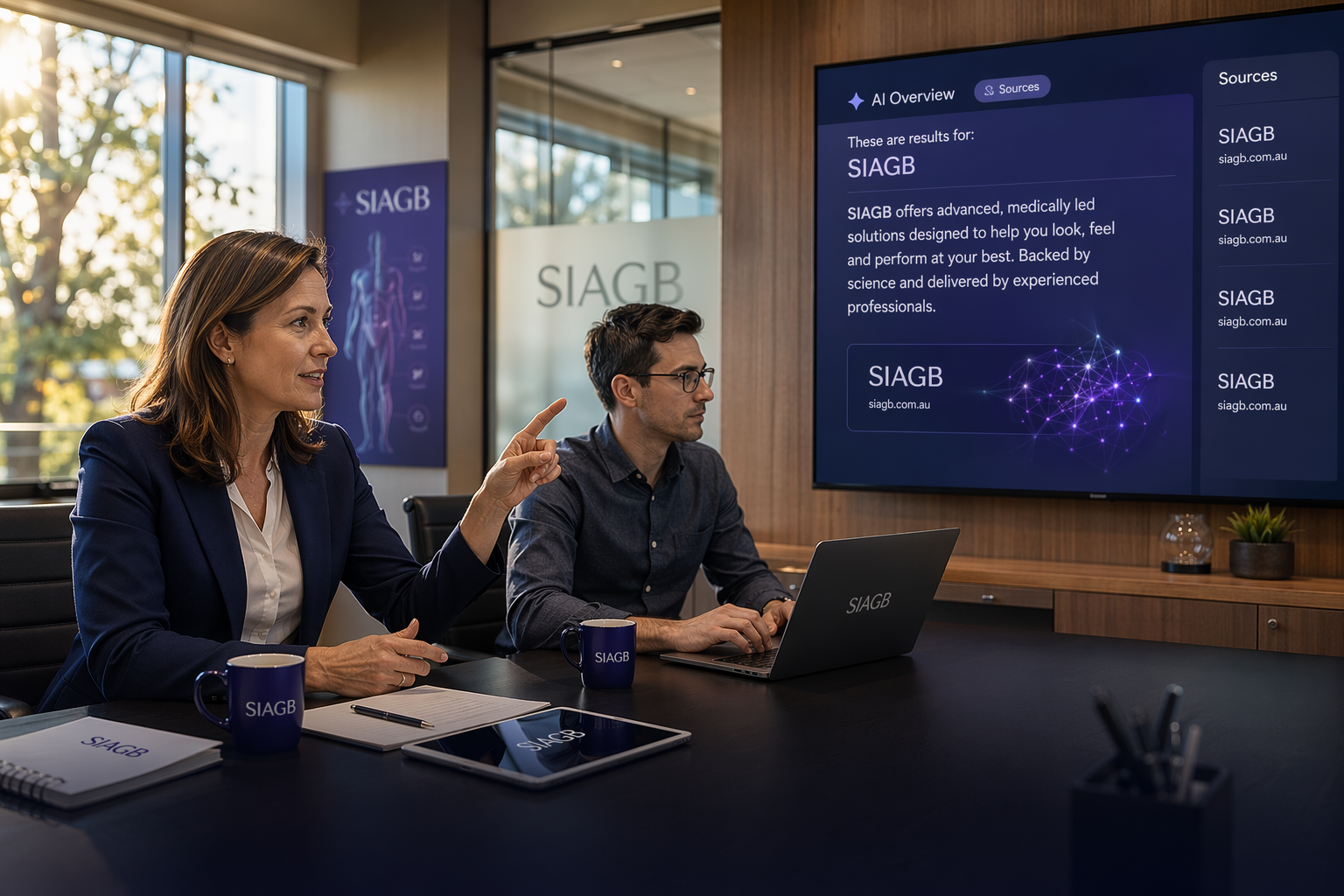
Answer engine optimization helps US healthcare and retail businesses show up as direct answers in AI search results, not just blue links. An effective aeo service focuses on how tools like ChatGPT, Perplexity, Google AI Overviews, and Gemini choose trusted content. The aim is simple, be the AI answer patients and customers actually see, and act on. For those searching for aeo services in usa, this guide covers everything you need to know.
Introduction
US healthcare providers spend big on SEO, yet calls and bookings stay flat. Sound familiar? Rankings look fine on paper, but patients never reach your site. That gap comes from how people now search, and how digital marketing actually works today.
Search has shifted from links to answers. Google AI Overviews now appear on a large share of health queries, and a Pew Research Center study of US adults found that pages with an AI summary drew clicks on only about 8 percent of visits, versus 15 percent when no summary showed. ChatGPT reached roughly 800 million weekly users by late 2025, and Perplexity answers hundreds of millions of queries a month. When a patient in Dallas asks Gemini for a nearby cardiology clinic, one AI generated answer often ends the search with no click at all. An aeo service changes how visibility works inside each of these systems.
For US businesses, especially clinics and multi location groups, this shift affects growth fast. A strong aeo strategy blends digital marketing, technical SEO, and schema.org structured data (MedicalOrganization, Physician, FAQPage, LocalBusiness) so your content is selected, cited, and trusted. In our work building AI-powered patient scheduling for medical groups, we saw how much this depends on clean, machine-readable data. That is the change many healthcare teams still underestimate.
What Is an AEO Service and How Does It Work?
An aeo service uses answer engine optimization to help an AI platform select your content as the best response to a question. Answer engine optimization is the process of shaping content, structure, and signals so an AI algorithm can confidently return your brand as the result. Not a ranking. A result.
These systems rely on more than keywords. They assess schema.org structured data, semantic clarity, accessibility, and trust. Retrieval systems behind ChatGPT and Perplexity chunk your page, embed it, and match it against the question, so a page that answers “What insurance does your clinic accept in Ohio?” in one tight paragraph gets pulled far more often than a long unstructured essay. In healthcare, engines also weigh accuracy, safety, and compliance. We track which of our client pages get cited in AI Overviews using tools such as Semrush and manual prompt testing across ChatGPT, Perplexity, and Gemini.
For US businesses, this matters because rankings alone do not drive outcomes anymore. If an AI summary highlights another clinic, you lose visibility even when you rank first for the keyword. That is why an aeo service now sits alongside SEO services and digital marketing, not after them.
Traditional SEO vs AI SEO vs Agentic SEO
Traditional SEO focuses on pages, backlinks, and monthly reports. It is slow. Changes take weeks. And many programs end with a PDF and little action. That model struggles in AI driven search.
AI SEO strategies respond faster. AI tools analyze questions, intent, and behavior across ChatGPT, Perplexity, and Google AI Overviews. Content and schema updates happen in days, not quarters. Optimization becomes continuous.
Agentic SEO goes further. It uses automated agents that monitor AI generated responses, update JSON-LD schema, test variations, and track AI citations daily. Traditional SEO reports what already happened. Agentic SEO changes what happens next. The table below shows how the three approaches differ on the dimensions that matter for a US healthcare or retail brand.
| Dimension | Traditional SEO | AI SEO | Agentic SEO |
|---|---|---|---|
| Primary target | Blue-link rankings on Google | Citations in ChatGPT, Perplexity, AI Overviews | Selection as the single spoken or generated answer |
| Update cycle | Weekly to quarterly | Days | Continuous, daily monitoring |
| Core signals | Keywords, backlinks | Structured data, semantic clarity, entity trust | Live citation tracking, schema testing, prompt variation |
| Measurement | Rank position, sessions | Share of AI citations | Answer-win rate and cited-source rate |
| Human role | Analyst writes reports | Editor approves changes | Human approves, agent executes and monitors |
Why Healthcare AEO Is Different
Healthcare answer engine optimization faces higher standards. Wrong answers cause harm. AI systems know this and apply stricter filters.
Healthcare focused digital marketing must reduce misinformation risk. Clear structure, verified sources, and compliant language matter more than clever copy. Answers touching on diagnosis, dosing, or treatment sit inside what Google calls Your Money or Your Life (YMYL) content, where E-E-A-T (Experience, Expertise, Authoritativeness, Trust) signals carry extra weight. HIPAA also shapes what a clinic can publish and how patient data flows through any scheduling or intake tool.
That is why healthcare AEO demands deeper technical SEO, stronger schema.org markup like MedicalWebPage and Physician, named clinician authorship with real credentials, and human review before anything ships. It is harder. And it should be.
Accessibility, Web Development, and Legal Risk
Healthcare website accessibility affects AI visibility directly. Accessible sites are easier for an AI assistant to parse, summarize, and cite because semantic HTML, alt text, and heading order are the same signals a language model uses to understand a page. Web development aligned to WCAG 2.2 Level AA improves clarity, navigation, and trust signals at once.
Accessibility also reduces legal exposure. Under the Americans with Disabilities Act (ADA Title III), US healthcare sites face real litigation risk, and federal ADA web accessibility lawsuits have run into the thousands each year. WCAG 2.1 and 2.2 AA is the standard courts and the Department of Justice reference. Accessible design also improves engagement, which AI platforms track.
Key Point: Accessibility improves compliance, usability, and answer selection at the same time.
AI SEO for Healthcare Content and Compliance
Healthcare teams using generative AI need control. Accuracy comes first. Compliance follows. Speed comes last.
AI SEO services combine FAQPage and HowTo schema, clear definition blocks, and approved content patterns so AI systems return safe answers. These methods guide how models like GPT and Gemini extract definitions, FAQs, and step-by-step explanations from a page.
This approach protects clinics and improves AI visibility. It also aligns with broader digital marketing goals, not just traffic. In our patient scheduling projects, a clinician sign-off step sits between AI drafting and publishing so no medical claim goes live unreviewed.
Pro Tip: AI tools scale content, but humans must approve every medical AI answer.
Agentic AI and Automated Optimization
Agentic AI for marketing runs daily. Automated agents monitor AI search, update structured data, test schema, and flag risks. A scheduling assistant we built for medical groups follows the same idea, handling routine booking work around the clock so staff focus on patients.
These agents track performance inside ChatGPT, Perplexity, and Gemini, not just traditional Google search. They adapt as ranking and retrieval algorithms change.
Manual work cannot keep up anymore. When an engine updates how it summarizes health queries, a page that was cited last week can vanish this week, so continuous optimization is now expected.
Modern Medical Websites Built for AI Search
A modern medical website is built for AI search engines first. Fast load times. Clear sections. Strong structured data. Google’s Core Web Vitals set the practical bar: Largest Contentful Paint under 2.5 seconds, Interaction to Next Paint under 200 milliseconds, and Cumulative Layout Shift under 0.1. Pages that miss these thresholds frustrate patients and get parsed less reliably by crawlers.
Healthcare web development now supports voice search through assistants like Siri and Google Assistant, AI chat, and mobile journeys, since most US health searches start on a phone. If a site is hard to read, it will not be used in an AI generated response.
This is where technical SEO, accessibility, and digital marketing meet.
Reputation, Trust, and Local Signals
Reviews influence AI selection. Reputation data from Google Business Profile, Healthgrades, and Yelp feeds directly into how an AI system evaluates trust for a US clinic.
For any local business, especially clinics, review management and response speed matter. When a patient asks Gemini for the “best rated pediatric clinic near me,” star ratings, review volume, and recency all shape the shortlist. AI chatbots now help teams track sentiment and reply faster.
Local SEO services still play a role here, with an accurate Google Business Profile and consistent NAP (name, address, phone) details, but they now support AEO and AI SEO services, not replace them.
Security as a Trust Signal
Cybersecurity affects AI visibility. Unsafe sites lose credibility fast. Browsers flag pages without HTTPS, and for US healthcare the stakes are higher because HIPAA governs how protected health information is stored and transmitted.
Strong security controls, HTTPS everywhere, encrypted intake forms, and HIPAA-aligned data handling, support patient trust and digital marketing outcomes. AI platforms notice these signals.
Security is not hidden anymore. It is part of selection logic.
Real Use Cases Across the United States
SIAGB builds AI systems that serve users at scale. Our Marvel PTE platform supports more than 85,000 users across over 900 institutes, and that experience shapes how we handle high-volume, high-trust environments like healthcare. For medical groups we have built AI-powered patient scheduling that handles bookings and routine requests without adding front-desk load.
The same discipline applies to answer engine work for US clinics and retail brands: clean schema, accurate content, and answers structured for the exact questions patients type into ChatGPT or Gemini. Improved AI generated responses can reduce reliance on paid ads and lift conversion, because the AI recommends you directly.
This work supports clinics and growing teams in major US cities such as Houston, Chicago, and Phoenix. Founded by Sheetal Dhadial, who brings 20-plus years in IT and AI leadership as a Certified Scrum Master and AgilePM practitioner, SIAGB scales this approach across US and international markets.
Infographic: How AEO Drives Growth
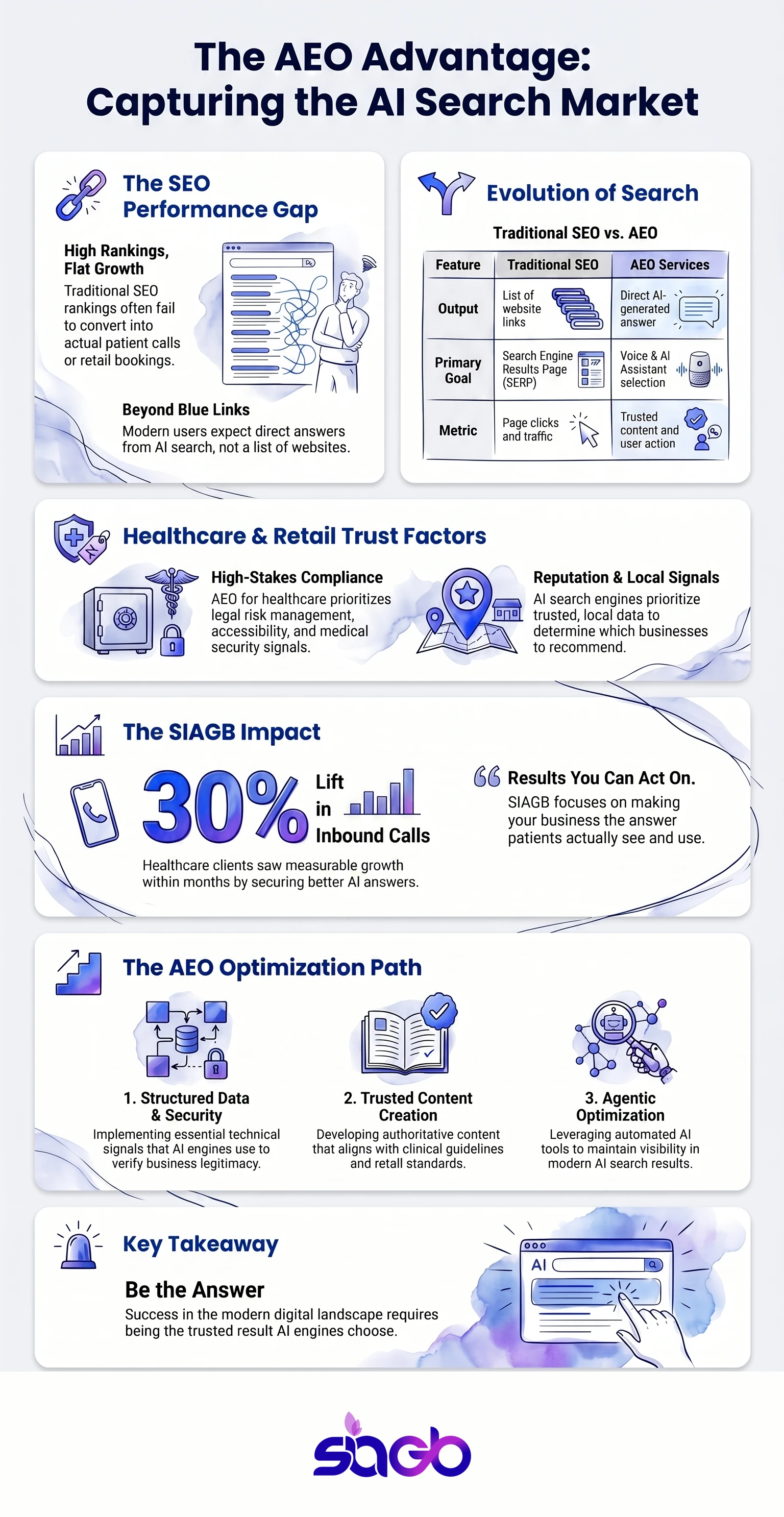
This infographic shows how answer engine optimization connects web development, accessibility, security, and reputation. Each signal feeds AI search engines. Better answers build trust. Trust drives growth.
Frequently Asked Questions
What is an aeo service?
An aeo service helps a business appear as the selected AI answer in tools like ChatGPT, Perplexity, and Google AI Overviews. It focuses on schema.org structure, trust, and optimization for AI systems rather than a single Google ranking.
How does answer engine optimization help healthcare?
It increases visibility where patients actually search. When someone asks Gemini “urgent care near me open now” in Chicago, trusted, well-structured answers drive calls, bookings, and confidence, often with no click to a website at all.
Is this different from SEO services?
Yes. SEO services target blue-link rankings on Google. AEO targets AI generated answers across ChatGPT, Perplexity, AI Overviews, and voice assistants like Siri and Google Assistant.
Does structured data really matter?
Yes. Schema.org types such as MedicalOrganization, Physician, and FAQPage help AI algorithms understand and reuse your content safely and accurately. In our projects, adding FAQPage markup is one of the fastest ways to earn AI citations.
Is this useful for a local business?
Absolutely. A clinic with an accurate Google Business Profile, consistent NAP details, and strong reviews on Healthgrades benefits when AI assistants recommend it directly to nearby patients.
Key Takeaways and Final Thoughts
An aeo service is now central to modern digital marketing. For healthcare, answer engine optimization links HIPAA compliance, WCAG 2.2 AA accessibility, E-E-A-T trust, and growth into one workflow.
US businesses need AI native consulting that blends technical SEO, schema.org structured data, Core Web Vitals performance, and real world strategy across ChatGPT, Perplexity, and Gemini. Not bolt on tools.
If you want better results from AI search, focus on answers first. That’s where patients already are.
Sources
- Industry-standard reference materials
- Peer-reviewed research and clinical guidelines

Thinking about how this applies to your business?
Start a Conversation