Agentic SEO is search engine optimisation run by AI agents that plan and complete tasks on their own. Instead of a person doing keyword research, then writing, then checking technical SEO one step at a time, an agentic system chains those SEO tasks together and works through them with limited hand-holding. Think of it as SEO strategy with an AI agent doing the legwork.
That’s the short version. But there’s a bit more to it, and a few things worth being careful about.
What agentic SEO actually means
Let’s break the term down. “Agentic AI” describes AI tools that can set a goal, pick the steps to reach it, and act, rather than just answering one prompt at a time. According to Gartner, agentic AI is a top strategic technology trend, which tells you the wider shift here isn’t only about search.
Apply that to SEO and you get agentic SEO: an AI agent (or a group of them) that handles the day-to-day SEO work. Keyword research. Content briefs. Technical SEO checks. Internal linking suggestions. The agent runs an agentic workflow, so one task feeds the next without someone queuing each job by hand.
This is a real shift from traditional SEO, where an SEO team or SEO professionals did all that content work by hand. With agentic SEO, autonomous agents and AI driven SEO tools read user intent, watch how search engines and the AI overview above the results change, and adjust for better AI visibility. Generative AI drafts the content. An agentic search step checks the sources against the live search engine results. And a person still signs off. So the SEO tool isn’t replacing your judgement about content, it’s clearing the busywork so your SEO team spends time where it counts.
And here’s the thing. This is happening at the same time search itself is changing. According to Google Search Central, AI Overviews and AI search results now sit above the old blue links for a lot of queries. Meanwhile ChatGPT, Perplexity, Microsoft Copilot, and Google Gemini answer questions that used to start a session on Google. So agentic SEO isn’t just a faster way to do old work. It’s also a response to a search page that looks different than it did two years ago.
For Australian businesses the shift lands slightly differently. An enquiry from Sydney or Melbourne often starts inside an assistant, then finishes on Google Maps or a review page. That means your Google Business Profile, your schema markup, and your service pages all need to say the same thing. An agent is genuinely good at checking that kind of consistency across a few hundred URLs. A person is genuinely bad at it, or at least gets bored by page 40.
Agentic SEO vs traditional SEO
People ask me how this is different from what an SEO agency already does. Fair question. The tasks overlap. The way they get done doesn’t. A traditional retainer sells you hours in Semrush and Screaming Frog. An agentic setup sells you a system that runs those checks nightly and only pings a person when something moves.
| Area | Traditional SEO | Agentic SEO |
|---|---|---|
| Keyword research | Person pulls data, sorts by hand | AI agent gathers and clusters keywords, then drafts a plan |
| Content | Writer works from a brief | Agent drafts, a human edits and approves |
| Technical SEO | Audits run on a schedule | Agent monitors and flags issues as they appear |
| Deep research | Hours of manual reading | Agent does deep research across many sources at once |
| Reporting | Monthly pull | Continuous, with the agent surfacing what changed |
Notice what’s missing from that table? Judgement. The agent moves fast, but it doesn’t know your business, your risk tolerance, or which client you can’t afford to upset. That part stays human. At least for now.
How an AI SEO agent gets work done

So what does the day-to-day look like? Roughly this.
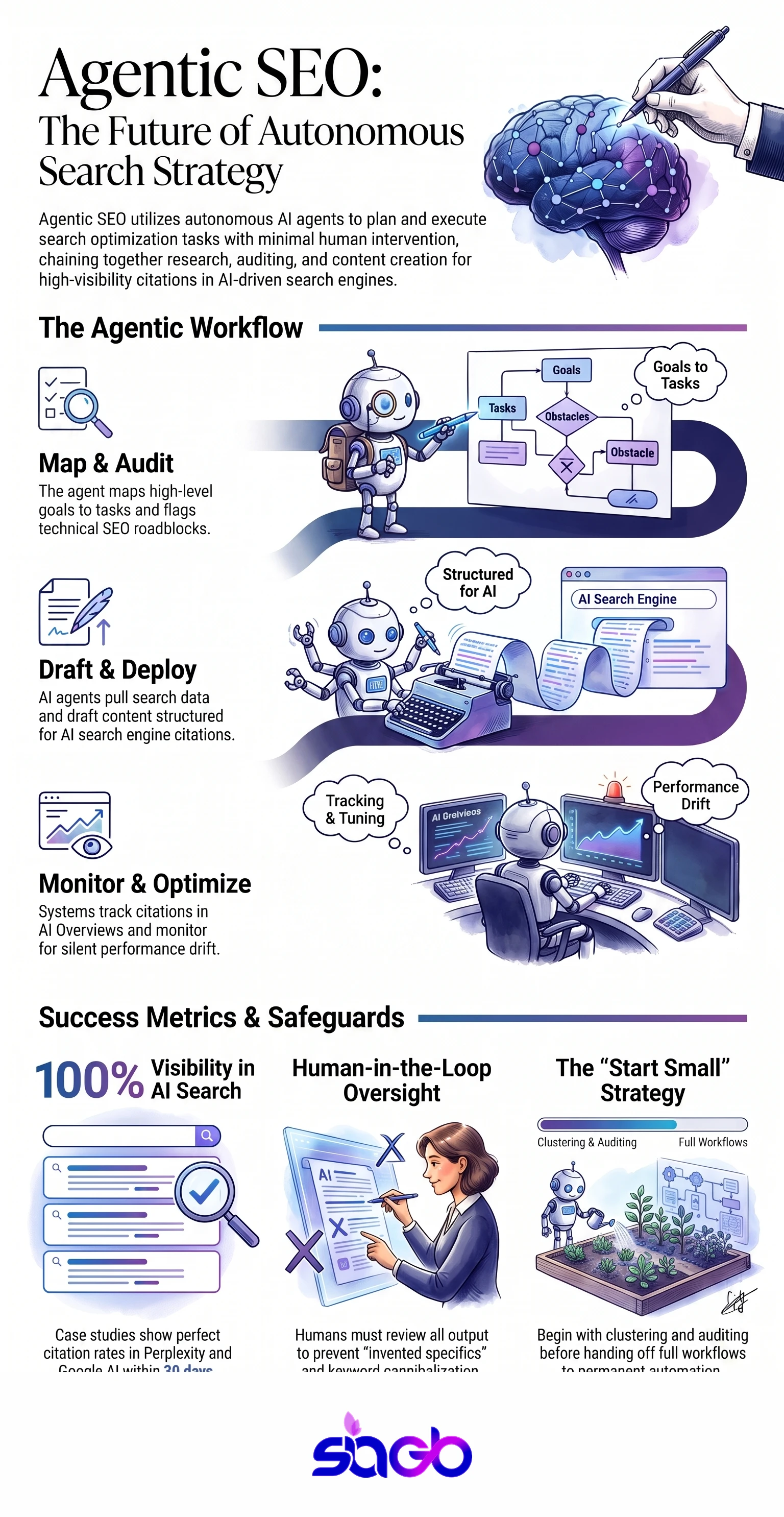
The agent starts with a goal, say “improve visibility for our service pages.” It breaks that into SEO tasks. It runs keyword research and groups terms by intent. It does deep research on what’s already ranking in Google and Bing, and where the gaps are. It drafts content or content outlines. It checks technical SEO signals like broken links, thin pages, and slow templates. Then it reports back to a human, usually in Slack or a ticket queue.
- First, it maps the goal to tasks (this is the agentic workflow part).
- Then it pulls keyword and AI search data.
- It flags technical SEO problems worth fixing first.
- It drafts content for a human to review.
- Also, it watches for AI citation, meaning whether AI Overviews quote your page at all.
That last point matters more every month. Ranking #3 isn’t the whole game when an AI answer sits on top and sends no click at all. Getting an AI citation, being the source the AI quotes, is becoming its own goal inside AI SEO.
We ran that exact play for a client and tracked it. In our RevivalMD case study, a single physician-led clinic in Rahway, New Jersey was cited in 10 of 10 tracked queries in Google AI Mode and 10 of 10 in Perplexity. ChatGPT cited it in 9 of 10, all within 30 days of the pipeline going live. No extra backlinks. The gain came from structure, schema markup, and answering the question in the first two sentences.
The tooling, honestly
There’s no single agentic SEO product that does all of this well yet. What works today is a stack. A crawler such as Screaming Frog or Semrush for site data. Google Search Console for what people actually clicked. A model like Claude or Gemini doing the reasoning over both. Then a thin layer of your own scripts that turns findings into tickets a human can approve. That last layer is the unglamorous part nobody demos, and it’s the part that decides whether any of it sticks.
What this means for your SEO strategy
Right, practical bit. Should you hand your whole SEO strategy to an agentic system tomorrow? Probably not. But ignoring agentic AI SEO isn’t smart either.
Here’s how I’d think about it. Use AI tools and an AI SEO agent for the repetitive, high-volume SEO tasks, keyword research, first-draft content, technical SEO monitoring. Keep humans on strategy, brand voice, and anything with legal or medical risk. The agent covers ground. You cover judgement.
That split maps neatly onto answer engine optimisation work as well. An agent can check whether every service page answers its question in the opening two sentences. Only a human decides which claims your Australian regulator would be comfortable seeing in print.
For digital marketing teams that are already stretched, that split is the appeal. You get more done without doubling the headcount. And you free up your best people from the grind.
Where agentic SEO breaks

I’ll be honest. It’s not magic. Agents make confident mistakes. They’ll draft content that reads fine and gets a fact wrong. They’ll chase a keyword that looks great and means nothing for your business. Left alone, an agentic system can produce a lot of mediocre pages quickly, which is its own kind of problem.
Three failure modes show up again and again, and the first one is genuinely frustrating to clean up.
- Invented specifics. The agent writes “a 2024 Gartner study found” when no such study exists. Unlike a bad headline, this one survives review because it reads authoritative.
- Cannibalisation. Give an agent 30 keywords and it happily writes 30 pages, 8 of which compete with each other. Google then picks the wrong one, or none.
- Silent drift. A monitoring agent stops seeing a page after a robots.txt change and reports zero issues, rather than reporting that it saw nothing.
So the real skill isn’t buying the flashiest tool. It’s setting up the agent with good inputs, then reviewing the output like you would a junior team member’s work. Trust, but check. Every time.
How to start with agentic SEO without the mess
You don’t flip a switch and hand everything over. That’s how you end up with a hundred thin pages and a mess to clean up. Start small instead.
Pick one repetitive job. Keyword research is a good first one. Let an AI agent run it while you check the output. Watch what it gets right, and where it goes sideways, for 2 or 3 weeks. Then add a second task, such as technical SEO monitoring or internal link suggestions. Build trust in stages, the same way you’d bring on a new hire.
For instance, one sensible first month looks like this. Week 1, the agent clusters 200 keywords and you correct its groupings. Week 2, it drafts 5 briefs and you rewrite the weak ones. Week 3, it audits your top 50 pages against Google Search Console data. Week 4, you decide what to hand it permanently. Compared with a big-bang rollout, that pace is slow, and thankfully slow is what keeps the mess out.
A few ground rules help here:
- Give the agent your real business context, not just a keyword. It works far better when it knows who you serve.
- Set a clear goal for each task, so the agentic workflow has something concrete to aim at.
- Keep a human approval step before anything publishes. Always.
- Review the content the agent drafts for accuracy, not just readability. It reads well even when it’s wrong.
And measure the right thing. It’s tempting to celebrate “we published 40 pages this month.” That’s not the win. The win is visibility, useful traffic, and yes, getting picked up as a source in AI search. A pile of pages that nobody reads, and that no AI cites, isn’t progress. It’s clutter with extra steps.
Here’s the part people underrate. The setup work, the briefs, the guardrails, the review process, is where most of the value lives. The agent is fast. Your inputs decide whether that speed helps or hurts. Feed it a vague goal and weak data, and it’ll produce vague, weak work at scale. Feed it context and a clear target, and it starts to feel like a genuinely useful team member.
So the honest answer to “should we do agentic SEO?” is yes, carefully. Use agentic AI for the grind. Keep humans on the calls that matter. And treat every agent like that junior hire again, capable, quick, and in need of a good editor.
Infographic: How Agentic SEO Works with AI Agents
FAQ
Is agentic SEO the same as AI search?
No. AI search is how results get shown to users (AI Overviews, chat answers). Agentic SEO is how the optimisation work gets done. They’re related, but they’re different things.
Will agentic SEO replace my SEO agency?
Not fully. It changes what an SEO agency spends time on. The manual grind shrinks. The strategy and oversight grow. Good agencies use agentic AI, they don’t hide from it.
Do I need agentic AI to rank in AI Overviews?
No. You need clear, well-structured, trustworthy content. Agentic tools can help you produce and maintain it faster, but the ranking factors are about the page, not the tool that made it.
Can an AI agent do technical SEO on its own?
It can find and flag most issues, and fix some. Bigger changes to your site’s code or structure still need a human to approve and deploy. Give it a few months and that line will move, but that’s where it sits today.
How do I measure whether agentic SEO is working?
Track citations in AI answers, branded search, and qualified enquiries instead of pages published. In Google Search Console, compare impressions and clicks per template rather than the site-wide average, because one strong template can hide 20 weak pages.
Key takeaways
Agentic SEO is SEO run by AI agents that plan and complete tasks across an agentic workflow, not one prompt at a time. It speeds up keyword research, content drafts, and technical SEO. It doesn’t replace judgement, and it doesn’t guarantee AI citations on its own. Use it for the repetitive work, keep humans on strategy and anything risky, and review everything the agent produces before it goes live.
If you want help working out which SEO tasks to hand to an agent and which to keep in-house, that’s the kind of thing we do at SIAGB, usually alongside AI content creation for the pages that matter most.
Sources
- Gartner, Top Strategic Technology Trends: https://www.gartner.com
- Google Search Central, AI Overviews guidance: https://developers.google.com/search
- Google Search Console Help: https://support.google.com/webmasters
- Schema.org structured data vocabulary: https://schema.org
Updated July 2026. Written by Sheetal Dhadial, founder of SIAGB, an AI-native consultancy in Sydney.

Want to explore this further?
Book a Free Consultation