
AI content creation services help regulated industries produce material at scale without losing trust, accuracy, or compliance. In healthcare and retail, speed alone isn’t the goal. The real aim is safe, usable, high quality content that supports growth while reducing risk.
Many US leaders already get this. They’re chasing outcomes, not hype. And they want written content that actually works in the real world, rather than filler built to please an algorithm.
Introduction: Why AI Content Needs More Than Speed
Look, most businesses don’t struggle to publish anymore. They struggle to trust what goes live. Fast output with no quality assurance can damage credibility, hurt a search engine presence, and even trigger legal issues. In healthcare and retail across the United States, that risk is very real.
That’s why many leaders feel skeptical about AI content creation services. They’ve seen thin blog post drafts, weak social media content, and every shiny ai tool promising miracles. Sound familiar?
This guide breaks down how SIAGB approaches ai content creation services differently. Our founder, Sheetal Dhadial, brings 20+ years in IT and AI leadership, holds Certified Scrum Master and AgilePM credentials, and runs the team out of Sydney (ABN 16 659 507 178) for US and Australian clients. The focus is practical delivery, safe use of artificial intelligence, and clear ROI. No fluff. Just systems that support a real content creation process and business outcomes, not stress.
What Are AI Content Creation Services?
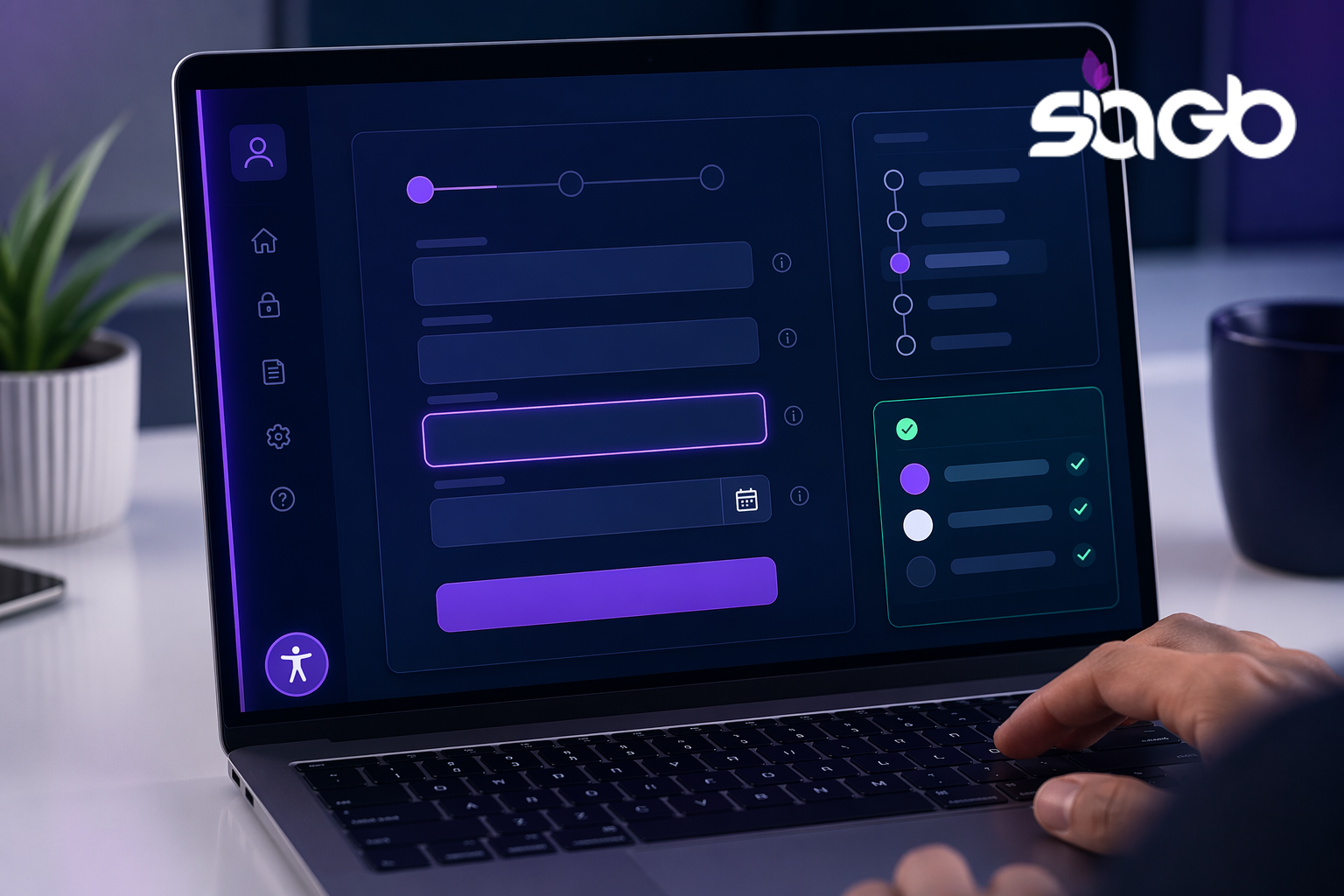
AI content creation services use artificial intelligence to help or automate parts of the content creation process. What is ai generated content? It’s text, images, or media produced directly by AI systems with little human input. AI assisted work is different. It uses generative ai as a support layer, with people in control.
The scope goes far beyond a single blog post. These services support websites, FAQs, patient education, social media content, product descriptions, video content scripts, and SEO assets. Many ai content creation tools also help with content ideas, updates to existing content, and large scale content production.
Here’s the thing. In regulated industries, full automation is risky. Compared with a marketing blog, healthcare and finance need oversight, version control, and approvals. For example, a drug interaction page carries very different stakes than a shoe listing. An ai writing tool should sit inside a structured workflow, not act alone without governance.
Here is how the two delivery models compare in practice:
| Factor | Unmanaged AI output | Governed AI content (SIAGB approach) |
|---|---|---|
| Human review | Optional or skipped | Clinician or subject expert signs off before publish |
| Accessibility | Checked after launch, if at all | WCAG 2.2 AA built into the draft stage |
| Compliance | Reactive, risk of an ADA or HIPAA gap | HIPAA and Section 508 rules mapped up front |
| SEO durability | Keyword stuffing, short-lived | Answer-first structure for ChatGPT, Perplexity, and Google AI Overviews |
| Data handling | Prompts may leak PHI | Approved tools only, with audit trails |
AI Content Creation for Healthcare and Medical Practices
Healthcare content creation puts clarity and accuracy first. AI content medical practice teams rely on must reflect clinical intent, patient safety, and local guidance. That includes service pages, patient education, forms, and social posts used across social media channels.
In practice, generative ai supports medical practice website design by drafting clear explanations, improving readability, and keeping tone consistent. It also speeds up healthcare website redesign by refreshing existing content instead of rewriting everything. In our work, we track a plain-language reading target of roughly a grade 7 to grade 8 level, since that is where most US patient education is comprehended reliably.
I’ve seen this work best when AI handles first drafts and clinicians approve the final version. For instance, we built an AI-powered patient scheduling flow for medical groups where the assistant drafts reminder copy, and a practice manager approves the wording before anything sends. The result is a modern site with safer messaging. Faster content generation, yes. But also stronger quality assurance.
Healthcare Website Accessibility and ADA Compliance Risks
Healthcare website accessibility isn’t optional anymore. It’s a legal and financial risk. WCAG healthcare website standards set clear rules for readability, keyboard access, contrast, and structure. Per the WCAG 2.1 and updated 2.2 guidelines at Level AA, body text needs a contrast ratio of at least 4.5 to 1, and every function must work by keyboard alone.
An ada compliance medical website supports patients with vision, hearing, or mobility challenges. It also lowers the risk of the ada website lawsuit doctors now face across the US. Under Title III of the Americans with Disabilities Act, and Section 508 for federally funded providers, an inaccessible portal is treated as an inaccessible place of business.
Here’s what often goes wrong. AI content generation happens first. Accessibility checks come later. That order increases risk. For example, an AI can produce a color palette that looks modern but fails the 4.5 to 1 contrast rule. Accessibility must be part of the content creation process from the start, rather than a patch at the end.
Building ADA-Compliant Patient Portals and Content
An ada compliant patient portal begins with accessible written content. That means simple language, clear labels, logical reading order, and consistent navigation.
Medical practice website design teams must align text structure with how portals actually work. An ai tool can draft copy, but it can’t judge accessibility on its own. Screen reader flow and form behavior still need review. In our testing, automated scanners such as axe or Lighthouse catch only part of the picture, so we pair them with manual keyboard and screen reader passes.
Accessibility isn’t optional. It’s built in or it breaks later.
AI SEO and Answer Engine Optimization for Healthcare
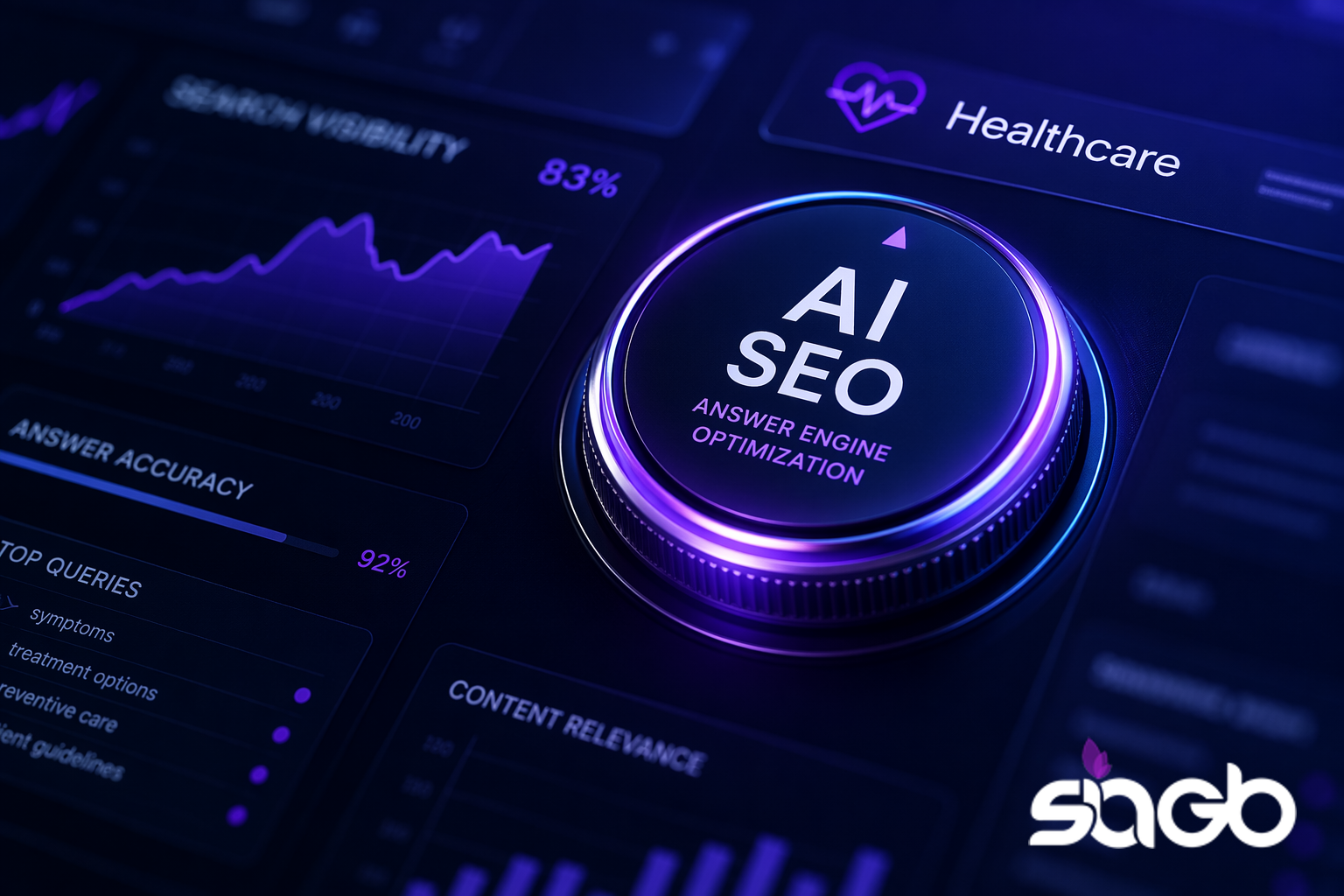
Traditional medical practice seo focuses on keywords and links. Answer engine optimization medical strategies focus on clarity and authority. They help pages get cited in ai overviews and voice results. Unlike a decade ago, the visitor may never reach your homepage. They read the answer that ChatGPT, Perplexity, or Google AI Overviews assembles about you.
AI SEO healthcare approaches structure answers clearly for both people and machines. That includes FAQs, service explanations, and guidance written at a clear level. We mark up pages with schema.org types such as MedicalWebPage, FAQPage, and MedicalOrganization so machines can parse the entity, not just the words. A strong healthcare seo strategy blends seo optimization with usability and seo services planning.
Core Web Vitals matter here too. According to Google’s guidance, a page should hit Largest Contentful Paint under 2.5 seconds, Interaction to Next Paint under 200 milliseconds, and Cumulative Layout Shift under 0.1. So, what does this mean day to day? Material must serve humans first. Clear answers. Verified facts. Logical structure. AI content services that ignore this won’t deliver long term visibility in any search engine.
Agentic SEO and Automated AI Agents Explained
Agentic seo isn’t a buzzword. It describes systems where AI agents for seo monitor, update, and optimize material on an ongoing basis. Automated agents track performance, spot gaps, and suggest changes without waiting months. Instead of a quarterly audit, the loop runs weekly or even daily.
This differs from one-off SEO projects. Whereas a classic project ends at handover, agentic ai for marketing supports continuous improvement across websites and social media platforms. It also aligns with ai automation goals for teams that publish often. For example, an agent can flag a service page that slipped out of an AI Overview and queue a refresh.
I don’t love set-and-forget SEO. Never have. This works best with human oversight and clear rules.
HIPAA-Compliant Websites and Healthcare Cybersecurity
A hipaa compliant website needs more than secure hosting. HIPAA has governed protected health information in the US since 1996, and AI content workflows must protect that data at every step. That includes prompts, drafts, approvals, and storage systems.
Healthcare cybersecurity threats often target weak processes. Tools such as public ai content creation tools can expose data if used carelessly, for instance when a staff member pastes patient details into a consumer chatbot. Cybersecurity for doctors now includes controlling which ai tool is approved and how it integrates.
Medical practice data security depends on governance. AI technology should run inside approved systems with audit trails and tight integration across platforms, rather than ad hoc tools. No shortcuts here.
Reputation Management and Patient Reviews Using AI
Online reputation healthcare signals play a big role in trust. AI helps manage google reviews medical practice profiles by spotting trends, drafting compliant replies, and flagging issues early. For example, a reply must never confirm that a reviewer is a patient, since that alone can breach HIPAA.
Reputation management doctors rely on must protect privacy. AI content creation helps scale responses across social media and review platforms while staying compliant. We track sentiment shifts so a single one-star cluster gets a human response within hours, not weeks.
Strong reviews support SEO, trust, and patient choice. Social media engagement plays a role too. All of it connects.
Patient Recall Systems and AI Chatbots
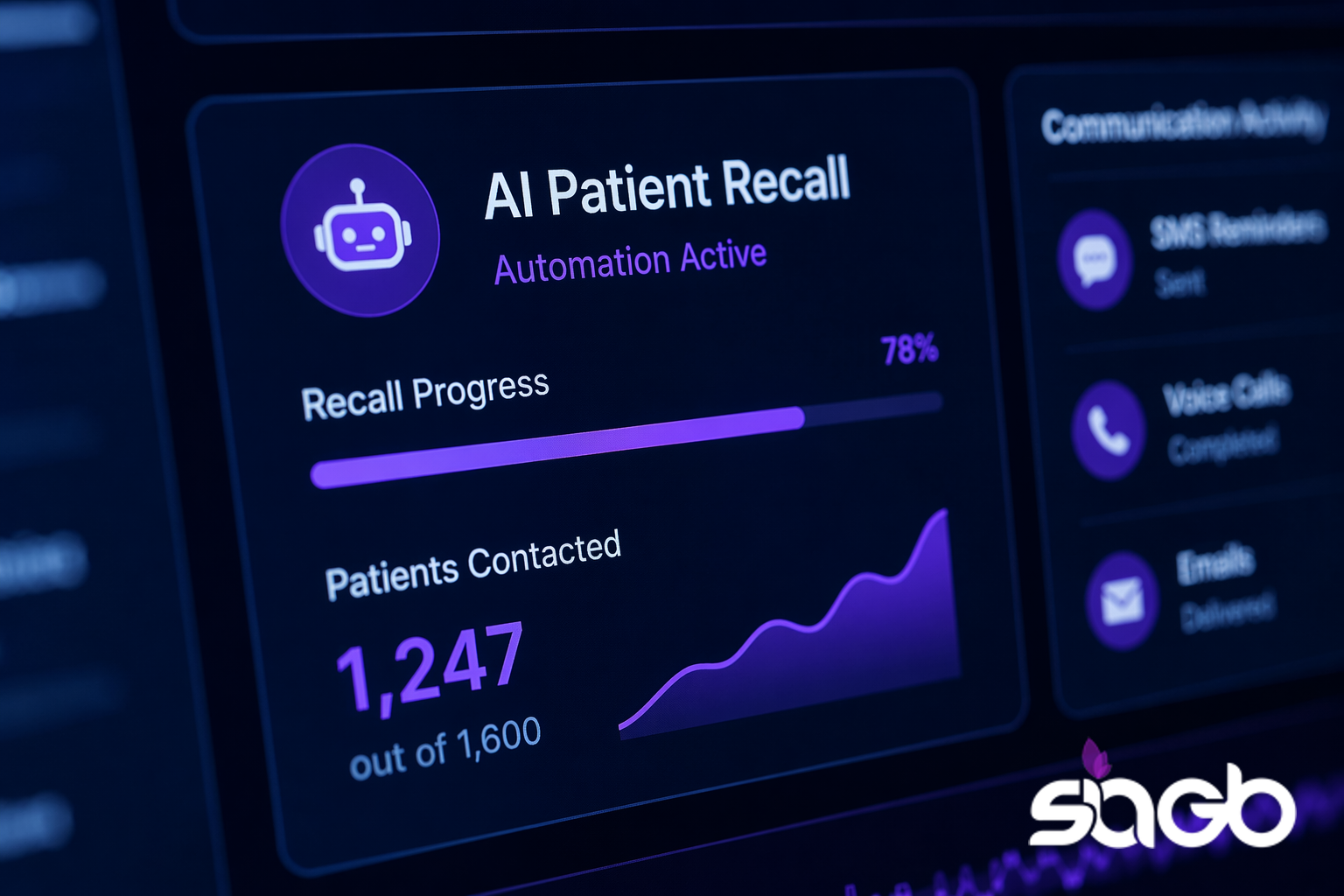
AI content works well with a patient recall system. Appointment reminders, follow ups, and education messages benefit from consistent tone and timing across email marketing and SMS. In our work, we saw missed-appointment rates drop when reminders were rewritten in plainer language and sent 48 hours ahead.
Chatbots extend this further. Guided by chatbot analytics consultants usa teams, they answer common questions, route requests, and reduce admin load. Some even use an ai avatar for simple interactions. This is the same discipline behind our AI-powered patient scheduling and the Marvel PTE platform, which serves 85,000+ users across 900+ institutes.
Cutting calls helps. Improving patient engagement across social media and portals helps more.
AI Consulting for Healthcare and Retail Businesses
AI consulting for retail businesses looks different from healthcare. Retail focuses on speed, campaigns, and social media scale. Healthcare focuses on trust, safety, and compliance.
SIAGB takes a problem-first approach. The aim isn’t to deploy another ai tool such as owlywriter ai or adobe express and hope for results. It’s to solve a real business problem tied to content marketing and digital marketing goals. For example, one client needed fewer no-shows, not more blog posts, so we started there.
End-to-end delivery matters. From content strategy to creation, optimization, and monitoring. No handoffs. No disappearing after go-live.
Infographic: AI Content Creation in Healthcare at a Glance
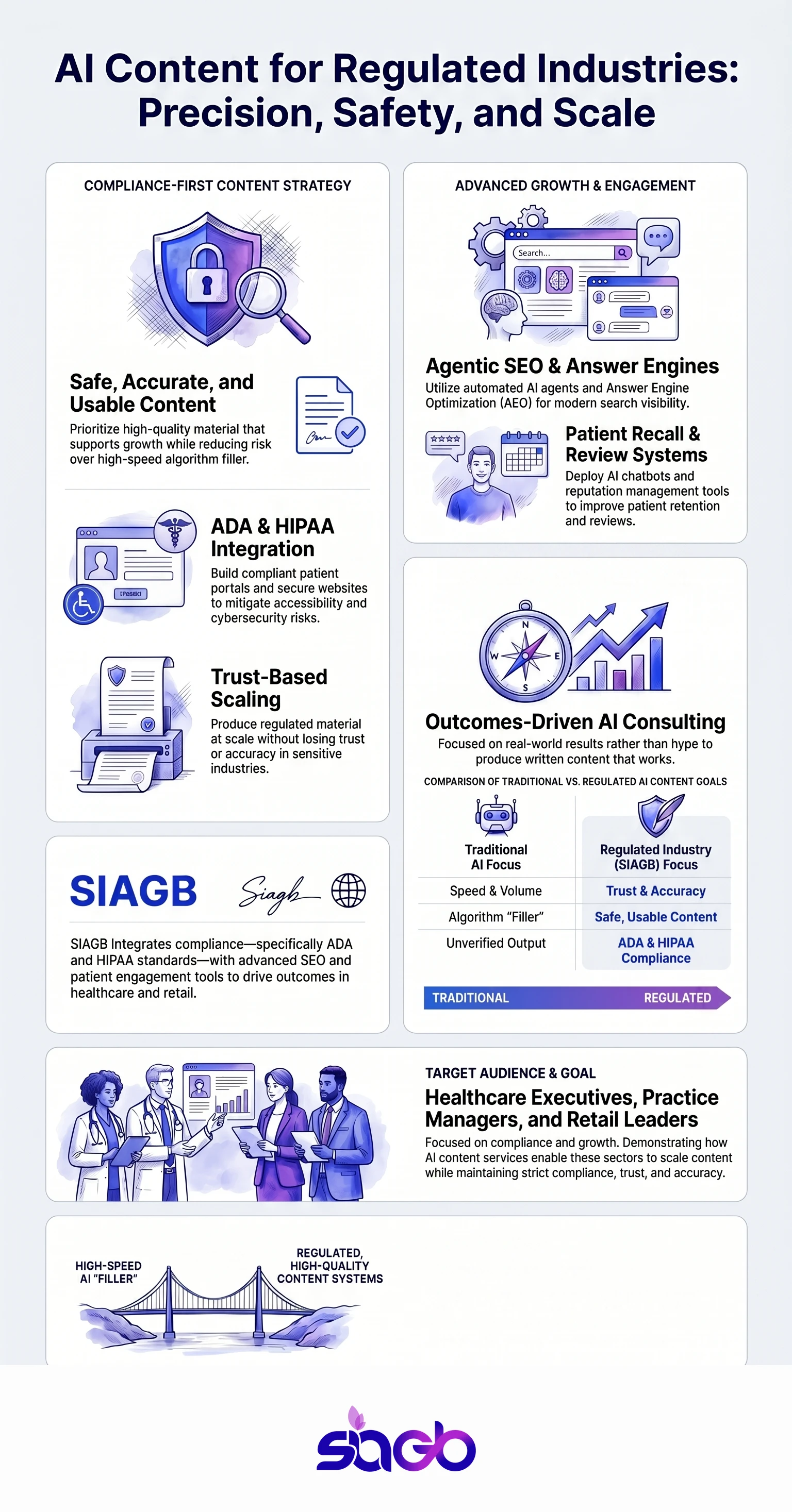
This infographic maps the full content lifecycle. From creation and review through SEO, accessibility, and security checks. It shows where agentic AI runs continuously and where human approval is required for visual content, video content, and written assets.
Frequently Asked Questions
What is AI generated content?
AI generated content is text, images, or media created directly by artificial intelligence systems. It relies on ai algorithms to predict and produce language or visuals.
Is AI content safe for healthcare websites?
Yes, when used properly. AI content creation must include clinical review, accessibility checks, and strong quality assurance.
How does AI help with healthcare SEO?
AI supports ai seo healthcare by structuring clear answers, refreshing existing content, and improving consistency. It also supports answer engine optimization medical.
Can AI help with website accessibility?
AI can assist, but it can’t replace people. Standards like WCAG require judgment that automation alone can’t provide.
What is agentic SEO in simple terms?
Agentic SEO uses automated AI agents to improve material continuously. It replaces one-time optimization with ongoing improvement.
Do AI tools replace content creators?
No. AI supports a content creator by speeding drafts and updates. Humans still guide tone, accuracy, and compliance.
Key Takeaways and Final Thoughts
AI content creation services only deliver value when scale, compliance, and trust work together. Healthcare and retail businesses need systems, not hype.
A strong content creation process supports accessibility, security, and long term visibility. One-off projects fade quickly. Continuous optimization lasts.
Healthcare website redesign and content production succeed when AI and human expertise work side by side. That balance is where the real value lives.
Sources
- MIT Technology Review (technologyreview.com)
- Stanford HAI - Human-Centered AI (hai.stanford.edu)

Want to explore this further?
Book a Free Consultation