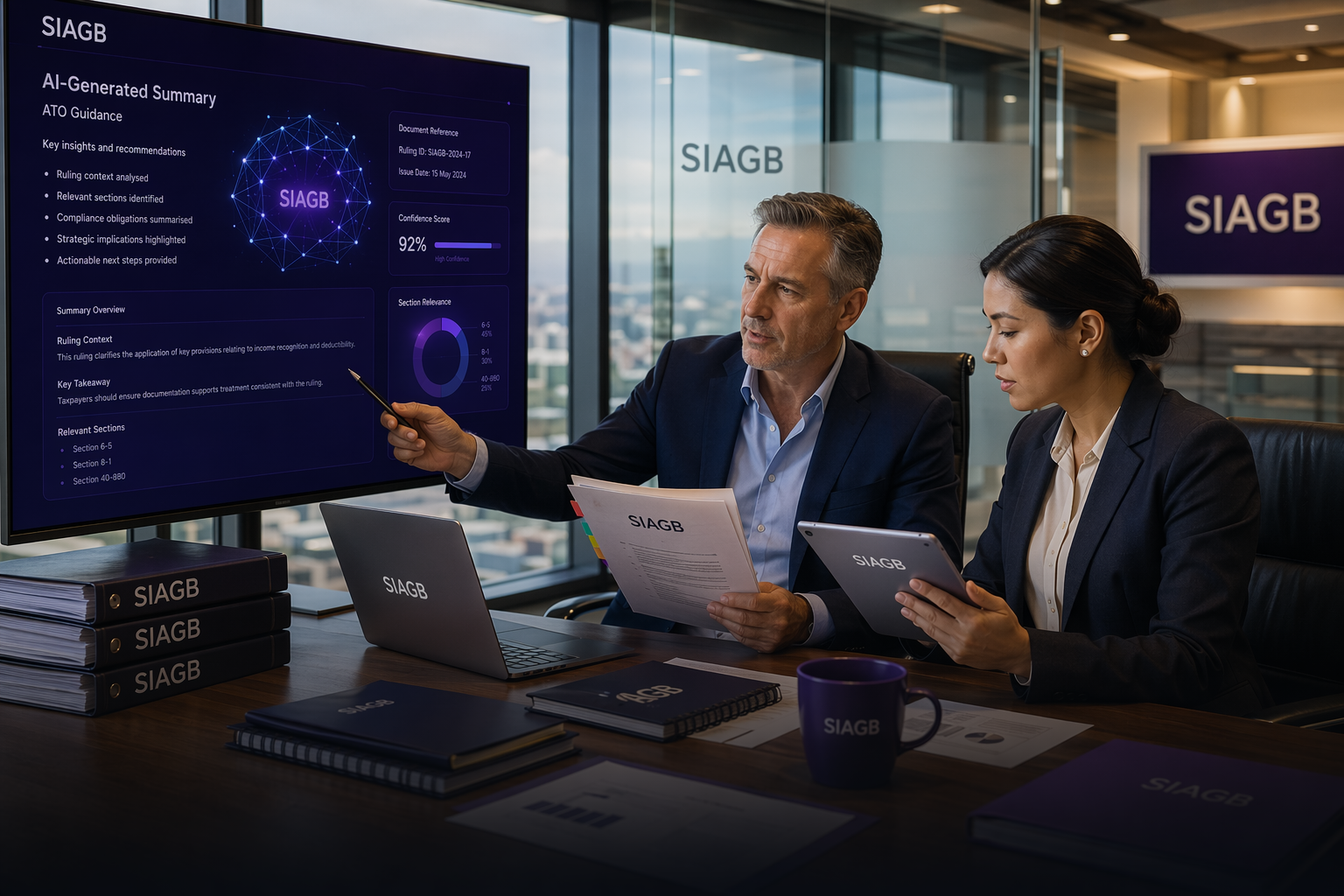
AI for accounting firms in Australia is about using artificial intelligence to reduce manual work, improve accuracy, and support better decisions for Australian businesses. It doesn’t mean AI replace accountants. It means smart systems handle high-volume tasks, so accounting professionals can focus on judgement, advice, and clients.
Most Australian firms see results when AI is applied to narrow, real problems. Think bank reconciliation, document handling, invoice checks, and Single Touch Payroll (STP) Phase 2 reporting. Not flashy demos. For example, a practice running Xero for 120 SME clients can route the whole quarterly BAS cycle, due to the ATO on the 28th of the month after each quarter, through an AI layer instead of chasing receipts by email. Real work that helps small business clients. That’s the difference.
Honestly? This is where ROI actually shows up.
AI for accounting firms in Australia explained simply
AI for accounting firms Australia means using artificial intelligence to support an accounting practice, not remove people from it. AI technology helps spot patterns, classify transactions, and flag issues early across financial reporting and daily workflows. Tools like ChatGPT and Perplexity now draft client emails, while document-capture engines such as Dext and Hubdoc read PDFs into Xero or MYOB with optical character recognition. The aim is less manual work and fewer errors.
For most teams, the biggest win is efficiency and accuracy. AI software cuts down time spent on data entry and checking. In our own delivery work at SIAGB, a Sydney-based consultancy (ABN 16 659 507 178), we track hours-per-client before and after each rollout so the gain is a number, not a feeling. It also helps Australian accountants respond faster to clients, which matters when the ATO quarterly BAS and end-of-financial-year 30 June deadlines pile up.
Here’s the thing. Successful teams don’t start big. They apply AI to one or two high-volume processes first. Bank reconciliation is a common choice. Invoice processing is another. Over time, these gains build across the accounting workflow.
Sound simple? It usually is. But simple doesn’t mean easy.
What real problems do Australian accounting firms face today?
Australian accounting firms are under pressure from all sides. Staff spend hours on reconciliations, chasing missing information, and fixing small errors. This work is necessary. It’s also draining. And expensive.
Compliance demands keep rising. BAS, STP Phase 2, payroll, audit support, and financial reporting all rely on accurate financial data, and the Australian Taxation Office sets firm expectations for lodgement accuracy and five-year record keeping under the Income Tax Assessment Act. One small mistake can lead to rework, or worse, a general interest charge on a late BAS. Many teams use tools already, but tools alone don’t reduce the workload.
Partners also want to grow advisory services like financial planning. But adding more clients often means adding headcount. That’s not sustainable for an Australian SME or a growing small business, where a single senior accountant might already carry 80 to 100 client files.
We have seen this play out. Teams stay busy, but they’re not consistently productive. An AI powered tool that reduces repetitive tasks can free up hours each week. That time goes back into client work, cash flow advice, and higher-value conversations with business owners.
That’s the real problem AI needs to solve.
Where AI fits and where human judgement still matters
AI is good at pattern recognition. It excels at classification, first-pass analysis, and scanning large volumes of information. Generative AI tools can summarise documents or draft responses. An AI agent can manage steps across a workflow, similar to how AI agents support other digital operations.
But AI doesn’t own judgement. Accountants do. Interpretation, professional standards, and client advice stay human responsibilities within the accounting profession, and bodies like Chartered Accountants ANZ hold members to the APES 110 Code of Ethics that few tools can absorb. An accountant understands context, such as whether a Division 7A loan needs restructuring before 30 June. AI rarely reads that nuance on its own.
Clear role separation matters. When an Australian firm defines what AI handles and what professionals review, risk drops. Trust goes up. Staff adoption improves.
And yes, people worry about whether AI replace accountants. In practice, it doesn’t. It shifts effort. From checking to thinking. From typing to advising.
That’s usually where value lives.
Traditional automation versus adaptive AI workflows
Traditional automation follows fixed rules. If X happens, do Y. This works until something changes. Then the automation breaks, and staff have to step in.
More advanced AI solutions use context and historical patterns to adapt steps. An AI agent can decide what to do next based on conditions and prior outcomes. That’s why these approaches handle exceptions better than basic automation.
Some teams already use similar ideas in other areas of their business. The same logic applies in accounting workflows. An AI solution can route documents, flag unusual transactions, and request missing information automatically.
The difference becomes clearer when you line up the two approaches side by side:
| Capability | Best use case for firms | Why it fits |
|---|---|---|
| Rule-based automation | Repeatable, stable tasks like scheduled report exports | Cheap and reliable when nothing changes |
| Adaptive AI workflow | Document routing and exception handling | Uses context to handle cases rules miss |
| Generative AI | Drafting client summaries and replies | Speeds up writing while a human reviews |
| AI agent | Multi-step processes across systems | Decides next steps from prior outcomes |
From what we have measured, teams using this approach report less rework. Fewer edge cases slip through the cracks. That’s a big deal during peak periods like the July tax season.
Is it flawless? Rarely. But it’s more flexible than rule-based automation.
AI use cases across core accounting workflows
AI fits into many day-to-day tasks. The key is choosing areas with high volume and low judgement.
Common use cases include:
- AI bookkeeping for transaction categorisation and anomaly detection using financial data.
- Bank reconciliation support that highlights mismatches before review.
- Invoice validation that checks amounts, suppliers, and timing.
- Payroll checks that flag errors before submission, reducing audit risk.
Here’s how those tasks map to what AI actually does for each one:
| Accounting task | How AI helps | What stays human |
|---|---|---|
| Bank reconciliation | Matches transactions and highlights mismatches before review | Final sign-off on unusual items |
| Invoice processing | Checks amounts, suppliers, and timing for errors | Approving exceptions and disputes |
| Transaction categorisation | Classifies entries and flags anomalies in financial data | Reviewing edge cases and odd patterns |
| Payroll checks | Flags errors before submission to reduce audit risk | Interpreting awards and entitlements |
| Document handling | Sorts, extracts, and routes incoming paperwork | Deciding what needs partner attention |
These capabilities usually sit on top of an existing accounting platform such as Xero, MYOB, QuickBooks Online, or Reckon. They don’t replace it. They add a smart layer, often via API webhooks, that cuts manual steps and improves AI output quality.
One Australian firm we worked with cut reconciliation time by about 35 percent within eight weeks. Another reduced payroll rework by half. Not magic. Just better use of automation and predictive AI. The same engineering discipline sits behind our other builds: Marvel PTE, an SIAGB product, now serves more than 85,000 users across 900-plus institutes, and our AI-powered patient scheduling was built for medical groups on the same secure foundations.
Clients noticed faster responses. Staff noticed fewer late nights. That surprised me, honestly.
Data security, privacy, and compliance for Australian firms
Data security matters. Accounting teams handle sensitive financial data every day. Any AI accounting software must respect confidentiality and privacy.
In Australia, systems should align with the Privacy Act 1988 and its 13 Australian Privacy Principles (APPs), plus the Notifiable Data Breaches scheme overseen by the OAIC. In practice that means AES-256 encryption at rest, TLS 1.3 in transit, role-based access controls, and audit logs, ideally under an ISO 27001 framework. Guidance from CPA Australia on technology and data governance is worth reviewing before any rollout. Weak controls increase exposure to cyber threats for financial professionals and auditors alike.
There’s a lesson here from healthcare. Topics like healthcare cybersecurity threats and medical practice data security show what happens when systems aren’t designed securely. For example, when we built AI-powered patient scheduling for medical groups, data residency and consent handling were designed in from day one. Accounting is no different.
AI integration must be secure by design. Not bolted on later. Otherwise, the risk outweighs the benefit.
Few partners want that OAIC notification call.
Integrating AI with existing accounting systems
Most teams already use platforms like Xero or MYOB. Replacing them isn’t realistic. Effective AI integration works alongside existing systems instead, usually through their published REST APIs and OAuth 2.0 connections.
This is where good consulting matters. End-to-end delivery avoids handoffs. One team designs, builds, and supports the AI layer. Accountability stays clear for the Australian firm and its clients.
SIAGB works this way. Led by founder Sheetal Dhadial, who brings 20-plus years of IT and AI leadership and holds Certified Scrum Master and AgilePM credentials, we’ve done similar integrations across healthcare, education, and complex data environments. The same principles apply to an AI accounting software rollout.
The result? Minimal disruption. Staff keep their workflows. AI quietly handles background tasks.
That’s how adoption sticks.
How can accounting firms measure ROI from AI?
ROI starts with time. Measure hours saved per staff member each week. Even one hour adds up across a team.
Next is cost. Fewer errors mean less rework. Cleaner financial reporting means smoother audits. These savings are real, even if they rarely show as a single clear line on the P&L.
Then there’s revenue. When accounting professionals have more capacity, they can offer advisory services like forecasting and financial planning. That’s where margins improve.
One team tracked these metrics over three months. Time saved averaged 4.5 hours per week per person. Advisory revenue rose without hiring. That’s measurable ROI.
Not hype. Just numbers.
Why does AI hype lead many accounting projects to fail?
Many projects fail because they start with tools. A shiny AI tool gets purchased before the problem is clear. It doesn’t fit real workflows or the needs of Australian accountants.
Others stop at a strategy document. No build. No change. Nothing happens.
Generative AI gets plenty of noise. But without problem-first thinking, even well-funded AI software rarely delivers.
Successful teams start small. They test. They adjust. Then they scale. Simple. Not easy. But proven.
We steer clients away from tool-first projects, and have done so on every engagement.
What effective AI consulting looks like in practice
Effective consulting is AI-native. Teams design, build, and support solutions end to end. There’s no disappearing act after delivery.
Cross-industry experience helps. Lessons from regulated sectors improve risk awareness and governance. That matters when handling sensitive financial data for clients and auditors.
Ongoing optimisation is key. Models drift. Workflows change. Regular tuning keeps AI output accurate and useful.
SIAGB operates this way. From AI SEO and analytics work to complex integration projects, the focus stays on outcomes. Not decks. Not demos. Outcomes.
That’s the difference clients feel.
Infographic: AI adoption framework for accounting firms
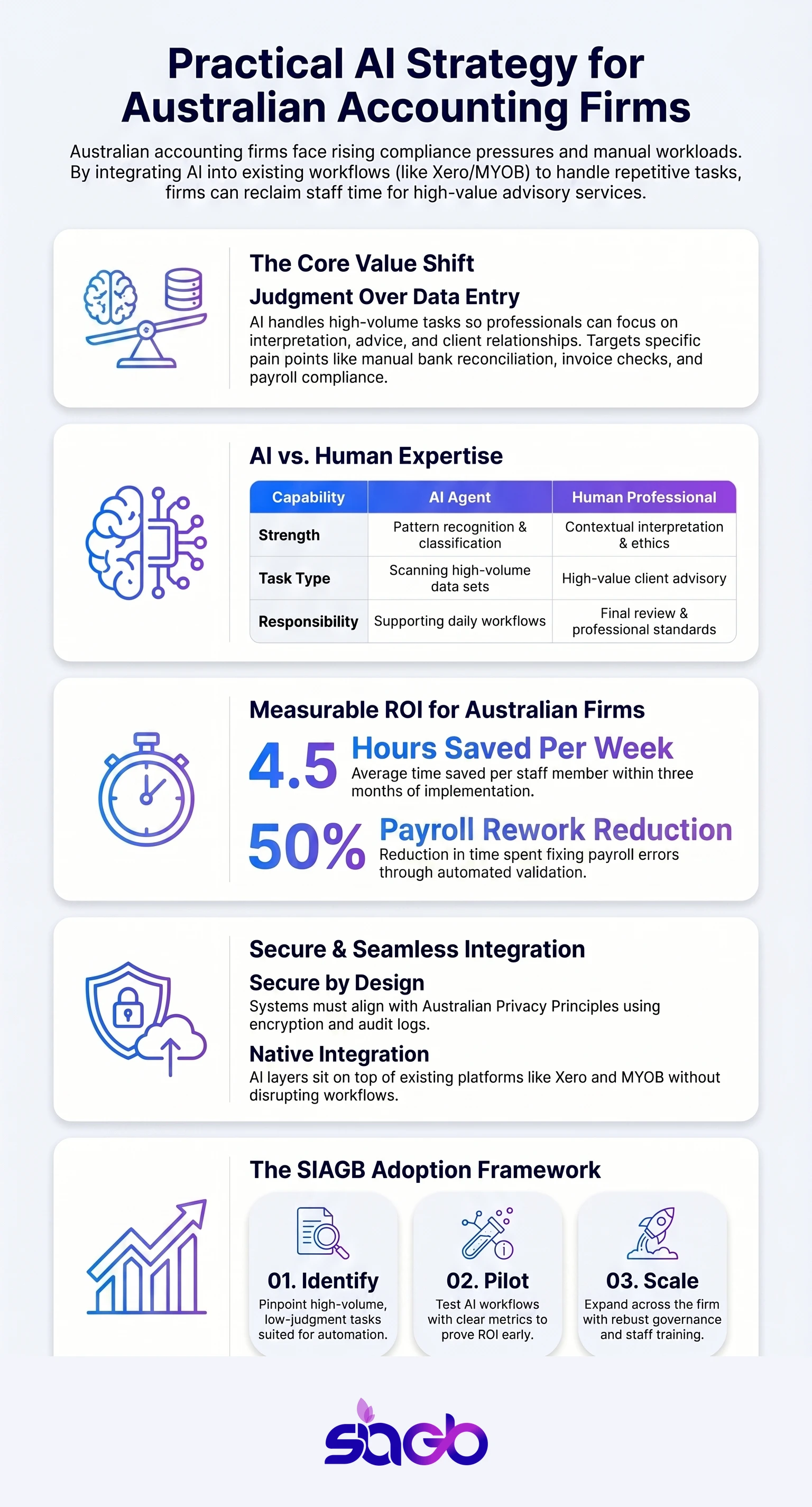
This framework shows how teams adopt AI safely. Step one is identifying high-volume tasks. Step two is piloting with clear metrics. Step three is scaling with governance and training.
It’s practical. It works. And it keeps accounting data secure.
Frequently Asked Questions
Can AI replace accountants in Australia?
No, AI replace accountants is a common fear, but it’s not reality. AI supports repetitive tasks, while accountants retain judgement, ethics, and client responsibility within the accounting profession.
Is AI safe for handling accounting data?
Yes, when designed correctly. Secure AI solutions use access controls, encryption, and audit trails to protect sensitive information for Australian businesses.
How long does it take to see ROI from AI?
Most teams see early results within 6 to 12 weeks. Time savings usually appear first, followed by cost and revenue benefits.
Do we need to replace our existing systems?
No. AI layers integrate with your current accounting platform. Replacement isn’t required.
Is AI suitable for small Australian firms?
Yes. Many Australian SME teams and CPA Australia members use AI in focused areas. Starting small reduces risk and cost.
How does AI help with audits?
Beyond flagging anomalies, AI gives auditors a cleaner starting point. It can sample full ledgers rather than a small subset, build an audit trail of every check it ran, and surface the riskiest transactions first. That lets auditors spend their hours on judgement calls instead of trawling through entries by hand.
Key Takeaways for accounting firm leaders
AI for accounting firms in Australia delivers value when applied to real operational problems faced by Australian businesses. Smarter automation outperforms basic rules in complex workflows. Measured ROI builds confidence and supports long-term adoption.
The goal isn’t more technology. It’s better use of financial data. When teams save time, business owners get better advice. Firms grow without burning out staff.
That’s what practical AI looks like. And that’s where SIAGB helps leaders move forward.
Sources
- MIT Technology Review (technologyreview.com)
- Stanford HAI - Human-Centred AI (hai.stanford.edu)

Ready to put this into practice?
Let's Talk