
AI for accounting firms in the USA is about using artificial intelligence to reduce manual work, improve accuracy, and support better decisions for US businesses. It doesn’t mean AI replace accountants. It means smart systems handle high-volume tasks, so accounting professionals can focus on judgment, advice, and clients.
Most US firms see results when AI is applied to narrow, real problems. Think bank reconciliation, document handling, invoice checks, and sales-tax nexus tracking across multiple states. Not flashy demos. Real work that helps small business clients. That’s the difference.
Honestly? This is where ROI actually shows up.
AI for accounting firms in the USA explained simply
AI for accounting firms USA means using artificial intelligence to support an accounting practice, not remove people from it. AI technology helps spot patterns, classify transactions, and flag issues early across financial reporting and daily workflows. The aim is less manual work and fewer errors.
For most teams, the biggest win is efficiency and accuracy. AI software cuts down time spent on data entry and checking. It also helps US accountants respond faster to clients, which matters when the March 15 and April 15 IRS deadlines pile up.
Here’s the thing. Successful teams don’t start big. They apply AI to one or two high-volume processes first. Bank reconciliation inside QuickBooks Online is a common choice. Invoice processing through tools like Bill.com or Ramp is another. Over time, these gains build across the accounting workflow.
Sound simple? It usually is. But simple doesn’t mean easy.
The real problems US accounting firms face today
US accounting firms are under pressure from all sides. The AICPA has documented a shrinking talent pipeline, with the number of new CPA exam candidates well below the peak of roughly 48,000 a decade ago. Staff spend hours on reconciliations, chasing missing W-9s, and fixing small errors. This work is necessary. It’s also draining. And expensive.
Compliance demands keep rising. Sales tax across 45 states plus Washington DC, 1099-NEC filing, payroll, audit support, and GAAP financial reporting all rely on accurate financial data. For example, after the 2018 South Dakota v. Wayfair ruling, a client selling into 30 states can trigger economic nexus once sales pass thresholds like $100,000 or 200 transactions. One small mistake can trigger rework, or worse, an IRS notice. Many teams use tools already, but tools alone don’t reduce the workload.
Partners also want to grow advisory services like CFO-style financial planning. But adding more clients often means adding headcount. That’s not sustainable for a US SME or a growing small business.
In our work with data-heavy operations, we see this play out often. Teams stay busy, but they’re not always productive. An AI powered tool that reduces repetitive tasks can free up hours each week. That time goes back into client work, cash flow advice, and higher-value conversations with business owners.
That’s the real problem AI needs to solve.
Where AI fits and where human judgment still matters
AI is good at pattern recognition. It handles classification, first-pass analysis, and scanning large volumes of information. Generative AI tools like ChatGPT and Claude can summarize documents or draft client responses. An AI agent can manage steps across a workflow, similar to how AI agents support other digital operations.
But AI doesn’t own judgment. Accountants do. Interpretation, professional standards under GAAP and the AICPA Code of Professional Conduct, and client advice stay human responsibilities within the accounting profession. An accountant understands context. AI doesn’t. Not fully.
Clear role separation matters. When a US firm defines what AI handles and what professionals review, risk drops. Trust goes up. Staff adoption improves.
And yes, people worry about whether AI replace accountants. In practice, it doesn’t. It shifts effort. From checking to thinking. From typing to advising.
That’s usually where value lives.
Traditional automation versus adaptive AI workflows
Traditional automation follows fixed rules. If X happens, do Y. This works until something changes. Then the automation breaks, and staff have to step in.
More advanced AI solutions use context and historical patterns to adapt steps. An AI agent can decide what to do next based on conditions and prior outcomes. That’s why these approaches handle exceptions better than basic automation. The table below shows the practical contrast.
| Factor | Traditional automation (rules) | Adaptive AI workflow |
|---|---|---|
| How it decides | Fixed if-then macros in tools like Zapier | Context and historical patterns, model-driven |
| Handling exceptions | Breaks, routes to a human | Adapts, flags low-confidence items for review |
| Uncategorized transactions | Left in a suspense account | Suggests a coding with a confidence score |
| Setup effort | Low upfront, high maintenance | Higher upfront, lower ongoing tuning |
| Best fit | Stable, repetitive tasks | Messy inputs like mixed-vendor invoices |
Some teams already use similar ideas in other areas of their business. The same logic applies in accounting workflows. An AI solution can route documents, flag unusual transactions, and request missing W-9s automatically.
From what we have seen, teams using this approach report less rework. Fewer edge cases slip through the cracks. That’s a big deal during peak periods like the January to April tax season.
Is it flawless? No. But it’s more flexible than rule-based automation.
AI use cases across core accounting workflows
AI fits into many day-to-day tasks. The key is choosing areas with high volume and low judgment.
Common use cases include:
- AI bookkeeping for transaction categorization and anomaly detection across QuickBooks and Xero financial data.
- Bank reconciliation support that highlights mismatches before review.
- Invoice validation that checks amounts, suppliers, and timing against purchase orders.
- Payroll checks that flag errors before submission, reducing audit risk under Sarbanes-Oxley controls.
These capabilities usually sit on top of an existing accounting platform. They don’t replace it. They add a smart layer that cuts manual steps and improves AI output quality.
Independent benchmarks point the same way. A 2023 Thomson Reuters survey found that professionals expected generative AI to save around four hours per week. In our own delivery work, we scope every pilot to one measurable process so those hours are easy to verify rather than assumed. For example, a mid-size firm might start with month-end bank reconciliation for 40 client accounts, measure the baseline for two weeks, then compare. Better use of automation and predictive AI, not magic.
Clients notice faster responses. Staff notice fewer late nights. That is the pattern we track first.
Data security, privacy, and compliance for US firms
Data security matters. Accounting teams handle sensitive financial data every day. Any AI accounting software must respect confidentiality and privacy.
In the US, systems should align with the FTC Safeguards Rule and the Gramm-Leach-Bliley Act, and vendors should hold a SOC 2 Type II report. The NIST Cybersecurity Framework is a useful baseline for controls. Access controls, AES-256 encryption at rest, and audit logs are essential. Weak controls increase exposure to cyber threats for financial professionals and auditors alike.
There’s a lesson here from healthcare. Topics like healthcare cybersecurity threats and medical practice data security under HIPAA show what happens when systems aren’t designed securely. Accounting is no different.
AI integration must be secure by design. Not bolted on later. Otherwise, the risk outweighs the benefit.
Few partners want that phone call.
Integrating AI with existing accounting systems
Most teams already use platforms like QuickBooks Online, Xero, or Sage Intacct. Replacing them isn’t realistic. Effective AI integration works alongside existing systems through their APIs instead.
This is where good consulting matters. End-to-end delivery avoids handoffs. One team designs, builds, and supports the AI layer. Accountability stays clear for the US firm and its clients.
SIAGB works this way. We built AI-powered patient scheduling for medical groups and we run Marvel PTE, a platform serving more than 85,000 users across 900-plus institutes. Founder Sheetal Dhadial brings 20-plus years of IT and AI leadership and holds Certified Scrum Master and AgilePM credentials. The same principles apply to an AI accounting software rollout.
The result? Minimal disruption. Staff keep their workflows. AI quietly handles background tasks.
That’s how adoption sticks.
How accounting firms can measure ROI from AI
ROI starts with time. Measure hours saved per staff member each week. Even one hour adds up across a team.
Next is cost. Fewer errors mean less rework. Cleaner financial reporting means smoother audits. These savings are real, even if they don’t reliably show as a clear line on the P&L.
Then there’s revenue. When accounting professionals have more capacity, they can offer advisory services like forecasting and financial planning. Advisory work often bills at a higher effective rate than compliance data entry, so that shift moves margins.
We track three numbers with clients: hours saved per person per week, error and rework rate, and advisory revenue per partner. When those move together over a quarter, the ROI case writes itself.
Not hype. Just numbers.
Why AI hype leads many accounting projects to fail
Many projects fail because they start with tools. A shiny AI tool gets purchased before the problem is clear. It doesn’t fit real workflows or the needs of US accountants.
Others stop at a strategy document. No build. No change. Nothing happens.
Generative AI gets plenty of noise. But without problem-first thinking, even a strong AI software product won’t deliver.
Successful teams start small. They test. They adjust. Then they scale. Simple. Not easy. But proven.
We avoid tool-first projects, and we say so upfront.
What effective AI consulting looks like in practice
Effective consulting is AI-native. Teams design, build, and support solutions end to end. There’s no disappearing act after delivery.
Cross-industry experience helps. Lessons from regulated sectors like healthcare under HIPAA improve risk awareness and governance. That matters when handling sensitive financial data for clients and auditors.
Ongoing optimization is key. Models drift. Workflows change. Regular tuning keeps AI output accurate and useful. It also keeps content and tools visible in AI answer engines like ChatGPT, Perplexity, and Google AI Overviews, where clients increasingly research providers.
SIAGB operates this way from Sydney (ABN 16 659 507 178), serving US clients remotely. From AI SEO and analytics work to complex integration projects, the focus stays on outcomes. Not decks. Not demos. Outcomes.
That’s the difference clients feel.
Infographic: AI adoption framework for accounting firms
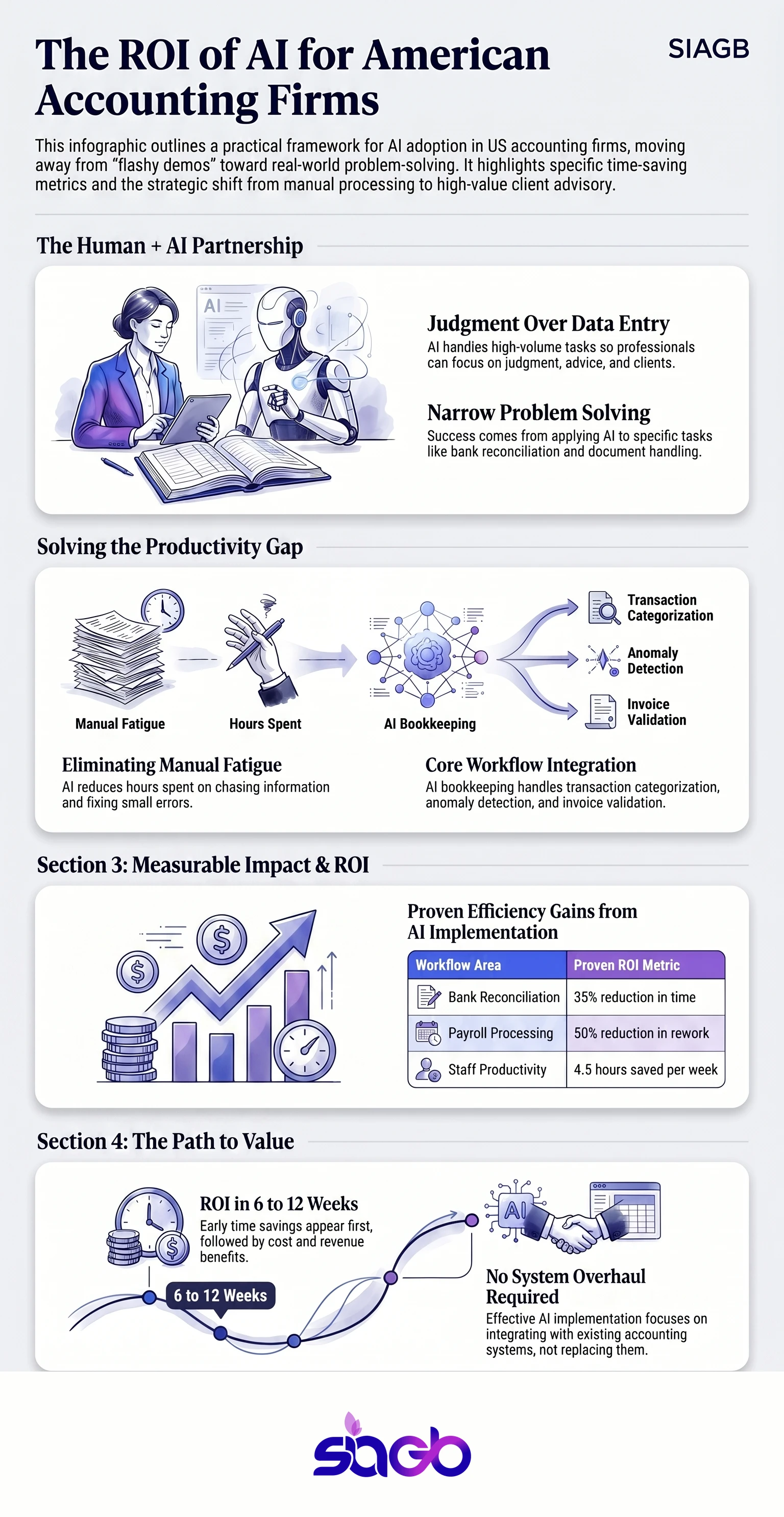
This framework shows how teams adopt AI safely. Step one is identifying high-volume tasks. Step two is piloting with clear metrics. Step three is scaling with governance and training.
It’s practical. It works. And it keeps accounting data secure.
Frequently Asked Questions
Can AI replace accountants in the USA?
No, AI replace accountants is a common fear, but it’s not reality. AI supports repetitive tasks, while accountants retain judgement, ethics, and client responsibility within the accounting profession.
Is AI safe for handling accounting data?
Yes, when designed correctly. Secure AI solutions use access controls, encryption, and audit trails to protect sensitive information for US businesses.
How long does it take to see ROI from AI?
Most teams see early results within 6 to 12 weeks. Time savings usually appear first, followed by cost and revenue benefits.
Do we need to replace our existing systems?
No. AI layers integrate with your current accounting platform. Replacement isn’t required.
Is AI suitable for small US firms?
Yes. Many US SME teams and AICPA members use AI in focused areas. Starting small reduces risk and cost.
How does AI help with audits?
AI helps auditors by flagging anomalies early, improving financial reporting quality, and reducing manual checks before formal audit work begins.
Key Takeaways for accounting firm leaders
AI for accounting firms in the USA delivers value when applied to real operational problems faced by US businesses. Smarter automation outperforms basic rules in complex workflows. Measured ROI builds confidence and supports long-term adoption.
The goal isn’t more technology. It’s better use of financial data. When teams save time, business owners get better advice. Firms grow without burning out staff.
That’s what practical AI looks like. And that’s where SIAGB helps leaders move forward.
Sources
- MIT Technology Review (technologyreview.com)
- Stanford HAI - Human-Centered AI (hai.stanford.edu)

Thinking about how this applies to your business?
Start a Conversation