
An AI implementation roadmap is a phased plan that takes a business from a clear goal to an AI system running in production. It sets the order of work: choose the use case, prepare data, skills and governance, prove it in a pilot, deploy and integrate, then scale and monitor. Each phase has an owner, a milestone and exit criteria.
When AI work stalls, the cause usually isn’t the AI technology. It stalls between steps: a pilot that never gets an owner, data that isn’t ready, or a tool nobody checks after launch. Honestly, that’s the frustrating part, because each of those gaps is visible early if someone is looking for it. Below we set out the 5 phases of an AI roadmap, a timeline table with milestones, and how Australia’s 6 essential practices for AI governance fit into each phase of your AI journey. If you’d rather build the plan with a team, our AI strategy service works through the same phases with Australian businesses.
What Is an AI Implementation Roadmap?
An AI implementation roadmap is the plan that sits between your AI strategy and the work your team does each week. The strategy answers why you’re using artificial intelligence and where it should create value. The roadmap answers what happens first, who owns it and how you know a step is finished. Two different jobs, and they’re easy to blur. We tell clients that a strategy without a plan to carry it out is just a nice document.
Microsoft’s Cloud Adoption Framework describes this kind of plan as one that “bridges the gap between AI vision and execution”, keeping each AI initiative aligned with business goals while it deals with skill gaps, resources and timelines. That’s a useful test for your own roadmap. If a line in it doesn’t connect to a business goal, it probably doesn’t belong there yet. And it’s a stricter test than it sounds.
Some teams call it an AI adoption roadmap. The label matters less than three features:
- Phases with exit criteria. Each phase ends with a decision to go on, change course or stop.
- Named owners. A person, not a team name, is accountable for each phase.
- A living document. Pilot results change the order and the dates. The same Microsoft guidance says to use proof of concept results to refine your priorities, so expect the roadmap to change after your first pilot.
What Are the Phases of an AI Implementation Roadmap?
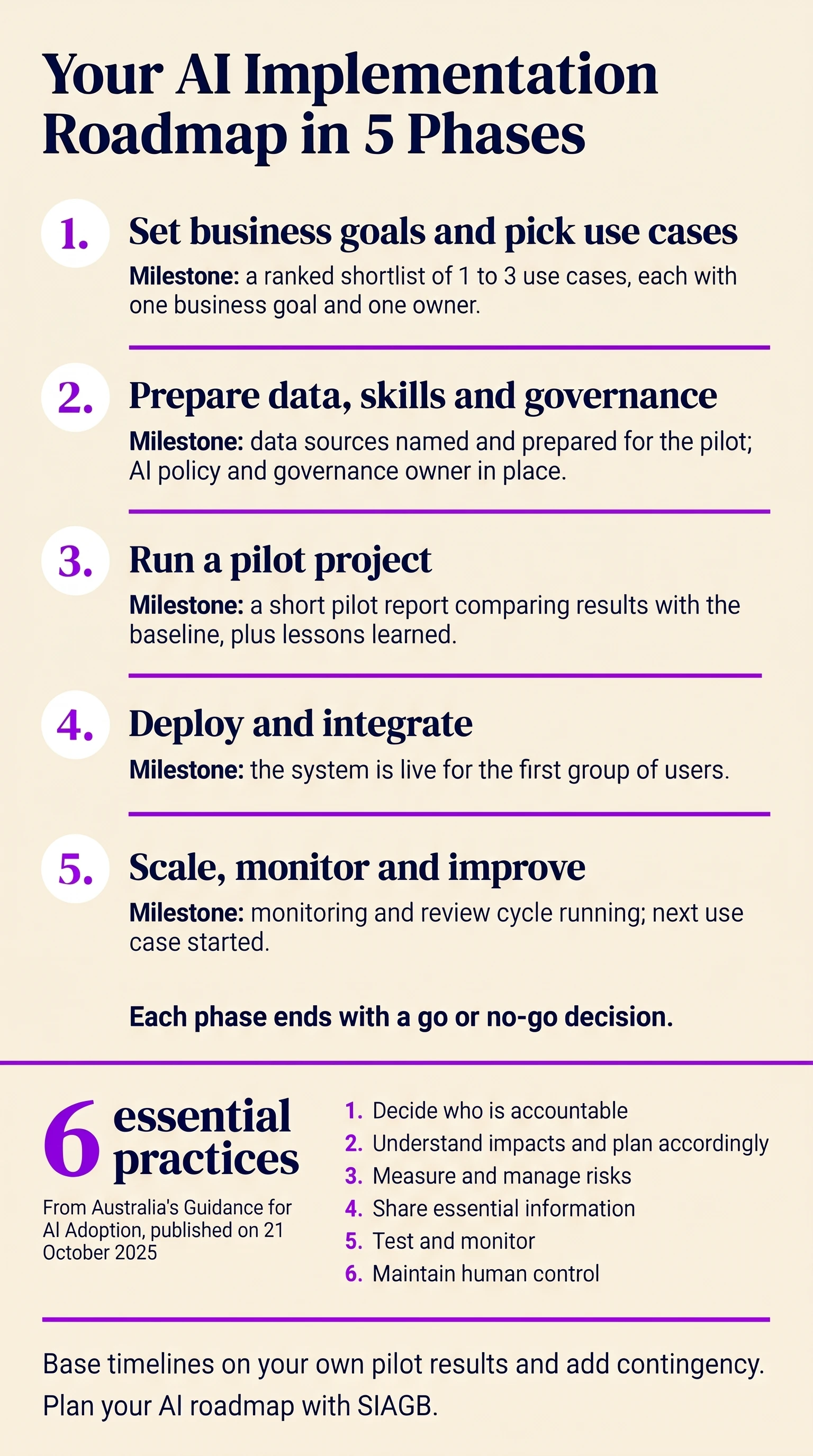
A practical AI implementation plan has 5 phases. Names vary from one framework to another, but the order tends to hold:
- Set business goals and pick use cases. Decide what problem AI should solve.
- Prepare data, skills and governance. Get the foundations ready for that use case.
- Run a pilot project. Test the idea on a small scale against agreed metrics.
- Deploy and integrate. Move the proven pilot into everyday systems.
- Scale, monitor and improve. Keep it working, then repeat with the next use case.
Each phase ends with a go or no-go decision. That way money and effort follow evidence, not enthusiasm. (Enthusiasm is useful. It just shouldn’t sign the cheques.) The sections below cover each phase in turn, with a milestone and exit criteria you can copy into your own plan.
Phase 1: Set Business Goals and Pick Use Cases

Start with business problems, not with tools. It sounds obvious. But it’s an easy step to skip, because a new tool is more fun to talk about than a slow approval process. When we start a roadmap with a team, we ask what’s slow, what’s repetitive and what costs money before anyone mentions AI. It’s the same opening we’ve used with medical groups such as Foundation Medical Group and All Health Medical, and in health the answers usually land on patient workflows and administrative tasks. Microsoft’s guidance suggests looking for places where results miss expectations or where people spend time on repetitive tasks, before you consider AI at all. Then turn each problem into a short use case statement that names the activity and the result you expect, such as “help support staff answer from internal documents so resolution time drops”.
Next, rank the candidates. Score each one on business value and on how hard it is to deliver with the people, data and systems you have today. When we rank them for a client, we add a third score: how quickly the use case shows value. A successful AI strategy usually begins with a use case in the middle: valuable enough to matter, simple enough to finish. The flashy one can wait.
For every use case on the shortlist, write one business goal you can measure. “Use AI in customer service” isn’t a goal. “Cut the time to answer a routine customer email from two days to one” is. Clear business objectives make the later phases much easier, because the pilot metrics come straight from them.
Before you commit, it helps to check whether your data, systems and team can carry the use case. That is the job of an AI readiness assessment, and our AI readiness assessment checklist walks through it. A readiness assessment doesn’t replace the roadmap. It tells you where Phase 2 needs the most work.
Milestone: a ranked shortlist of 1 to 3 use cases, each with one business goal and one owner. Exit criteria: leadership agrees on the first use case and the result it should deliver.
Phase 2: Prepare Data, Skills and Governance
Phase 2 is where most of the quiet work happens. It isn’t glamorous. It has three parts.
Data. List the data sources the use case needs, where they live, what format they are in, how clean they are and who can access them. Microsoft’s framework puts this inventory early because data quality decides which use cases you can deliver at all. A quick aside, because it catches people off guard. When we look at a business’s data, most owners find they’re sitting on more useful data than they thought. Good news, mostly. It also means more to clean before a pilot. Anyway, back to the inventory. If the data isn’t good enough, fix it now or go back to Phase 1 and pick another use case. That’s a painful call after weeks of planning, but it’s a better call now than halfway through a pilot. A simple data strategy for this one use case is enough to start.
Skills. Name the gaps. You may need someone who can manage the data, someone who can configure or build the AI solution, and someone in the business who owns the process. Each gap can be filled by training, hiring or outside help. Building AI capability inside the team pays off later, because the same people will run the next project.
Governance. The Australian Government’s National AI Centre publishes guidance on this. For organisations starting out, its foundations guidance says to assign a senior leader as the overall AI governance owner and to create an AI policy, then turn that policy into a governance framework as your use of AI grows.
Don’t skip change management. Tell the people whose work will change what’s coming, why, and who they can ask. A tool that staff don’t trust won’t get used, however well it performs. Honestly, this is the part we see underestimated most. People, not the technology, decide whether a tool sticks.
Milestone: data sources named and prepared for the pilot; AI policy and governance owner in place. Exit criteria: the pilot has data it may lawfully use and a named person accountable for it.
Phase 3: Run a Pilot Project With Clear Success Metrics

A pilot project, or proof of concept, tests whether the idea works in your business before you commit to full deployment. Microsoft’s guidance is to start with internal, non-customer-facing projects to limit risk. If the AI tool makes a mistake, a colleague catches it, not a customer. Which takes a lot of pressure off the first attempt.
Choose the type of AI to match the job. The same guidance notes that generative AI produces outputs that can vary for the same input and suits unstructured work like documents and natural language. Nongenerative AI gives consistent results from structured inputs and suits tasks like prediction, where accuracy matters most.
Set your success metrics before the pilot starts, and record the current baseline. Why before? Because once results come in, it’s tempting to pick whichever number looks good. A good set has three parts:
- Business metric: tied to the Phase 1 goal, such as hours saved or time to resolve a request.
- Quality metric: such as the share of outputs accepted without changes.
- Adoption metric: such as how many intended users still use the tool after a few weeks.
If you’re buying AI solutions rather than building them, the National AI Centre’s foundations guidance says to ask the supplier for proof that the system has been properly tested, and to test it yourself before you deploy it. That applies to pretty much every AI project, from a chatbot to a forecasting model.
Milestone: a short pilot report comparing results with the baseline, plus lessons learned. Exit criteria: a written decision to scale up, change the approach or stop.
Phase 4: Move From Pilot to AI Deployment and Integration
A pilot can run on a spreadsheet and goodwill. Production can’t. AI deployment means the system works inside the tools people already use, with proper security, access controls and support.
The biggest choice here is the AI architecture. Some use cases fit an off-the-shelf AI tool on AI platforms you already pay for. Others need custom AI development, with software development work to connect the AI model to your systems and data. Off-the-shelf usually means faster AI integration and less control. Custom work means more control and more to maintain. Neither is right everywhere, it depends on the use case and who’ll look after it. We don’t resell any platform, so when we help a client with this choice the real question is what their team can maintain. If you plan to bring in outside delivery help for this step, our guide to AI implementation in Australia explains what that work covers.
Before launch, the National AI Centre’s implementation guidance sets out clear steps: define acceptance criteria and test methods, conduct pre-deployment testing, and obtain documented deployment authorisation from the person accountable for the AI system, based on the test results. It also calls for a deployment plan that covers response, recovery and communication if a remaining risk turns into a real problem.
Roll out to one group of users first. And keep the old process available until the new one has proved itself. Yes, running two processes side by side is a bit annoying for a few weeks. It’s still worth it.
Milestone: the system is live for the first group of users. Exit criteria: acceptance criteria met, and a tested way to roll back.
Phase 5: Scale, Monitor and Improve Your AI Systems
Launch isn’t the finish line. According to the National AI Centre, AI systems can change their behaviour over time, so an AI system that worked well last month may give different answers today. That’s a slightly unsettling idea the first time you hear it. Monitoring is part of the job, not an extra.
Three habits keep AI applications healthy:
- Track the metrics. Keep measuring the pilot metrics in production and review them on a regular cycle with the people who use the system.
- Keep an AI register. Record each AI system, its purpose, owner, risks and test results in one place. The implementation guidance lists this as a core practice.
- Keep human control. Set clear points where a person can pause, override or roll back the system, and keep an alternative way to do critical work if it fails or is retired.
Then scale. Take the next use case from your Phase 1 shortlist and run it through the same phases, reusing the data work, skills and governance you have already built. Enterprise AI is rarely one big launch. We find that reassuring, to be honest. It is a series of proven use cases, each one easier than the last. That is the closest thing to a rule for successful AI implementation, and it matches the best practices in the official guidance.
Milestone: monitoring and review cycle running; next use case started. Exit criteria: none. This phase repeats for as long as the system is in use.
AI Roadmap Timeline and Milestones at a Glance
Use this table as the skeleton of your own AI roadmap. Dates are left out on purpose. Set them from your own pilot data, not from someone else’s average.
| Phase | Milestone | Owner | Exit criteria | How to set the timing |
|---|---|---|---|---|
| 1. Goals and use cases | Ranked shortlist with one business goal each | Business sponsor | First use case agreed | Fixed planning window |
| 2. Data, skills and governance | Data prepared, AI policy and governance owner in place | Governance owner and data lead | Lawful data and a named accountable person | Depends on data quality found |
| 3. Pilot project | Pilot report against baseline metrics | Use case owner | Scale, change or stop decision | Agreed before the pilot starts |
| 4. Deployment and integration | Live for the first user group | Accountable person for the system | Acceptance criteria met, rollback tested | Estimate from pilot results |
| 5. Scale and monitor | Review cycle running, next use case started | Governance owner | Repeats | Regular review cycle |
How long each phase takes depends on what you deploy. Microsoft notes that its Copilot tools typically give the shortest time to return on investment, days to weeks, while custom Azure AI and machine learning workloads need several weeks to months to reach production readiness.
How Long Does AI Implementation Take in a Business?
There’s no honest single number, which isn’t what anyone wants to hear. AI implementation time depends on the use case, the state of your data and whether you buy or build. Buying a tool that plugs into systems you already use is usually much faster than building a custom model.
The most reliable estimate comes from your own pilot. Microsoft’s guidance is to use proof of concept results to estimate timelines for each use case and to add 20-30% contingency time to initial estimates, because AI projects often need several rounds of iteration. So when implementing AI for the first time, plan for the learning as well as the build: the first use case takes longest, and later ones reuse its foundations.
What Governance Does an Australian Business Need Before Deploying AI?
On 21 October 2025, the Department of Industry, Science and Resources published the Guidance for AI Adoption, which sets out 6 essential practices for safe and responsible AI governance. The department describes it as updated and simplified guidance that evolves the earlier Voluntary AI Safety Standard and its 10 guardrails. Here is how the 6 practices map to the roadmap:
| Essential practice | Where it fits in the roadmap |
|---|---|
| 1. Decide who is accountable | Phase 2: governance owner and AI policy |
| 2. Understand impacts and plan accordingly | Phases 1 and 2: who the use case affects |
| 3. Measure and manage risks | Phase 3: risk screening before the pilot |
| 4. Share essential information | Phases 4 and 5: AI register, telling users when AI is involved |
| 5. Test and monitor | Phases 3 to 5: pre-deployment testing and monitoring |
| 6. Maintain human control | Phases 4 and 5: override points and alternative pathways |
The guidance comes in two versions: foundations, for organisations starting out or using AI in low-risk ways, and implementation guidance, for more complex or higher-risk use. Both say you don’t need to do everything at once. That’s a relief if you run a small team and you’re reading a government framework for the first time. If you also work with US clients, the NIST AI Risk Management Framework, released on 26 January 2023 and intended for voluntary use, is another framework you can use alongside it.
Why Do AI Projects Fail to Move From Pilot to Production?
According to Microsoft’s framework, one cause stands out: AI projects fail when organisations attempt implementations beyond their technical maturity or data availability. Put another way, the pilot was bigger than the foundations under it. Which is a polite way of saying someone got excited too early.
In practice, a few other patterns come up again and again:
- No success metrics set up front, so nobody can show the pilot worked.
- No owner after go-live, so the system slowly drifts and loses trust.
- Pilot data that doesn’t match real data, so results drop in production (clean sample data hides a lot).
- Integration left until the end, so the “finished” pilot needs months of extra work.
- Weak change management, so staff keep working around the new tool.
Each phase of the roadmap above has an exit check that catches one of these early. That’s the main reason to follow phases at all. Not paperwork for its own sake. Early warning.
Key Takeaways
- An AI implementation roadmap turns your AI strategy into an order of work with owners, milestones and exit criteria.
- The 5 phases are: goals and use cases, data, skills and governance, pilot, deployment and integration, then scale and monitor.
- Set business goals before you choose tools, and set success metrics before the pilot starts.
- Build governance in Phase 2, using the 6 essential practices from Australia’s Guidance for AI Adoption.
- Base timelines on your own pilot results and add contingency.
FAQ
How do you choose the first AI use case or pilot project?
Pick a problem that happens often, costs real time or money, and can be measured today. Then check that you have the data to support it and that the work is internal rather than customer-facing, so a mistake stays contained. A smaller use case that you can finish and measure beats a bigger one that stalls.
What success metrics should an AI pilot use?
Use three kinds. A business metric tied to the goal, such as hours saved per week or time to resolve a request. A quality metric, such as the share of outputs a person accepts without changes. And an adoption metric, such as how many of the intended users still use the tool after a month. Record the baseline before the pilot starts.
What is the difference between an AI strategy and an AI implementation roadmap?
An AI strategy explains why the business is using AI and where it should create value. The roadmap turns that into an order of work: which use case comes first, who owns each phase, what the milestones are and what has to be true before the next phase starts.
Is the Voluntary AI Safety Standard still the main Australian guidance?
The Department of Industry, Science and Resources published the Guidance for AI Adoption on 21 October 2025. It sets out 6 essential practices and is described as an updated and simplified version that evolves the Voluntary AI Safety Standard and its 10 guardrails. For a new roadmap, the 6 practices are the place to start.
Does a small business need a formal AI roadmap?
Not a long document, but it does need the same decisions. Even a one-page plan should name the goal, the first use case, the person accountable, the metric that decides success and how you will switch the tool off if it goes wrong. The National AI Centre’s foundations guidance is written for organisations at this stage.
Sources
- Microsoft Learn, Plan for AI adoption, Cloud Adoption Framework.
- National AI Centre, Guidance for AI adoption: foundations.
- National AI Centre, Guidance for AI adoption: implementation guidance.
- Department of Industry, Science and Resources, Voluntary AI Safety Standard: the 10 guardrails.
- NIST, AI Risk Management Framework.

Thinking about how this applies to your business?
Start a Conversation