
What AI Implementation Services Mean in Australia
AI implementation services cover the full lifecycle of an AI initiative. That includes strategy, design, software development, deployment, and ongoing optimisation using real data. In Australia, this work must align with local regulations, industry rules, and emerging expectations around responsible AI.
A strong ai consulting service starts with business problems, not tools. The goal is to improve operational efficiency, reduce risk, or open new revenue using practical solutions. AI strategy defines where AI fits, how data flows, and how ai governance supports safe use from day one.
Australian businesses also need AI solutions that respect privacy, accessibility, and security expectations. Healthcare, education, financial services, and the public sector face higher scrutiny. That changes how generative ai, automation, and data handling are designed and reviewed.
Problem-first ai consulting services reduce wasted spend. Instead of buying tools and hoping, teams assess ai readiness early, often through an ai readiness assessment, then build only what supports outcomes. From what I’ve seen, that’s where real ROI starts.
Problem-First AI Consulting Versus Tool-Driven AI
Many AI projects fail because they start with technology. Someone buys a platform. Then they look for a problem. Sound familiar?
Problem-first ai consulting flips that around. You start with a clear goal tied to data. Save staff hours. Reduce errors. Improve bookings. Strengthen customer engagement. Only then do you design an ai solution or a tailored solution that fits.
SIAGB was founded on this approach. The team delivers end to end, from ai strategy consulting to deployment, without handoffs. That matters in healthcare and financial services, where fragmented delivery creates gaps in data, accountability, and insight.
Healthcare, retail, and public sector organisations benefit most from this model. AI touches websites, customer service, operations, and security at once. A single ai consultant with deep ai expertise owning the full delivery reduces risk and improves outcomes. I’ve seen this difference play out more than once.
AI Implementation for Healthcare Websites and Accessibility
Healthcare website accessibility is not optional. A wcag healthcare website ensures patients can book, read, and interact regardless of ability. An ada compliance medical website also reduces legal risk for practices serving international patients.
AI helps by automating audits, testing, and ongoing monitoring. Machine learning tools scan content, code, and user flows using real data. Issues are flagged early, before they affect patients or search visibility.
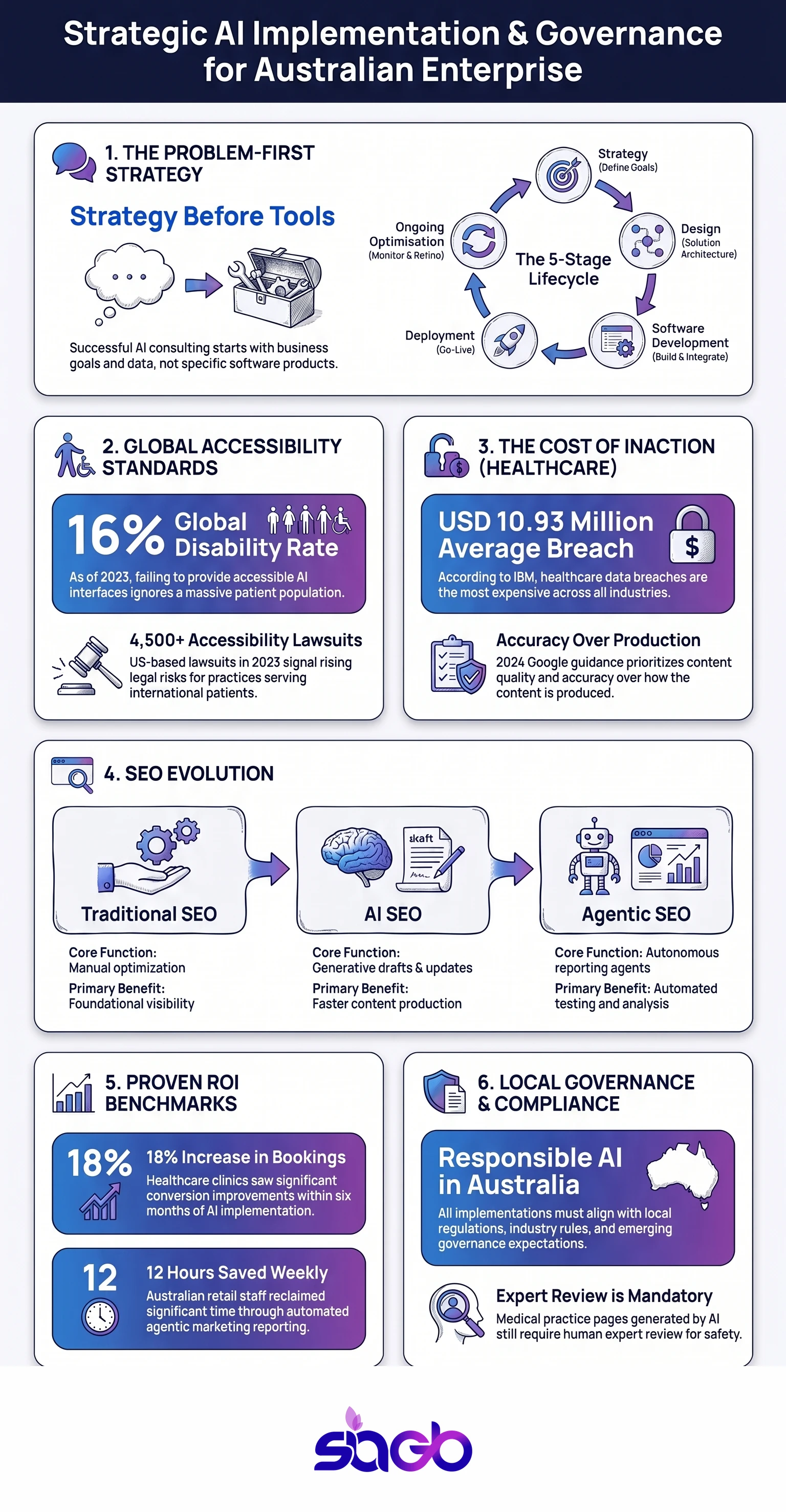
Accessibility also affects trust. Patients who struggle to use a site often leave. That hurts bookings and reputation. According to the World Health Organisation, about 16 percent of the global population lived with a disability as of 2023. That’s a big group to ignore.
AI delivery here must include clear ai governance. AI can assist, but responsibility stays with the provider. That balance between automation and accountability is key in healthcare website accessibility.
ADA and WCAG Risks for Medical Practices
ADA website lawsuit activity has increased globally. Doctors and clinics face claims when sites or portals block access for users with disabilities. This includes booking forms and patient portals.
An ada compliant patient portal must support screen readers, keyboard navigation, and clear content structure. AI-assisted testing helps find issues using real user data, but it doesn’t remove accountability.
In the United States, accessibility lawsuits exceeded 4,500 cases in 2023, according to UsableNet. Australian practices serving international patients should pay attention. Responsible AI means using automation to reduce risk, not ignoring it.
AI SEO, AEO, and Agentic SEO for Healthcare
Traditional SEO focuses on keywords and links. That’s no longer enough. AI-driven search engines now surface answers, not pages. AI SEO healthcare strategies respond to this shift using structured data and clear explanations.

Answer engine optimisation medical content helps practices appear in AI summaries and voice results. It relies on data analytics, accurate content, and clear review processes. Healthcare seo strategy must also manage risk, especially with generative ai content.
Generative AI can assist with drafts and updates, but controls matter. AI content medical practice pages still need expert review. According to Google Search Central guidance updated in 2024, quality and accuracy matter more than how content is produced.
Here, generative ai becomes a generative ai solution only when paired with human oversight. Data sources, review steps, and update cycles must be defined. That’s how visibility improves without harming trust.
From AI SEO to Agentic SEO
Agentic SEO uses AI agents to monitor, test, and optimise continuously. Each ai agent tracks rankings, content performance, and technical issues using live data.
Automated seo agents reduce manual effort. They run checks daily, not quarterly. But healthcare needs tighter controls than retail. Custom ai agents must follow rules set by ai governance teams.
Agentic ai for marketing works best when humans stay in the loop. AI proposes changes. Teams approve. That balance supports responsible AI while scaling optimisation and insight.
Modern Medical Website Design with AI Optimisation
A modern medical website must be fast, accessible, and secure. Design alone isn’t enough. AI supports content optimisation, behaviour analysis, and conversion tracking using real data.
Medical practice website design now intersects with SEO, accessibility, and security. Healthcare website redesign projects often fail when these teams work in silos. AI services help connect them and turn data into actionable insights.
Generative ai tools can assist with layout testing and content variations. Automation tracks what patients click, where they drop off, and what converts. That insight guides updates over time and improves operational efficiency.
A modern medical website is never done. Ongoing optimisation, backed by data and clear oversight, keeps it compliant and effective.
Patient Reviews, Reputation, and Recall Systems
Online reputation healthcare outcomes matter. Patients check reviews before booking. Google reviews medical practice scores directly affect trust and customer engagement.
AI can automate patient review management. Systems send review requests, analyse sentiment, and flag issues using data analytics. Automation saves staff time while improving consistency.
Patient recall systems also benefit. AI schedules reminders based on visit history and risk factors, using secure data. Privacy rules still apply. AI deployment must avoid exposing personal details.
Reputation management doctors rely on balance. Automation helps, but human judgement stays critical.
Healthcare Cybersecurity and AI Deployment
AI systems increase the attack surface if poorly designed. Healthcare cybersecurity threats include ransomware, phishing, and data leaks. Medical practice data security must guide every AI system decision.
HIPAA cybersecurity principles influence global healthcare AI projects. Access controls, encryption, and audit logs are essential. AI integration must respect these controls across software development and operations.
According to IBM’s 2024 Cost of a Data Breach Report, healthcare breaches averaged USD 10.93 million per incident. That surprised me, honestly. It shows why cybersecurity for doctors can’t be an afterthought.
Responsible AI includes security by design. Clear ai governance defines who can access data, how models learn, and how incidents are handled.
End-to-End AI Delivery Examples
Healthcare example. A multi-site clinic combined healthcare website redesign, AI SEO, and accessibility audits. Automation reduced content update time by 40 percent. Booking conversions improved by 18 percent within six months, based on internal data.
Retail example. An Australian retailer used ai automation and agentic ai for marketing. An ai expert helped deploy reporting agents that handled testing and analysis. Marketing staff saved 12 hours per week. Revenue from organic search grew steadily.
These outcomes came from end-to-end delivery. Strategy, ai development, deployment, and optimisation stayed connected. That’s where ai consulting for retail businesses and healthcare delivers value.
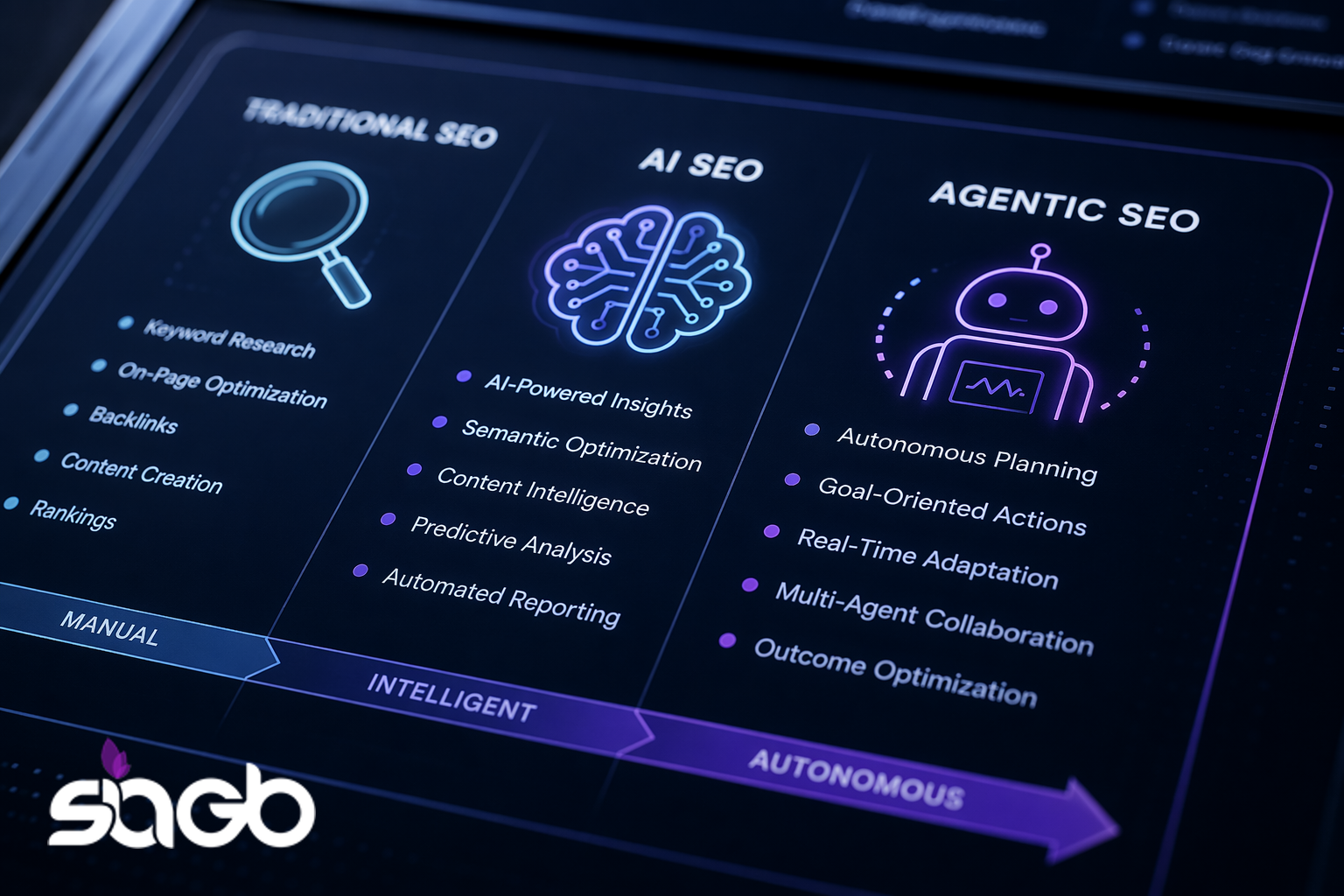
Infographic: Traditional SEO vs AI SEO vs Agentic SEO
Traditional SEO relies on manual updates and periodic reviews. AI SEO uses automation and structured data to support answer engines. Agentic SEO adds continuous optimisation through AI agents.
The table below summarises how these three approaches differ across the areas that matter most for medical practices.
| Approach | How it works | Update cadence | Oversight needed | Best starting point |
|---|---|---|---|---|
| Traditional SEO | Manual updates focused on keywords and links | Periodic reviews | Low | Established sites with basic needs |
| AI SEO | Automation and structured data to support answer engines | Frequent | Moderate, with expert content review | Most Australian businesses |
| Agentic SEO | AI agents monitor, test, and optimise continuously | Continuous | High, with human-in-the-loop approval | Teams with mature controls and ai governance |
For medical practice seo, compliance increases with each step. Most Australian businesses start with AI SEO, then scale once ai capabilities and controls mature.
Choosing an AI Partner in Australia
Choosing the right partner matters. Look for proven delivery, not just strategy decks. Ask about real users, ai expertise, and long-term support.
Healthcare and public sector experience reduces risk. Accessibility, data security, and ai governance aren’t side issues. They shape every AI system decision.
SIAGB delivers ai implementation services australia with end-to-end ownership. From ai strategy consulting and ai training to custom ai agents and full ai development, the focus stays on outcomes, not hype. Backed by deep expertise, the team acts as a trusted ai expert for growing organisations.
Frequently Asked Questions
What are AI implementation services in Australia?
AI implementation services in Australia cover strategy, build, deployment, and optimisation of AI systems. They focus on measurable outcomes using secure data and clear oversight.
How does AI affect healthcare website accessibility?
AI supports WCAG testing, monitoring, and content checks. Healthcare providers still remain accountable for accessibility and compliance.
What is an AI readiness assessment?
An ai readiness assessment reviews data quality, systems, skills, and risk before starting an AI initiative. It helps teams avoid costly mistakes.
Is AI SEO safe for medical practices?
Yes, when done with strong controls. AI SEO healthcare strategies must prioritise accuracy, review, and responsible AI use.
What is agentic SEO and is it suitable for healthcare?
Agentic SEO uses AI agents for continuous optimisation. It suits healthcare when audits, controls, and human oversight are in place.
Key Takeaways
AI delivery works best when tied to real business problems. Healthcare AI must balance accessibility, SEO, data security, and ai governance. End-to-end delivery improves operational efficiency and reduces risk. Problem-first ai consulting, supported by strong expertise and clear insight, helps Australian businesses move from hype to results.
Sources
- MIT Technology Review (technologyreview.com)
- Stanford HAI - Human-Centred AI (hai.stanford.edu)

Thinking about how this applies to your business?
Start a Conversation