An AI optimized website for an aesthetic clinic is designed to answer real patient questions, guide skin care choices, and drive bookings while staying compliant. For clinics like RevivalMD, the payoff is safer growth, clearer communication, and stronger trust. The right setup supports healing, protects data, and helps each person feel confident booking an appointment.
Look, most clinics already have a modern medical website. But many still struggle with inquiries, visibility, or legal risk. Sound familiar? In our work at SIAGB, the gap is rarely design. It is structure: pages that a physician trusts, that Google can rank, and that ChatGPT and Perplexity can cite word for word.
Introduction: Why Clinic Websites Must Do More Than Look Good
Aesthetic and medical clinics rely on their website for trust, bookings, and first impressions. Clients check services, read about skin concerns, and decide if they’ll book treatment. If the site feels unclear or risky, they leave. Fast. Google’s own Core Web Vitals thresholds set the bar here: Largest Contentful Paint under 2.5 seconds, Interaction to Next Paint under 200 milliseconds, and Cumulative Layout Shift under 0.1. Miss those and both rankings and bookings slip.
Many clinic sites fail for basic reasons. Poor accessibility locks people out. Weak SEO hides services. Compliance gaps create stress no one needs. All of this hurts performance, even when treatments are excellent. For instance, a booking button that only works with a mouse fails WCAG 2.2 keyboard rules, and that single gap can trigger an ADA Title III demand letter.
This guide explains how AI optimized healthcare websites support growth without shortcuts. It looks at medical practice website design that balances trust, performance, and safety. For a practice like RevivalMD Aesthetic Clinic, the website isn’t just marketing. It’s part of primary care and patient attention from the first click.
What an AI Optimized Medical Website Really Means

An AI optimized website healthcare platform is built around patient needs. Not buzzwords. It uses data to understand what people ask about skin, the body, and treatment options. Then it answers those questions clearly, with medical oversight. Under the hood it leans on schema.org types such as MedicalClinic, MedicalProcedure, Physician, and FAQPage, so a search engine reads a laser hair removal page as a specific procedure rather than plain text.
This approach blends SEO, accessibility, analytics, and automation. AI content medical practice tools help explain services in plain language. That matters when people compare options and worry about wrinkles, skin texture, or laser outcomes. Here is a concrete example of what changes:
| Website element | Legacy clinic site | AI optimized clinic site |
|---|---|---|
| Search visibility | Keyword pages only, ranks on Google | Structured answers cited by Google AI Overviews, ChatGPT, Perplexity, and Gemini |
| Accessibility | No formal standard | WCAG 2.2 Level AA, keyboard and screen reader tested |
| Speed | LCP over 4 seconds on mobile | LCP under 2.5 seconds, INP under 200 ms |
| Structured data | None | schema.org MedicalClinic, MedicalProcedure, FAQPage |
| Security | Basic SSL only | HIPAA aligned forms, encrypted patient portal |
| Content upkeep | Manual, quarterly | Agentic AI review, checked weekly |
Honestly? AI works best when it stays in the background. It improves structure and flow without shouting. Clients just feel the site is easier to use. They find the right laser or facial treatments faster. They book an appointment with less friction.
The goal isn’t hype. It’s accuracy, speed, and trust. Especially in aesthetic medicine.
Healthcare SEO Strategy for Clinics and Aesthetic Practices
Healthcare SEO strategy goes beyond keywords. It’s about intent. People search by concern, not jargon. Think unwanted hair, skin type, or adult acne.
Medical practice SEO must show trust. Clear service pages, practitioner profiles, and local signals all matter. So does accuracy. AI helps keep content current and compliant, which saves time and supports a clear treatment plan.
Here’s what tends to work best for clinics like RevivalMD:
- Clear explanations of advanced aesthetic treatments and expected results, for example what to expect across a 6 to 8 week laser hair removal course
- Local relevance for Rahway and surrounding areas, tied to a Google Business Profile and LocalBusiness schema
- Signals of medical expertise, years in practice, and physician oversight, mapped to Google’s E-E-A-T guidance
From what I’ve seen, clinics that put healing and safety as a priority perform better. Inquiries improve. It’s not magic. It’s structure. We track this the plain way: form completions and calls in Google Analytics 4, not vanity traffic.
Answer Engine Optimization and AI SEO in Healthcare
People now ask AI tools questions about skin and care. Not just Google. Answer engine optimization medical content is built for this shift. In practice that means writing a direct 40 to 60 word answer under each question heading, so ChatGPT, Perplexity, and Google AI Overviews can lift it cleanly.
AI SEO healthcare focuses on clear answers. Short sections. Accurate facts. This makes it easier for AI tools to cite a clinic as a trusted source rather than a competitor.
Thing is, medical content needs precision. A wrong answer damages trust. A clear one builds it. That’s why AI optimization must include review by a physician or board certified medical team. Especially in aesthetic medicine.
Agentic SEO and Automated AI Agents for Continuous Growth
Agentic SEO uses AI agents for SEO that work in the background every day. They monitor pages, update content, and track changes in behavior. Automated SEO agents don’t replace people. They support them.
This matters because questions change. Algorithms change too. Agentic SEO adapts without waiting months for a refresh.
I’ve seen clinics gain steady results this way. Not spikes. Steady improvement. It’s calmer. More predictable. Probably better for sleep.
ADA and WCAG Compliance for Healthcare Websites
Healthcare website accessibility isn’t optional. Accessibility laws apply to clinics, portals, and booking systems. WCAG healthcare website standards show how to meet them. The working target for United States clinics is WCAG 2.1 and 2.2 at Level AA, the same bar courts reference under ADA Title III and Section 508.
Accessible design helps everyone. Larger text. Clear labels. Keyboard navigation. WCAG 2.2 Level AA calls for a color contrast ratio of at least 4.5 to 1 on body text, visible focus indicators, and touch targets of at least 24 by 24 pixels. People with vision or mobility needs can then access skin care information without friction.
Non compliance increases risk. Legal, reputational, and ethical. And yes, accessibility also improves SEO and conversion. Funny how that works, but a keyboard-navigable menu is exactly what a screen reader and a search crawler both need.
Reducing Legal Risk from ADA Website Lawsuits
ADA website lawsuit doctors face real exposure. Thousands of ADA Title III web accessibility cases are filed in United States federal courts each year, and clinics with inaccessible sites are often targeted, including revive aesthetic clinic style practices.
An ADA compliance medical website audit reduces this risk. It checks the site against the 50-plus WCAG 2.2 Level AA success criteria, then fixes barriers and improves usability at the same time.
The bonus? A better experience for every person who visits the site. Accessibility isn’t just protection. It’s good medicine.
HIPAA Compliance and Cybersecurity for Medical Websites
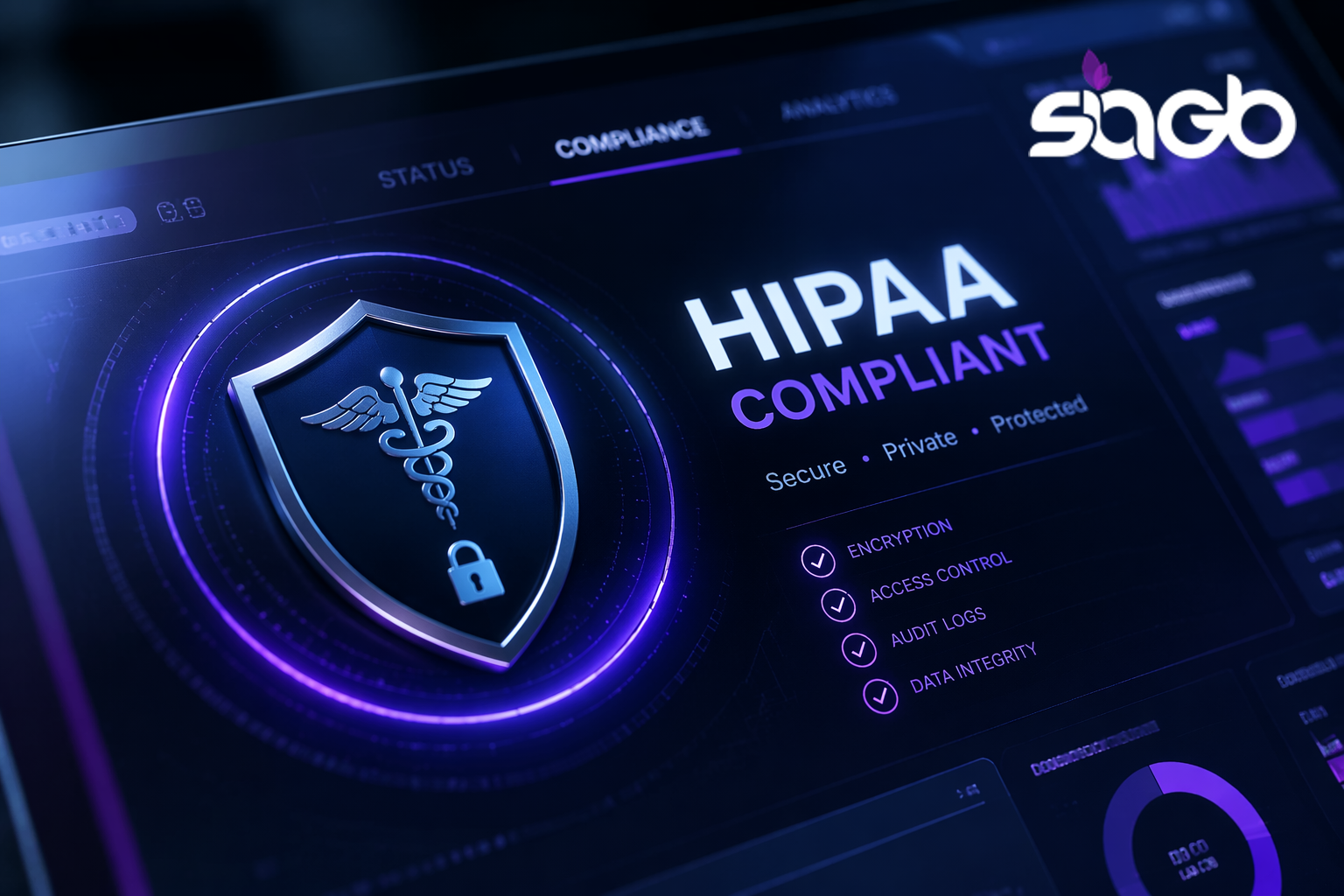
A HIPAA compliant website protects data shared through forms and portals. Medical practice data security is part of trust and part of care. In practical terms that means TLS 1.2 or higher on every form, encryption of protected health information at rest, and a signed Business Associate Agreement with any vendor that touches patient data.
Healthcare providers face growing threats. Ransomware. Phishing. Data leaks. Healthcare has ranked as the most breached sector in the United States for over a decade, and a HIPAA breach can carry civil penalties into the millions of dollars. People notice breaches. And they remember.
Security isn’t just an IT issue. It’s part of the overall experience. A secure site feels safe. That supports treatment decisions.
Common Healthcare Cybersecurity Threats Explained Simply
Healthcare cybersecurity threats often start small. A fake email. An outdated plugin. A weak password.
Cybersecurity for doctors doesn’t need to be complex. Basic protections stop most attacks:
- Secure hosting
- Regular updates
- Encrypted patient portals
Patient portals are high value targets. Protecting them protects trust. Simple as that.
Website Design That Builds Trust and Increases Bookings
Healthcare website redesign should reduce friction. Clear menus. Fast pages. Simple booking paths.
Good medical practice website design supports clarity. People reading about laser hair removal or advanced laser technology need guidance. They need to feel seen, not sold to. Compared with a brochure site, a booking flow of 3 steps or fewer, with pricing visible before the form, removes the friction that sends people to a competitor.
Speed, accessibility, and clear calls to action all help. People stay longer. They book sooner. It just feels easier. In our experience, pairing a sub-2.5-second load time with one clear primary action per page does more for bookings than any redesign of the color palette.
Online Reputation, Reviews, and Patient Recall Systems
Google reviews medical practice visibility shapes choice. People read reviews before booking treatment. Almost always.
AI helps manage reviews. It prompts feedback and suggests responses. This keeps tone consistent and highlights strengths without sounding scripted.
A recall system brings people back. Follow ups for skin treatments, laser sessions, or IV therapy improve continuity. And outcomes. Both matter.
AI Chatbots, Analytics, and Inquiry Insights

AI chatbots answer questions about skin type, pricing, and what to expect. They capture inquiries after hours, when roughly 1 in 3 healthcare searches happen outside clinic hours, which clinics appreciate.
Analytics show patterns. What confuses people? What services get the most attention? We analyze Google Analytics 4 events, scroll depth, and on-site search to see exactly where a visitor hesitates, then fix that page rather than guess.
These insights improve content and services. It’s quiet feedback, but powerful.
Case Context: RevivalMD Aesthetic Clinic
RevivalMD Aesthetic Clinic in Rahway serves adults seeking safe, physician led aesthetic medicine. The clinic is located at 1531 Irving St Rahway and supports clients from Rahway and nearby areas, including neighboring towns.
Services include laser hair removal, facial treatments, and IV therapy, all delivered with medical expertise. Each treatment plan is built around the person, their unique needs, and their goals for skin and body health.
The clinic is led by Dr Haroon Arshad and Sanna Arshad, supported by a physician assistant and a board certified medical team. That structure matters. It shows why RevivalMD stands out from a typical revive aesthetic clinic model.
How SIAGB Delivers AI Native Healthcare Consulting
SIAGB is an AI consulting company founded in 2022, based in Sydney under ABN 16 659 507 178. Founder Sheetal Dhadial brings more than 20 years of IT and AI leadership to regulated industries like healthcare, and holds Certified Scrum Master and AgilePM credentials.
The approach is problem first. Not tools first. SIAGB delivers end to end, with no handoffs. That level of attention matters in medical settings. We have built AI-powered patient scheduling for medical groups, and our Marvel PTE platform now serves more than 85,000 users across 900-plus institutes, so the same reliability engineering carries straight into a clinic site.
Experience spans healthcare, education, and data driven platforms. The same principles apply. Reduce risk. Measure impact. Build systems that last.
Infographic: How AI, SEO, and Compliance Work Together
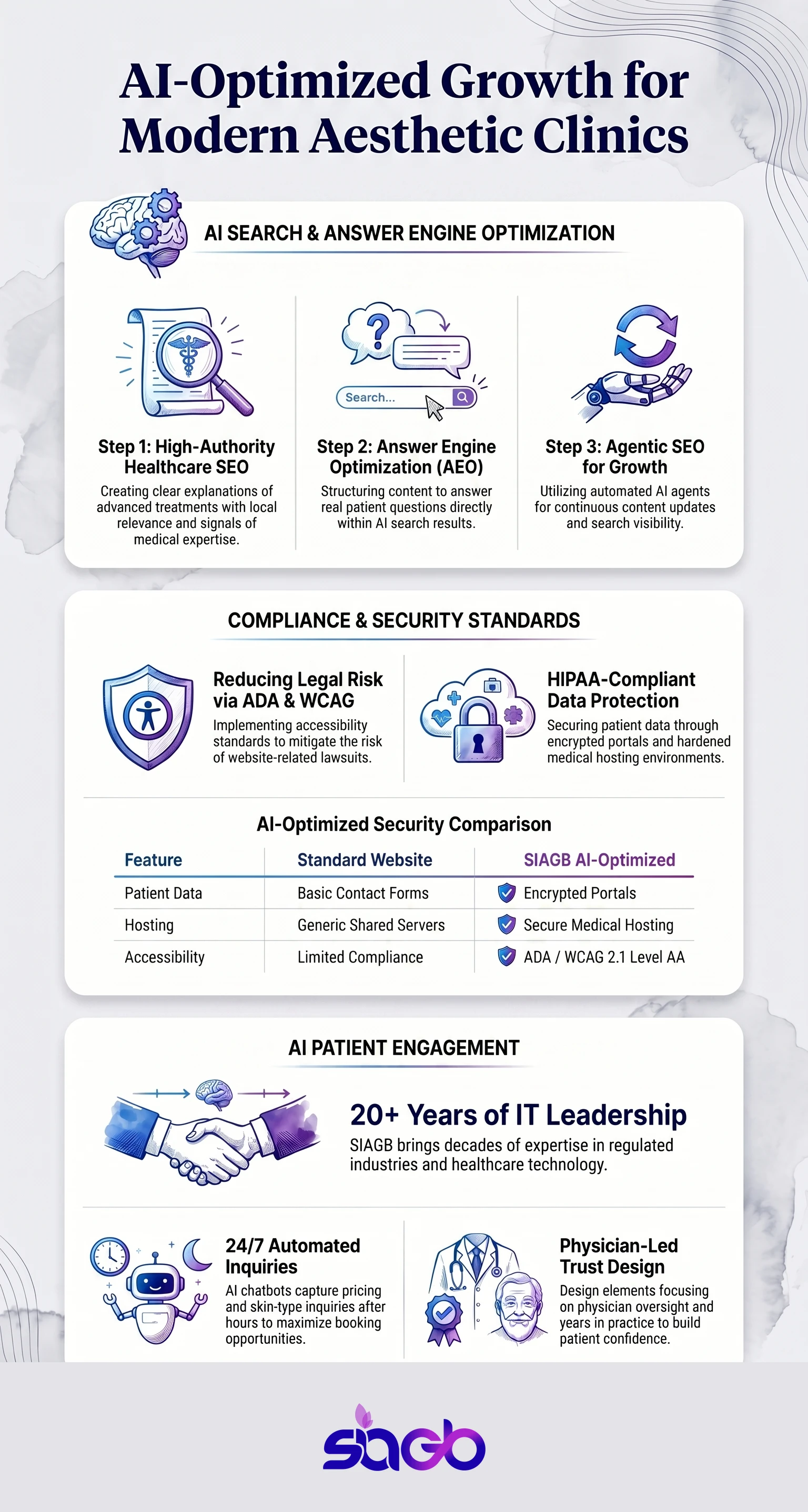
This infographic highlights how AI SEO automation, accessibility, and security connect. It maps the journey from search to appointment.
It also shows continuous improvement using agentic AI. SEO, AEO, and compliance working together. Not in silos.
Frequently Asked Questions
What is an AI optimized website for an aesthetic clinic?
An AI optimized website uses data and automation to improve clarity, accessibility, and visibility. It helps people find skin care information and book treatment with confidence.
Do clinics need ADA and WCAG compliance?
Yes. WCAG healthcare website standards reduce legal risk and improve usability for everyone, including international visitors.
How does AI SEO help medical practices?
AI SEO healthcare strategies structure content for search engines and AI tools. This increases visibility and trust over time.
Are patient portals high risk for cyber attacks?
Yes. Patient portals are valuable targets. Strong security reduces most risks.
How long does a healthcare website redesign take?
Most projects take weeks, not months. Timing depends on content, compliance needs, and integrations.
Key Takeaways and Final Thoughts
Clinic websites must balance growth, trust, and compliance. Aesthetic medicine depends on clarity, especially around skin and results.
For clinics like RevivalMD, AI works best when it’s built into strategy from day one. Not bolted on later.
The right approach reduces risk, supports healing, and improves inquiries. And it shows people they’re in safe hands. Something to think about.
Sources
- American Academy of Dermatology (aad.org)
- American Society of Plastic Surgeons (plasticsurgery.org)
Want to explore this further?
Book a Free Consultation