AI search SEO is the work of keeping your pages findable and quotable when a search engine answers with an AI summary before it shows any links. That covers Google AI Overviews, AI Mode, ChatGPT search and other answer tools built on artificial intelligence.
For Australian businesses, the change is recent, and a little unsettling if search has been a steady source of customers. AI Overviews went Australia wide in October 2024, and AI Mode arrived a year later. Below, we look at how these answers are built, what differs from traditional SEO, what to change on your site and how to measure the results. If you’d rather have a team check your site against all of this, every engagement with our AI SEO service begins with a free AI visibility audit.
What Is AI Search SEO?
AI SEO, in plain terms, means making sure the pages people need are crawlable, indexed, clear and trustworthy. Then a search engine can use them as a supporting link inside an AI summary, not only as a blue link further down.
Google’s view is short. In its guide to generative AI features, Google says optimising for generative AI search is “optimizing for the search experience, and thus still SEO.” The same guide calls AEO and GEO terms you may see for work aimed at visibility in AI search. It also suggests reading its advice on third-party SEO help before you pay for “AEO” or “GEO” services. That’s a relief for most teams, because the work you’ve already done still counts.
So what changes? Mostly the way results are shown. The SEO practices underneath them stay the same.
You will see a few names for this work in digital marketing:
- Answer engine optimisation (AEO) focuses on pages that give a direct, quotable answer. Our guide to what answer engine optimisation is covers it in full.
- Generative engine optimisation (GEO) focuses on how AI tools that write answers choose sources to cite. Read more in our piece on generative engine optimisation.
- AI search optimisation is the broad term. US guides spell it AI search optimization.
Whatever the label, the job is the same. Help search engines understand your content and trust it enough to show it.
When Did AI Overviews and AI Mode Arrive in Australia?
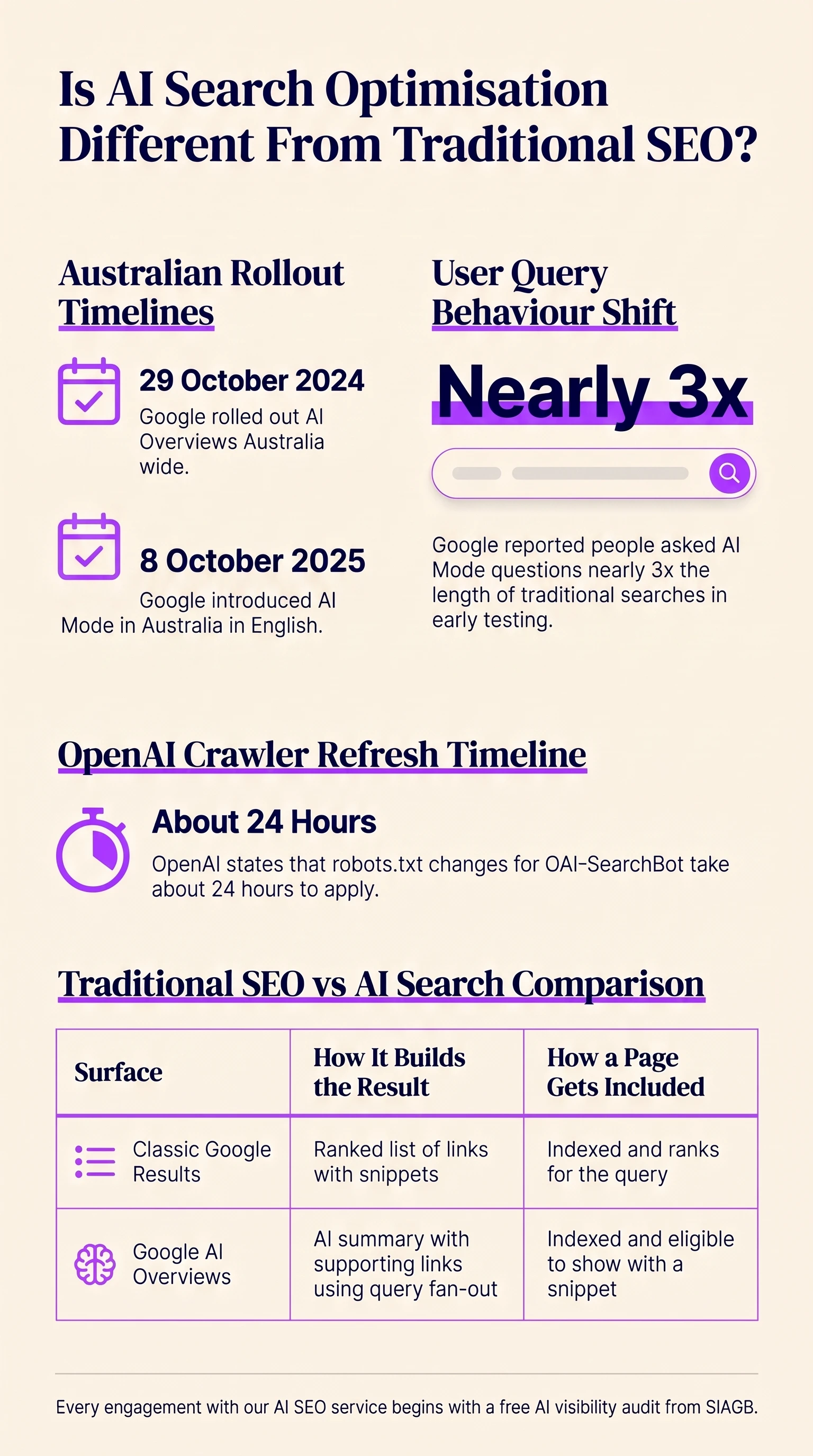
AI Overviews launched first in the US. Google then tested them in Australia before it announced, on 29 October 2024, that it was rolling out AI Overviews Australia wide. In the same post, Google said people who use AI Overviews are “more satisfied with their results”. That is Google’s claim about its own product, not an independent finding.
The next step came almost a year later. In October 2025, Google brought AI Mode to Australia in English. Google AI Mode is a conversational view of Google Search. You ask a question, get a written answer, then ask follow-ups. Google says it runs on “a custom version of our advanced Gemini models”, so Google Gemini sits under the hood.
Google also shared one figure from early testing. It said people asked AI Mode questions “nearly 3x the length of traditional searches”. Again, that’s Google’s number.
What does that mean for a local business? A Google AI Overview now often sits above the organic search results for questions in your field. And people type longer, more specific questions with follow-ups. Take a plumber in Parramatta as an example. They might once have aimed at “blocked drain plumber”. A customer could now ask what causes a blocked drain after heavy rain, and whether it’s an emergency. Your pages need to answer the real question, not just repeat one short keyword.
How Does AI Search Work Behind the Answer?

Each AI search platform works a little differently, but Google’s version follows a clear pattern. Generative AI writes the summary. Before it writes anything, the search system finds pages to ground the answer in.
Google calls the key step query fan-out. In its Australian post, Google says AI Mode uses “a query fan-out technique, breaking your question into subtopics and issuing a multitude of queries”. On its AI features page, Google says AI Overviews and AI Mode may both use this technique.
Here is why that matters. One question can pull in pages that rank for related sub-questions, not only for the exact phrase typed. A site that covers a topic in depth usually has more ways to be picked up than a site with one thin page.
So which pages are eligible? Google’s rule is plain. To show as a supporting link, a page “must be indexed and eligible to be shown in Google Search with a snippet”. Then it adds: “There are no additional technical requirements.” Google also says that meeting these rules doesn’t guarantee a page will be crawled, indexed or served.
That’s the honest picture of AI powered search on Google. Nobody outside Google knows the exact AI algorithms or ranking signals behind each summary. Treat any claim of a secret ranking factor with caution.
AI driven search outside Google works in its own way. ChatGPT and other AI chatbots use their own crawlers and their own AI models, so the next section looks at them separately.
How Do ChatGPT and Other AI Search Engines Find and Cite Websites?
ChatGPT search is one of the AI search engines outside Google. OpenAI publishes its crawler rules, and one line matters most. OpenAI says OAI-SearchBot “is used to surface websites in search results in ChatGPT’s search features”. It also says sites that opt out of OAI-SearchBot will not be shown in ChatGPT search answers.
OpenAI runs a second crawler, GPTBot, for model training. The two are separate robots.txt settings. A site can allow OAI-SearchBot and still block GPTBot. OpenAI also notes that robots.txt changes take about 24 hours to apply.
That gives you a quick first check. Before you blame your content for missing AI answers, read your robots.txt file. Then check any firewall or hosting rules that block bots. A security setting can block AI crawlers without anyone meaning it to. It’s a frustrating thing to discover late, so check it early.
Other AI search engines publish their own crawler documentation. Read each one for the bots it uses. Be wary of anyone who claims to know how those tools rank or cite pages, because the companies don’t publish that.
This page keeps ChatGPT to one section. For the step by step version, see how to appear in ChatGPT.
How Is AI Search Optimisation Different From Traditional SEO?
The foundations are shared. The presentation is what changes.
Featured snippets were the first taste of answers on the results page. A single box quoted one page. AI answers take that idea further, with a written summary and several supporting links. Here is how each surface finds and shows pages in Australia.
| Surface | Launched in Australia | How it builds the result | How a page gets in | Where you see the data |
|---|---|---|---|---|
| Classic Google results | Long established | Ranked list of links with snippets | Indexed and ranks for the query | Search Console Performance report |
| AI Overviews | 29 October 2024 | AI summary with supporting links; may use query fan-out | Indexed and eligible to show with a snippet | Search Console Performance report, “Web” search type |
| AI Mode | 8 October 2025 (English) | Conversational answers with follow-ups; query fan-out | Same rule as AI Overviews | Search Console Performance report, “Web” search type |
| ChatGPT search | See OpenAI’s own documentation | Answers with links to sources | OAI-SearchBot allowed in robots.txt | Not in Search Console; check answers by hand |
What stays the same. Traditional SEO still decides whether a page can appear at all. Crawlable pages, clean indexing, helpful content and links from trusted sites all carry over. Classic links also still appear below the AI summary.
What shifts. Some simple questions can be answered on the results page, so a quick fact alone may earn fewer clicks. Pages that win the click tend to offer something a summary can’t: depth, a tool, local detail, prices you can confirm, or first-hand experience.
Here is the difference between traditional SEO and AI search work in one line. Traditional SEO asks, “Will this page rank?” AI search work also asks, “Will this page be a useful source inside an answer?” Good traditional SEO is still the way to get there.
Treat AI search results as one more surface on top of traditional search, not a replacement. The traditional SEO basics remain the entry ticket.
Do You Need Special Optimisation or an llms.txt File to Appear in AI Search?
No, not for Google. Google states it directly on its AI features page: “There are no additional requirements to appear in AI Overviews or AI Mode, nor other special optimizations necessary.”
The same page goes further. You “don’t need to create new machine readable files, AI text files, or markup to appear in these features.” Google also says there is no special schema.org structured data to add.
What about llms.txt? According to Google’s optimisation guide, these files neither harm nor help you in Google Search, “as Google Search ignores them”. Keeping one for other services is fine. Google also says you don’t need to break your content into tiny “chunks” for AI.
For transparency, SIAGB’s own site keeps an llms.txt file for other services. We don’t claim any search engine uses it to rank or cite pages, and you shouldn’t expect one to.
So where should the effort go? Into the basics that decide eligibility, plus the local changes in the next section. Any provider who sells AI content files as a shortcut to AI search is selling something Google says it doesn’t need.
What Should Australian Businesses Change for AI Search?

Start from the Australian Government’s own baseline. The business.gov.au guide to improving your search engine rankings sets out six steps:
- Understand how your online customers search.
- Use relevant keywords, and don’t overuse them. Content should read naturally.
- Update your content regularly.
- Get linked on other websites.
- Use meta tags.
- Stay up to date with the latest SEO techniques, because search engines change how they rank results.
Those steps still hold. On top of them, a sound SEO strategy for AI search adds four checks.
Technical SEO. Make sure the pages you want seen are indexable and allowed to show snippets. Set robots.txt rules for AI crawlers on purpose. For example, you can allow OAI-SearchBot while blocking GPTBot. Google-Extended is a separate control. It limits AI training and grounding in some of Google’s other systems, while robots.txt rules for Googlebot remain the control for Search.
Local SEO. Keep your Google Business Profile current, with the right hours, services and service areas. Google’s AI features page also advises keeping Merchant Center details up to date if you sell products. Wrong details in either place can flow into AI answers about your business.
Content. Answer the longer questions customers ask, in plain language. Google’s helpful content guidance asks you to make clear the Who, How and Why behind each page. Show who wrote it, how it was made and why it exists.
Preview controls. Google names nosnippet, data-nosnippet, max-snippet and noindex as the controls that limit what shows from your pages in Search, AI features included. Use them only where you mean to limit what shows.
One more thing changes: brand mentions. When customers, local news or industry sites talk about you, it builds the trust that every search engine looks for. Earn those mentions through real work, not paid placements.
Does Publishing Lots of AI Content Help You Rank in AI Search Results?
No. Google is clear that generating many pages without adding value “may violate Google’s spam policy on scaled content abuse”. Its guidance on generative AI content asks you to “focus on accuracy, quality, and relevance” instead.
Google also explains why AI output needs checking. Generative models “don’t retrieve facts, but predict a likely sequence of words”. A draft can sound sure of itself and still be wrong.
The optimisation guide adds one more warning. Building separate pages for every fan-out question, mainly to manipulate rankings or AI responses, falls under the same spam policy.
So how should you use AI? Treat it as a helper, not an author. In practice, AI tools are good for research, outlines, first drafts and spotting gaps in existing content. A person should then check every fact, add first-hand detail and decide what deserves to be published.
How Can You Measure Your AI Search Visibility?
Start with official data. According to Google, sites that appear in AI Overviews and AI Mode are included in the Performance report in Google Search Console, under the “Web” search type. Google’s optimisation guide also points to the Generative AI performance report in Search Console for its AI features.
Bing Webmaster Tools is Microsoft’s official tool for site owners, so set it up as well.
Official reports won’t show everything, so add a simple manual check. It’s the same method we start with in our own AI visibility audits: the real questions your customers ask, put to ChatGPT, Perplexity, Gemini and Claude.
- Write down 10 to 20 real questions your customers ask.
- Ask each one in every AI platform you care about, on the same day each month.
- Log whether your brand or page appears, and whether the answer describes you correctly.
- Keep screenshots, because AI answers change from day to day.
Track brand mentions inside those answers too. A wrong price, an old address or a closed location in an AI answer is painful to see. But it’s usually a fix you can make at the source.
For tools that track ChatGPT visibility, see our roundup of ChatGPT SEO tools. Whatever AI SEO tool you choose, compare its numbers against Search Console before you trust them.
Where Do AI Agents Fit, and When Should You Get Help With AI SEO?
Google’s optimisation guide asks site owners to stay informed about agentic experiences. Google describes AI agents as systems that perform tasks for people, such as booking a reservation or comparing product specifications. The practical step is simple. Keep forms, prices, opening hours and booking steps clear, in normal HTML, so both people and software can follow them.
AI powered SEO tools help with audits, keyword grouping and first drafts. They don’t replace judgement about what your customers need.
When is it time to get help? Watch for three signs:
- Search Console shows important pages aren’t indexed or are losing visibility.
- AI answers describe your business wrongly, or leave you out of questions you should own.
- A provider promises you a place in AI Overviews. Google’s guide says to be wary of third-party tools that promise ranking success, so treat that as a red flag.
Good SEO services start with an honest audit, not a promise. And if you’d like to know who’s behind this page, read more about our author, Sheetal Dhadial.
Key Takeaways
- Google says optimising for AI search is still SEO, so the foundations stay the same.
- AI Overviews reached all of Australia on 29 October 2024, and AI Mode arrived on 8 October 2025.
- Google needs no llms.txt file, special AI files or special schema for its AI features.
- ChatGPT search relies on OAI-SearchBot, so check your robots.txt and firewall rules.
- Measure in Search Console, then add a fixed monthly question check across AI tools.
FAQ
Is optimising for AI search different from normal SEO?
Google says no. In its own guide, optimising for generative AI search is optimising for the search experience, and so it is still SEO. The goal is the same: pages that are crawlable, indexed, helpful and clear enough to be used as a supporting link inside an AI summary.
When did AI Overviews launch in Australia?
Google rolled out AI Overviews Australia wide on 29 October 2024, after testing them locally. AI Mode followed on 8 October 2025, in English. Both had launched in the US first.
How do Google AI Overviews and AI Mode choose which pages to show?
They draw on pages that are already indexed and eligible to show in Google Search with a snippet. Both may run several related searches at once, a method Google calls query fan-out. Google lists no extra requirement, and it says that meeting the rules is no guarantee a page will be shown.
Do you need an llms.txt file to appear in AI search?
Not for Google. Google Search ignores llms.txt files, so one neither helps nor harms you there. Keeping one for other services is fine, but don’t expect it to change how Google shows your pages.
Can you block AI training but still appear in ChatGPT search?
Yes. OpenAI documents OAI-SearchBot and GPTBot as separate robots.txt settings. You can allow OAI-SearchBot so your pages can be shown in ChatGPT search answers, and block GPTBot, which OpenAI uses for training.
Sources
- Google Search Central, AI features and your website.
- Google Search Central, Optimizing for generative AI features on Google Search.
- Google Australia Blog, Introducing AI Overviews in Australia.
- Google Australia Blog, Google Search: Introducing AI Mode in Australia.
- Google Search Central, Creating helpful, reliable, people-first content.
- Google Search Central, Guidance on using generative AI content on your website.
- business.gov.au, Improve your search engine rankings.
- OpenAI, Overview of OpenAI Crawlers.

Want to explore this further?
Book a Free Consultation