
AI SEO automation is the use of controlled AI systems to run SEO tasks at scale, while people set goals and manage risk. For healthcare and retail, it lowers acquisition costs, improves search visibility, and protects trust across modern medical website and retail platforms. When it’s done well, automation supports growth without cutting corners, even in highly regulated healthcare website accessibility environments governed by WCAG 2.2 AA.
So, why does this matter now? Many Australian businesses are paying more for ads but are still hard to find in a crowded search engine landscape. I’ve seen this happen. A lot. Especially in healthcare. In our work at SIAGB, a Sydney firm (ABN 16 659 507 178) led by Sheetal Dhadial across 20+ years of IT and AI delivery, one pattern repeats: teams add three or four disconnected tools and lose the thread between spend and bookings. Trust, accuracy, and compliance slow things down, and they should. This guide breaks down what actually works, what doesn’t, and where automated SEO needs a human in the loop. And yes, it’s based on real delivery, including platforms like our AI-powered patient scheduling built for medical groups and Marvel PTE, which now serves 85,000+ users across 900+ institutes.
Introduction
AI SEO automation helps businesses fix real problems like low search visibility, rising marketing costs, and fragmented optimisation workflows. It matters most in industries where trust and accuracy are non negotiable, such as medical practice SEO and regulated retail. Healthcare and retail teams feel this pressure every day, especially as Google, ChatGPT, and Perplexity reshape how people find answers.
At SIAGB, we see plenty of scepticism around hype driven AI tools. Fair enough. We track three numbers on every engagement: cost per booked appointment, share of pages that pass Core Web Vitals, and the count of queries where a client is cited in Google AI Overviews. This article explains how AI driven SEO fits into real workflows, where it helps, and where it can cause harm if left unmanaged. No fluff. Just practical optimisation for regulated industries, including ai seo healthcare and answer engine optimisation medical use cases that actually work.
What Is AI SEO Automation in Plain Language
AI SEO automation is software driven automation that handles repeatable SEO tasks. This includes keyword research, content optimisation, site audit checks, and technical seo reviews across medical practice website design and retail ecommerce platforms. The goal is speed and consistency, not shortcuts or risky claims. A single clinic site can carry 40 to 60 service pages, each needing correct schema.org markup (MedicalClinic, Physician, FAQPage), and reviewing that by hand every quarter is slow work.
Agentic SEO goes a step further. It uses an ai agent that can plan actions, run them, then review results. It works in a loop, with guardrails in place. Think of it as a workflow engine powered by a specialised ai seo tool, not a magic ai assistant or empty promise. A typical loop we run checks four things: Core Web Vitals (LCP under 2.5 seconds, CLS below 0.1, INP under 200 milliseconds), broken internal links, missing alt text, and JSON-LD validity.
Here’s the thing. Automation supports people, it doesn’t replace them. Strategy, approvals, and accountability stay human. In healthcare and retail, that line matters. A lot. Without it, automated SEO systems can drift, break compliance like WCAG healthcare website standards, or damage trust with search engines and patients.
How Agentic SEO Works in Healthcare and Retail
Agentic AI for marketing works in cycles. The system analyses data from tools like Google Search Console and Google Analytics 4, takes action, measures outcomes, then adjusts optimisation rules. This loop might run daily or weekly, depending on risk and governance requirements. For a lower-risk retail catalogue we might run it daily; for a medical site under WCAG 2.2 AA and Australian Privacy Act obligations, we hold changes for a weekly human review instead.

In healthcare and retail, the workflow needs tighter rules. Content changes must follow guidelines. Product or service pages must stay accurate. Brand voice can’t drift. I reckon this is where many ai seo tools fall over, they automate without enough controls.
End to end systems matter. Good automation links SEO actions to bookings, leads, or sales. For retail, that’s purchases. For clinics, it’s appointments. This is where ai consulting for retail businesses and healthcare providers adds real value, tying optimisation to outcomes, not vanity metrics.
What AI Agents Actually Automate
AI agents for SEO handle tasks that humans shouldn’t repeat by hand, especially at scale.
They automate keyword research based on real search intent and questions. That includes how people phrase problems in ai search, voice queries, and answer engine optimisation medical results.
They manage content optimisation by refreshing pages when guidelines change or demand shifts. Seasonal demand in retail and service updates in healthcare website redesign projects are classic cases of ongoing content optimisation.
They run technical seo checks across hipaa compliant website infrastructure, schema, indexing, and crawl errors. Automated SEO agents don’t get tired. But they still need rules and regular review by SEO professionals.
Key tasks commonly automated include:
- Keyword and question discovery for ai optimised website healthcare content
- Technical site audit checks for accessibility and performance
- SEO content creation and refreshes aligned to healthcare seo strategy
Key Point: Automation works best when tasks are clear, optimisation goals are defined, and risk is set upfront.
AI SEO vs Traditional SEO vs Answer Engine Optimisation
Traditional seo relies on manual updates and slower feedback. It focuses on rankings in search engines. That still matters, but it’s not enough on its own for modern medical practice seo or complex retail SEO efforts.
AI SEO uses automation tools to scale faster. Workflows run daily. Optimisation reacts to data, not guesswork. Automated SEO shines when content libraries grow large or span multiple locations and services.
Answer engine optimisation medical strategies go further. AEO targets answers shown in AI assistants, voice tools, and google ai overviews. It’s about being the cited answer, not just another blue link in a search engine result.
Healthcare seo strategy now spans search engines and answer engines. If your content can’t be trusted or understood by generative AI systems, it won’t surface. Sound familiar?
| Dimension | Traditional SEO | AI SEO Automation | Answer Engine Optimisation (AEO) |
|---|---|---|---|
| Primary target | Ten blue links on Google | Rankings plus scaled optimisation | Cited answers in ChatGPT, Perplexity, Google AI Overviews |
| Update cadence | Manual, monthly or slower | Daily to weekly, agent-driven | Continuous, tied to prompt patterns |
| Key signals | Keywords, backlinks | Core Web Vitals, schema, intent clusters | Entity clarity, JSON-LD, first-party evidence |
| Human role | Writes and edits pages | Sets rules, approves changes | Verifies factual accuracy and citations |
| Healthcare fit | Baseline only | Strong, with WCAG 2.2 AA guardrails | Growing fast for symptom and service queries |
| Typical clinic KPI | Page-one rankings | Cost per booked appointment | Share of answers citing the practice |
AI SEO for Healthcare Websites and Accessibility
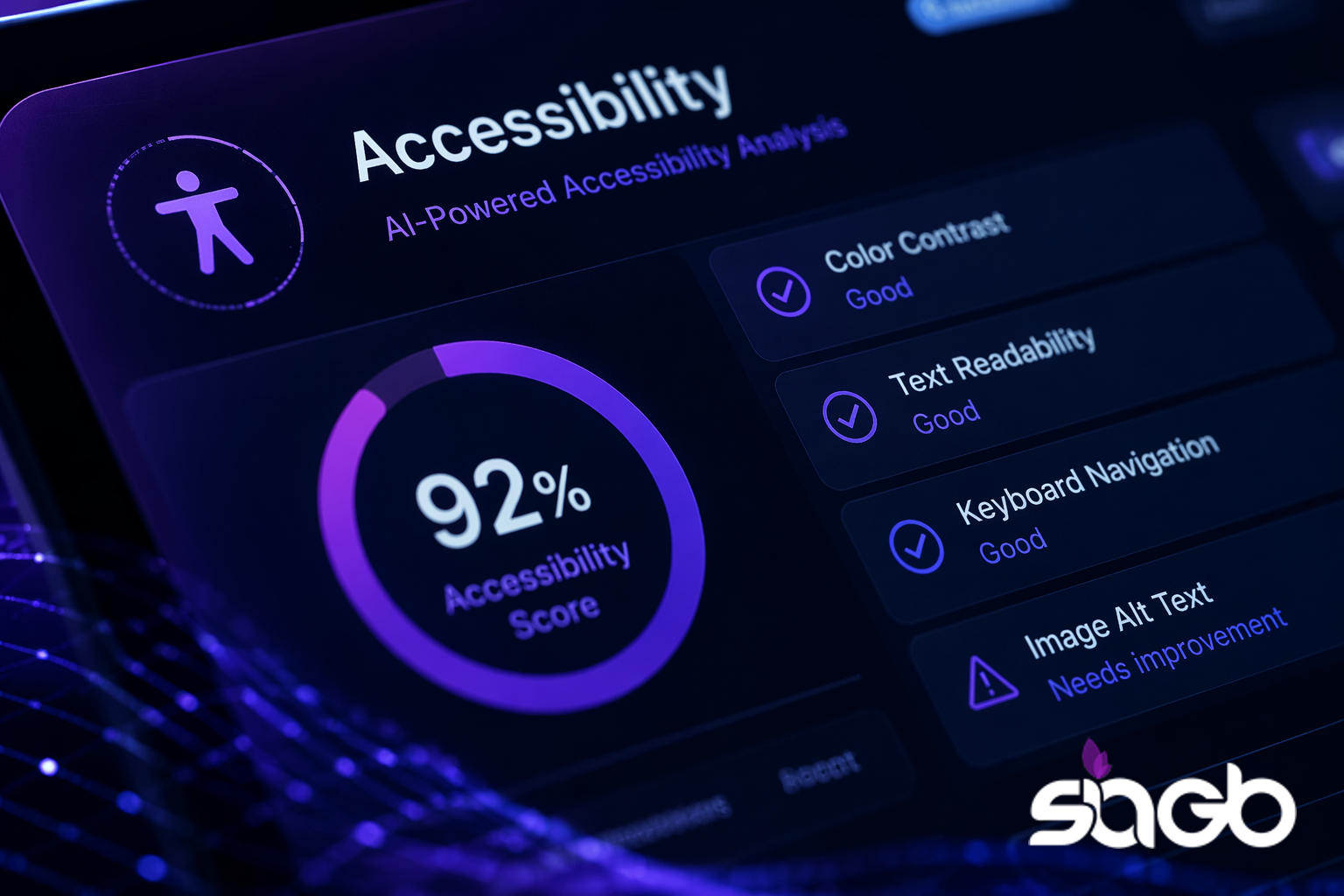
Healthcare website accessibility is no longer optional. AI can scan pages against the WCAG 2.2 AA success criteria and flag risks early across a wcag healthcare website build. Colour contrast (a minimum 4.5:1 ratio for normal text), headings, form labels. All checkable with the right ai powered tool, using engines like axe-core or Lighthouse.
Reducing ada website lawsuit doctors face starts with structure and clarity. In the United States, ADA web claims still run into the thousands each year, and Australian clinics serving international patients feel the same exposure. An ada compliant patient portal supports access, usability, and trust for all patients while improving overall optimisation.
Accessible sites also perform better in optimisation. Search engines favour clarity. So do ai search systems. In our audits, fixing heading order and adding missing alt text often lifts the Lighthouse accessibility score from the 70s into the 90s, and a healthcare website accessibility focus often improves conversion and reduces bounce rates at the same time. Weird, right?
Pro Tip: Accessibility fixes often improve seo performance within weeks when tracked in Google Search Console.
Medical Practice SEO, Content, and Website Redesign
Medical practice seo works best when it’s baked into the design. Retrofitting later costs more. Trust me on this.
AI supports consistent service pages and patient focused seo content. It helps with seo content creation and ongoing content optimisation, not clinical judgement. That distinction matters in ai content medical practice workflows.
A modern medical website balances speed, trust signals, and compliance. Medical practice website design should support local seo, booking flows, and clear information. AI content medical practice systems help scale, but humans on the SEO team still approve what patients read.
Compliance, Data Security, and Cyber Risk
AI SEO automation must never expose patient data. Ever. A hipaa compliant website mindset still applies, even in Australia, where the Privacy Act 1988 and the Australian Privacy Principles set the baseline, and health records count as sensitive information under APP 3.
Poorly governed automation tools can increase healthcare cybersecurity threats. Logs, analytics, and integrations need controls. In our work we keep booking and patient data out of the SEO layer entirely, so the agent only ever sees anonymised page and query data from Google Search Console. Medical practice data security isn’t just IT’s job anymore, it’s part of the SEO stack.
Cybersecurity for doctors now includes marketing systems. Seo tools, chatbots, and analytics platforms touch sensitive systems. I don’t like loose setups. Never have.
Warning: Never connect automation to live patient data without strict isolation.
Using AI for Reviews, Reputation, and Patient Recall
Google reviews medical practice profiles shape trust and rankings. AI helps monitor sentiment, flag issues, and draft responses, but humans approve tone and accuracy.
Online reputation healthcare signals influence search engines and ai overview results. Consistency matters here, especially for reputation management doctors rely on.
Automation can also link SEO to patient recall system workflow improvements. Follow ups, reminders, and content updates connect visibility to lifetime value. That’s where optimisation turns into growth, slowly but reliably.
Limits of AI SEO Automation and Where Humans Step In
Automation can’t judge clinical accuracy or legal nuance. It just can’t. Not reliably.
Unchecked agents can damage rankings or trigger compliance issues like ada website lawsuit doctors want to avoid. I’ve seen rankings drop fast after a poorly set SEO task. Human oversight sets strategy, reviews outputs, and controls risk.
AI seo tools and ai seo services should clearly show where automation stops. If they don’t, walk away.
How Australian Businesses Should Evaluate AI SEO Partners
Look for problem first consulting, not a shiny seo tool demo running on a Google Sheet. Ask how workflows tie to revenue, bookings, and patient outcomes. A good partner should name the schema types they will implement, the Core Web Vitals targets they hold, and the review cadence for every automated change.
Demand measurable ROI. Leads, bookings, sales. Not just dashboards pulled from Google Analytics 4. Experience in regulated industries and healthcare website redesign matters to any serious SEO team. Ask whether they have shipped systems at scale: our own work spans AI-powered patient scheduling for medical groups and Marvel PTE at 85,000+ users across 900+ institutes, and it is led by a Certified Scrum Master and AgilePM practitioner with 20+ years in IT and AI.
AEO services in Australia should reflect local rules and global platforms. Content should be structured so ChatGPT, Perplexity, and Google AI Overviews can quote it cleanly, while still meeting the Privacy Act 1988 and WCAG 2.2 AA. SIAGB, based in Sydney, focuses on end to end delivery, with accountability built in across the full SEO stack. That’s the difference.
Infographic: How AI SEO Automation Connects to Patient Growth
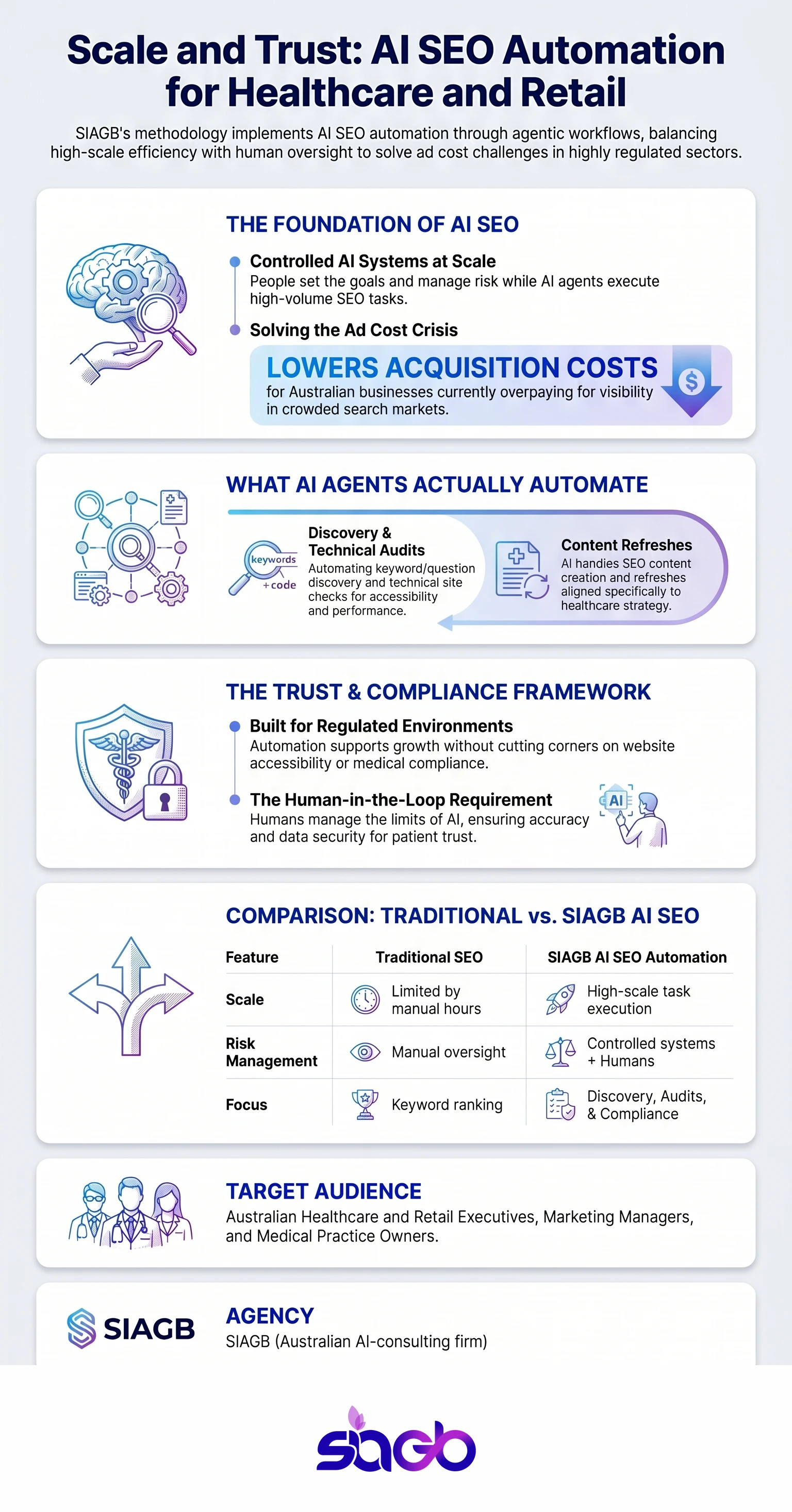
A visual flow showing how an ai optimised website healthcare journey moves from search and answers to trust, reviews, recall, and conversion through structured optimisation steps.
Frequently Asked Questions
What is ai seo automation in healthcare?
AI SEO automation uses controlled automation to handle SEO tasks like content optimisation, monitoring, and accessibility checks. In healthcare, it runs with strict rules to protect accuracy, privacy, and compliance.
Is automated seo safe for medical websites?
Automated SEO can be safe if workflows exclude patient data and include human review. Unchecked automation increases risk to compliance and trust.
How does agentic SEO differ from normal seo tools?
Agentic SEO uses an ai agent that plans, acts, measures, and adjusts. Normal seo tools report data but don’t run workflows or closed loop optimisation.
Does AI SEO help with accessibility and WCAG?
Yes. AI can flag accessibility gaps and track fixes as part of a structured site audit. Humans still approve changes to meet wcag healthcare website requirements.
Can AI SEO improve patient bookings and recall?
When tied to recall systems, reviews, and reputation management doctors rely on, automation supports long term growth. It’s not instant, but it’s measurable.
Key Takeaways and Final Thoughts
AI SEO automation works when it’s tied to real outcomes, not hype. Healthcare and retail need stricter controls, clearer goals, and strong governance across every optimisation layer.
Automation improves optimisation speed, consistency, and scale. Humans bring judgement, ethics, and accountability to SEO efforts.
If you want to use AI to support search engine optimisation responsibly, choose partners who understand risk as well as growth. That balance is what actually scales.
Sources
- MIT Technology Review (technologyreview.com)
- Stanford HAI - Human-Centred AI (hai.stanford.edu)

Want to explore this further?
Book a Free Consultation