
AI SEO in healthcare helps clinics earn visibility, trust, and compliance at the same time. It aligns medical content, accessibility, and security with how AI search and answer engines rank healthcare sites. For Australian healthcare teams, AI SEO is now part of a safe and measurable healthcare SEO strategy.
Here’s the thing. Patients trust what they see first. And AI systems now decide what they see.
Introduction: Why AI SEO Matters for Healthcare Now
Healthcare websites must do three jobs at once. They need to build patient trust, stay visible in search, and meet strict rules. That mix is tough. Traditional medical marketing and traditional SEO often fall short here.
AI SEO approaches in healthcare change how content is planned, tested, and improved. They focus on real patient questions, not just keywords. That shift matters as AI search, AI summaries, and answer engines reshape healthcare SEO strategy.
Australian clinics also face higher expectations. Accessibility standards, data security, and local SEO accuracy now affect rankings and reputation. A slow or confusing healthcare website can cost patient enquiries and trust.
Honestly? The AI hype makes people cautious. Fair enough. But when AI SEO is handled carefully, it supports steady, safe growth. It brings content, compliance, and patient experience into one connected system.
What Is AI SEO in Healthcare?
AI SEO for healthcare is the use of AI systems to improve how healthcare content performs in search and answer engines. It uses data, automation, and testing to match patient intent. Not guesswork.
Medical practice SEO with AI looks beyond keywords alone. It studies how patients ask questions, which answers they trust, and how AI platforms surface medical information. This includes Google Search, Google AI Overviews, ChatGPT, Perplexity, and Microsoft Copilot. In our work building AI-powered patient scheduling for medical groups, we saw the same pattern: patients now arrive already having asked an AI tool three or four follow-up questions before they ever reach the clinic website.
AI SEO also supports ongoing updates. Healthcare content changes quickly. Guidelines shift. Services evolve. AI tools help keep content accurate and current, with human review in place.
So instead of one off updates, clinics get a living healthcare SEO system. One that adapts to AI search and local SEO needs. Sound reasonable?
Why Does Traditional Medical Practice SEO Fall Short?
Traditional SEO often relies on static audits. You get a PDF. Then silence. I’ve never liked that model.
Medical practice SEO needs constant care. AI search behaviour changes often. Traditional SEO can’t keep pace with AI mode results or AI recommendations. Rankings slip, content ages, and risks build up.
Another gap is compliance. Many healthcare SEO plans overlook accessibility, technical SEO, or security. That’s risky. WCAG issues, poor user experience, or weak data controls can damage visibility and trust.
Healthcare SEO strategy now needs more than keywords. It needs systems. And teams who stay involved.
Here’s how the two approaches compare for a typical clinic:
| Focus area | Traditional SEO | AI SEO for healthcare |
|---|---|---|
| Keywords | Static keyword lists | Real patient questions and intent |
| Updates | One-off audits, then silence | Continuous monitoring and refresh |
| Search surfaces | Google rankings only | Google, AI Overviews, answer engines, local results |
| Compliance | Rarely considered | Accessibility and security built in |
| Measurement | Rankings and traffic | Patient enquiries and bookings |
Answer Engine Optimisation for Medical Practices
Answer engine optimisation for medical practices focuses on how AI tools deliver answers. Patients now ask AI search tools direct questions. They want clear responses, fast.
AEO structures content so AI systems can pull safe and accurate answers. This includes clear headings, short summaries, and schema.org markup. For healthcare, the types that matter most are MedicalOrganization, Physician, MedicalWebPage, and FAQPage, which tell an answer engine who is speaking, their credentials, and how current the information is. It also checks tone and clarity for both healthcare professionals and patients.
Medical accuracy matters here. AI answer tools reward trusted sources, and Google’s own quality guidelines treat medical topics as Your Money or Your Life (YMYL) content, where author expertise and reviewer credentials carry extra weight. Clear authorship, a visible clinical reviewer, current medical content, and topical authority all improve AI visibility. We track this on our own pages: bylines that name a real practitioner and a review date are the ones AI Overviews cite back.
AEO isn’t a shortcut. It’s about helping AI platforms show the right answers from the right healthcare provider.
How AI SEO and AEO Work Together in Healthcare
AI SEO builds long term authority across healthcare content. AEO focuses on delivering direct answers in AI Overview and answer tools. Together, they support AI search visibility.
| AI SEO | AEO | |
|---|---|---|
| Main goal | Long term topical authority | Direct answers in AI results |
| Typical work | Content planning, testing, optimisation | Headings, summaries, schema markup |
| Patient benefit | Easier to find trusted care | Faster, clearer answers |
Structured data helps AI systems trust the content. Patients get clearer answers. Clinics rely less on paid ads. That’s the upside.
What Are Agentic SEO and Automated SEO Agents?
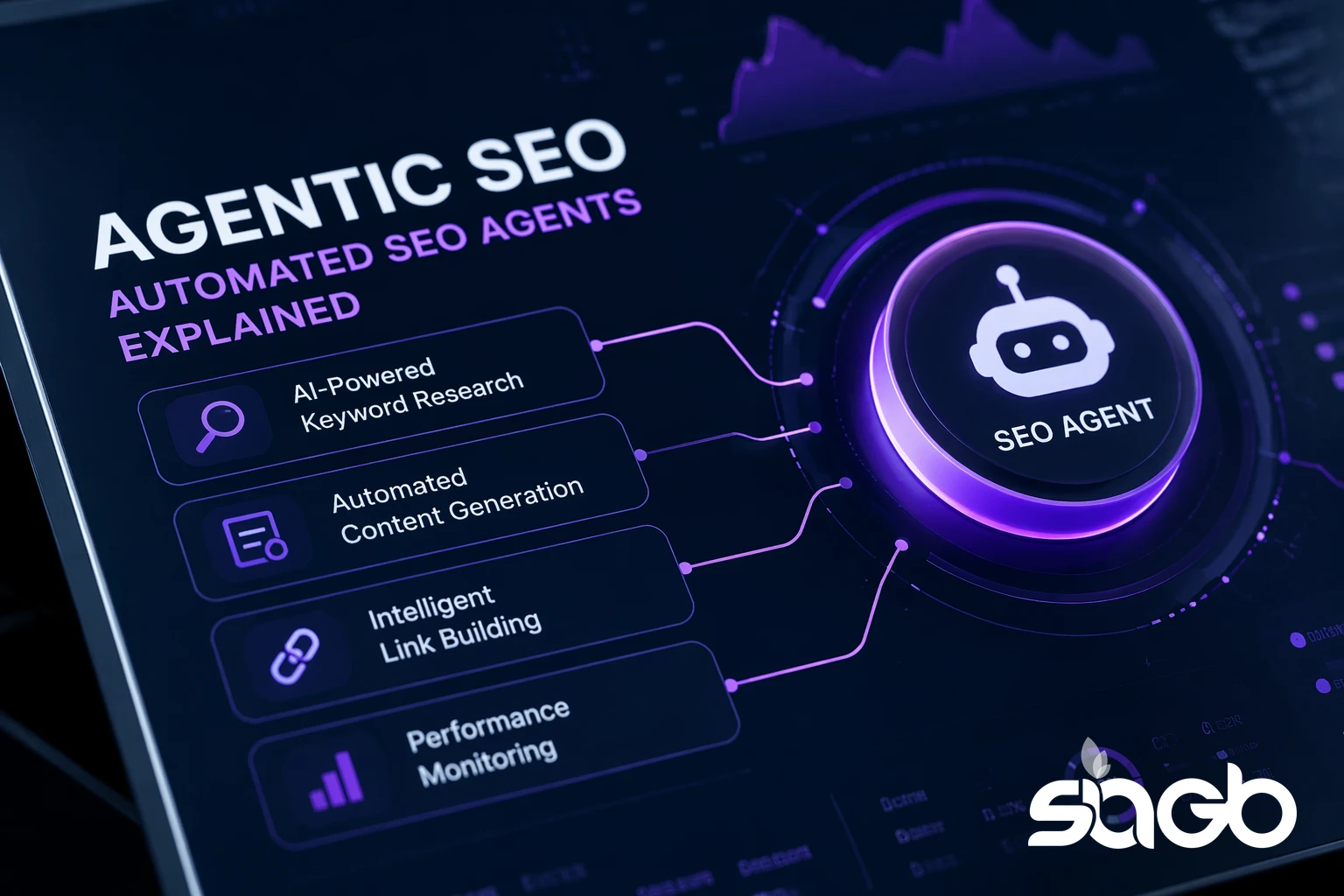
Agentic SEO uses AI agents to monitor, test, and improve SEO on an ongoing basis. These automated SEO agents track rankings, content gaps, and technical SEO issues.
AI agents for SEO can update internal links, flag outdated medical information, and suggest new content topics. For example, an agent can watch a services page for a clinic and alert the team the moment a Core Web Vitals score drops below the 2.5 second Largest Contentful Paint threshold, or when a competing practice starts ranking in AI Overviews for “bulk billing near me”. They work around the clock. Which helps.
But healthcare is different. You can’t let an AI agent publish unchecked medical content. Human oversight is essential. Always.
Agentic SEO works best as support. It helps teams move faster, test ideas, and maintain local SEO accuracy across multiple clinic locations.
Using Agentic AI Safely in Medical SEO
Safety comes first. Clinical review stays mandatory. Data access follows strict rules. AI SEO automation supports people, it doesn’t replace them.
Agentic AI for marketing works when boundaries are clear. And when healthcare teams remain in control.
How Does Healthcare Website Accessibility Reduce Legal Risk?
Healthcare website accessibility improves patient experience and SEO. WCAG 2.1 and the newer WCAG 2.2 standards, at Level AA, support all users, including people with low vision, motor impairments, or reading difficulties. That means practical things: text contrast of at least 4.5:1, keyboard-navigable booking forms, and labels a screen reader can announce.
Accessible content loads faster, reads clearer, and ranks better. Much of it overlaps with Google’s Core Web Vitals, the same thresholds that feed AI ranking signals: Largest Contentful Paint under 2.5 seconds, Interaction to Next Paint under 200 milliseconds, and Cumulative Layout Shift under 0.1. That surprised me too. But it tracks. AI search values clarity.
Accessibility also reduces legal risk. In Australia, the Disability Discrimination Act 1992 already applies to websites, and government-facing services are expected to meet WCAG 2.1 AA. ADA-aligned and WCAG-aligned design is increasingly expected worldwide, and Australian healthcare organisations are paying attention.
Accessible patient portals also boost engagement. Patients book, read, and respond more easily. That builds trust and improves outcomes.
ADA Website Lawsuit Risks for Doctors
Website accessibility lawsuits against doctors are rising worldwide. Poor design invites complaints. And reputational damage can hurt more than fines.
An ADA-compliant patient portal lowers that risk. It also helps every patient. Something to sit with.
AI Optimised Healthcare Website Design
AI optimised healthcare website design balances conversion and trust. A modern medical website guides patients without pressure.
AI helps test navigation, page flow, and content clarity. It studies how a potential patient moves from search to booking. Then it improves that journey.
Medical practice website design must also meet security and accessibility needs. A fast, clear, and secure healthcare website builds confidence. Right?
Healthcare Website Redesign Done End to End
Healthcare website redesigns work best when handled end to end. SEO, accessibility, and security need to be built together.
Patient recall systems add value too. They reduce missed appointments and support patient engagement. No handoffs means fewer delays and less risk.
Reputation Management and Patient Recall Using AI
Online reputation signals in healthcare influence AI search and local SEO. The Google reviews a medical practice receives, along with a complete Google Business Profile, shape patient trust and AI rankings. For example, a practice with 120 reviews at a 4.7 average, consistent name-address-phone details, and photos of the actual clinic will usually surface ahead of a competitor with 12 stale reviews when a patient asks an AI tool for “a physiotherapist in Parramatta”.
AI tools help manage reviews. They prompt feedback, suggest responses, and track trends. In our work we watch review velocity, not just the star average, because a steady stream of recent reviews signals an active, trustworthy practice to both Google and AI answer engines. Patient recall systems also help reduce no shows.
The reputation management doctors rely on today links content, reviews, and patient communication. That loop supports growth. And trust.
Healthcare Cybersecurity and Data Protection
Healthcare cybersecurity threats are rising. Clinics are clear targets. Smaller healthcare organisations often lack strong protection.
HIPAA-compliant website principles still apply as a useful baseline, but the law that actually binds an Australian clinic is the Privacy Act 1988 and its 13 Australian Privacy Principles, with health records treated as sensitive information. Data minimisation, role-based access control, and encryption in transit (TLS 1.2 or higher) all matter. Since 2018, the Notifiable Data Breaches scheme also requires clinics to report eligible breaches to the OAIC. Medical practice data security protects patients and brands.
AI tools must follow strict governance. Chatbots, analytics, and AI systems should never expose sensitive data. Cybersecurity for doctors is now part of digital marketing. Strange, but true.
End to End AI Consulting for Healthcare
SIAGB delivers end to end AI consulting for healthcare. Strategy, build, deploy, and optimise. One team.
We are based in Sydney (ABN 16 659 507 178) and led by founder Sheetal Dhadial, who brings 20+ years in IT and AI leadership and holds Certified Scrum Master and AgilePM credentials. Our team has shipped systems at genuine scale: Marvel PTE, our AI education platform, serves 85,000+ users across 900+ institutes, and we have built AI-powered patient scheduling for medical groups. That mix of scale and clinical-grade caution is exactly what healthcare websites need. Not hype.
AI native delivery reduces risk. Metrics guide every step. That’s how trust grows.
Infographic: How AI SEO, Accessibility, and Security Connect
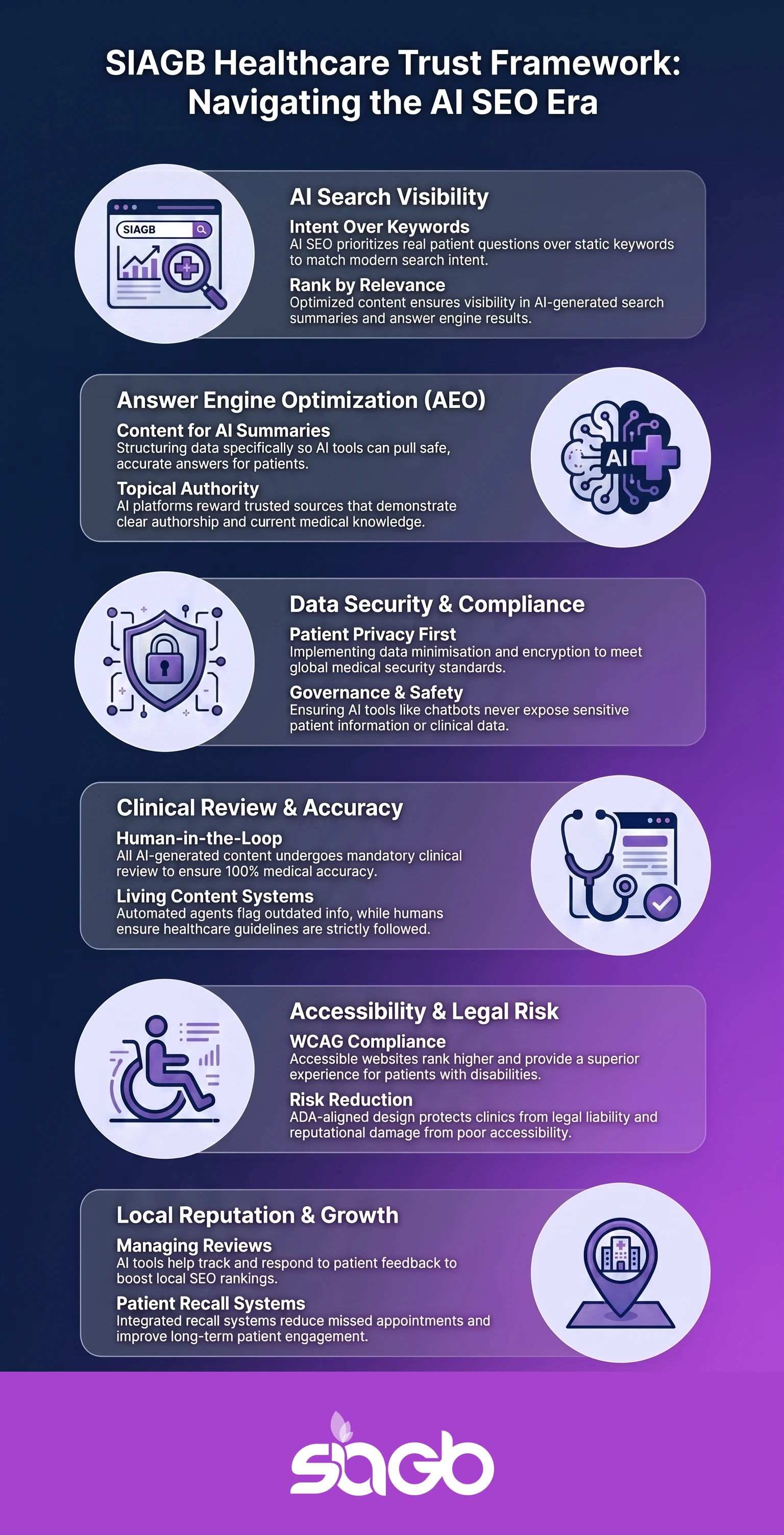
This visual shows how AI SEO in healthcare connects accessibility, rankings, and trust. It maps the patient journey from AI search to booking, supported by automation and human review.
Frequently Asked Questions
How does AI SEO help a healthcare practice?
AI SEO aligns your content with how patients actually phrase questions in AI tools. In practice, that means more enquiries from people who already understand your services, fewer mismatched calls, and content that holds up under compliance review.
Is AI SEO safe for medical content?
Yes, when the workflow is right. Use AI for research, drafts, and optimisation, then have a clinician or medical writer sign off before anything goes live. The risk comes from skipping that review step, not from the tools themselves.
What is the difference between AI SEO and traditional SEO?
Traditional SEO chases keywords and backlinks, usually through one-off audits. AI SEO treats your site as a living system: it studies patient intent, tracks how answer engines present your content, and keeps pages current as guidelines and services change.
Does accessibility really affect healthcare SEO?
Yes, in two ways. Accessible pages tend to be faster and clearer, which both search engines and AI tools reward. And WCAG compliance lowers your exposure to complaints and lawsuits, which protects the reputation signals AI systems weigh.
Can small clinics use agentic SEO?
They can, and often gain the most, because automated SEO agents handle the monitoring and updates a small team can’t staff. The limit is publishing: keep a human reviewing anything medical before it goes live.
Key Takeaways
AI SEO must be practical, compliant, and measurable. Accessibility and security now directly shape healthcare SEO strategy. End to end delivery lowers risk, improves content quality, and builds lasting patient trust.
Sources
- MIT Technology Review (technologyreview.com)
- Stanford HAI - Human-Centred AI (hai.stanford.edu)

Thinking about how this applies to your business?
Start a Conversation