An AI SEO specialist is an SEO practitioner who also works on how your business shows up in AI answers, and who uses artificial intelligence tools in their own work. Hire one when AI answers already shape how customers find you and your own team doesn’t have the time or skills to keep up.
Before you sign, check three things: proof of past work, the access they ask for, and how they handle your data in AI tools. Be wary of anyone who promises you a place in AI answers. We explain why below. If you’d like to see how this works in practice, our AI SEO service begins every engagement with a free AI visibility audit.
What Does an AI SEO Specialist Do Day to Day?
Most of the week looks like good SEO. A typical AI SEO specialist will:
- Run a technical audit and work through the fixes, from indexing to page speed.
- Do keyword research that includes the longer, full-sentence questions people now type into chat assistants.
- Write content briefs and review drafts, building topical authority one subject at a time.
- Check how AI answers describe the brand in Google AI Overviews, ChatGPT and Bing Copilot, and log what changes.
- Report on what moved and why.
The difference from a classic SEO specialist is the AI layer. They watch AI answers as closely as rankings, and they review everything an AI assistant produces before it reaches your site.
Google keeps the core skills in perspective. Its guide to generative AI features says optimising for AI search is optimising for the search experience, “and thus still SEO.” So a good AI SEO strategy still rests on technical SEO, research and useful content.
You’ll also hear the term answer engine optimisation. It’s the part of the work focused on pages that give clear, quotable answers. Our guide to answer engine optimisation covers it in more detail.
When Does a Business Need an AI SEO Specialist?
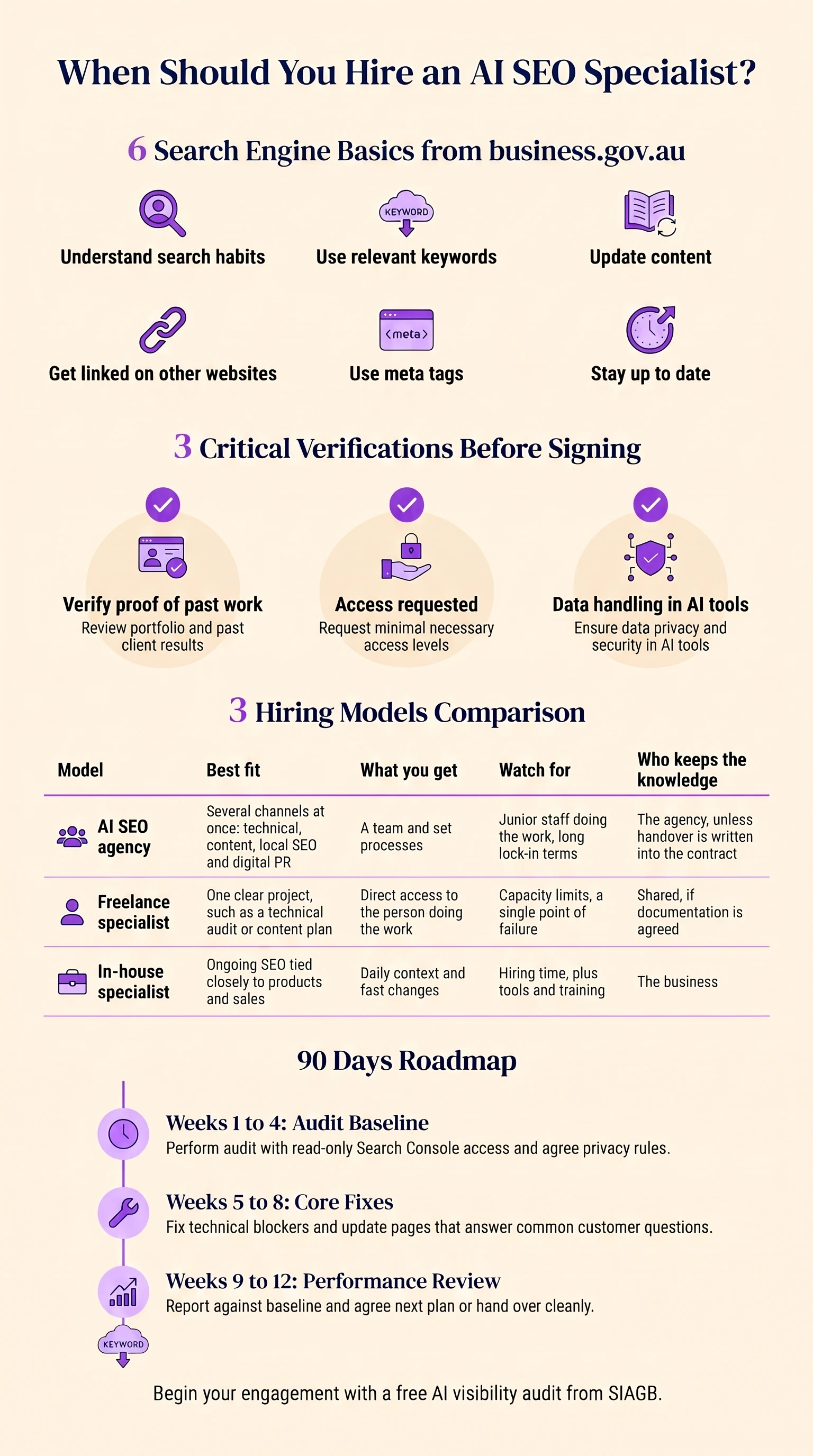
Start with what you can do yourself. The Australian Government’s business.gov.au guide to improving your search engine rankings lists the basics:
- Understand how your online customers search.
- Use relevant keywords, and don’t overuse them, so content reads naturally.
- Update your content regularly.
- Get linked on other websites.
- Use meta tags.
- Stay up to date, because search engines change how they rank results.
You can handle many of those steps in-house. But a specialist earns their fee when the problems go beyond them.
Here are the signs it’s time:
- Your customers’ questions now show AI Overviews, and your pages aren’t among the links. If a Google AI Overview answers the questions you used to rank for, that’s frustrating, and someone needs to work out why your content isn’t being used.
- Technical problems stop pages being indexed. That’s specialist work, and it blocks everything else.
- You’re being sold “AEO” or “GEO” packages. Google suggests reviewing its guidance on third-party SEO advice before you buy them. A specialist on your side can judge whether a package is worth it.
- Traditional SEO work has stalled. If the work has no clear owner, it tends to drift, with or without AI search in the picture.
How Google’s AI features choose pages is a topic of its own. This page sticks to hiring and working with the right person.
Should You Hire an AI SEO Agency, a Freelancer or an In-House Specialist?
There’s no single best AI SEO agency for every business. There’s only the right fit for your scope, your budget and your team. This table compares the three common models.
| Model | Best fit | What you get | Watch for | Who keeps the knowledge |
|---|---|---|---|---|
| AI SEO agency | Several channels at once: technical, content, local SEO and digital PR | A team and set processes | Junior staff doing the work, long lock-in terms | The agency, unless handover is written into the contract |
| Freelance specialist | One clear project, such as a technical audit or content plan | Direct access to the person doing the work | Capacity limits, a single point of failure | Shared, if documentation is agreed |
| In-house specialist | Ongoing SEO tied closely to products and sales | Daily context and fast changes | Hiring time, plus tools and training | The business |
One rule applies to every model. Search Console, your Google Business Profile, analytics and the domain should stay in your business’s name. The specialist gets a user role, not ownership.
Local SEO and digital PR can be split across providers. A web developer might own the site, a digital marketing agency the local listings, and a PR contact the press coverage. Write down who owns each piece, so nothing falls between them.
When you compare AI SEO service offers, look past the label. Some SEO services are mostly content production. Others are mostly technical. Ask for the actual task list. If you’re weighing up answer-focused providers in particular, our overview of AEO services in Australia explains what that work usually covers.
What Should You Ask an AI SEO Expert Before You Sign?

Google publishes its own list of questions to ask an SEO. It suggests asking: “Can you show me examples of your previous work and share some success stories?” It also suggests asking whether they follow the Google Search Essentials, and “What kind of results do you expect to see, and in what timeframe?”
Those cover proof. For an AI SEO expert, add questions about how the engagement will run:
- Who does the work each week, and will I speak to that person?
- Which AI tools will touch our content or data, and where does that data go?
- Who checks AI output before it goes live?
- What will the monthly report show?
- How do we end the contract, and what do we get back?
Good answers are specific. They name a person, a tool and a process. Vague answers about “our proprietary AI” tell you little.
Listen for how they talk about Google AI features too. A specialist who explains what’s in your control, and what isn’t, is more useful than one who sounds certain about everything.
Can an AI SEO Specialist Guarantee AI Overview or ChatGPT Citations?
No. Google’s hiring advice is blunt: “If they guarantee you that their changes will give you first place in search results, find someone else.”
The same logic applies to AI answers. Google says third-party tools “don’t have access to our internal ranking data” and “can’t guarantee performance”. Google’s AI features page adds that even a page that meets every requirement isn’t guaranteed to be crawled, indexed or served. That makes a promised AI citation, in AI Overviews, AI Mode or ChatGPT, hard to back up.
Watch for these red flags:
- A promised AI citation, or promised placement in AI Mode.
- Claims of a special relationship with Google. Google says it doesn’t evaluate or endorse third-party services or tools.
- Plans to publish large numbers of AI pages quickly. Google’s spam policies treat pages made mainly to manipulate rankings as scaled content abuse.
- Paid llms.txt files or “AI schema” packages sold as required for Google. Google says neither is needed for its AI features.
- Bought links. Buying links for ranking purposes is link spam under Google’s policies.
What a good specialist can promise is a clear process, honest reporting and work that makes each citation more likely over time. Less exciting than a guarantee, sure. But it’s real.
What Access Should AI SEO Specialists Get to Your Website and Search Console?
Start small. According to Google’s advice for an SEO audit, you should “only grant read access to Search Console” and not grant write access at that stage.
From there, give the least access each task needs:
- An editor role in your website’s content system, not an administrator account.
- Changes tested on a staging site before they reach the live site, especially technical SEO changes.
- Analytics access as a user, so they can read data but not change settings.
Keep ownership of every account. Add the specialist as a user, and remove them on the day the work ends. A simple access log, with who has what and since when, makes that easy to check.
This matters more with AI in the mix. Some AI products ask to connect to other accounts, so ask before any tool is linked to your Search Console, analytics or website.
How Should a Specialist Handle Personal Information in AI Tools?
This is where Australian rules shape the engagement. The Office of the Australian Information Commissioner (OAIC) published guidance on commercially available AI products on 21 October 2024 and updated it on 17 January 2025.
Its first point is clear. Privacy obligations “will apply to any personal information input into an AI system”, and to output that contains personal information.
As a matter of best practice, the OAIC recommends that organisations do not enter personal information, “and particularly sensitive information”, into publicly available generative AI tools. Before adopting an AI product, it says organisations should do due diligence. That includes how human oversight fits into the process and who will have access to the data.
For an SEO engagement, your business stays responsible. In practice:
- Agree in writing that customer lists, enquiry forms and reviews with names don’t go into public AI tools.
- Ask which AI platform each task uses, and whether it keeps or trains on what’s entered.
- Make sure a person reviews AI output before it’s used.
This isn’t legal advice. If your business handles health or other sensitive information, check the OAIC guidance in full, or get advice, before any AI systems touch that data.
Which AI SEO Tools Will a Specialist Use, and What Data Do They Need?
Most specialists use a mix of AI SEO tools by category:
- Site crawlers for each technical audit.
- Keyword research tools that show search demand and related questions.
- AI writing and summarising assistants built on large AI models.
- Rank trackers and AI answer trackers.
- SEO automation and AI SEO agent tools for repeat tasks, such as tagging pages or drafting reports.
Google doesn’t evaluate or endorse third-party SEO tools. It strongly encourages using its own first-party tool, Google Search Console, whether or not you use others.
To get started, a specialist usually needs:
- Read access to Search Console and analytics.
- Permission to crawl the site.
- A copy of your robots.txt, including any rules for AI crawlers.
Ask how each AI SEO tool stores your data. A good SEO tool makes the work faster, but the judgement still has to come from a person. For a sector example, see our guide to AI SEO automation in healthcare and retail.
How Do You Measure the Results of AI SEO Specialists?
Measure in three layers.
Search Console. According to Google, appearances in AI Overviews and AI Mode are included in the Performance report under the “Web” search type. Google’s optimisation guide also points to the Generative AI performance report in Search Console.
AI visibility check. Ask the same list of real customer questions in each AI tool every month. Log whether your business appears, whether the answer is accurate, and save screenshots. Over time, this log shows whether your AI search visibility is improving. It’s the same check we start with in our own AI visibility audits, putting real customer questions to ChatGPT, Perplexity, Gemini and Claude.
Real results. Track enquiries, bookings and sales in your own analytics. Visibility only matters if it brings customers.
A good monthly report links each change to one of these layers. A line such as “we fixed indexing on 12 service pages, and here is how their impressions changed” is useful. A long list of tasks with no outcome isn’t.
Be patient but not passive. A quarter with no movement in any layer is a fair reason to worry, though. Ask why, and ask what will change.
What Should the First 90 Days of an AI SEO Strategy Look Like?

A scoped plan helps both sides. Here’s a typical shape, as planning guidance rather than a promise:
- Weeks 1 to 4. Audit with read-only access. Set a baseline from Search Console and the monthly AI question check. Agree the privacy rules for AI use in writing.
- Weeks 5 to 8. Fix the technical blockers. Update the pages that answer your customers’ most common questions.
- Weeks 9 to 12. Report against the baseline. Agree the next quarter’s plan, or hand over notes and access cleanly if you decide to stop.
That last step matters. A good specialist leaves you better documented than they found you.
If you’d like to know who wrote this guide, read more about our author, Sheetal Dhadial.
Key Takeaways
- Do the business.gov.au SEO basics first. Hire when AI answers shape demand and no one owns the work.
- Choose an agency, freelancer or in-house specialist by scope, and keep every account in your name.
- Ask for proof of past work, and walk away from promised AI citations.
- Give read-only Search Console access for an audit.
- Under OAIC guidance, keep personal information out of public AI tools.
FAQ
What does an AI SEO specialist do?
An AI SEO specialist does the core SEO work, such as technical fixes, keyword research and content planning. On top of that, they check how AI answers describe your business and review anything AI tools produce before it goes live.
When should a business hire an AI SEO specialist?
Once the basics are in place and AI answers are starting to shape how customers find you, but your team doesn’t have the time or skills to act on it. Indexing problems and stalled SEO work are other common triggers.
Should you hire an AI SEO agency, a freelancer or an in-house specialist?
An agency suits work across several channels at once. A freelancer suits one clear project, such as a technical audit. An in-house specialist suits ongoing work that is tied closely to your products and sales. Whichever you choose, keep every account in your business’s name.
What access should an AI SEO specialist get to Search Console?
Read access for an audit. Google’s own hiring advice says to grant only read access to Search Console at that stage, not write access. Give more only when a specific task needs it, and remove access when the work ends.
Can a specialist put customer data into ChatGPT or other AI tools?
The OAIC recommends, as best practice, that organisations do not enter personal information, and particularly sensitive information, into publicly available generative AI tools. Privacy obligations still apply to any personal information put into an AI system, so agree the rules in writing first.
Sources
- business.gov.au, Improve your search engine rankings.
- Google Search Central, Do you need an SEO?.
- Google Search Central, Optimizing for generative AI features on Google Search.
- Google Search Central, Guidance on third-party SEO tools and advice.
- Google Search Central, AI features and your website.
- Google Search Central, Spam policies for Google web search.
- OAIC, Guidance on privacy and the use of commercially available AI products.

Ready to put this into practice?
Let's Talk