An AI SEO strategist is the person who keeps your brand findable when the answer shows up before the click. That means classic Google results, AI Overviews, AI Mode and chat assistants. They use artificial intelligence tools for research and drafts, and they keep a person accountable for every fact that gets published.
For US marketers, the turning point was May 2025, when Google started rolling out AI Mode across the country. If you’re the one who has to decide whether to hire for this, or explain it to your boss, here’s the ground we’ll cover: what the role covers, what changed, and the GEO and llms.txt myths. After that come which work to automate, what a plan looks like for a multi-location brand, and the questions to ask before you hire someone for this part of your digital marketing.
What Does an AI SEO Strategist Do?
Forget the job ad for a moment. Here’s what a typical week looks like for an AI SEO strategist.
- Monday: research. Pull the questions buyers ask, including the follow-ups they type into AI search after the first answer.
- Tuesday: mapping. Match those questions to pages. Find the questions no page answers yet, and the pages fighting each other for the same question.
- Wednesday: technical. Fix what stops Google from crawling and indexing the site: broken links, blocked pages, slow templates.
- Thursday: content. Brief writers, review drafts, and check every claim that came out of an AI tool.
- Friday: monitoring and reporting. See how AI answers describe the brand this week, and report on Search Console numbers.
The skills behind that week are classic SEO, comfort with AI tools, editorial judgment and analytics. None of them is new on its own.
What’s different from a traditional SEO strategist is where the hours go. In practice, a bigger share of the week now goes to reviewing tool output and checking AI answers. Each SEO task has an AI shortcut, and the strategist’s value is knowing which shortcuts hold up. Good SEO professionals will recognize most of this list. The AI SEO strategy layer sits on top of it.
You’ll also see “AEO”, short for answer engine optimization, which applies the same thinking to answer engines. We explain it in what answer engine optimisation is.
A solid SEO strategy still starts with the business itself: who buys, what they ask, what you can prove. An SEO expert who opens with a tool demo instead of those questions has the order wrong. If you want the whole role covered, our AI SEO service handles each of these jobs.
What Changed When Google Launched AI Mode in the US?
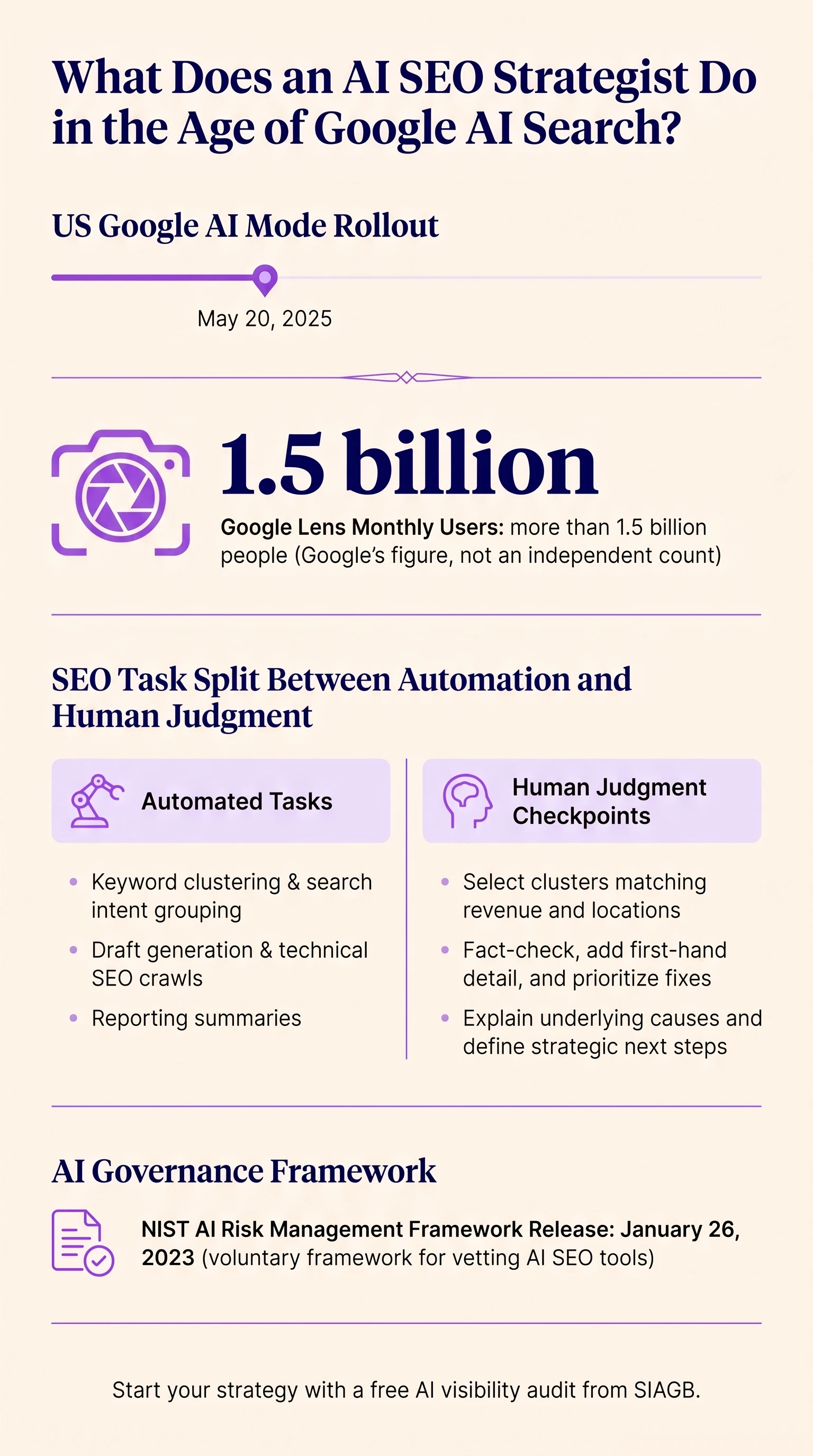
On May 20, 2025, Google announced: “starting today we’re rolling out AI Mode in the U.S.” Google describes AI Mode as having “more advanced reasoning and multimodality”, with room for follow-up questions and links to the web. In the same announcement, Google said Google Lens is used by “more than 1.5 billion people” every month. That’s Google’s figure, not an independent count.
AI Mode joined AI Overviews, which already placed a written summary above many results. Google says both features “may use a query fan-out technique”. In plain terms, one question can trigger several related searches across subtopics, and the AI model combines what it finds into one answer with supporting links.
So what does that mean for traditional SEO? A few things, and none of them is a reason to panic:
- The result is an answer, not just a list. Traditional search showed ten links and let the user choose. Now the user often reads a summary first.
- Questions get longer. Google says people using its AI experiences ask “longer and more specific questions” and follow up with more.
- Subtopics matter. If the answer is built from several searches, the page that clearly answers one subtopic has a way in, even if it doesn’t win the main query.
What it doesn’t change matters just as much, and that’s good news if you’ve spent years getting the basics right. Google’s index, crawling and its helpful content basics still sit underneath every AI search feature. A page Google can’t index won’t appear in an AI Overview or in AI Mode, however well it’s written. Other AI engines run their own systems, and we won’t guess at their internals here.
Is Generative Engine Optimization a New Discipline or Still SEO?
Generative engine optimization (GEO) and AEO are the labels you’ll see on proposals. Both describe optimizing content so it appears in AI answers.
Google has answered the “new discipline” question directly: “From Google Search’s perspective, optimizing for generative AI search is optimizing for the search experience, and thus still SEO.” It also suggests reviewing Google’s own guidance before buying third-party “AEO” or “GEO” services.
So here’s the practical read for a US buyer. A GEO proposal should still show audits, content work and measurement. If it does, you’re buying SEO with a generative AI focus, which is fine. If it mostly promises special tricks or guaranteed mentions in AI answers, the label is usually doing the heavy lifting for a weak plan.
The labels aren’t worthless. They push teams to think about how answers get built and quoted. Our longer piece on generative engine optimisation goes deeper into how AI engines pick what to cite, as far as anyone outside them can tell.
Do You Need an llms.txt File or Special Schema for AI Search?
For Google, no.
Google’s documentation on AI features says: “There are no additional requirements to appear in AI Overviews or AI Mode, nor other special optimizations necessary.” You don’t need to create new machine readable files, AI text files or markup either, according to the same page, and there’s no special schema.org structured data needed for the AI Overview or AI Mode.
Google’s optimization guide goes a step further on llms.txt specifically. It says LLMS.txt files are not needed for Google Search, which does not use them.
What about other AI platforms? Their documentation isn’t covered on this page, so we make no claim either way. Some sites, ours included, publish an llms.txt file for reasons that have nothing to do with Google. That’s a reasonable choice. What isn’t reasonable is a vendor telling you the file, or a special “AI schema” package, is required to appear in Google’s AI search features. Google says it isn’t.
What does matter is ordinary technical SEO. The page has to be indexed and eligible to show with a snippet. Content has to be helpful and written for people. If those two things aren’t in place, no file or markup will fix it. That’s less exciting than a shiny new file, but it’s the part that actually counts.
How Do AI Engines Decide Which Brands Show Up in AI Answers?
Honestly? No AI engine publishes its ranking factors for brand mentions. We won’t invent a list, and you should be skeptical of anyone who hands you one.
Google does give some direct advice. “Focus on making unique, non-commodity content,” it says, and keep your Merchant Center and Business Profile data up to date. Google also states that clicks from results pages with AI Overviews “are higher quality”. That’s Google’s claim, and it doesn’t give a number.
That’s thin, admittedly, if you were hoping for a checklist. A strategist turns it into three habits:
- Depth on the subjects you own. A site that covers its core topics fully, including the follow-up questions, builds topical authority. That’s practical advice, not a ranking factor Google has confirmed.
- Entity-clear writing. Name the brand, the product, the service and the location plainly. That’s the heart of semantic SEO: writing so AI systems can’t mistake who you are or what you offer.
- Consistent facts. The same product names, locations, hours and contact details on the site, in Business Profile and in Merchant Center.
Tracking AI visibility takes a method, not a dashboard promise. Build a fixed set of real buyer questions. Run them in each AI assistant on a schedule, say monthly. Log which brands and pages appear in the AI generated answers, and note changes after you update content. Our own AI visibility audits work the same way: we put the real questions customers ask to ChatGPT, Perplexity, Gemini and Claude, then map where the brand appears, where competitors appear, and where the gaps are.
Here’s what that looks like with a real client. Take RevivalMD, a physician-led clinic in Rahway, New Jersey. We tracked 10 test queries for it, and within 30 days of its content pipeline launch, the clinic was cited on 10 of 10 in Google AI Mode, 10 of 10 in Perplexity and 9 of 10 in ChatGPT. That’s one clinic and a small set of queries, so it’s a sign the method can work, not a promise for your site. The details are in our RevivalMD case study.
Results vary from session to session, so one check proves little. That’s frustrating if you want a clean monthly number. But a log kept over months shows whether brand mentions in generated answers are moving the right way.
Which SEO Tasks Can You Automate With AI Tools?
Start with what the tools are. The models “don’t retrieve facts, but predict a likely sequence of words”, according to Google’s guidance on generative AI content. The same page warns that generating many pages without adding value “may violate Google’s spam policy on scaled content abuse.”
Google also says it doesn’t evaluate or endorse third-party SEO tools, and that those tools have no access to Google ranking data. Treat any SEO tool’s “ranking score” as an estimate. A useful one, sometimes. Not gospel.
So which tasks should you automate? Here’s a working split.
| SEO task | Automate? | Human judgment checkpoint |
|---|---|---|
| Keyword clustering and search intent grouping | Yes, mostly | Pick the clusters that match revenue and locations |
| Content drafts | Partly | Fact check, add first-hand detail, approve |
| Technical SEO crawls | Yes | Prioritize fixes by impact |
| Product and location page copy at scale | Risky | Each page must add value (scaled content abuse policy) |
| Reporting | Partly | Explain causes and next steps |
The pattern: use AI for volume and speed, and put human judgment wherever a fact, a priority or a value call is made. When teams use AI for AI content, someone has to own accuracy. Human expertise is what turns a fast draft into a page worth ranking.
Governance is the other half, and it’s the part that tends to get skipped until something goes wrong, especially in larger US organizations. NIST’s AI Risk Management Framework, released January 26, 2023, is “intended for voluntary use”. It isn’t an SEO document and it isn’t a legal requirement. But it gives a useful checklist frame when you’re vetting AI SEO tools: what the tool does with your data, how its output gets checked, and who is accountable when it’s wrong.
For multi-step automation with AI agents, see our piece on AI agents for SEO.
What Does an AI SEO Strategy Cover for a Multi-Location US Brand?

A brand with several US locations, or a large product catalog, needs a plan with clear deliverables. With that many moving parts, it’s easy to end up paying for activity instead of progress. Here’s what a good plan covers.
- SEO audit and technical SEO baseline. Crawl the full site. Find indexing gaps, duplicate location templates and slow pages. This sets the starting line for every later report.
- Keyword research by search intent. Do it per location or per product line, not once for the whole brand. Include the follow-up questions buyers ask in AI search, because each keyword now comes with a trail of related questions.
- Content strategy. One clear page per service and location, and each page needs something unique: local details, staff, services that really differ, real product specifics. Swapping the city name in the same template is exactly what Google’s scaled content abuse warning describes.
- Local SEO. Keep the Business Profile for each location up to date, and keep Merchant Center current for products, as Google advises. Hours, phone numbers and services should match across every listing and every location page.
- Measurement. Search Console by location folder or product section, plus the scheduled AI answer check from earlier.
The order matters. We know, an audit sounds like the dull part when you’re keen to see new pages. But the audit comes first, because content built on a broken technical base won’t get indexed. We start our own AI SEO work with an audit too (an AI visibility audit), before any content gets written. Content comes before link and mention work, because there’s nothing worth linking to yet.
A plan like this should be written down and shared. Get it in writing. If you can’t see each deliverable, you can’t hold anyone to it. Months in, with invoices still arriving, that written plan is what lets you ask what you’re actually paying for.
If answer-first content is the main gap, our answer engine optimisation service focuses on that layer.
What Should You Ask Before Hiring AI SEO Services?

Picking the wrong agency is an expensive mistake, and usually a slow one to undo. So go in with questions. Google publishes its own hiring advice in “Do you need an SEO?”. Combine it with a few AI questions and you have a checklist.
| Question to ask | A good answer includes | Source |
|---|---|---|
| Can you show examples of previous work? | Real pages and what changed | Google, Do you need an SEO? |
| Do you follow Google Search Essentials? | Yes, with how | Google, Do you need an SEO? |
| What results and timeframe should we expect? | A range, no guarantee | Google, Do you need an SEO? |
| How will you measure success? | Search Console metrics plus an AI answer check | Google, Do you need an SEO? |
| Which AI tools do you use, and who checks the output? | Named review step by a person | Google gen AI content guidance |
| Do you vet AI tools against a framework? | For example NIST AI RMF (voluntary) | NIST |
Google also says the best time to hire is before a site redesign or a new site launch. Give read-only Search Console access at first, and widen it once the work earns trust.
Keep one line from Google in mind through every sales call: “No one can guarantee a #1 ranking on Google.” The same goes for AI answers.
Walk away, or at least push back hard, if you hear any of these:
- Guaranteed AI citations or guaranteed brand mentions.
- An llms.txt or “AI schema” package sold as required for Google.
- Plans to generate hundreds of location or product pages fast.
SIAGB is a Sydney-based consultancy founded in 2022 by Sheetal Dhadial, who has more than 20 years in IT and AI leadership. Our AI SEO services start with a free AI visibility audit. For what a good engagement includes, see our guide to AEO services in the USA.
Key Takeaways
- AI SEO strategists keep a brand findable in Google results, AI Overviews, AI Mode and chat assistants.
- Google rolled out AI Mode in the US on May 20, 2025, and it uses query fan-out.
- Google needs no llms.txt, special files or special schema for its AI features.
- Google calls optimizing for generative AI search “still SEO”.
- Automate the busywork and keep human judgment on facts and value; NIST AI RMF is a voluntary frame for vetting tools.
FAQ
What does an AI SEO strategist do?
An AI SEO strategist plans how a brand stays visible across Google results, AI Overviews, AI Mode and chat assistants. The work covers buyer research, page planning, technical fixes, content review and measurement, with a person reviewing everything AI tools produce.
Is generative engine optimization different from SEO?
Google says no. In its words, optimizing for generative AI search is optimizing for the search experience, and thus still SEO. GEO is a useful label for the AI answer side of the work, but the underlying work is the same.
Do you need an llms.txt file to show up in Google AI search?
No. Google says llms.txt files are not needed for Google Search, which does not use them, and that AI Overviews and AI Mode need no special files, markup or schema. The page needs to be indexed and eligible for a snippet.
Which SEO tasks can AI tools handle?
AI tools handle keyword clustering, first drafts, technical crawls and report summaries well. People still need to check facts, decide which fixes matter, approve content and make sure every page adds something of value.
What should you ask before hiring AI SEO services?
Ask for examples of previous work, whether they follow Google Search Essentials, what results and timeframe to expect, how they measure success, and who checks the output of their AI tools. No one can guarantee a number one ranking on Google.
Sources
- Google Search Central, AI features and your website.
- Google Search Central, Optimizing for generative AI features on Google Search.
- Google Search Central, Do you need an SEO?.
- Google Search Central, Guidance on using generative AI content on your website.
- Google Search Central Blog, Top ways to ensure your content performs well in Google’s AI experiences on Search.
- Google, AI in Search: Going beyond information to intelligence.
- NIST, AI Risk Management Framework.

Want to explore this further?
Book a Free Consultation