
Automated SEO agents are AI systems that plan, decide, and act to improve search performance with feedback and controls. They go beyond simple automation by learning from results, risks, and rules. For regulated businesses in the United States, including healthcare and retail, these AI agents only work well when strong governance, clear optimization goals, and human review are built in.
US healthcare and retail leaders keep asking the same thing. What is SEO automation, really? And can it be trusted in high risk environments like healthcare website accessibility and medical practice SEO? Fair questions. This guide breaks it down in plain language, without the hype, and with real examples SEO professionals recognize.
In our work at SIAGB, we treat an automated agent as a system bound by three hard limits: the Americans with Disabilities Act (ADA) Title III, the Health Insurance Portability and Accountability Act (HIPAA), and the Web Content Accessibility Guidelines (WCAG) 2.1 and 2.2 at Level AA. Any agent that touches a US medical or retail site has to respect those three before it optimizes a single title tag. We track its actions against Core Web Vitals thresholds too: Largest Contentful Paint under 2.5 seconds, Interaction to Next Paint under 200 milliseconds, and Cumulative Layout Shift under 0.1. Those numbers are not decoration. Google uses them as ranking inputs, and an agent that ships a schema block or a hero image without checking them can quietly break the page it was meant to help.
Introduction: Why SEO Automation Needs a Rethink
US healthcare and retail businesses face rising SEO complexity and growing compliance risk. Search rules change fast across Google, Bing, and now the AI answer surfaces like Google AI Overviews, ChatGPT, Perplexity, and Gemini. Accessibility laws tighten under ADA compliance medical website and WCAG healthcare website standards, and federal contractors carry Section 508 obligations on top. Patient trust is fragile. Many owners are skeptical of AI hype, and honestly, that makes sense. Past tool driven SEO promised speed and delivered mess, poor optimization, and unresolved SEO issues.
AI agents sound like the next shiny thing. But here’s the thing. Scale only works when control exists. An AI agent without rules becomes a liability, not an asset, especially for a HIPAA compliant website or an ADA compliant patient portal. I’ve seen this play out more than once, and it’s frustrating.
This article explains how agentic AI works inside real, regulated environments. We’ll show where automation helps, where it hurts, and how human led systems protect ROI and SEO performance. No fluff. No magic buttons. Just how modern AI agents actually behave inside a real SEO workflow.
What Are Automated SEO Agents?
Automated SEO agents are AI systems designed to pursue SEO goals by planning, acting, and learning. Unlike a basic SEO tool or script, an AI agent decides what to do next based on outcomes. It observes signals, reasons about options, and then takes action.
A simple way to put it. An AI agent watches the site, tests changes, checks results, and adjusts. Over and over. Each AI SEO agent can work across content optimization, technical SEO, and agentic AI tasks, but only within set boundaries defined by compliance, brand risk, and the wider SEO strategy.
Behind the scenes, the AI SEO agent connects to platforms like Google Search Console, Google Analytics 4, Screaming Frog crawlers, and server logs. It treats each SEO task as part of a loop, not a checklist. That loop is what makes it agentic, not just automation or a basic automation tool running once and stopping.
Agentic SEO vs Traditional SEO Automation
Traditional SEO automation runs on fixed rules. Do keyword research. Push content. Run a technical audit. The tool executes, then stops. There’s no reasoning, no learning, and no sense of risk or context.
Agentic SEO works differently. An AI agent evaluates results before deciding the next step. If rankings drop after a change, the AI agent pauses or rolls it back. If impressions rise but clicks fall, it shifts content optimization instead of publishing more pages. That kind of optimization loop is hard to do by hand.
The table below is the frame we use with US clients when they ask which approach fits a regulated site. It maps each model against the controls that actually matter under ADA, HIPAA, and WCAG.
| Capability | Manual SEO | Basic automation tool | Agentic SEO agent |
|---|---|---|---|
| Decides next action from results | Human only | No, fixed rules | Yes, evaluates then acts |
| Rolls back a change that hurts rankings | Manual, slow | No | Yes, within the loop |
| Checks WCAG 2.2 AA before publishing | If remembered | Rarely | Yes, gated every loop |
| Validates Core Web Vitals (LCP 2.5s, INP 200ms, CLS 0.1) | Ad hoc | No | Yes, per change |
| Respects HIPAA data boundaries | Depends on person | Not designed for it | Yes, enforced by config |
| Adds schema.org markup (MedicalOrganization, FAQPage) | Hand coded | Template only | Yes, then human review |
| Scales across hundreds of pages | No | Yes, blindly | Yes, with guardrails |
| Requires human sign off on medical claims | Yes | No gate | Yes, hard gate |
This difference matters in regulated industries. Healthcare, finance, and education can’t afford blind systems. An agentic system supports a healthcare SEO strategy that adapts to outcomes and constraints. Many older seo automation tools don’t. They just follow instructions, even when those instructions cause harm to SEO efforts.
How AI Agents Actually Work Behind the Scenes
Here’s what happens behind the curtain. An AI agent breaks a goal into tasks. That might include keyword research, schema markup checks, technical SEO fixes, content optimization, and answer engine optimization medical updates.
The AI agent pulls data from Google Search Console, Google Analytics 4, crawlers, and server logs. It compares SEO performance over time and across templates. Then it proposes actions, not just executes them. That step creates actionable insights for the SEO team, which is critical for AI powered SEO in healthcare environments. In our engagements we cap what any single agent run can change: no more than a defined batch of pages per cycle, every schema change diffed against the live MedicalWebPage and Physician markup, and every proposed edit logged so a human can approve or reject it in Google Search Console before it ever ships.
Human review gates matter here. A SEO agent can draft, test, or simulate changes. It might even prepare notes in a shared Google Doc for review. But publishing, especially in healthcare and medical practice website design, requires approval. That’s how AI powered SEO agents stay useful without becoming dangerous.
Agentic AI for Marketing vs Manual SEO Workflows
Manual SEO workflows struggle to scale. Teams chase pages, updates, and audits by hand. It’s slow. It’s inconsistent. And people burn out, including more than one SEO specialist I know.
Agentic AI for marketing supports humans by handling repeatable decisions. An AI agent tracks hundreds of pages, flags SEO issues, and suggests fixes. It manages ongoing optimization while humans focus on strategy, trust, and compliance across ai consulting for retail businesses and healthcare organizations. We have watched this scale play out beyond SEO. Our EdTech platform, Marvel PTE, serves 85,000+ users across 900+ institutes, and that kind of footprint is impossible to monitor by hand. The same discipline that keeps a large multi tenant platform stable, tight boundaries and human sign off, is exactly what a regulated SEO program needs.
This doesn’t remove people from SEO work. It reshapes it. Humans guide the AI agent. The agent accelerates execution using the right tool for the job. AI powered SEO works best when it reduces noise, not responsibility, and supports the whole SEO workflow.
Automated SEO Agents in Healthcare Environments
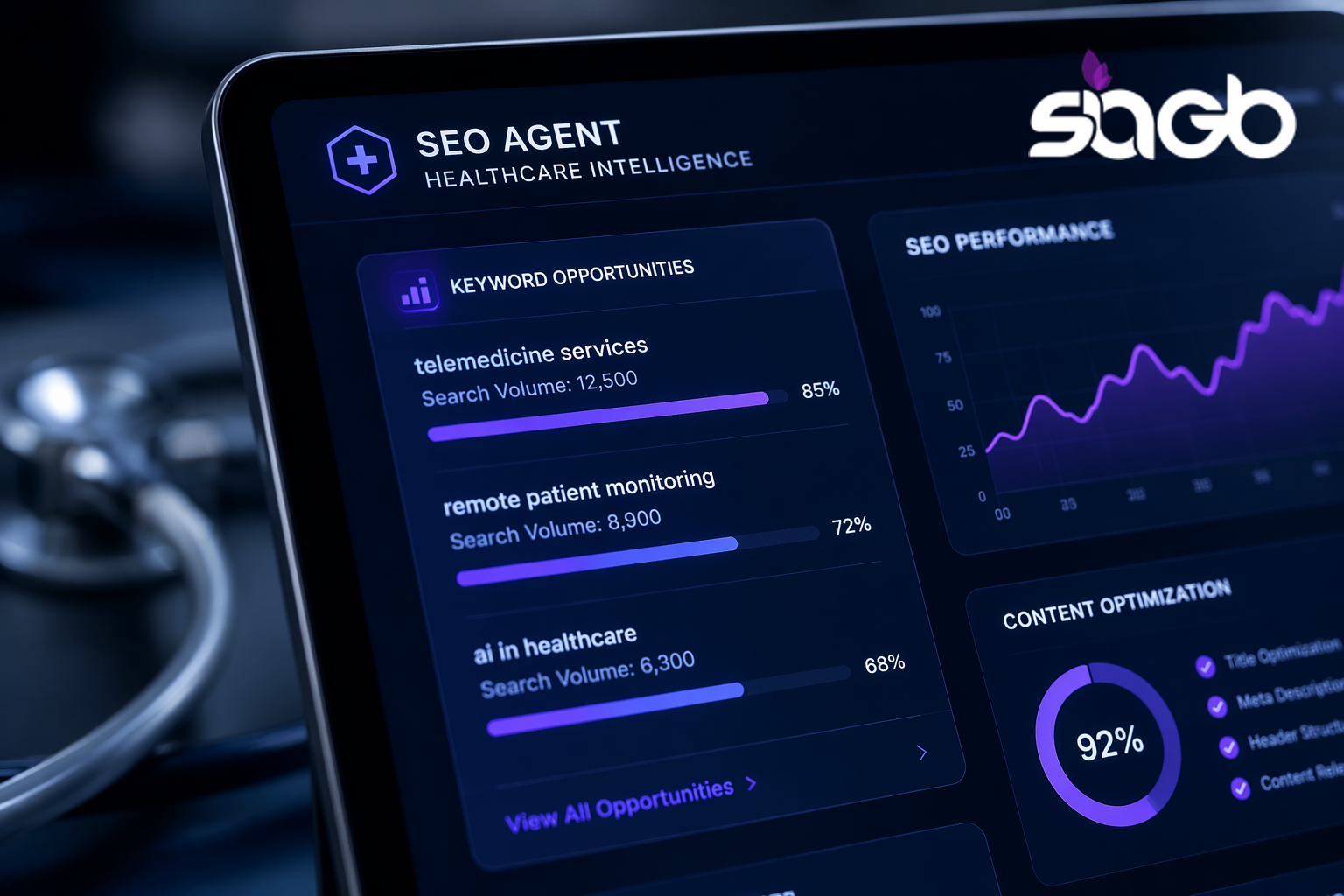
Healthcare SEO is high risk. Claims must be accurate. Content needs citations. Accessibility isn’t optional. One bad optimization step can trigger legal or reputational harm.
An AI SEO healthcare agent must understand medical context. It needs guardrails around language, structured data, and patient facing content. Medical practice SEO can’t be treated like retail SEO. That shortcut never ends well, trust me on this.
We’ve seen poor automation expose clinics to ADA website lawsuit doctors now face. The lesson is simple. AI agents need medical specific rules, not generic AI SEO tool logic. Otherwise, optimization turns into exposure instead of growth.
Answer Engine Optimization for Medical Websites
Answer engine optimization medical focuses on direct answers in search and AI tools. Think featured snippets, voice search, and the AI summaries shown by Google AI Overviews, ChatGPT, Perplexity, and Gemini. Accuracy matters more than volume, right? When a patient asks one of these tools a symptom question, the answer is often pulled from a handful of pages, so the citation you earn there carries real weight.
An AI agent supports AEO by structuring content, adding schema.org markup like FAQPage, MedicalWebPage, and Physician, and monitoring queries. It can surface actionable insights about what patients actually ask. But it cannot replace clinical review. Ever. This is the same reason we built AI powered patient scheduling for medical groups the way we did: the machine handles structure and speed, a qualified human owns the clinical truth.
AI generated content for medical practice systems works when doctors approve answers. Agents help format and optimize content. Humans validate facts. That balance protects trust, local SEO visibility, and long term rankings across the search engine.
ADA, WCAG, and Accessibility Risks in AI SEO
Healthcare website accessibility is a legal requirement, not a nice to have. US courts read ADA Title III to cover websites, and the practical benchmark is WCAG 2.1 and 2.2 at Level AA. WCAG healthcare website standards cover contrast, navigation, labels, and screen readers. Concrete example: success criterion 1.4.3 requires a contrast ratio of at least 4.5:1 for normal text, and 1.1.1 requires a text alternative for every meaningful image. An agent that swaps a hero image or recolors a call to action button can fail either one in a single edit.
AI driven SEO changes can accidentally break accessibility. A tool that rewrites headings or injects schema markup might disrupt ARIA labels. That’s how risk creeps in during content optimization.
ADA website lawsuits against doctors are rising. AI agents must include accessibility checks in every optimization loop. Otherwise, SEO efforts create silent legal debt instead of measurable gains.
Key accessibility risks AI agents must monitor include:
- Heading structure changes that affect screen readers
- Form updates inside an ADA compliant patient portal
- Dynamic content that breaks keyboard navigation
HIPAA, Cybersecurity, and Data Protection Concerns
SEO agents often touch forms, analytics, and patient portals. That creates risk. A HIPAA compliant website requires strict boundaries around data access, even during a technical SEO audit. Under HIPAA, protected health information includes 18 identifiers, from names and dates to IP addresses in the wrong context, and any of them leaking into an analytics stream is a reportable breach. A concrete US failure mode: an agent that drops a third party tracking pixel on a patient intake form can send appointment or condition data to an ad platform, which is exactly the pattern the Office for Civil Rights has warned health systems about.
Healthcare cybersecurity threats now include marketing systems. An AI agent pulling logs or tracking behavior can expose sensitive data if poorly configured. I’ve seen teams miss this during a rushed technical audit.
Cybersecurity for doctors is now part of SEO. The agent must respect data minimization, encryption, and access control. Optimization that ignores security isn’t optimization at all, it’s a problem waiting to happen.
Key data protection areas agents must respect:
- Medical practice data security and access controls
- HIPAA cybersecurity requirements for analytics
- Separation between SEO data and patient records
Reputation Management and Trust Signals at Scale
Google reviews medical practice listings shape patient choice. One bad review can outweigh ten good ones. Agents can help, carefully, with local SEO signals.
An AI agent can monitor reviews, flag sentiment shifts, and suggest responses. It can support online reputation healthcare efforts without posting fake feedback or manipulating users. That matters to SEO professionals who care about long term trust.
Automation must stay ethical. Patient review management works when humans respond with care. Agents surface issues. People build trust. That’s the balance.
AI-Optimized Healthcare Website Design and Redesign
Modern medical website design balances UX, compliance, and visibility. That’s hard to do manually at scale, especially during a redesign.
AI agents assist by analyzing structure, schema markup, internal links, and content optimization opportunities. They support healthcare website redesign with data, not opinions, and feed insights back to the SEO team.
But here’s the truth. Human led healthcare website redesign is still essential. Agents guide decisions. People make them. That’s how an AI optimized website healthcare project delivers optimized content without creating new SEO issues.
Infographic: Automated SEO Agents in Healthcare
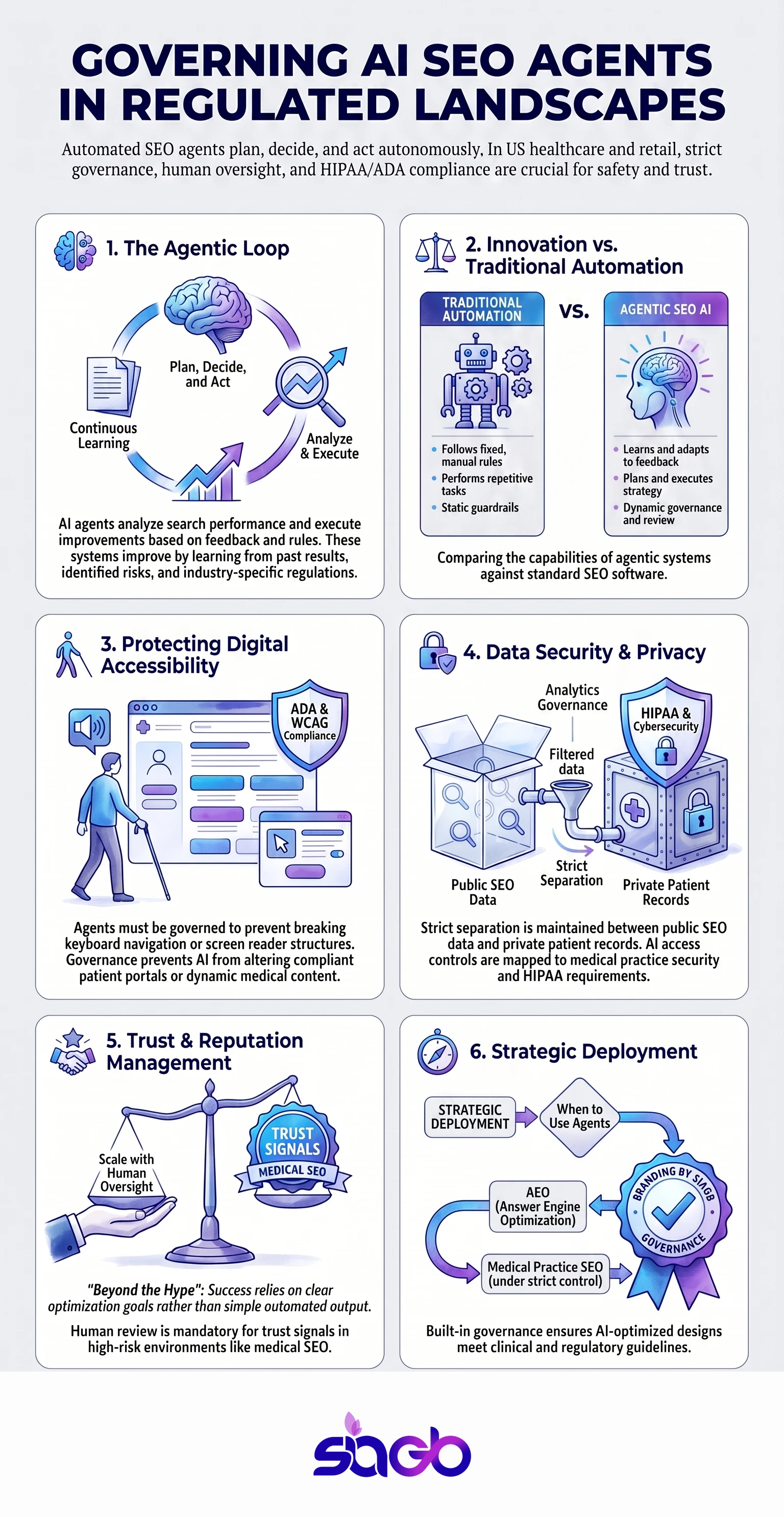
This visual shows the AI agent decision loop, data inputs, and human checkpoints. It compares manual SEO, basic automation, and agentic models with compliance and security layers highlighted, including technical SEO audits and ongoing content optimization.
When to Use Automated SEO Agents and When Not To
AI agents work best for monitoring, optimization, and AEO support. They shine in technical SEO checks, keyword research updates, content optimization reviews, and structured content audits using an AI SEO tool like Search Atlas.
They should not publish medical claims, accessibility changes, or legal language without approval. Ever. That includes changes suggested during a technical SEO audit or broader SEO audit.
Governance models matter. A clear human in the loop process protects ROI and SEO performance. This is where AI consulting for retail businesses and healthcare diverge. Context defines control for the SEO specialist and the wider SEO team.
Use agents as copilots, not autopilots. That’s the difference between scale and trouble.
Frequently Asked Questions
What is an automated SEO agent?
An automated SEO agent is an AI system that plans, executes, and adapts SEO tasks based on results. It differs from a basic SEO tool because it learns from outcomes and adjusts actions over time within a defined SEO workflow.
Is SEO automation safe for healthcare websites?
SEO automation can be safe in healthcare when strong human review, accessibility checks, technical SEO audits, and data controls are in place. Ungoverned systems increase legal and reputational risk.
How does agentic SEO differ from traditional SEO tools?
Agentic SEO systems decide what to do next based on feedback and optimization data. Traditional tools follow fixed rules without reasoning or adaptation.
Can AI agents handle medical content creation?
AI agents can support SEO content creation by structuring drafts and improving content optimization. Medical accuracy, claims, and AI generated content must always be reviewed by qualified professionals.
Do automated SEO agents help with AEO?
Yes. AI agents help structure content, apply schema markup, and monitor queries for answer engine optimization. Human validation remains essential for trust and compliance.
Key Takeaways and Final Thoughts
Automated SEO agents are systems, not shortcuts. They combine data, reasoning, optimization, and action with feedback loops that surface actionable insights.
Healthcare SEO demands compliance first AI design. Accessibility, security, and trust can’t be automated away, no matter how advanced the ai tool looks.
The strongest results come from human led, agent supported models using the right seo workflow and optimization approach. That’s how SIAGB delivers AI powered SEO and AEO services in the USA that actually work. Our founder, Sheetal Dhadial, brings 20+ years of IT and AI leadership and holds Certified Scrum Master and AgilePM credentials, and that governance mindset is baked into every agent we deploy. SIAGB is based in Sydney (ABN 16 659 507 178) and works with US healthcare and retail teams who need scale without losing the human in the loop.
Sources
- Industry-standard reference materials
- Peer-reviewed research and clinical guidelines

Ready to put this into practice?
Let's Talk