Chatbot analytics consultants in Australia help businesses turn conversations into clear revenue, booking, and service insights. The focus isn’t the chatbot alone, but what the data proves about customer intent, drop offs, and outcomes. For healthcare and retail, this approach supports safer decisions, better customer experience, and measurable ROI.
Introduction
Chatbot analytics is the practice of measuring what happens before, during, and after an automated conversation. It links questions, clicks, and handoffs to real business results. Think bookings, sales, fewer calls, or faster customer service.
Many Australian businesses are learning a tough lesson. Deploying an ai chatbot without insight is guesswork. And guesswork doesn’t stand up in board meetings. Or audits. Or complaints to the Office of the Australian Information Commissioner (OAIC).
This is where chatbot analytics consultants Australia wide step in. At SIAGB, a Sydney consultancy (ABN 16 659 507 178), we lead with the business problem, then design the right ai strategy around it. In our work building an AI-powered patient scheduling system for medical groups, the first question was never “which chatbot?” It was “which booking gets missed, and why?” The goal is simple. Prove value. Stay compliant. Improve outcomes over time. Honestly? Anything else is just noise.
What Chatbot Analytics Consultants Do in Australia
Chatbot analytics consultants design how data flows from each customer interaction into systems that matter. Booking software like HotDoc and HealthEngine. CRMs such as HubSpot and Salesforce. Practice management and clinical systems like Best Practice and MedicalDirector. Support tools like Zendesk. This is data engineering in practice, not theory.
The consulting work covers measurement design, data integration, data governance, and ongoing optimisation. We define success first, then track it. Missed intents. Abandoned chats. Repeat questions. Conversion points. In our Marvel PTE work, analytics run across 85,000 plus users and 900 plus institutes, so we know first hand how much signal sits inside conversations at scale. The result is data driven insights leaders can trust.
Many teams stop at chatbot development. They deploy and move on. Analytics led consulting keeps improving performance month after month. It turns conversational AI and generative AI into business intelligence and data intelligence. And yes, it can get uncomfortable. The data doesn’t lie.
Why Businesses Hire Chatbot Analytics Specialists
Businesses hire specialists when the ai chatbot feels busy but results stay flat. Analytics expose where users drop off or get stuck. They surface failed intents and wasted automation paths. In practice we watch three numbers first: intent-match rate, containment rate (queries resolved without a human), and booking conversion. When intent-match sits below roughly 80 percent, users start rephrasing and abandoning, and that pattern shows up clearly in the logs.
Out of the box reports rarely tell the full story. They don’t link an ai agent or chatbot solution to revenue or reduced workload. Proper data analytics connects behaviour to board level reporting, predictive analytics, and clearer ROI. That’s when leadership listens.
Chatbot Analytics for Healthcare vs Retail
Healthcare chatbot analytics focus on safety, clarity, and trust. Retail focuses on speed, customer engagement, and transactions. Same artificial intelligence. Very different risk.
The table below shows how the same metrics carry different weight across the two sectors.
| Analytics focus | Healthcare | Retail |
|---|---|---|
| Primary goal | Accurate guidance, completed bookings and recalls | Higher conversion, faster checkout |
| Key metric | Intent-match accuracy and safe-handoff rate | Add-to-cart and sales conversion |
| Governing rules | Privacy Act 1988, Australian Privacy Principles, My Health Records Act 2012 | Australian Consumer Law, Spam Act 2003 |
| Escalation trigger | Symptom or medication query routes to a human | High-value cart or refund request |
| Acceptable automation | Assist only, human oversight on clinical steps | Fully automated for most flows |
| Accessibility bar | WCAG 2.2 Level AA, mandatory | WCAG 2.1 Level AA, strongly advised |
In healthcare, journeys include symptoms, bookings, recalls, and follow ups, often tied to Medicare and bulk-billing eligibility. Analytics must respect accessibility and privacy rules. Errors here frustrate patients and create legal risk under the Notifiable Data Breaches scheme.
Retail chatbot analytics track product discovery, cart support, and customer service deflection. The goals are higher conversion and better customer interaction. In healthcare, the goal is accurate guidance and completed bookings. Ignore that difference, and things usually end badly.
Linking Chatbot Data to Healthcare SEO and AEO
Here’s what happens in practice. Patients ask chatbots the same questions they type into Google, and now into ChatGPT, Perplexity, and Google AI Overviews. Analytics capture those questions. That data feeds healthcare SEO strategy.
AI SEO healthcare uses these insights to shape content that answers real patient intent. Not guessed keywords. Real questions. Answer engine optimisation medical strategies depend on this clarity.
Answer engines prefer clear, direct answers. Analytics show which responses convert into bookings. We track which chatbot questions appear most often, then map them to page content and schema.org markup, using FAQPage, MedicalWebPage, and LocalBusiness types so answer engines can quote the practice directly. Add data visualisation and on site copy that match how patients actually phrase things, and you get better alignment between intent and outcome. More bookings. Fewer confused patients.
Agentic AI and Automated SEO in Regulated Industries
Agentic AI refers to systems that take action based on rules and goals. An ai agent can monitor pages, suggest updates, or flag risks. Sounds great. And risky.
In healthcare, agentic systems and ai agents for SEO need strong governance. Human review still matters. Automation without checks breaks compliance fast, especially against the Australian Privacy Principles and Therapeutic Goods Administration advertising rules for anything touching medicines or devices.
Safe generative AI automation focuses on monitoring, alerts, and recommendations. Not uncontrolled publishing. We keep a human in the loop on every clinical-facing change and log each automated suggestion for audit. Used properly, ai technology saves time and improves consistency. Used poorly, it creates legal exposure. I don’t like the second option. Never have.
Healthcare Website Accessibility and Chatbot Accuracy
Accessibility affects automated conversations more than most people expect. WCAG healthcare website standards, specifically WCAG 2.2 Level AA, shape how patients interact with intelligent chatbots. That means visible focus states, keyboard-operable widgets, and a minimum 4.5:1 contrast ratio for text.
If an ai chatbot fails screen readers or keyboard navigation, drop offs rise. Frustration spikes. Data quality drops. Speed matters too: Google’s Core Web Vitals set the bar at Largest Contentful Paint under 2.5 seconds, Interaction to Next Paint under 200 milliseconds, and Cumulative Layout Shift under 0.1. A chat widget that blows past those thresholds hurts both rankings and predictive analytics and decision making.
An ada compliant patient portal must work with conversational AI flows. Same for ada compliance medical website requirements. Accessibility failures aren’t just legal risks. They hide real user intent.
HIPAA Compliant Websites and Chatbot Data Security
Healthcare chatbots handle sensitive data. That brings obligations. HIPAA compliant website principles overlap with Australian healthcare data laws, chiefly the Privacy Act 1988, the 13 Australian Privacy Principles, and the My Health Records Act 2012 overseen by the Australian Digital Health Agency.
Logging, storage, and access controls matter. Who can see transcripts? Where are they stored? Australian data residency is often required, so we host in AWS Sydney (ap-southeast-2) or Azure Australia East. How long are they kept? This is where data governance and data engineering intersect.
Healthcare cybersecurity threats increasingly target automated systems. Medical practice data security requires encryption in transit and at rest (TLS 1.2 or higher, AES-256), role based access, and monitoring. Under the Notifiable Data Breaches scheme, an eligible breach must be reported to the OAIC and affected patients, usually within 30 days. Cybersecurity for doctors isn’t optional anymore. It’s survival.
Reputation Management Through Chatbot Analytics
Chatbots collect feedback at the right moment. After a booking. After a visit. Analytics show patterns in sentiment and complaints.
That insight feeds google reviews medical practice strategies and online reputation healthcare programs. It also supports smarter recall timing and customer engagement.
Done right, analytics driven review management improves trust without pressure. Patients feel heard. Practices spot trends early. Clients appreciate that level of care.
Modern Medical Website Design with Integrated AI
Modern medical website design treats automated conversations as part of the experience. Not pop ups bolted on later.
Analytics guide redesign decisions. Where users stall. Where they convert. What content helps. This applies to websites and mobile app journeys alike.
An ai optimised website healthcare teams trust balances automation and accessibility. Generative AI supports care journeys. It doesn’t replace them. Subtle difference. Huge impact.
Infographic: How Chatbot Analytics Drive Healthcare ROI
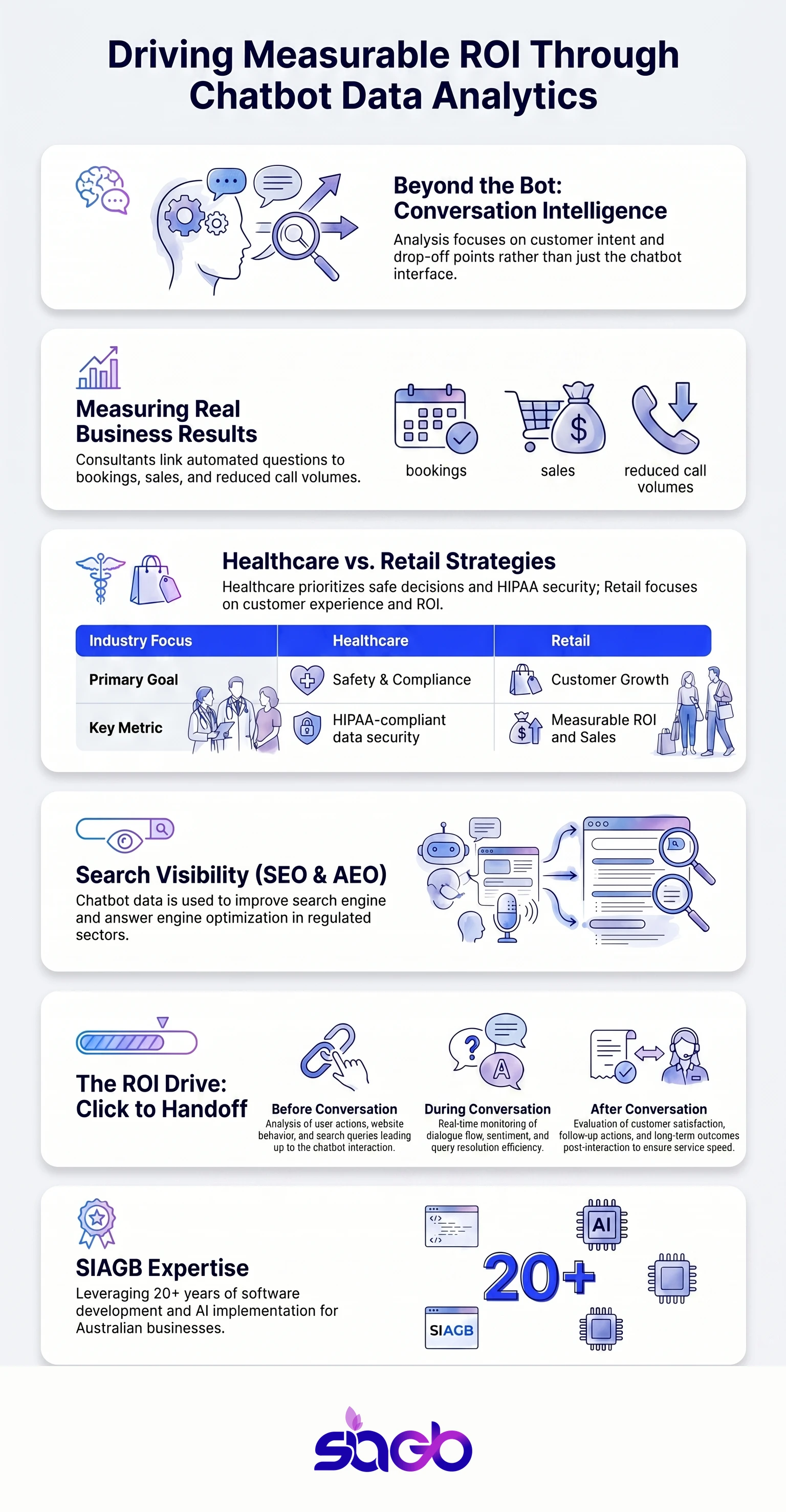
A simple flow shows questions turning into bookings and recalls. Compliance, security, and accessibility checkpoints sit at each stage. Data science, data visualisation, and business intelligence make performance visible.
Frequently Asked Questions
What does a chatbot analytics consultant actually measure?
A consultant measures conversations, intent accuracy, drop offs, and outcomes. That includes bookings, calls avoided, and follow ups completed. The goal is actionable insights, not vanity metrics.
Are chatbot analytics safe for healthcare data?
Yes, when designed correctly. Secure logging, access controls, and governance are required. Compliance must be built into analytics from day one.
Can chatbot data really improve healthcare SEO?
It can. Chatbot questions reflect real patient searches. That data improves content relevance and answer engine optimisation performance.
How much automation is too much in healthcare chatbots?
It depends on risk. Automation should assist, not decide. Human oversight is essential for regulated workflows.
Do retail and healthcare need different chatbot analytics?
They do. Retail prioritises speed and sales. Healthcare prioritises accuracy, trust, and compliance. Analytics must reflect those goals.
Key Takeaways and Final Thoughts
Chatbot analytics isn’t about more reports. It’s about better decisions. For healthcare, the stakes are higher. Compliance, trust, and safety matter as much as ROI.
SIAGB delivers ai consulting services built on real ai expertise. Our founder, Sheetal Dhadial, brings 20 plus years of IT and AI leadership and holds Certified Scrum Master and AgilePM credentials, so delivery discipline is baked into every engagement. From ai strategy and ai implementation to ai chatbot development, power virtual agent solutions, process automation, and end to end ai projects, we help Australian businesses build real ai capability. We have shipped analytics for Marvel PTE across 85,000 plus users and 900 plus institutes, and an AI-powered patient scheduling system for medical groups. That’s how sustainable artificial intelligence and generative AI actually work.
Sources
- MIT Technology Review (technologyreview.com)
- Stanford HAI - Human-Centred AI (hai.stanford.edu)

Thinking about how this applies to your business?
Start a Conversation