
A ChatGPT SEO tool checks whether AI assistants mention and cite your brand when people ask questions in your space. It runs a fixed set of prompts across ChatGPT, Perplexity, Google’s AI Overviews and others, records which brands get named, and tracks how that shifts week to week. Think visibility monitoring, not keyword rankings.
That’s the short version. The longer version is where it gets interesting, because half these tools measure the wrong thing, and the category is barely two years old.
What a ChatGPT SEO tool actually does
Strip away the marketing and every one of these tools does the same three jobs. It sends prompts to one or more AI assistants. It reads the answers and notes which brands, domains and sources got mentioned. Then it charts that over time so you can see whether you’re gaining or losing ground.
The good ones go a step further. They tell you not just that you appeared, but how: were you named in the body of the answer, or cited as a linked source? Were you first, or buried behind three competitors? A mention in passing and a citation with a link are very different outcomes, and a tool that lumps them together isn’t much use.
Here’s the mental shift, and it trips people up. Traditional SEO tools like Semrush and Ahrefs answer one question: where does my page rank for this keyword. A ChatGPT SEO tool answers a different one. When someone asks about your space, does the assistant bring you up at all? There’s no position 4 to climb to. You’re either in the answer or you’re not. That binary is the whole game now, and it’s why we treat this as a core part of answer engine optimisation rather than a bolt-on.
Why bother tracking visibility in ChatGPT?
Fair question. If you can’t rank in the old sense, why measure it?
Because the traffic pattern is shifting under your feet. According to Google Search Central, AI Overviews now sit above the traditional results for a lot of queries, and separate assistants like ChatGPT and Perplexity answer questions that used to begin on a search engine. When the answer arrives without a click, being the brand named in that answer is worth more than being link number six that few people scroll to.
So the thing you’re tracking isn’t vanity. It’s whether you exist at the exact moment a buyer is deciding. A clinic in North Sydney that gets cited when someone asks an assistant “who does website accessibility audits near me” is in a genuinely different position from one that doesn’t. There’s an Australian wrinkle here too: a lot of local buyers phrase questions with “near me” or a suburb name, so the assistant leans on your Google Business Profile and your .com.au service pages saying the same thing. Get that consistent and you show up for Parramatta and Bondi Junction, not just “Sydney”. And you can’t improve what you’re not watching. Right?
The main types of tool

They’re not all the same shape. Broadly they split into three camps, and which one fits depends on how deep you’re going.
| Type | Example tools | What they track | Best for |
|---|---|---|---|
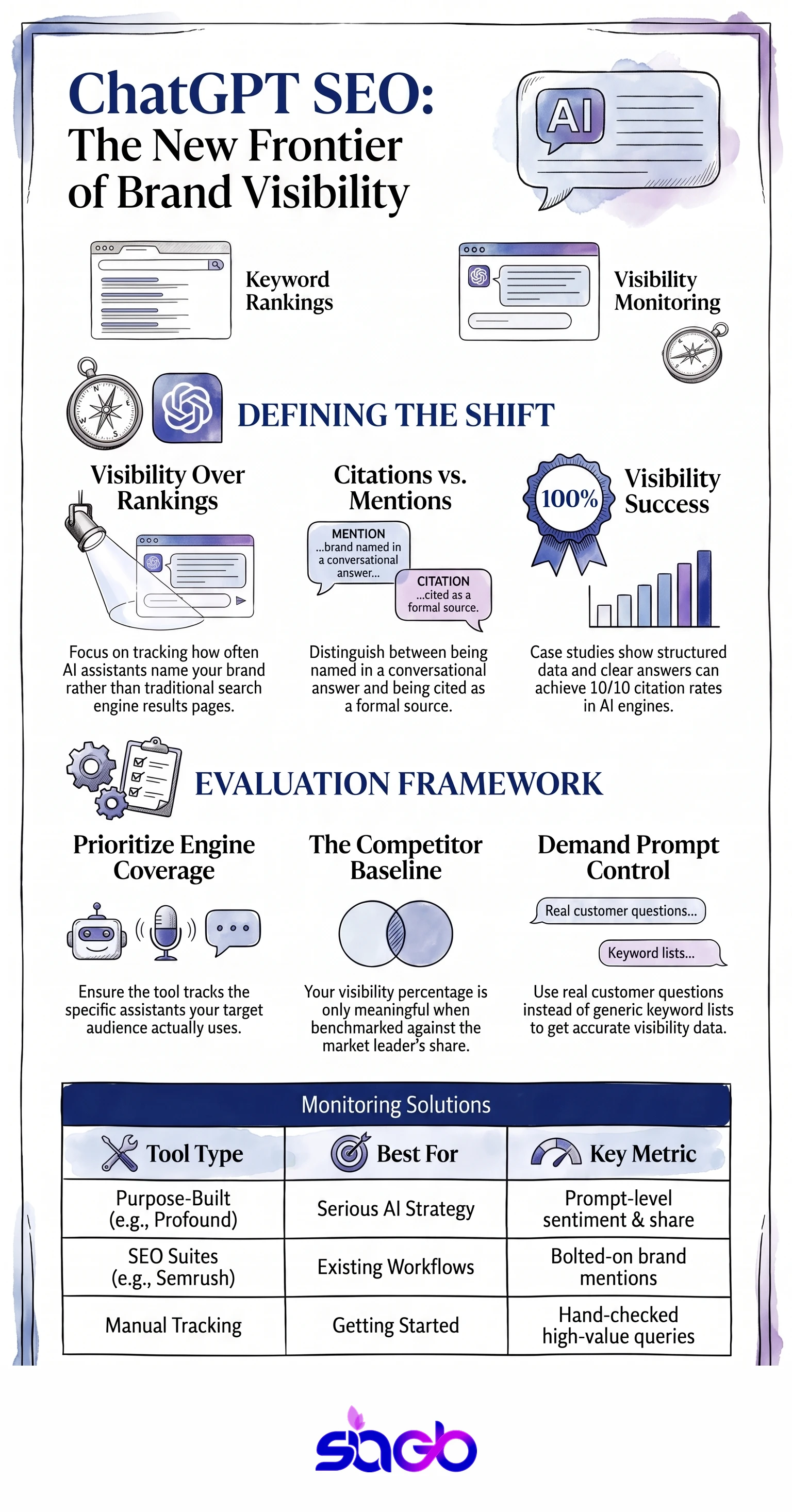
| Purpose-built AI trackers | Profound, Otterly.AI, Peec AI | Prompt-level mentions, citations, competitor share, sentiment across multiple assistants | Businesses serious about AI visibility as a channel |
| SEO suites with AI add-ons | Semrush, Ahrefs Brand Radar | AI mentions bolted onto an existing keyword and backlink toolset | Teams already living in one SEO platform who want it all in one login |
| Manual and lightweight checks | A spreadsheet, or a free checker | A small set of prompts run by hand, when you remember | Getting started, or checking a single high-value question |
The purpose-built trackers do the most, and they cost the most. The suite add-ons are convenient if your team already pays for Semrush anyway, though the AI features tend to lag behind the specialists by a release or two. And the manual approach is genuinely underrated for a first pass. I’ve told plenty of clients around Sydney and the Central Coast to spend a week running twenty prompts in a spreadsheet before spending a cent on software. One accounting firm in Chatswood did exactly that and found they already showed up for half their prompts, so they spent the budget on the other half instead. It clears up fast whether you have a visibility problem worth paying to solve.
One caveat on all of it: this space moves quickly. Pricing, engine coverage and features shift every few months, so treat any specific claim (including mine) as a starting point to verify, not gospel.
How to choose one
Skip the feature-count comparison. Most of those features you’ll never touch. These are the four things that actually decide whether a tool earns its keep.
- Engine coverage first. If it doesn’t track the assistants your buyers use, the prettiest dashboard on earth is useless. Check the engine list before anything else.
- Citation vs mention. Make sure it separates “named in the answer” from “cited as a source”. You need both numbers, not a blended one.
- Competitor tracking. Your own trend line means little without the field. Being mentioned 40% of the time sounds fine until you learn the market leader sits at 85%.
- Prompt control, so you can feed it the real questions your customers ask rather than a generic keyword list. This one’s easy to overlook and it matters more than it looks.
Notice what’s not on that list: AI-generated reports, content suggestions, all the bells. Nice to have. Rarely why you’re buying.
What these tools can’t do

Here’s the part the sales pages skip. A tracking tool measures. It does not move the needle by itself. It’ll tell you, cheerfully, that you’re invisible for your best prompt, and then it’ll sit there while you figure out why.
Getting cited is still earned the hard way. You answer the question clearly in the first two sentences of the page. You mark it up with clean schema so machines can parse it (Google’s own structured data guidance is the reference we point clients to). You build enough trust signals that an assistant is willing to repeat you. The tool watches all that land. It doesn’t do any of it.
And they can be noisy. Assistants give slightly different answers to the same prompt on different days, so a single week’s dip might be variance, not a real drop. Read the trend, not the daily wobble. In Google Search Console you’d never panic over one day’s impressions. Same discipline here.
Where we sit on this
I’ll be straight about our angle, because it colours the advice. We don’t sell a tracking tool. We use them, several of them, and then we do the optimisation work they only measure.
We tested this properly rather than guessing. In our RevivalMD AI citations case study, a single physician-led clinic was cited in 10 of 10 tracked queries in Google AI Mode and 10 of 10 in Perplexity. ChatGPT cited it in 9 of 10, all within 30 days of the pipeline going live. No extra backlinks. The gain came from structure, schema markup, and answering the question in the first two sentences. A tool showed us the before and after. It didn’t create the after.
So if you’re weighing up software, good. Track your visibility, you should. Just don’t expect the dashboard to be the strategy. If you want the strategy alongside the measurement, that’s the work we do in AI SEO, and it’s the same play whether your buyers are in Sydney or Los Angeles.
Infographic: Choosing a ChatGPT SEO Tool
FAQ
What is a ChatGPT SEO tool?
Software that watches whether assistants like ChatGPT, Perplexity and Google’s AI Overviews name or cite your brand when someone asks a relevant question. It fires a set of prompts on a schedule, logs which brands come up, and charts the movement so you can see the trend rather than guess at it.
Can you actually track rankings inside ChatGPT?
Not in the old blue-link sense, no. There’s no page one to sit on. What you track instead is presence and citation: how often you’re named, whether you’re linked as a source, and how you stack up against competitors on the same prompt. That comparison is the number worth caring about.
Do I need a paid tool, or can I check by hand?
For a handful of prompts, by hand is fine, and honestly a sensible way to start. Once you care about 50 prompts across four assistants, tracked weekly, with the competitor field included, a tool earns its money. Doing that manually is a part-time job, and not a fun one.
Will a tracking tool improve my visibility on its own?
It won’t. It measures, it doesn’t fix. The tool will tell you you’re missing from your best prompt and then wait for you to do something about it. The lift still comes from clear answers up top, clean schema, and content an assistant trusts enough to repeat.
Which AI assistants should a tool cover?
ChatGPT, Google AI Overviews and Perplexity at a minimum, since that’s where most of the volume is. Add Google Gemini and Microsoft Copilot if your buyers lean on them. Engine coverage matters more than the dashboard, so read the list of assistants before you fall for the interface.
Key takeaways
ChatGPT SEO tools measure whether AI assistants mention and cite your brand, not where a page ranks. The category splits into purpose-built trackers (Profound, Otterly.AI, Peec AI), AI add-ons inside existing suites (Semrush, Ahrefs), and plain manual checks that are fine to start with. Choose on engine coverage, citation-versus-mention detail, and competitor tracking, not feature counts. And remember the tool only measures. Getting cited is still earned through clear answers, schema, and trust, which is the optimisation work itself.
If you’d rather someone ran both the measurement and the optimisation for you, that’s the work we do in answer engine optimisation. It usually pairs with a look at how to appear in ChatGPT for the questions that matter most to your business.
Sources
- Google Search Central, AI features and your website: https://developers.google.com/search/docs/appearance/ai-features
- Google Search Central, structured data intro: https://developers.google.com/search/docs/appearance/structured-data/intro-structured-data
- Google Search Console Help: https://developers.google.com/search/docs/monitor-debug/search-console-start
Updated August 2026. Written by Sheetal Dhadial, founder of SIAGB, an AI-native consultancy in Sydney.

Ready to put this into practice?
Let's Talk