
Cybersecurity for doctors is about protecting patient data, keeping clinics open, and staying out of legal trouble. It is no longer just an IT issue. One breach can stop care, break trust, and cost a practice for years. Under the HHS Breach Notification Rule, any breach affecting 500 or more individuals must be reported within 60 days, so a single lost laptop can become a public event.
Most doctors do not need to become tech experts. What they need is clear advice that fits real clinical work in the health care setting. That is exactly what this covers. In our work building AI-powered patient scheduling for medical groups, we track the same five weak points in almost every clinic we review: shared logins, unpatched plugins, missing multi-factor authentication, untested backups, and staff who were never trained to spot phishing.
Introduction Cybersecurity for Doctors
Cybersecurity for doctors has moved from the back office to the center of business risk. Clinics depend on digital records, online bookings, connected medical devices, and patient portals every day. That dependence makes the healthcare sector a prime target for cyber security threats.
In the United States, healthcare cyber attacks have increased fast over recent years. Small clinics are hit just as often as large hospitals, and sometimes more. Many healthcare organizations do not have full time security staff or mature cyber security processes. Unlike a large hospital system with a dedicated security operations center, a five-physician practice often runs on one part-time IT contractor.
This guide stays practical. No jargon. No scare tactics. You will see how cyber security affects patient safety, your reputation, and day to day operations, and what steps actually lower cyber risk. As our founder Sheetal Dhadial, who brings 20+ years of IT and AI leadership, puts it: “Security is not a product you buy once; it is a habit your whole clinic keeps.”
Sound familiar?
Why Doctors Are Prime Targets for Cyber Attacks

Health information is valuable. Very valuable. On black markets, a stolen health record often sells for far more than a credit card number, because it includes names, insurance and Social Security numbers, and full medical histories that cannot be reissued the way a card can. That is sensitive health information criminals want.
Many clinics run as small businesses within the healthcare industry. Care comes first, protection comes later. Tight budgets and busy schedules mean safeguards around patient information can slip. Attackers know this. In contrast with retail, a health record stays exploitable for years rather than weeks.
Digital tools also raise exposure. Online forms, patient portals, cloud software such as e-prescribing and telehealth apps, and networked medical devices like infusion pumps all widen the attack surface. Each system needs proper controls. Miss one setting and problems start.
Here is the thing. Hackers do not care how compassionate your healthcare organization is. They care about easy access to sensitive patient data.
Common Cybersecurity Threats Facing Healthcare Providers
Ransomware is one of the biggest risks in the healthcare sector. A ransomware attack can lock every system in minutes. Appointments stop. Records disappear. Patient care suffers quickly.
Phishing is just as common. Staff receive emails that look real. Urgent. Routine. Familiar. One wrong login and attackers gain access to systems holding health data. The HHS Office for Civil Rights has repeatedly reported that phishing and stolen credentials, rather than exotic zero-day exploits, drive the majority of large healthcare breaches.
Weak passwords cause trouble too. Reused logins. Shared accounts. Unlocked screens. Small gaps turn into a major cyber security risk for any healthcare provider.
Unsecured laptops and phones matter as well. A lost device without encryption can trigger a full cyber security incident. And yes, it happens more often than people admit.
Honestly? Most breaches start small, often with insider threats or simple mistakes. The table below maps the four threats we see most, specifically how each one enters and the first control that blocks it.
| Threat | How it usually enters | Typical impact | First control to deploy |
|---|---|---|---|
| Ransomware | Malicious email attachment or unpatched software | Systems locked in minutes, care halted for days | Daily tested backups plus rapid patching |
| Phishing | Fake login or invoice email to staff | Stolen credentials, account takeover | Multi-factor authentication on every account |
| Weak or shared passwords | Reused logins, unlocked screens | Quiet access to portals holding health data | Password manager plus unique 12+ character logins |
| Lost or stolen device | Laptop or phone left in a car or clinic | Exposure of unencrypted patient records | Full-disk encryption and remote wipe |
US Healthcare Cybersecurity Landscape
The US Cybersecurity and Infrastructure Security Agency (CISA) offers guidance, alerts, and support to organizations facing cyber threats. It lists healthcare and public health as 1 of the 16 critical infrastructure sectors, and one of the most targeted across the USA. Many practices also map their controls to the NIST Cybersecurity Framework 2.0, which organizes work into 6 functions: Govern, Identify, Protect, Detect, Respond, and Recover.
The HHS Office for Civil Rights sets direction for safe digital health use and enforces patient privacy rules. Its work helps US healthcare organizations balance access, privacy, and protection of health information. The HIPAA Security Rule, for example, treats encryption of protected health information as an addressable safeguard, which means you either implement it or document a defensible reason why not.
Legal risk is real. Data breaches can lead to investigations, fines, and mandatory reporting under HIPAA and the Breach Notification Rule. Civil penalties run across 4 tiers based on culpability, and the annual caps reach into the millions of dollars per violation category. Reputational damage often hurts more. Patient trust takes years to rebuild.
For healthcare organizations, cyber security is now part of duty of care. Not optional. Not something to fix later.
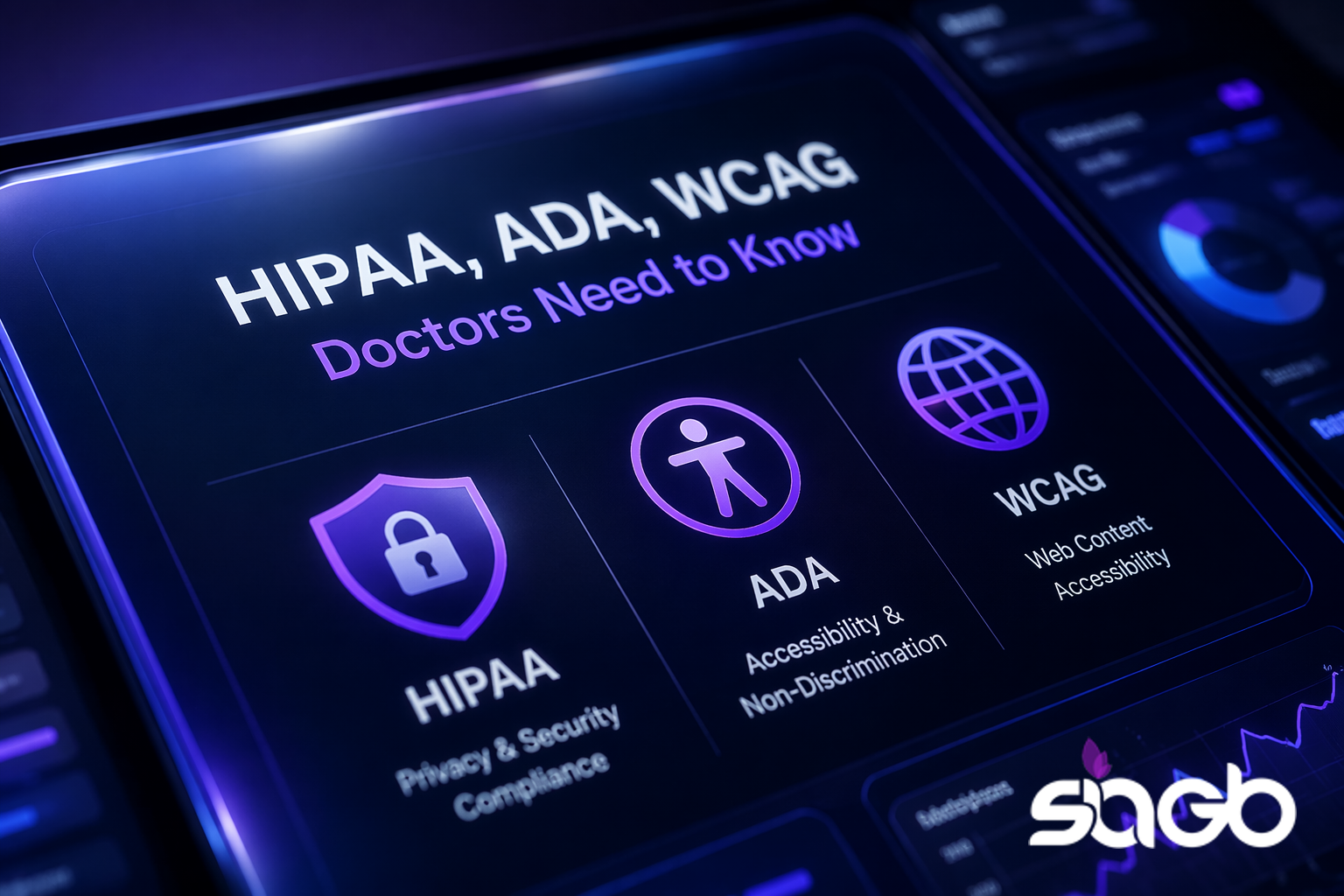
HIPAA, ADA, and WCAG What Doctors Need to Know
HIPAA focuses on protecting patient information and personal information. A HIPAA compliant website uses secure hosting, encrypted forms over HTTPS with TLS, and strict access controls. It is about real protection, not just paperwork.
ADA compliance medical website rules focus on accessibility. Clinics across the US face exposure if their sites are hard to use for people with disabilities. In April 2024, the Department of Justice finalized a rule adopting WCAG 2.1 Level AA as the technical standard for state and local government web content, and courts increasingly treat that same bar as the yardstick for private medical practices. ADA website lawsuit doctors are seeing this more often.
WCAG healthcare website standards support both access and security. The current WCAG 2.2 Level AA guidelines, published in 2023, add criteria such as accessible authentication and larger click targets, which reduce mistakes and legal risk. Three quick tests: keyboard-only navigation, a color contrast ratio of at least 4.5 to 1 for normal text, and descriptive labels on every form field.
Protection, accessibility, and compliance overlap more than most expect. The table below shows how the three regimes differ and where they reinforce each other.
| Regime | Primary goal | Applies to | Key control example |
|---|---|---|---|
| HIPAA | Protect health information | Covered entities and business associates | Encryption, audit logs, access controls |
| ADA | Prevent disability discrimination | Public-facing services and websites | Usable portal, no access barriers |
| WCAG 2.2 AA | Technical accessibility standard | Web content and apps | 4.5 to 1 contrast, accessible auth, labels |
Improve one, and the others often follow.
Website Security and Accessibility Risks for Clinics
Many doctors underestimate website risk. Outdated plugins, weak hosting, and loose access controls create easy entry points for attackers.
ADA website lawsuit doctors face often involve patient portals. A non compliant portal can block access and expose sensitive information. That’s a double problem.
Healthcare website redesign projects add risk too. Gaps often appear during changes. New features go live without full testing. Attackers love transition periods.
Slow down here. Rushing usually costs more later.
Cybersecurity Best Practices for Doctors

Strong protection doesn’t need to be complicated. It needs to be consistent.
Multi factor authentication should protect email, portals, and admin accounts. Microsoft has reported that MFA blocks more than 99% of automated account-takeover attempts, which makes it the single highest-value control for the money. Full stop.
Regular updates matter. Systems, devices, and websites need patching, ideally within 30 days for high-severity issues rather than whenever someone remembers. Backups should follow the 3-2-1 rule: 3 copies, on 2 types of media, with 1 kept offsite and tested monthly. This limits damage from ransomware and data loss.
Staff training builds security awareness and cybersecurity awareness. Short sessions work best. Teach healthcare professionals how to spot phishing and report issues fast. In our experience, 4 quarterly 20-minute sessions beat 1 long annual lecture, because the habit sticks.
Every clinic needs an incident response plan. Who to call. What to shut down. How to keep services running. When a cyber incident hits, clarity reduces panic.
These cybersecurity measures support patient safety, not just systems.
Key Point: Robust cyber security improves cyber resilience across the healthcare industry.
The Role of AI in Modern Healthcare Cybersecurity
AI helps spot unusual behavior faster than people alone. It flags odd logins, strange data access, and possible cyber attack activity.
Some clinics already use AI tools to monitor systems around the clock. They support cybersecurity measures by spotting patterns humans might miss. We built the Marvel PTE platform, which now serves 85,000+ users across 900+ institutes, so we know firsthand that anomaly detection at that scale only works when the underlying logins and data flows are locked down first.
Automation helps. But people still matter. AI cuts noise. Humans make final decisions.
Balance is key. Too much automation creates blind trust. Too little leads to burnout.
AI SEO and Reputation Risks Doctors Often Miss
Protection affects visibility. Insecure websites load slowly, get flagged, or drop in rankings. Google measures this through Core Web Vitals, and the recommended thresholds are direct: Largest Contentful Paint under 2.5 seconds, Interaction to Next Paint under 200 milliseconds, and Cumulative Layout Shift under 0.1. A compromised or bloated site misses all three and hurts discovery and trust.
AI answer engines raise the stakes further. When a patient asks ChatGPT, Perplexity, or Google AI Overviews for a local doctor, these systems favor sites that are secure, fast, and marked up with schema.org types such as MedicalOrganization, Physician, and MedicalWebPage. A site flagged as unsafe rarely gets cited.
Google reviews profiles are also targets. Account takeovers can post fake reviews or remove real ones. That damages reputation management doctors depend on.
Patient review management needs secure logins and access control. Trust signals matter online. Strong cyber resilience supports credibility, even when patients do not notice it directly.
Reputation and protection move together. Break one and the other follows.
Cybersecurity and Patient Experience Go Hand in Hand
Secure patient recall systems improve follow ups and trust. Patients expect reminders without leaks of patient information. Simple.
Chatbots can improve access, but only if built safely. Clinics often work with specialists to balance insight and privacy.
Protecting sensitive health information while improving access is possible. Good cyber security supports better experiences, not worse ones.
This links back to earlier. Convenience without protection always backfires.
Infographic Cybersecurity Checklist for Doctors
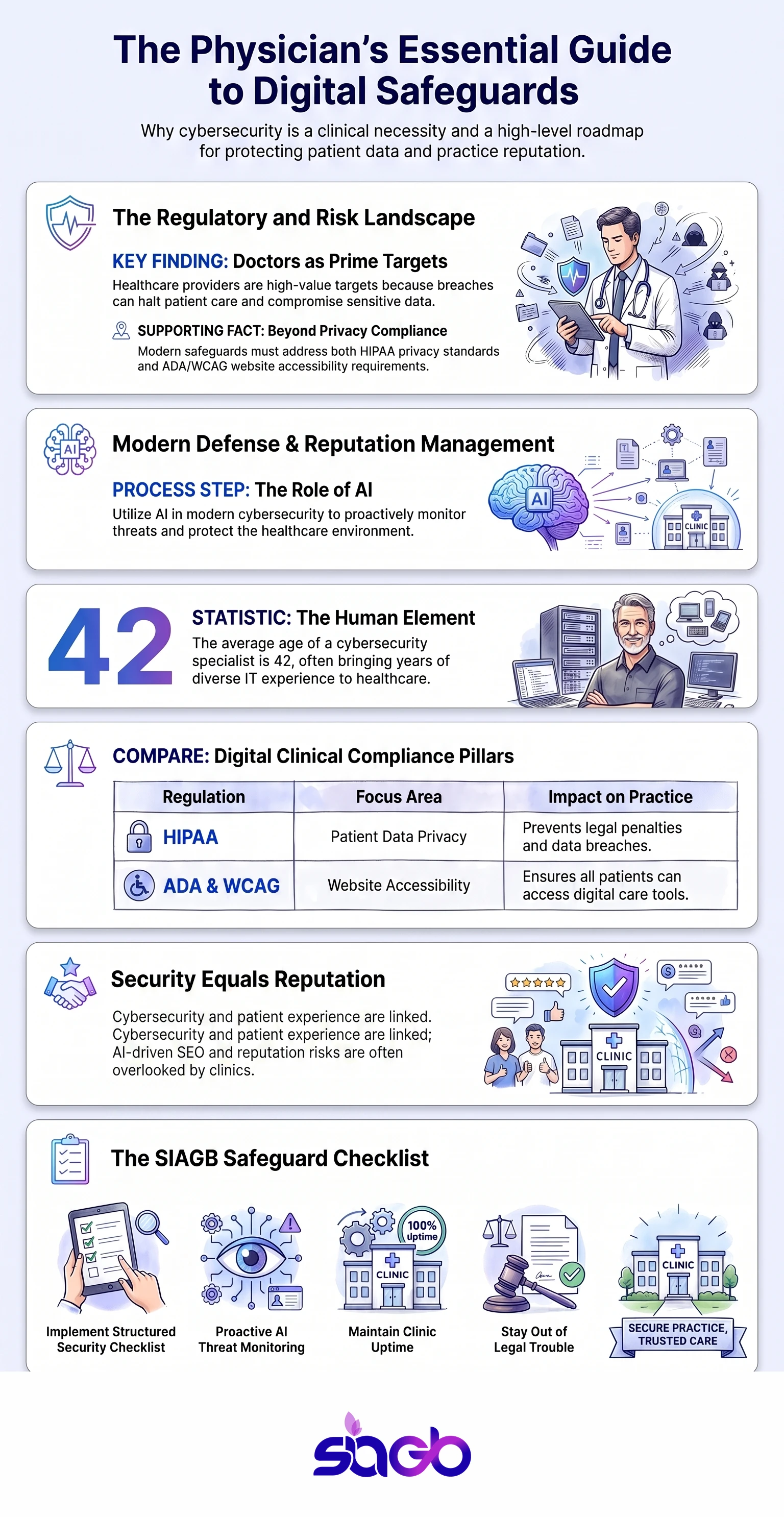
This simple checklist helps doctors review cyber security basics. Website safety. Staff habits. System access. Healthcare website accessibility included.
Use it as a quick internal audit. Share it with staff. Revisit it regularly.
Small checks. Big impact.
Frequently Asked Questions
What is cybersecurity for doctors?
Cybersecurity for doctors means protecting patient information, systems, and services from cyber threats. It supports safe care, legal compliance, and business stability.
What are the biggest cyber threats in healthcare?
The biggest risks include ransomware, phishing, weak passwords, insider threats, and unsecured devices. These threats affect all healthcare settings, large and small.
How does security relate to accessibility laws?
Accessible websites often improve protection. WCAG standards reduce user errors, while ADA compliance medical website rules lower legal risk.
What is the average age of a cyber security specialist?
The average age of a cyber security specialist is around 42 years, based on industry surveys. Many professionals move into security after earlier IT roles.
Which cybersecurity certification is best?
It depends on career goals. CISSP suits leadership roles. CompTIA Security+ works well for beginners. Healthcare roles often value privacy focused credentials.
How long does it take to become a cyber security specialist?
It usually takes two to four years, including study and hands on experience. Some move faster with focused training.
Key Takeaways for Doctors
Cybersecurity for doctors is essential in modern health care. It protects health data, keeps clinics operating, and maintains trust.
Compliance, accessibility, and robust cyber security are connected. Ignoring one increases risk everywhere. That includes websites, portals, and connected systems.
Proactive steps reduce stress. They lower legal exposure under HIPAA. They support safer outcomes for patients and physicians alike.
You don’t need perfection. You need steady progress. And consistency.
Sources
- Industry-standard reference materials
- Peer-reviewed research and clinical guidelines

Thinking about how this applies to your business?
Start a Conversation