
Cybersecurity for doctors is about protecting patient data, keeping clinics open, and staying out of legal trouble. It’s no longer just an IT issue. One breach can stop care, break trust, and cost a practice for years.
Most doctors don’t need to become tech experts. What they need is clear advice that fits real clinical work in the health care setting. That’s exactly what this covers.
Introduction Cybersecurity for Doctors
Cybersecurity for doctors has moved from the back office to the centre of business risk. Clinics depend on digital records, online bookings, connected medical devices, and patient portals every day. That dependence makes the healthcare sector a prime target for cyber security threats.
In Australia, healthcare has been the most reported sector to the OAIC for data breaches for several years running, accounting for roughly 20 percent of all notifications under the Notifiable Data Breaches scheme. The MediSecure breach in 2024 exposed the records of about 12.9 million people, and the 2022 Medibank incident hit close to 9.7 million current and former customers. Small clinics are hit just as often as large hospitals. Sometimes more. Many healthcare organisations don’t have full time security staff or a mature security programme built on the ACSC Essential Eight.
This guide stays practical. No jargon. No scare tactics. You’ll see how cyber security affects patient safety, your reputation, and day to day operations. And what steps actually lower cyber risk. In our work building AI powered patient scheduling for medical groups, we treat every booking field and portal login as sensitive by default, because that is where attackers look first.
Sound familiar?
Why Doctors Are Prime Targets for Cyber Attacks
Health information is valuable. Very valuable. On dark web markets, a full medical record can sell for 10 to 40 times the price of a stolen credit card number, because it cannot be cancelled the way a card can. Records hold names, dates of birth, Medicare numbers, IHIs (Individual Healthcare Identifiers), and full medical histories. That’s sensitive health information criminals want, and under the Privacy Act 1988 you are the one accountable when it leaks.
Many clinics run as small businesses within the healthcare industry. Care comes first, protection comes later. Tight budgets and busy schedules mean safeguards around patient information can slip. Attackers know this.
Digital tools also raise exposure. Online forms, patient portals, cloud software, and networked medical devices all widen the attack surface. Each system needs proper controls. Miss one setting and problems start.
Here’s the thing. Hackers don’t care how compassionate your healthcare organisation is. They care about easy access to sensitive patient data.
Common Cybersecurity Threats Facing Healthcare Providers
Ransomware is one of the biggest risks in the healthcare sector. A ransomware attack can lock every system in minutes. Appointments stop. Records disappear. Patient care suffers quickly. The ACSC’s Annual Cyber Threat Report has repeatedly flagged healthcare among the top three sectors for reported ransomware, and downtime often runs for days, not hours.
Here is how the main threats compare, and what actually blunts each one:
| Threat | How it gets in | Real impact on a clinic | Control that helps most |
|---|---|---|---|
| Ransomware | Phishing link, unpatched VPN or remote desktop | Full system lockout, cancelled appointments | Tested daily backups (3-2-1), Essential Eight patching |
| Phishing | Spoofed email, fake login page | Stolen portal or email credentials | Phishing resistant MFA, staff training |
| Weak or reused passwords | Shared logins, no lockout policy | Silent account takeover | Password manager, MFA, unique 14+ character passphrases |
| Lost or stolen device | Unencrypted laptop or phone | Notifiable breach under the NDB scheme | Full disk encryption, remote wipe |
| Insider mistake | Misdirected email, wrong attachment | Accidental disclosure of patient data | Data loss prevention, least privilege access |
Phishing is just as common. Staff receive emails that look real. Urgent. Routine. Familiar. One wrong login and attackers gain access to systems holding health data.
Weak passwords cause trouble too. Reused logins. Shared accounts. Unlocked screens. Small gaps turn into a major cyber security risk for any healthcare provider.
Unsecured laptops and phones matter as well. A lost device without encryption can trigger a full cyber security incident. And yes, it happens more often than people admit.
Honestly? Most breaches start small. Often with insider threats or simple mistakes.
Australian Healthcare Cybersecurity Landscape
The Australian Cyber Security Centre (ACSC) offers guidance, alerts, and support to organisations facing cyber threats. Its ReportCyber portal is where you log an incident, and its Essential Eight maturity model is the baseline most Australian practices are now measured against. They list healthcare as one of the most targeted sectors in Australia.
The Australian Digital Health Agency sets direction for safe digital health use, including My Health Record and secure messaging standards. Their work helps Australian healthcare organisations balance access, privacy, and protection of health information.
Legal risk is real. Under the Notifiable Data Breaches scheme in Part IIIC of the Privacy Act 1988, an eligible breach likely to cause serious harm must be reported to the OAIC and to affected patients as soon as practicable, generally within 30 days of becoming aware. Penalties for serious or repeated interference with privacy now reach into the tens of millions of dollars after the 2022 amendments. Reputational damage often hurts more. Patient trust takes years to rebuild.
For healthcare organisations, cyber security is now part of duty of care. Not optional. Not something to fix later.
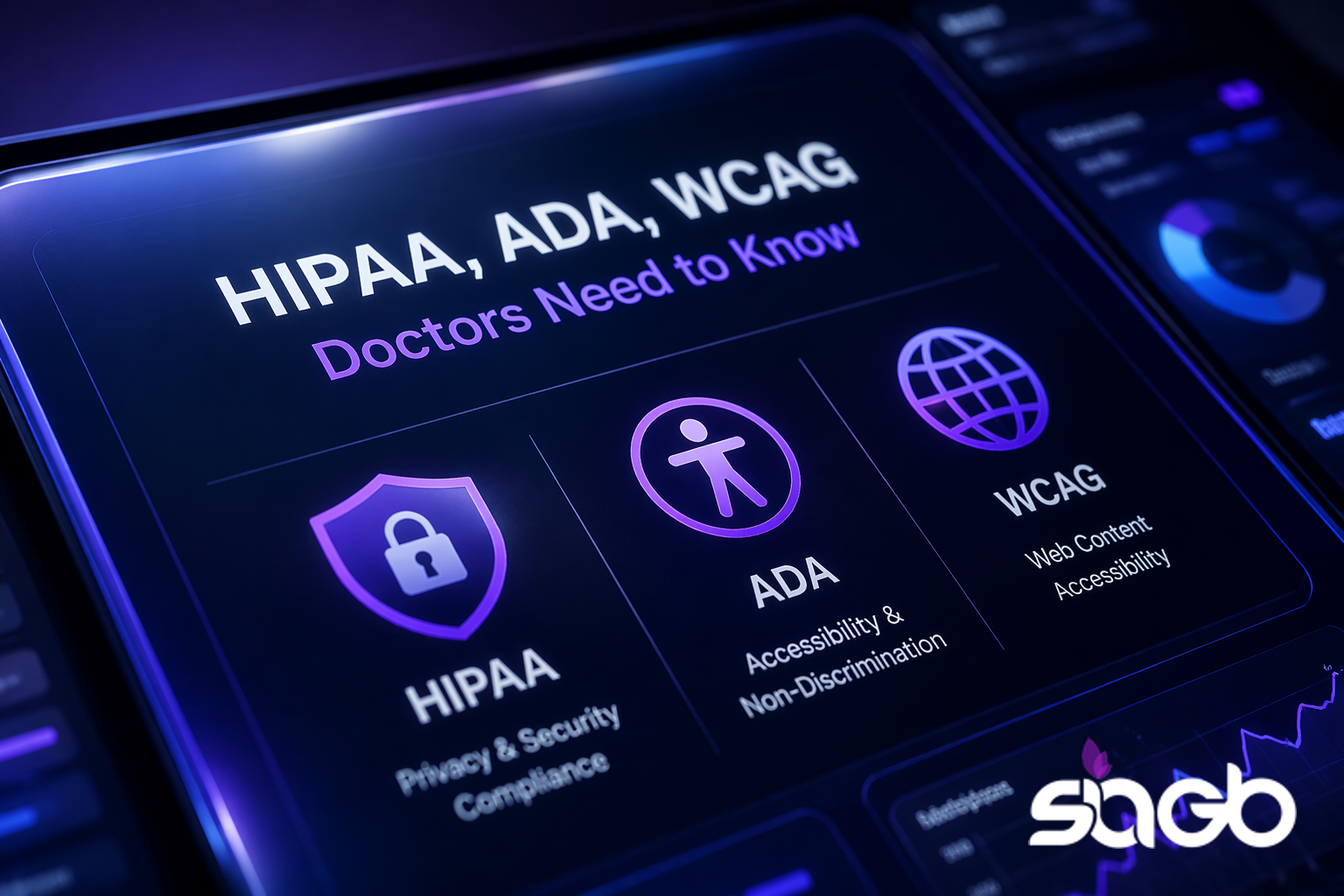
HIPAA, ADA, and WCAG What Doctors Need to Know
HIPAA focuses on protecting patient information and personal information. A HIPAA compliant website uses secure hosting, encrypted forms, and strict access controls. It’s about real protection, not just paperwork.
ADA compliance medical website rules focus on accessibility. Even Australian clinics face exposure if their sites serve global users. ADA website lawsuit doctors are seeing this more often.
WCAG healthcare website standards support both access and security. The current benchmark is WCAG 2.2 Level AA, which covers things like colour contrast ratios of at least 4.5:1 for body text, visible focus indicators, and forms with proper labels. Clear navigation, correct labels, and secure forms reduce mistakes and legal risk at the same time.
Protection, accessibility, and compliance overlap more than most expect. Improve one, and the others often follow.
Website Security and Accessibility Risks for Clinics
Many doctors underestimate website risk. Outdated plugins, weak hosting, and loose access controls create easy entry points for attackers.
ADA website lawsuit doctors face often involve patient portals. A non compliant portal can block access and expose sensitive information. That’s a double problem.
Healthcare website redesign projects add risk too. Gaps often appear during changes. New features go live without full testing. Attackers love transition periods.
Slow down here. Rushing usually costs more later.
Cybersecurity Best Practices for Doctors
Strong protection doesn’t need to be complicated. It needs to be consistent.
Multi factor authentication should protect email, portals, and admin accounts. Microsoft’s own analysis found MFA blocks over 99 percent of automated account compromise attempts, so this one control does more than almost anything else. Full stop.
Regular updates matter. Systems, devices, and websites need patching, ideally within 48 hours for high risk vulnerabilities as the Essential Eight recommends. Backups should follow the 3-2-1 rule (three copies, two media types, one offline or offsite) and be test restored, not just scheduled. We track restore success, not backup success, because a backup you have never restored is only a hope. This limits damage from ransomware and data loss.
Staff training builds security awareness and cybersecurity awareness. Short sessions work best. Teach healthcare professionals how to spot phishing and report issues fast.
Every clinic needs an incident response plan. Who to call. What to shut down. How to keep services running. When a cyber incident hits, clarity reduces panic.
These cybersecurity measures support patient safety, not just systems.
Key Point: Robust cyber security improves cyber resilience across the healthcare industry.
The Role of AI in Modern Healthcare Cybersecurity
AI helps spot unusual behaviour faster than people alone. It flags odd logins, strange data access, and possible cyber attack activity.
Some clinics already use AI driven tools such as Microsoft Defender, CrowdStrike, or Darktrace to monitor systems around the clock. They support cyber security measures by spotting patterns humans might miss, like a login from an unusual location at 3am. In our own platform work, serving 85,000 plus users across 900 plus institutes on Marvel PTE, anomaly detection on login behaviour is what surfaces credential stuffing before it becomes a breach.
Automation helps. But people still matter. AI cuts noise. Humans make final decisions.
Balance is key. Too much automation creates blind trust. Too little leads to burnout.
AI SEO and Reputation Risks Doctors Often Miss
Protection affects visibility. Insecure or slow websites get flagged by browsers and drop in rankings. Google’s Core Web Vitals set concrete targets: Largest Contentful Paint under 2.5 seconds, Interaction to Next Paint under 200 milliseconds, and Cumulative Layout Shift under 0.1. A site without HTTPS, or one leaking mixed content after a breach, fails trust checks that both search engines and patients apply.
There is a newer angle too. AI answer engines like ChatGPT, Perplexity, and Google AI Overviews increasingly decide which clinics get named in an answer. They favour sites with clean structured data, so marking up your pages with schema.org types such as MedicalClinic, Physician, and FAQPage helps you get cited rather than skipped. A hacked or defaced site quietly disappears from those answers.
Google Business Profile listings are also targets. Account takeovers can post fake reviews or remove real ones. That damages the reputation management doctors depend on.
Patient review management needs secure logins and access control. Trust signals matter online. Strong cyber resilience supports credibility, even when patients don’t notice it directly.
Reputation and protection move together. Break one and the other follows.
Cybersecurity and Patient Experience Go Hand in Hand
Secure patient recall systems improve follow ups and trust. Patients expect reminders without leaks of patient information. Simple.
Chatbots can improve access, but only if built safely. Clinics often work with specialists to balance insight and privacy. Our team, led by SIAGB founder Sheetal Dhadial with 20 plus years in IT and AI leadership, builds these flows so that no patient message is stored in plain text and every integration follows least privilege access.
Protecting sensitive health information while improving access is possible. Good cyber security supports better experiences, not worse ones.
This links back to earlier. Convenience without protection always backfires.
Infographic Cybersecurity Checklist for Doctors
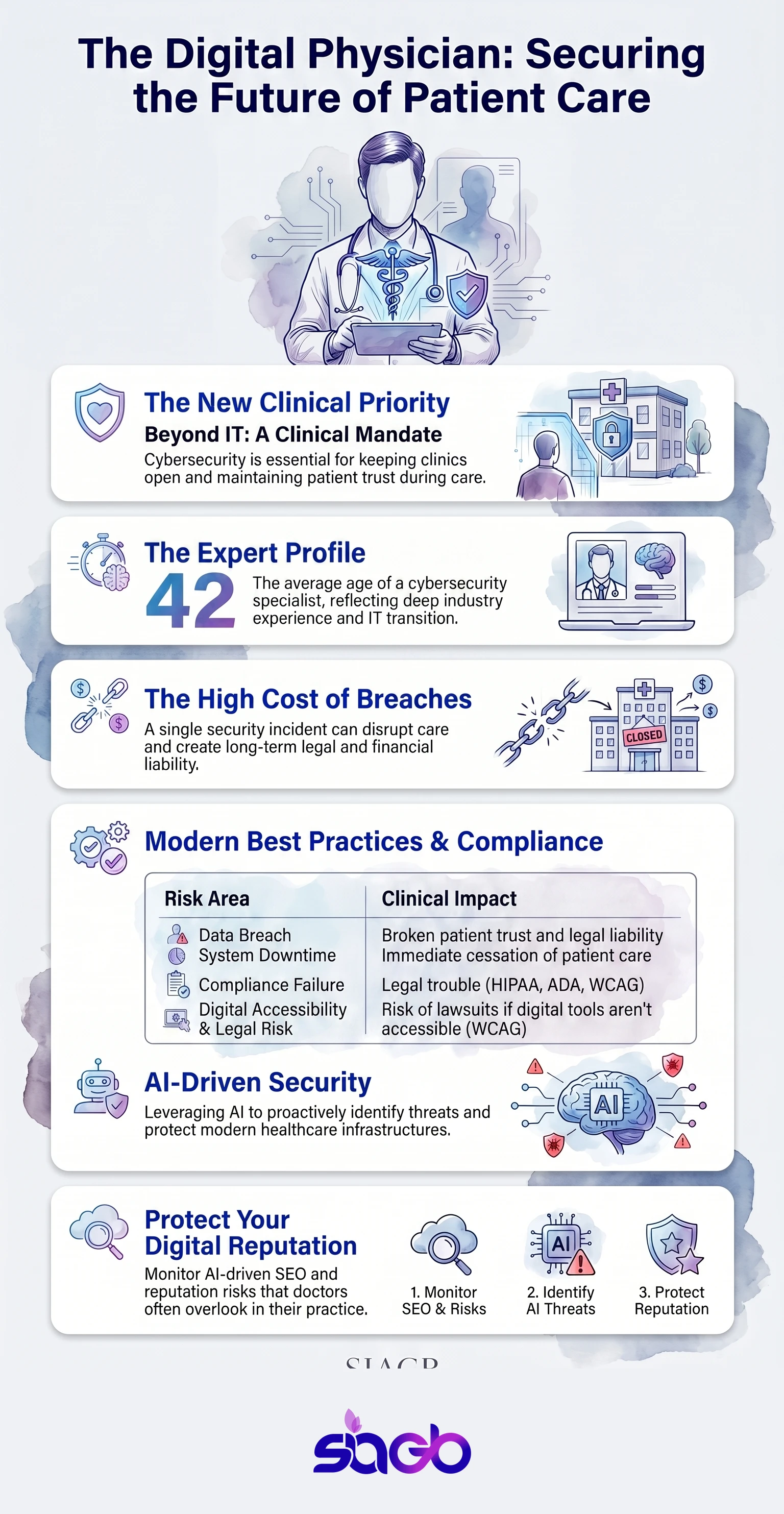
This simple checklist helps doctors review cyber security basics. Website safety. Staff habits. System access. Healthcare website accessibility included.
Use it as a quick internal audit. Share it with staff. Revisit it regularly.
Small checks. Big impact.
Frequently Asked Questions
What is cybersecurity for doctors?
Cybersecurity for doctors means protecting patient information, systems, and services from cyber threats. It supports safe care, legal compliance, and business stability.
What are the biggest cyber threats in healthcare?
The biggest risks include ransomware, phishing, weak passwords, insider threats, and unsecured devices. These threats affect all healthcare settings, large and small.
How does security relate to accessibility laws?
Accessible websites often improve protection. WCAG standards reduce user errors, while ADA compliance medical website rules lower legal risk.
What is the average age of a cyber security specialist?
The average age of a cyber security specialist is around 42 years, based on industry surveys. Many professionals move into security after earlier IT roles.
Which cybersecurity certification is best?
It depends on career goals. CISSP suits leadership roles. CompTIA Security+ works well for beginners. Healthcare roles often value privacy focused credentials.
How long does it take to become a cyber security specialist?
It usually takes two to four years, including study and hands on experience. Some move faster with focused training.
Key Takeaways for Doctors
Cybersecurity for doctors is essential in modern health care. It protects health data, keeps clinics operating, and maintains trust.
Compliance, accessibility, and robust cyber security are connected. Ignoring one increases risk everywhere. That includes websites, portals, and connected systems.
Proactive steps reduce stress. They lower legal exposure under the Privacy Act. They support safer outcomes for patients and general practitioners alike.
You don’t need perfection. You need steady progress. And consistency.
Sources
- Australian Cyber Security Centre (ACSC), Essential Eight and Annual Cyber Threat Report
- Office of the Australian Information Commissioner (OAIC), Notifiable Data Breaches statistics and Privacy Act 1988 guidance
- Australian Digital Health Agency, My Health Record and secure messaging standards
- W3C Web Content Accessibility Guidelines (WCAG) 2.2

Thinking about how this applies to your business?
Start a Conversation