
Google reviews for a medical practice are the star ratings and comments patients leave on your Google Business Profile, and they shape whether potential patients pick you or the clinic down the road. But healthcare is different from a cafe or a plumber.
In Australia, you can’t ask patients for reviews of a regulated health service. And everywhere, you have to answer them without confirming who is a patient. Get that wrong and a helpful reply becomes a privacy breach.
Handling Google reviews for a medical practice well, without review requests that break the rules, is a real skill for medical practitioners and any healthcare provider. It includes knowing what to do about fake Google reviews, and how satisfied patients can help a health practitioner build trust the right way. Let’s sort out what’s allowed, what isn’t, and how to handle the reviews you’d rather not have.
Why Google reviews matter for a practice
When someone searches for a doctor, your Google Business Profile is often the first thing they see, the map pin, the rating, a few recent patient reviews. That little block does a lot of quiet work. Positive reviews tell a new patient you’re worth trusting. A wall of negative online reviews sends them elsewhere before they ever call.
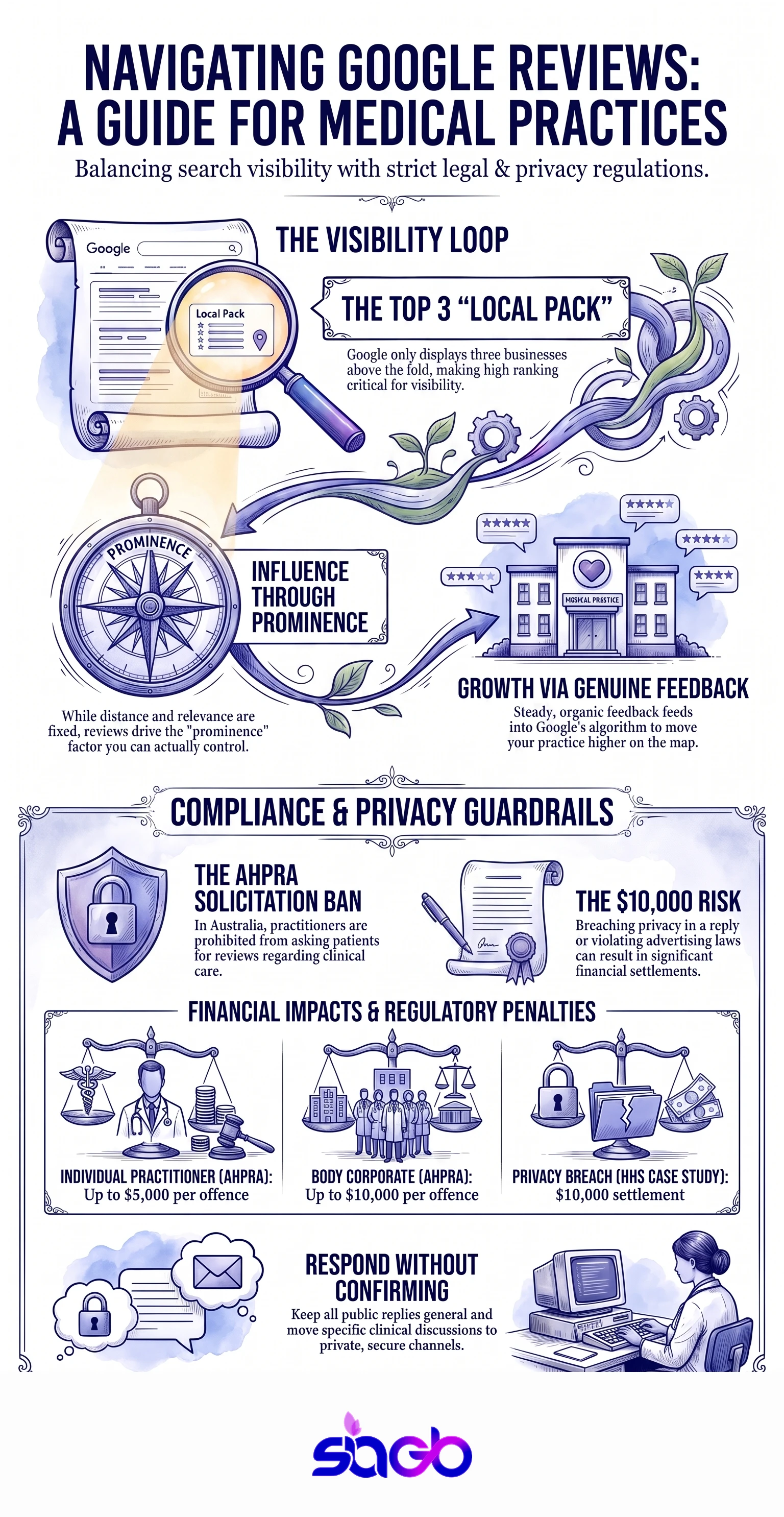
And it’s not only about looks. Online reviews and an active Google Business Profile (renamed from Google My Business back in November 2021) feed into local Google search, so a practice with steady, genuine patient feedback tends to show up higher on the Google Map. Google names 3 factors behind local results: relevance, distance, and prominence. Reviews sit inside prominence, which is the one you can actually influence. The local pack shows just 3 businesses above the fold, so the gap between fourth and third is worth more than the gap between fourteenth and fourth. More visibility, more prospective patients. That’s the loop, and it’s the same loop we work on in healthcare AI SEO engagements.
For a healthcare practice, that loop is patient acquisition, plain and simple. A good Google review, and steady patient satisfaction, is healthcare marketing you didn’t have to pay for. It brings a new patient to your clinic, and it does more than an ad because it’s another patient talking, not you. That’s why review management matters to a medical practice, and to every practitioner in it: your reviews shape whether a prospective patient ever walks in.
The rule Australian clinics keep missing

Here’s the big one, and it catches a lot of general practitioners off guard. According to Ahpra’s Guidelines for advertising a regulated health service, which took effect on 17 December 2020, you must not use testimonials about clinical care in advertising a regulated health service. The rule itself sits in section 133 of the Health Practitioner Regulation National Law, in force since the national scheme began in 2010. Because your Google Business Profile is advertising, that means you cannot ask patients to leave reviews about the treatment they received.
The penalties are real, if modest: up to 5,000 dollars for an individual practitioner and 10,000 dollars for a body corporate, per offence. In practice Ahpra usually opens with education and a request to take the content down, rather than a fine on day one.
I know. That feels backwards when every other business is begging for reviews. But it’s the law here, and Ahpra has acted on it.
So what can you do? You can’t solicit clinical testimonials, but you also aren’t expected to police reviews a patient posts on their own. Ahpra’s guidance draws that line clearly: you’re responsible for content you control, such as your own website and social channels, not for unsolicited comments on a platform you don’t own. The safe path is simple: don’t ask for reviews of clinical care, don’t offer incentives, and don’t repost glowing patient reviews in your own marketing. Focus your energy on service, because a good experience still leads to reviews, you just can’t chase them.
In the United States the rules are looser on asking, but HIPAA still stops you from confirming someone was a patient in a public reply. Different country, same caution.
Responding without breaching privacy

This is where practices get nervous, and fairly so. A patient leaves a review. You want to reply. But the moment you write “Thanks for coming in for your appointment last week,” you’ve just confirmed, in public, that this person is your patient. That’s a privacy problem in Australia and a HIPAA problem in the US.
So respond in a way that doesn’t confirm care:
- Keep it general: “Thank you for your feedback, we appreciate it.”
- Leave out their condition, visit, or treatment.
- Don’t argue clinical details in public.
- Move anything specific to a private channel: “Please contact our practice manager so we can help.”
A calm, generic review response protects the patient and shows other readers that you’re professional. That’s the goal.
This is not a theoretical risk. In October 2019, the HHS Office for Civil Rights settled with a Dallas dental practice, Elite Dental Associates, for 10,000 dollars after it responded to a Yelp review in a way that disclosed a patient’s name and treatment details. One reply, one settlement. Australian practitioners face a parallel exposure under the Privacy Act 1988, where confirming someone attended your clinic is itself a disclosure of health information.
Handling a negative review
It stings to open the Google Maps app to a one-star. But a negative review handled well can actually build trust, people expect the occasional unhappy voice, and they watch how you react.
| Do | Don’t |
|---|---|
| Reply calmly and briefly | Get defensive or emotional |
| Thank them for the feedback | Confirm they were a patient |
| Offer to talk privately | Discuss any clinical detail publicly |
| Fix the real issue behind it | Ignore it and hope it sinks |
One thing worth saying: not every negative online review deserves a fight. Some you answer once, politely, and let go. According to Google’s prohibited and restricted content policy, if a review is fake, abusive, or not a real patient experience, you can report it and ask for removal. That doesn’t work every time, but it’s there. Expect a few days for the review to be assessed, and expect a decision rather than a conversation.
And honestly? A steady flow of ordinary, genuine reviews is the strongest defence you have. One angry comment stands out against ten calm ones. It disappears against fifty.
How to build reviews the right way
So you can’t ask for reviews. What can you do? Quite a bit, really.
Start with the experience. Happy patients leave good reviews on their own. A warm front desk helps. So do short wait times. And a doctor who listens. These do more for your rating than any clever tactic.
Next, make it easy to find you. Claim your Google Business Profile. Fill it in fully. Add your hours. Add your address. Add a few photos. A complete profile earns more trust. It also earns more clicks. Google displays your rating to one decimal place, so a practice sitting on 4.4 and one sitting on 4.6 look measurably different to a patient scanning the map, even though the two are 2 or 3 reviews apart.
You can point people to your profile in a neutral way. A small sign at reception works. So does a line on your website. Just don’t ask them to review their care. There’s a real difference here. “Find us on Google” is fine. “Please rate your treatment” is not.
Reply to the reviews you do get. Keep it short. Keep it generic. Thank people. Never confirm they were a patient. This shows future patients that you’re present and professional. That matters more than you’d think.
Watch your profile often. Look for new reviews. Look for questions. Look for wrong details, like an old phone number. A profile that’s tended looks alive. One that’s ignored looks abandoned.
And give it time. Reviews build slowly. That’s normal. A steady trickle of honest feedback beats a sudden burst. A burst looks staged, to patients and to Google both.
Now a warning. Don’t buy reviews. Not ever. Fake reviews break Google’s rules. They break AHPRA’s rules too. And they read as fake to real people. The risk isn’t worth it.
It helps to know what a healthy profile looks like. It’s not the one with the highest star count. It’s the one that looks real. A mix of ratings, mostly good. Replies that are calm and generic. Details that are correct and current. A nervous new patient can spot a genuine profile in seconds. So can Google. A wall of five-star reviews all posted the same week looks staged, and it does more harm than good.
Here’s the mindset that keeps you safe. You’re not chasing stars. You’re running a good practice and letting the reviews follow. Do the care well. Set up the profile properly. Answer with care. Then step back. The reviews come. Real ones. Slowly. And those are the ones that hold up, both to a nervous new patient and to the regulator.
Infographic: Google Reviews for Medical Practices: The Rules
FAQ
Can an Australian medical practice ask patients for Google reviews?
No. AHPRA’s guidelines prohibit using testimonials about clinical care to advertise a regulated health service, and asking for reviews counts. You can provide great care and let reviews come naturally, but you can’t solicit them.
How should we respond to a patient review?
Keep it generic and never confirm the person is a patient. Thank them, avoid any clinical detail, and take specifics to a private conversation. This protects their privacy under both Australian law and US HIPAA rules.
Can we get a fake or unfair review removed?
You can report reviews that breach Google’s policies and request removal. Genuine but negative reviews usually stay, so the better strategy is responding well and building up honest patient feedback over time.
Do Google reviews affect where my practice ranks?
Yes, indirectly. Google names reviews as part of the prominence signal behind local results, so an active, well-reviewed Google Business Profile helps your practice show up in the three-result local pack and on the map.
What are the penalties for breaching the AHPRA advertising rules?
Under section 133 of the National Law, advertising offences carry fines of up to 5,000 dollars for an individual practitioner and 10,000 dollars for a body corporate, per offence. Ahpra usually starts with education and a request to remove the content.
Key takeaways
Google reviews shape how potential patients see your medical practice, but healthcare carries rules other businesses don’t. In Australia, AHPRA prohibits soliciting testimonials for a regulated health service, so you can’t ask for reviews. Everywhere, respond without ever confirming someone is a patient. Handle negative reviews calmly, report ones that break policy, and let genuine patient feedback build over time. That’s how a practice stays compliant and still looks trustworthy online.
Want your Google Business Profile set up the compliant way, so it brings in new patients without tripping over AHPRA or privacy rules? That’s exactly the kind of thing we help medical practices with at SIAGB. We handle the setup, the compliant response templates, and the ongoing monitoring, so you can focus on patients instead of policy. Our AllHealth reputation management case study shows how that runs alongside a broader AI SEO program.
Sources
- Ahpra, Guidelines for advertising a regulated health service covering testimonials and section 133 of the National Law.
- U.S. Department of Health & Human Services, HIPAA and patient privacy including the Elite Dental Associates resolution.
- Google, prohibited and restricted content policy for Maps user contributions.
- Office of the Australian Information Commissioner on health information under the Privacy Act 1988.
Updated July 2026. Written by Sheetal Dhadial, founder of SIAGB, which helps healthcare providers with compliant online marketing.

Want to explore this further?
Book a Free Consultation