
A healthcare SEO strategy is a system that helps healthcare providers appear in search results while building patient trust and meeting legal duties. It connects search engine visibility with accessibility, security, and accurate medical information. In healthcare, rankings alone are not enough.
Introduction
Healthcare SEO is no longer just about rankings and traffic. Patients judge safety, clarity, and trust before they ever book. One confusing page or a slow site can push them away. And once trust is gone, it is hard to get back.
A strong healthcare SEO strategy brings medical practice SEO, accessibility, AI, and security together. These areas now overlap more than ever. Search engines reward trusted healthcare websites. Patients do too. Medical practice SEO works best when it supports patient confidence, not just clicks. That shift is still catching some providers off guard. Sound familiar?
At SIAGB, an AI consultancy based in Sydney (ABN 16 659 507 178), we build systems where compliance and visibility move together instead of fighting each other. In our work with regulated products, we have learned that the two goals rarely conflict once the structure is right.
Why Does a Healthcare SEO Strategy Start With Patient Trust?

Healthcare SEO starts with trust, not keywords. Search engine algorithms look for signs of real care, accuracy, and safety. Google’s own E-E-A-T guidance puts experience, expertise, and trustworthiness at the centre of how health content is judged. Patients look for the same signals. Clear services, real reviews, and easy access matter more than clever wording.
Medical SEO is different from retail SEO or content marketing blogs. A healthcare provider has higher standards to meet. Unlike a shopping page, a medical page carries a duty of care, so pages must clearly show who you are, what you offer, and how you protect patients. Trust signals such as named clinician details, secure forms, and clear consent influence search results and patient choices. Structured data helps here too: marking up your practice with schema.org types like MedicalClinic, Physician, and FAQPage tells both Google and AI systems exactly who is behind the advice.
Here is how the two worlds compare in practice:
| Area | Retail SEO | Healthcare SEO |
|---|---|---|
| Content sign off | Marketing team approves | Clinical review with audit trails |
| Advertising rules | General consumer law | AHPRA advertising guidelines apply |
| Trust signals | Reviews, price, delivery | Clinician credentials, secure forms, consent |
| Cost of getting it wrong | Lost sales | Patient harm, complaints, legal exposure |
Local SEO plays a big role here. Most healthcare searches have local intent. Patients want care close to home, whether that is a GP clinic in Parramatta or a specialist rooms in Melbourne. Accurate listings, a complete Google Business Profile, and consistent name, address, and phone details help healthcare providers appear in the local map pack, which typically shows only three results. But visibility alone is not patient acquisition. Trust turns visibility into bookings.
In our experience, we have seen practices rank well yet struggle with recalls. Why? Their healthcare websites felt dated or confusing. That damages patient trust. Effective SEO in healthcare links search engine optimisation with confidence, compliance, and care. That is the core of a healthcare SEO strategy that lasts.
AI SEO for Healthcare Is About Control, Not Automation
AI SEO healthcare is not about letting tools take over. In healthcare, control matters. Every change needs oversight, records, and review. AI can support SEO efforts, but it has to follow rules.
Agentic SEO uses AI systems that act with clear goals and limits. These systems can help with technical SEO, site audits, and content checks. But they do not replace people. Automated SEO agents still need human review, especially for medical content. Think of it as the difference between a co-pilot and an autopilot: useful for repeatable checks, unsafe for clinical claims.
AI SEO automation must respect clinical boundaries. A medical practice cannot publish content without checks. Search engine guidelines, legal rules, and patient safety all apply. From what we have seen, the best healthcare SEO strategy uses AI as support, not as the driver.
AI content for medical practice websites needs audit trails. Who approved it? When was it reviewed? What sources were used? We track three things on every AI-assisted edit: the reviewer, the timestamp, and the source. Search engines reward accuracy. Patients expect it. And healthcare providers are accountable for it.
This is where agentic AI for marketing can work well. AI handles repeat tasks. People handle judgment. For example, we built AI-powered patient scheduling for medical groups so front-desk staff spend less time on rebooking and more on care. That same discipline shaped Marvel PTE, a platform we built that now serves more than 85,000 users across over 900 institutes: high volume, strict controls. That balance protects SEO performance and patient trust at the same time.
Agentic AI and Automated SEO Agents in Regulated Care
AI agents for SEO can manage updates that are safe and repeatable, such as schema.org changes, broken link checks, and page speed monitoring. Automated SEO agents can also track search results and alert teams when rankings shift by more than a set threshold.
Human review remains essential for medical information and claims. That part cannot be automated away. SIAGB builds agentic AI with healthcare safeguards built in. Controls, logs, and review steps come first. Then speed. Never the other way around.
Answer Engine Optimisation for Medical Search

Patients now ask AI assistants health questions, not just Google search. Tools such as ChatGPT, Perplexity, Google Gemini, and Google AI Overviews increasingly answer a query directly instead of sending a click. That shift changes how healthcare SEO works. Answer engine optimisation medical focuses on clear answers, not just pages.
AEO needs structured content: clear questions, clear answers, and strong entity signals about your healthcare services and clinicians. Unlike traditional SEO, where you compete for ten blue links, here you are competing to be the single sentence an AI reads aloud. AI systems pull from trusted healthcare websites that show clarity and authority, and they favour pages with clean FAQPage markup and a plain-language summary near the top.
An AI optimised website healthcare setup helps control how AI cites your practice. Without structure, AI fills gaps on its own, sometimes blending your clinic with a similarly named one. That can create risk. Answer engine optimisation helps healthcare providers stay accurate in AI driven search results.
How Does Healthcare Website Accessibility Create Legal Risk?
Healthcare website accessibility is both a patient need and a legal risk. Many healthcare consumers rely on screen readers, keyboards, or captions. If they cannot use your site, they leave. Search engines notice that behaviour too.
The W3C Web Content Accessibility Guidelines guide accessible design worldwide, built on four principles: perceivable, operable, understandable, and robust. Most healthcare providers should target WCAG 2.1 Level AA, and ideally the newer WCAG 2.2 AA, published in 2023. In practice that means concrete thresholds, such as a contrast ratio of at least 4.5:1 for normal text and full keyboard navigation for every form. Healthcare websites that follow WCAG often perform better in search engine results and reduce complaints.
ADA website lawsuit doctors face are not limited to the US. Australian healthcare providers with global patients or US exposure can still face risk. At home, the Australian Human Rights Commission treats inaccessible websites as potential disability discrimination under the Disability Discrimination Act 1992. Even without lawsuits, accessibility failures damage reputation.
Healthcare SEO services must include accessibility checks. It is part of technical SEO now, and it overlaps with performance: Google’s Core Web Vitals set specific targets, with Largest Contentful Paint under 2.5 seconds, Interaction to Next Paint under 200 milliseconds, and Cumulative Layout Shift under 0.1. Ignoring accessibility hurts search engine optimisation, patient trust, and long term growth.
ADA Compliant Patient Portals and Inclusive Access
An ADA compliant patient portal supports screen readers, keyboard use, and clear labels. That improves access for everyone. Patients complete forms faster. Recall rates improve.
ADA compliance medical website planning also reduces risk during a healthcare website redesign. Inclusive access should be built in from day one, rather than bolted on after launch when fixes cost far more.
Modern Medical Practice Website Design
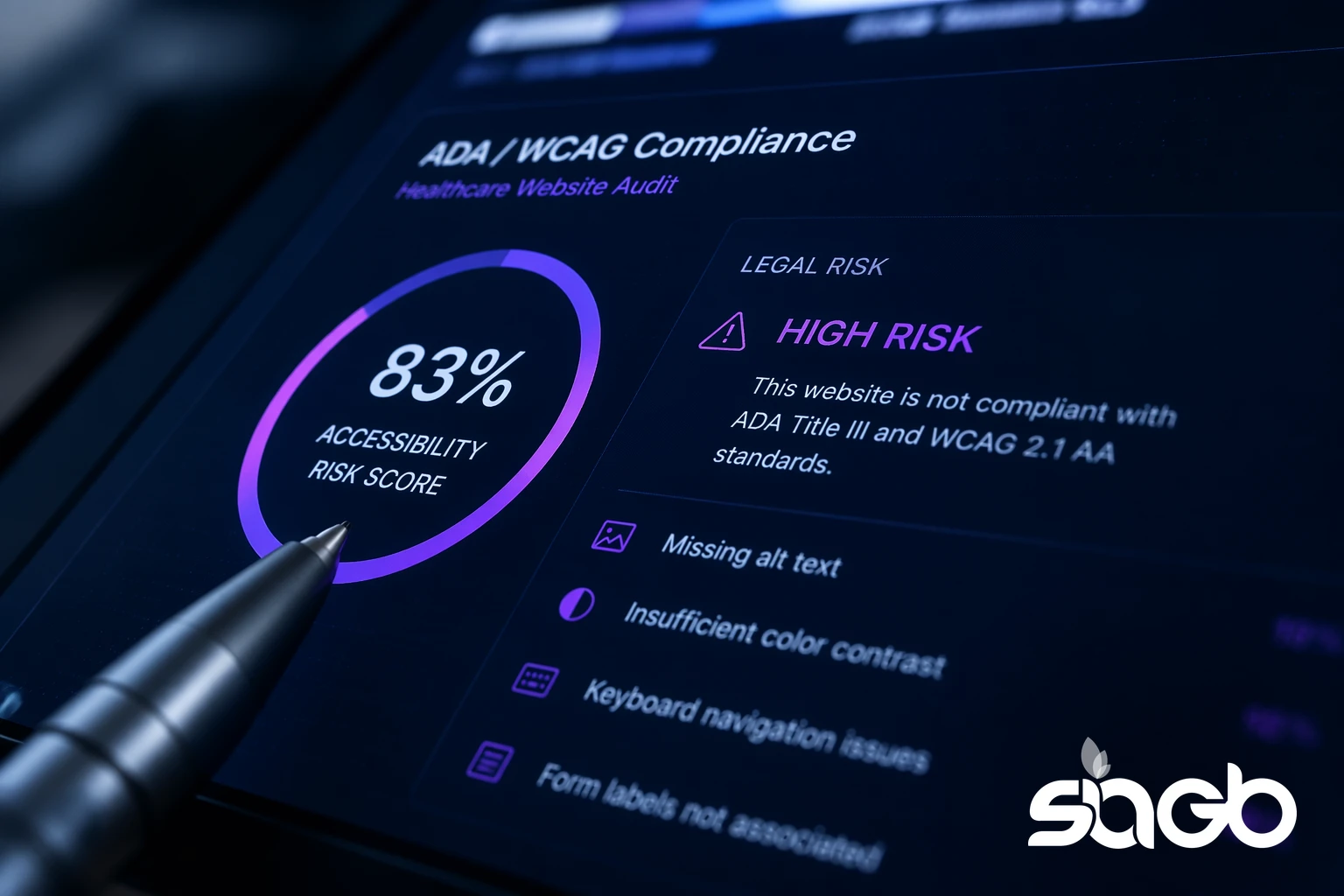
Medical practice website design shapes how patients feel in seconds. Clean layouts, fast load times, and clear paths matter. A modern medical website supports healthcare SEO, accessibility, and consent. Research from Google has long linked slower pages to higher bounce, which is why we treat the 2.5 second Largest Contentful Paint target as a design constraint, not an afterthought.
Healthcare website redesign projects should start with compliance. Performance, privacy, and clarity come before style. Technical SEO choices such as clean site structure, compressed images, and page speed affect both search results and usability.
We do not love flashy designs for healthcare. Never have. Calm, clear, and accessible works better. In particular, high contrast text, generous tap targets, and predictable navigation beat animation every time. That approach supports effective SEO strategy and patient confidence at the same time.
How Do HIPAA and Cybersecurity Affect SEO Risk?
SEO tools can expose sensitive healthcare data if they are misused. Tracking scripts, form tools, and analytics need careful setup. For example, a standard analytics tag that captures a URL containing a patient name can leak protected data without anyone noticing. Healthcare cybersecurity threats are rising. Cybersecurity for doctors is now a board level issue.
A HIPAA compliant website protects patient data and protects rankings. In Australia, the equivalent duty comes from the Privacy Act 1988 and its 13 Australian Privacy Principles, which govern how patient information is collected and stored. Search engines penalise insecure sites, and browsers now flag any page served without HTTPS. Patients avoid them too. Medical practice data security affects online reputation healthcare wide.
Healthcare SEO strategy must include security reviews. HIPAA cybersecurity, consent controls, and secure hosting are part of modern search engine optimisation in healthcare.
Online Reputation Management for Doctors
Google reviews medical practice profiles influence patient choice more than ads. Reviews appear in local SEO results and search engine results pages. They shape first impressions fast, and star ratings feed directly into the local map pack ranking.
Patient review management is not about gaming ratings. It is about ethical follow up. In Australia, AHPRA’s advertising guidelines restrict how testimonials can be used, and specifically prohibit using patient testimonials about clinical care in advertising, so review handling needs the same care as any other clinical communication. Patient recall systems can ask for feedback at the right time, rather than blasting every patient at once. Responses to reviews also affect SEO performance.
Online reputation healthcare work supports trust and patient acquisition. Ignore it, and even strong SEO services struggle to convert potential patients.
Infographic: How SEO, Accessibility, AI, and Security Connect
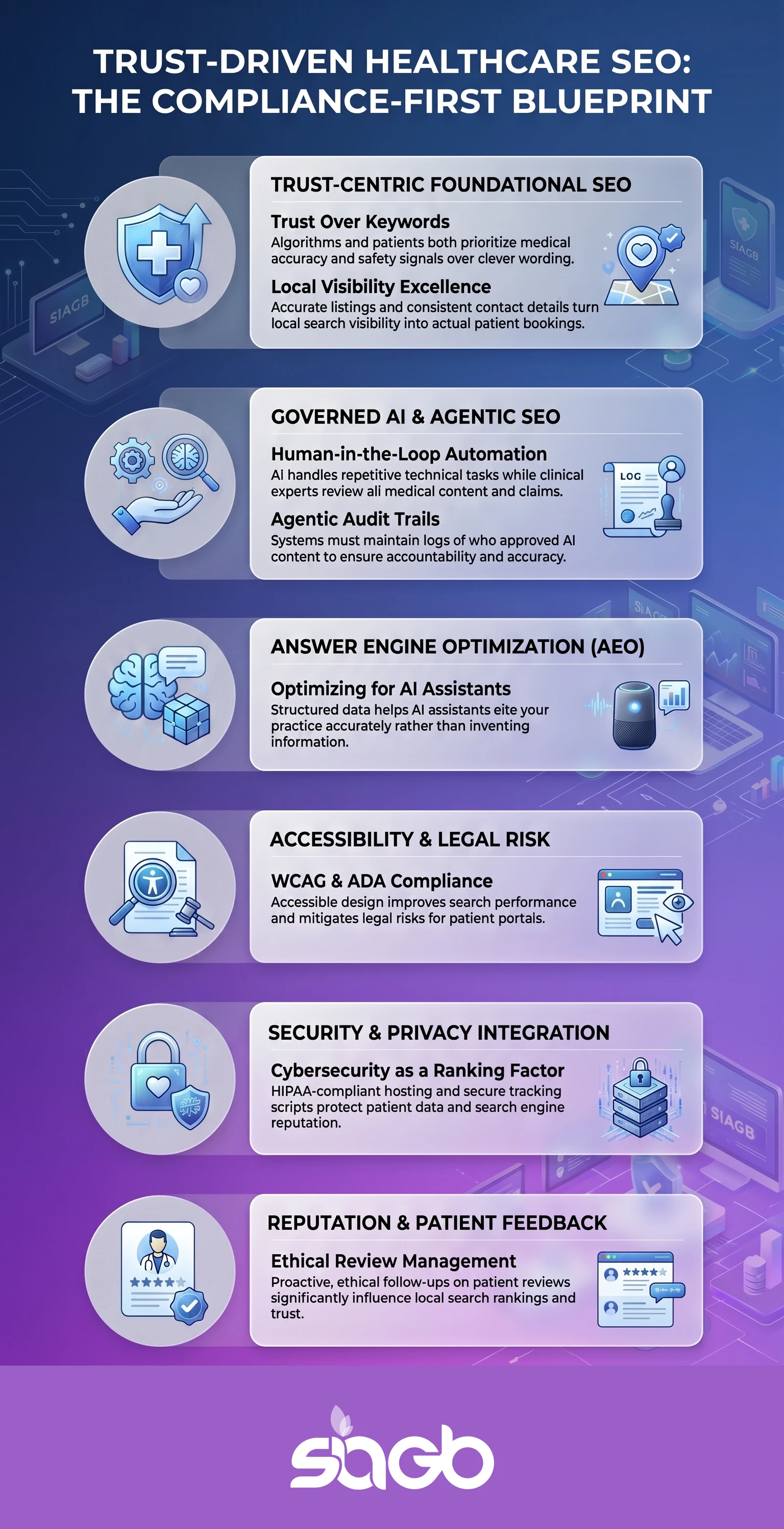
This infographic maps how healthcare SEO services connect trust, accessibility, AI, and security. It highlights risk points and optimisation layers. Teams use it for planning and board talks.
Frequently Asked Questions
What makes healthcare SEO different from other industries?
The stakes. A retail page with a typo loses a sale. A medical page with a wrong claim can mislead a patient and breach AHPRA advertising rules. That is why healthcare SEO adds clinical review, consent handling, and compliance checks on top of the usual keyword and technical work.
Can AI be used safely for medical SEO?
Yes, with controls. AI SEO healthcare works when humans review content and actions. For instance, we log the reviewer, the timestamp, and the source on every AI-assisted edit. Automated tools support teams, rather than replacing them.
Do accessibility issues affect search engine rankings?
Indirectly but reliably. Accessible sites tend to load faster, use cleaner markup, and keep visitors on the page longer. Descriptive alt text also helps images appear in search. So fixing accessibility, such as meeting the 4.5:1 contrast ratio, usually lifts the same signals search engines reward.
Are ADA lawsuits a real risk for Australian doctors?
They can be. Doctors with US patients or portals face exposure. At home, the Disability Discrimination Act 1992 can treat an inaccessible site as discrimination, and accessibility also protects reputation even without lawsuits.
How long does a healthcare SEO strategy take to show results?
Most healthcare providers see changes in three to six months. Here is a realistic timeline:
| Timeframe | What usually happens |
|---|---|
| Months 1-3 | Technical SEO fixes, local listings cleaned up, accessibility repairs |
| Months 3-6 | Local rankings lift, reviews build, first measurable booking gains |
| Months 6-12 | Authority content compounds, AI assistants start citing your pages, steady patient acquisition |
Key Takeaways and Final Thoughts
Healthcare SEO must be built end to end. Trust, access, AI, and security all connect. Ignore one, and the whole system weakens.
AI works best with governance. Agentic SEO supports scale, but people protect patients. Led by founder Sheetal Dhadial, who brings more than 20 years in IT and AI leadership as a Certified Scrum Master and AgilePM practitioner, SIAGB focuses on measurable, compliant growth across healthcare and beyond. That includes ai consulting for retail businesses too. Different industries. Same discipline.
Sources
- Industry-standard reference materials
- Peer-reviewed research and clinical guidelines

Ready to put this into practice?
Let's Talk