
Healthcare website redesign is about reducing risk, improving access, and supporting care. It’s not a visual refresh. A modern healthcare website design improves compliance, security, search visibility, and patient trust at the same time. For Australian clinics, redesign decisions now affect legal exposure, bookings, staff workload, and long term revenue.
So here’s the thing. A medical website that looks fine but fails accessibility, security, or search intent can quietly harm a practice every day.
Introduction
Healthcare website redesign is a business, legal, and patient access issue. It’s not just web design. Australian medical practices face rising risks from poor accessibility, weak cybersecurity, and low visibility in search and AI answers. Each risk hits patients and revenue, sometimes without warning.
A modern medical website must support compliance, speed, and clear user experience. It also has to match how patients now search for care. That includes AI tools, voice search, and quick answers on the go.
AI-native healthcare website redesign focuses on outcomes. Fewer missed appointments. Better patient engagement. Lower risk. Measurable ROI. That’s what medical practice website design needs to deliver now. Not just pages that look new.
Why Is Healthcare Website Redesign a Risk Problem?
Healthcare website redesign benefits go well beyond appearance. An outdated website increases risk across the whole practice. Accessibility gaps can block patients. Security gaps can expose data. Poor performance can quietly reduce bookings.
Many healthcare websites grow without a clear plan. A new form here. A patient portal there. Content added by different teams over time. The result is a modern medical website in name only.
Slow load times frustrate patients. Confusing navigation drives more calls to staff. Broken appointment booking flows reduce completed bookings. According to Google, 53 percent of mobile users leave a website that takes more than three seconds to load.
Here’s what happens next. Patients don’t complain. They leave. They choose another healthcare provider.
Redesign choices affect compliance, reputation, and revenue together. That’s why healthcare website redesign needs to be treated as a risk management project. Not just website design.
A quick way to think about it is a redesign risk checklist:
| Risk area | What goes wrong on an outdated site | Who feels it first |
|---|---|---|
| Accessibility | Screen reader users can’t book or complete forms | Patients, then legal teams |
| Security | Insecure forms and old plugins expose patient data | Patients and practice reputation |
| Performance | Slow mobile pages push patients to another clinic | Bookings and revenue |
| Search visibility | Content invisible to AI answers and voice search | New patient growth |
| Staff workload | Confusing navigation drives avoidable phone calls | Reception and admin teams |
How Does Healthcare Website Accessibility Create Legal Exposure?
Healthcare website accessibility directly affects patient access to care. It also affects legal exposure. Many patients rely on screen readers, keyboard navigation, or high contrast views to use a website properly.

An ADA compliance medical website supports those needs. When accessibility fails, patients can’t book appointments, complete forms, or access medical information.
Globally, accessibility complaints and legal actions are rising. In the US alone, more than 4,500 website accessibility lawsuits were filed in 2023, according to UsableNet. Healthcare sites are frequent targets.
The scale of the problem is bigger than most clinics realise. The WebAIM Million study, which tests the world’s top one million home pages every year, consistently finds detectable WCAG failures on more than nine in ten of them. Healthcare websites are not exempt from that pattern.
Accessibility also builds trust. Patients expect care providers to remove barriers. A healthcare website that ignores accessibility sends the wrong message.
ADA Compliance and WCAG for Healthcare Websites
WCAG defines practical rules for accessible web design. A WCAG healthcare website supports text alternatives, clear structure, colour contrast, and keyboard access. These aren’t optional extras.
ADA website lawsuit doctors cases often focus on simple failures. Missing labels. Inaccessible forms. Broken navigation.
Compliance isn’t a one time fix. Content changes. Plugins update. New pages go live. Accessibility needs ongoing testing and monitoring.
Honestly? Clinics that treat accessibility as a checkbox tend to face repeat issues. Continuous review really does matter.
HIPAA Compliance and Medical Data Security
A healthcare website often handles sensitive data. Contact forms. Patient portals. Appointment requests. Even analytics can create risk.
A HIPAA compliant website follows principles of data minimisation, encryption, access control, and audit trails. While HIPAA is a US law, its standards influence global healthcare security expectations.
Medical practice data security starts with website design. Poor hosting choices, insecure plugins, and weak authentication increase breach risk.
According to IBM’s 2024 Cost of a Data Breach Report, healthcare breaches had the highest average cost at USD 10.93 million. That surprised me, honestly.
Security isn’t just an IT issue. It affects patient trust and clinical operations.
Healthcare Cybersecurity Threats Clinics Face
Healthcare cybersecurity threats are growing. Ransomware, phishing, and credential theft often target medical websites because downtime disrupts care.
Patient portals and online forms are common attack points. Outdated software and weak passwords make the problem worse.
Cybersecurity for doctors must align with real workflows. Systems that are too complex lead to workarounds. And that creates new risks.
Effective healthcare web design balances security and usability. It protects patients without slowing staff down.
How Do AI SEO and Answer Engine Optimisation Help Healthcare Websites?
Patients don’t only search through blue links anymore. They ask questions in AI tools, voice assistants, and answer engines.
AI SEO healthcare focuses on being the answer. Answer engine optimisation for medical practices structures content so AI systems can understand and cite it.
According to Gartner, by 2026, 25 percent of organic search traffic will shift to AI driven answers. That changes healthcare SEO strategy in a big way.
Healthcare websites need clear, accurate, structured medical information. Definitions. FAQs. Service explanations. All written for patients, not algorithms.
This improves visibility for high intent queries. Symptoms. Services. Appointment booking. You know the ones.
Agentic SEO and Automated AI Agents in Healthcare Marketing
Agentic SEO uses AI agents to monitor and optimise continuously. These automated SEO agents track changes in search behaviour, content gaps, and technical issues.
AI agents for SEO can update schema, flag broken pages, and test content performance. But healthcare needs guardrails.
Agentic AI for marketing must respect compliance, accuracy, and tone. Medical content can’t hallucinate or exaggerate. Ever.
When done right, agentic SEO reduces manual effort and improves consistency. It keeps the healthcare website aligned with how patients search now.
AI Content, Chatbots, and Patient Recall Systems
AI content medical practice tools support access. They don’t replace clinicians. Chatbots answer common questions, guide navigation, and support patient engagement.

AI chatbots help patients find services, understand next steps, and book appointments. They also reduce call volume for staff, which helps on busy days.
Patient recall system tools use AI to prompt follow ups and reminders. Missed appointments drop. Continuity of care improves.
Chatbot analytics consultants Australia often spot patterns clinics miss. What patients ask. When they leave. Where confusion starts.
That data feeds back into better website design and a smoother patient experience over time.
Online Reputation and Patient Review Management
Google reviews medical practice visibility matters more than many clinics think. Reviews shape trust and influence choice.
Online reputation healthcare risks grow when feedback goes unmanaged. A single unresolved review can outweigh dozens of positive ones.
Structured review systems help request, monitor, and respond to patient feedback. AI supports scale and consistency without losing tone.
Reputation management doctors workflows protect compliance and professionalism. They also surface trends clinics can actually act on.
This isn’t about gaming reviews. It’s about listening.
Traditional vs AI-Optimised Healthcare Website Redesign
Traditional healthcare website redesign often ends at launch. Pages go live. The project wraps up. Everyone moves on.
AI optimised website healthcare approaches work differently. They learn from usage, search behaviour, and patient actions.
User experience improves through data, not guesswork. Content adapts. SEO evolves. Security stays under watch.
End to end ownership matters here. Fewer handoffs mean fewer gaps. Over time, that reduces cost and risk.
Look, redesign isn’t a moment. It’s a system.
Infographic: What an AI-Native Healthcare Website Includes
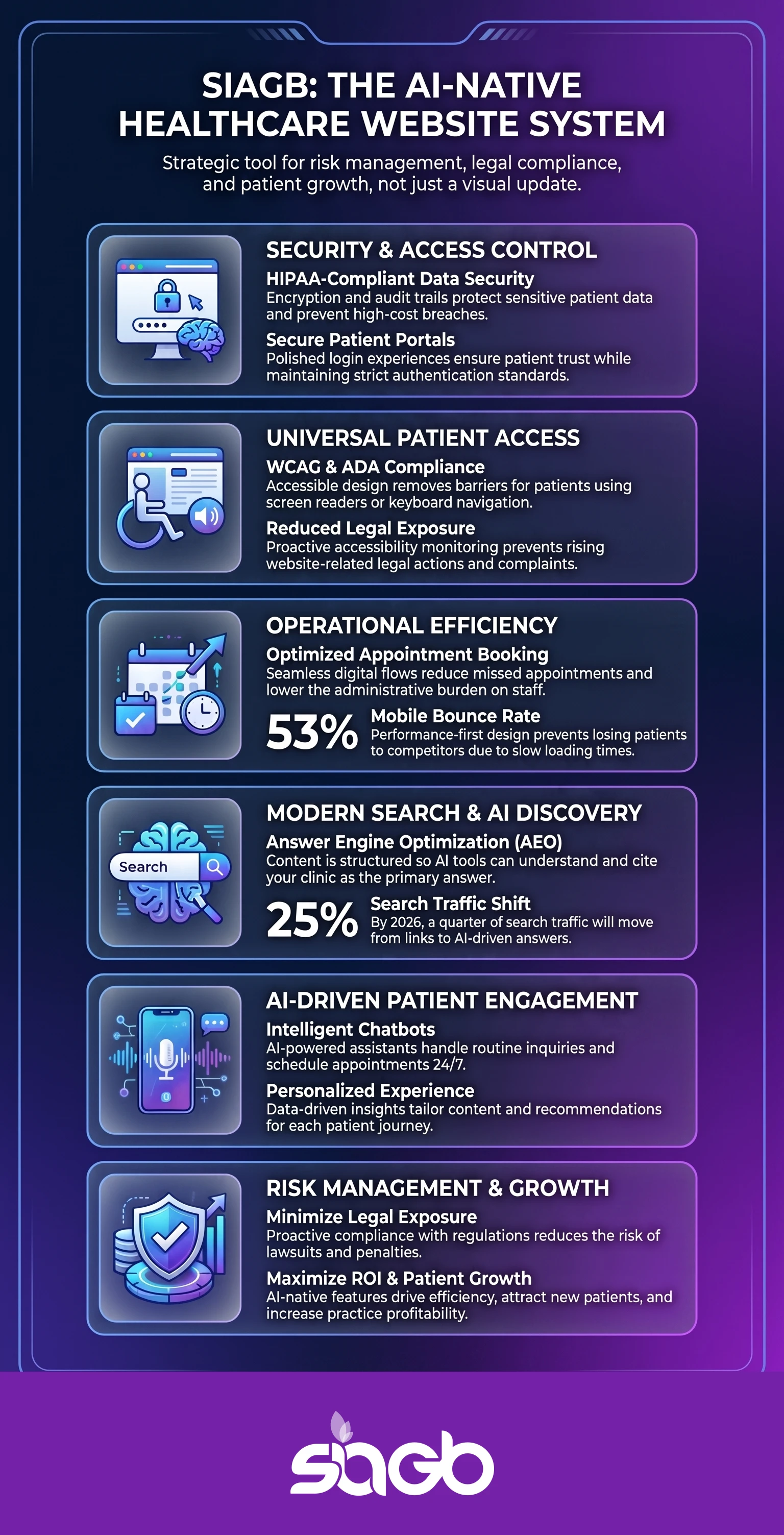
An AI-native healthcare website includes accessibility layers, security controls, and continuous optimisation. It supports healthcare website ideas grounded in real needs. These healthcare website examples focus on outcomes. Access, safety, trust.
Frequently Asked Questions
How much does a healthcare website redesign cost?
The average cost of website redesign for healthcare varies widely. Scope and risk drive the cost, so the most useful way to budget is by tier:
| Redesign tier | Typical scope | Indicative cost (AUD) |
|---|---|---|
| Basic clinic site | Service pages, contact forms, accessibility fundamentals | From around 8,000 |
| Portal-enabled site | Patient portal, secure forms, online booking, compliance work | Between the two tiers, depending on scope |
| AI-enabled platform | Chatbots, recall systems, agentic SEO, continuous optimisation | Can exceed 30,000 |
Before requesting quotes, write down what the site must do for patients and staff. A clear scope keeps pricing honest.
Do Australian clinics need ADA and WCAG compliance?
Australian clinics are guided by WCAG through local disability standards. ADA cases overseas show where the risk is heading. Following WCAG healthcare website standards reduces legal and access risk.
How does AI SEO help medical practice SEO?
AI SEO healthcare improves visibility in answer engines and voice search by structuring content around how patients actually ask questions. A practical first step is rewriting your service pages so each one opens with a direct, plain language answer to the question patients type or speak. That helps both traditional rankings and AI citations.
Are AI chatbots safe for healthcare websites?
AI chatbots are safe when designed with proper controls. They must avoid diagnosis and protect data. Used correctly, they improve access and patient engagement.
Is ongoing optimisation really necessary?
Yes. Search behaviour, security threats, and patient needs all change after launch. A practical rhythm is a quarterly review of accessibility, page speed, security updates, and search performance, with fixes scheduled like any other clinical admin task. That keeps the healthcare website effective and compliant without big surprise costs later.
Key Takeaways and Final Thoughts
Healthcare website redesign is a strategic investment. It affects patients, staff, compliance, and revenue at the same time.
AI-native, compliant websites reduce risk and improve ROI. They support accessibility, security, and modern search behaviour.
Ongoing optimisation matters far more than a visual refresh. Clinics that treat their website as a living system tend to perform better.
siagb approaches healthcare website redesign with this mindset. Problem first. Outcomes measured. Systems built to last.
That’s something to think about.

Want to explore this further?
Book a Free Consultation