
Medical practice data security is the protection of patient data, health information, and systems across websites, portals, staff workflows, and AI tools. It matters because breaches damage patient trust, trigger legal action, and disrupt day to day patient care. According to the HHS Office for Civil Rights breach portal, more than 133 million individual records were exposed in reported US healthcare incidents during 2023 alone, and the IBM Cost of a Data Breach 2024 report put the average healthcare breach at 9.77 million dollars, the highest of any industry for the fourteenth year running. For modern clinics, protecting sensitive information is no longer just an IT concern. It shapes growth, compliance, and reputation across the health care industry.
Introduction: Why data security now shapes medical practice success
Most clinics handle patient information in many places at once. Booking forms, portals, reviews, recalls, and AI tools all touch clinical details. That same information supports clinical practice, billing, and daily service delivery. When security slips, the impact spreads fast.
Security failures hurt more than systems. They affect staff workload, revenue, and confidence in care delivery. One breach can pause care for days. It can also bring audits, fines, and legal pressure tied to the HIPAA Privacy and Security Rules, where civil penalties reach up to 2.13 million dollars per violation category, per year, under the current HHS adjustment tiers.
The risks have changed. It is not only hackers anymore. Accessibility claims, weak website builds, and insecure vendors can all expose sensitive data. Cyber security now sits at the center of clinical, legal, and business decisions for healthcare organizations. Ignore it, and problems stack up quickly. In our work with medical and education clients, we track where data actually leaves the building, and the surprise is almost always a marketing tool nobody added to the risk register.
What is data security in healthcare?
Data security in healthcare is the protection of health information across digital and physical systems. It focuses on the three pillars named in the HIPAA Security Rule: confidentiality, integrity, and availability. In simple terms, the right people get access, the information stays accurate, and systems work when needed.
This includes medical records, a health record held in an EHR platform such as Epic, Cerner, or athenahealth, medicines information, and personal data. It also covers emails, backups, laptops, and the paper files still used in most clinics. All of it counts as protected health information, or PHI, under 45 CFR Part 160 and Part 164.
What has changed is the risk surface. Websites, chatbots, and marketing platforms now touch patient information. A single WordPress contact form plugin with an unpatched vulnerability can expose 18 HIPAA identifiers at once, from names to full-face photos. A chatbot may store details with an offshore vendor outside any Business Associate Agreement. Securing healthcare data now means covering every system that touches care delivery, not just the servers in the back room.
Medical practice data security fundamentals and failure points
Most failures in practice security are basic. Outdated websites run old plugins. Staff reuse passwords across 6 or 7 systems. Access stays active for weeks after someone leaves. These gaps expose sensitive patient data quickly, and the Verizon 2024 Data Breach Investigations Report ties 68 percent of breaches to a human element rather than a zero-day exploit.
Third party tools are another weak spot. Booking systems, review platforms, and recall tools often connect straight into an EHR. Each connection adds risk. Many healthcare providers do not fully check how vendors handle securing personal information, and a valid Business Associate Agreement is often missing entirely.
Human error still leads. Someone clicks a phishing email. A shared login hides responsibility. Planning needs to assume mistakes will happen. Good controls limit damage when they do. The table below maps the most common failure points we see in a first-pass audit, and the concrete control that closes each one.
| Failure point | What typically goes wrong | Concrete control | Standard or reference |
|---|---|---|---|
| Website forms | Plain HTTP, no encryption on submit | TLS 1.2+, form data encrypted at rest | HIPAA Security Rule 45 CFR 164.312 |
| Patient portal access | Shared logins, no role separation | Role based access, MFA on every account | NIST 800-63B authentication guidance |
| Third party vendors | No signed agreement, offshore storage | Business Associate Agreement, US data residency | HIPAA 45 CFR 164.308(b) |
| AI chatbots | Inputs reused to train the model | Zero-retention API terms, consent capture | HHS OCR AI guidance 2024 |
| Accessibility gaps | Forms unusable by screen readers | WCAG 2.2 AA conformance | ADA Title III, WCAG 2.2 |
Key Point: Most healthcare data breaches start with simple issues that were never fixed.
Healthcare cybersecurity threats facing clinics today
Healthcare cybersecurity threats keep rising, especially for small and mid sized clinics. Ransomware can lock systems and halt care delivery, as the Change Healthcare attack in February 2024 showed when it disrupted claims for thousands of US practices for weeks. Phishing steals logins quietly. Credential theft opens records without alarms.
Websites and portals are common entry points. A weak form or an old theme running an outdated plugin creates access. Once inside, attackers move laterally in minutes, and the median dwell time before detection still runs into weeks.
Across the healthcare sector, breaches show the scale of the problem. Shared systems and weak controls have exposed millions of record entries in real cases reported to the HHS breach portal, where any incident affecting 500 or more people is published publicly. These events highlight why cyber security needs ongoing attention, not a yearly check.
HIPAA compliant websites and secure patient portals
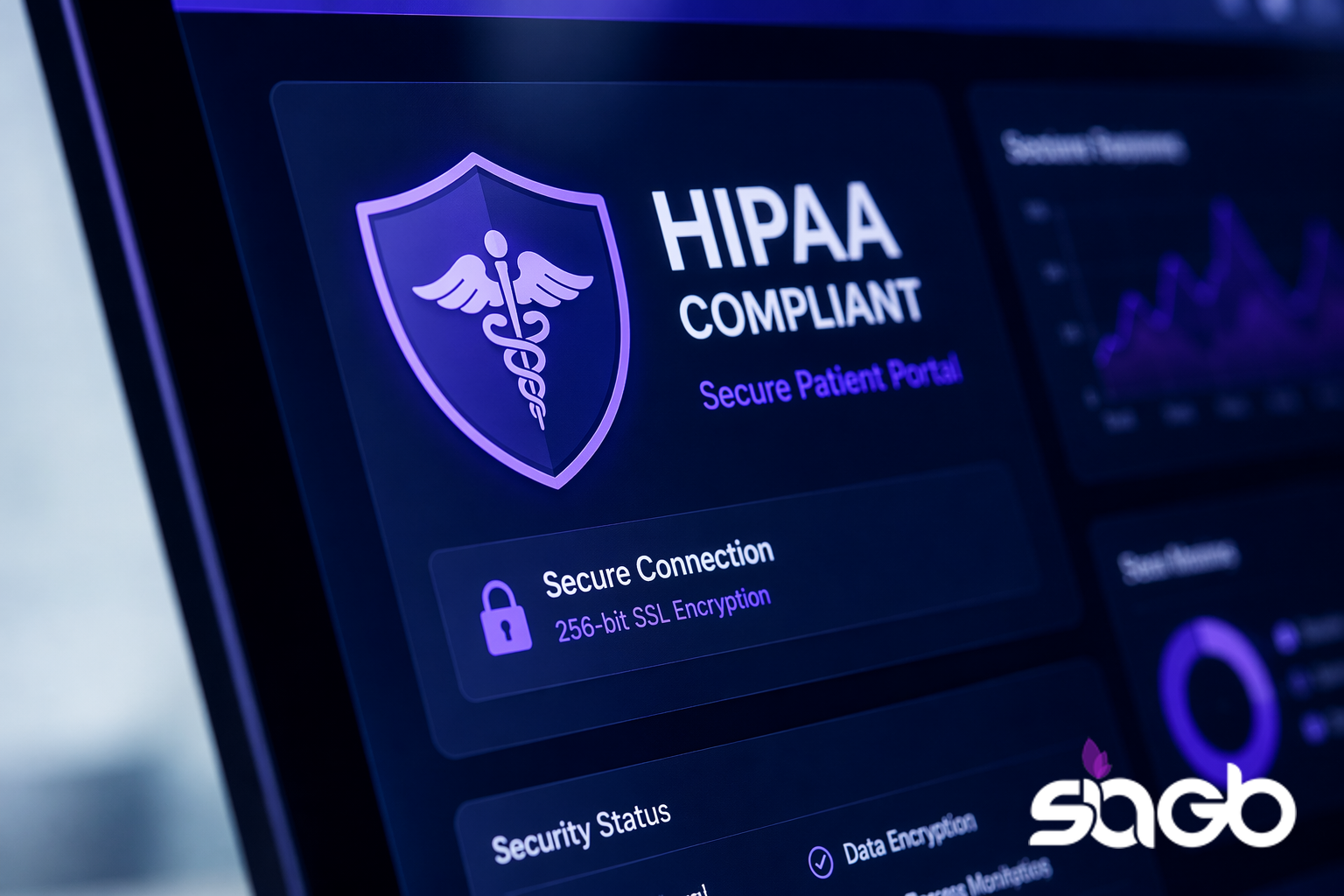
A HIPAA compliant website does more than post a policy. It uses secure hosting, TLS encryption, and access controls. Forms must protect patient health information from capture, and any analytics tag, including Google Analytics or the Meta pixel, must be stripped from pages that collect PHI, a point HHS OCR made explicit in its December 2022 bulletin.
Patient portals need stricter controls. Role based access limits views. Audit logs track every activity for at least the 6 years HIPAA requires records be retained. Encryption protects data at rest and in transit. These steps support patient confidentiality and patient privacy.
Accessibility matters as well. An ADA compliant portal must work for everyone while staying secure. Poor design pushes staff into workarounds, which increases risk. Fast pages help too: Google treats Core Web Vitals as a ranking signal, with a target Largest Contentful Paint under 2.5 seconds and Interaction to Next Paint under 200 milliseconds. Security and usability must support each other.
Healthcare website accessibility and legal risk
Healthcare website accessibility is now a legal issue. People rely on websites for care, bookings, and information. When they cannot use them, access to health care suffers.
WCAG 2.2 AA standards guide clear structure and readable content. They require a minimum color contrast ratio of 4.5 to 1 for body text, keyboard operability, and labeled form fields. These standards also reduce user mistakes. Fewer mistakes mean less chance of exposing sensitive data.
ADA lawsuits against healthcare organizations are rising. UsableNet tracked more than 4,600 web accessibility lawsuits filed in US federal court in 2023, and healthcare sits among the most targeted sectors. Claims often involve forms and patient portals. Many cases come down to fixes that were missed. Accessibility, cyber security, and compliance overlap more than teams expect.
Warning: An inaccessible form can trigger legal action and expose patient data.
Medical practice website design and secure redesigns
Medical practice website design now sits at the crossroads of trust and practice security. A modern site must load fast, protect information, and support different needs. When we rebuild a clinic site, we treat schema.org markup as part of the build, using MedicalOrganization, Physician, and FAQPage types so search engines and AI answer engines read the practice correctly.
Healthcare website redesign projects often focus on looks first. That creates risk. Data protection, securing personal information, and compliance should guide the build from day one. Fixing it later costs more, and retrofitting encryption onto a live portal is far harder than baking it in.
Security by design lowers long term risk. Clear data flows, limited access, and testing support healthcare organizations under pressure. When systems work, staff spend less time fixing avoidable issues.
AI use in medical marketing and data security risks

AI tools now write content, answer questions, and manage recalls. They can save time. They can also expose sensitive patient data.
An insecure chatbot may collect health information and store it with an unvetted offshore vendor. Some tools reuse inputs to train models unless you opt into a zero-retention tier. That can breach federal privacy rules and the AI guidance issued by the HHS Office for Civil Rights. Before any clinic connects a large language model to patient data, we check whether the vendor signs a Business Associate Agreement, because most consumer-grade tools will not.
Practices need clear answers. Where is the medical data stored, and is it inside the United States? Who can access it? Is patient consent respected? Without answers, AI adds speed but also risk to patient confidentiality.
AI SEO, agentic SEO, and automated SEO agents in healthcare
AI SEO in healthcare helps clinics appear in search and answer engines. Increasingly that means being cited by ChatGPT, Perplexity, and Google AI Overviews, not only ranking in the classic ten blue links. It improves visibility without touching sensitive information when done properly.
Agentic SEO and automated agents can act without oversight. They may pull content, publish pages, or respond to reviews. Without controls, they risk exposing practices data. We optimize for citation by building clean structured data and clear, factual pages, then measure how often each answer engine references the practice.
AI agents should never touch medical records or an EHR platform. Clear limits, audit logs, and separation protect clinical practice. Cyber security supports growth when boundaries are clear.
Online reputation, reviews, and patient data privacy
Online reviews influence choice. Reputation tools affect revenue. But responses must protect patient confidentiality, and replying to a Google review by confirming a diagnosis is itself a HIPAA violation the OCR has fined practices for.
Patient review management should never confirm visits or conditions. Even small replies can leak sensitive information. Clear approval steps help.
Reputation tools should log actions and restrict access. One careless response can damage trust. Governance matters.
How AI consulting firms approach healthcare security and ROI
Strong AI consulting starts with problems, not tools. Clinics care about time, cost, and risk. Securing healthcare data affects all three.
SIAGB follows a problem first approach. Founded in 2022 and led by Sheetal Dhadial, a Certified Scrum Master and AgilePM practitioner with over 20 years of IT and AI leadership, the team works end to end with healthcare providers and healthcare organizations. That scope covers websites, AI tools, analytics, and cyber security planning. Our work on AI-powered patient scheduling for medical groups, and on the Marvel PTE platform that now serves more than 85,000 users across 900 plus institutes, taught us how to secure systems at real volume.
AEO services focus on secure growth. The goal is measurable ROI without risking sensitive data. Evidence matters more than hype.
Infographic: Where medical practice data risks really occur
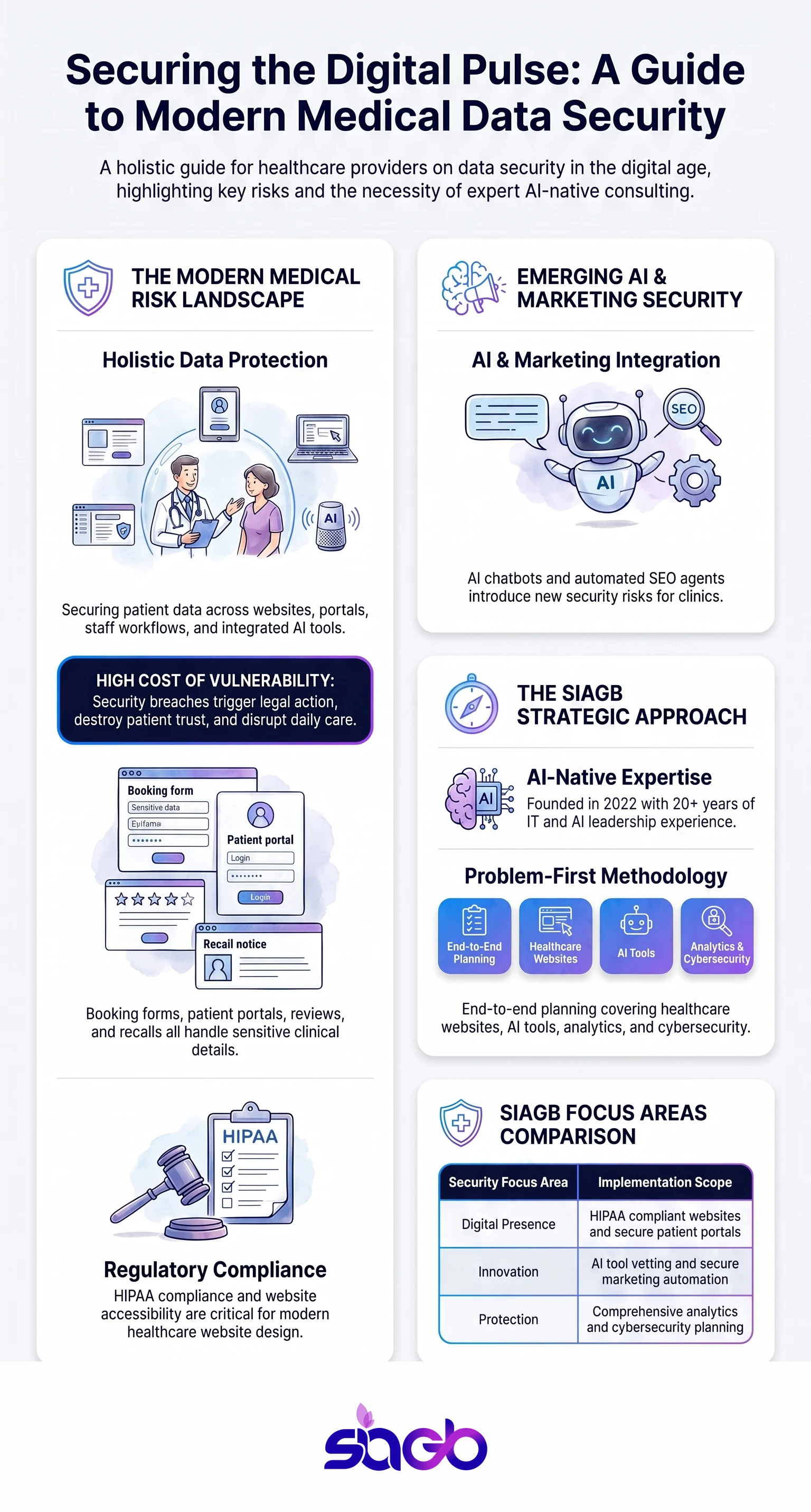
This infographic shows where risks hide across a healthcare practice. It maps websites, portals, AI tools, staff actions, and vendors. The visual highlights blind spots many teams miss. It also shows how security, accessibility, and SEO connect in daily work.
Frequently Asked Questions
What is data security in healthcare?
It is the protection of health information across systems and people. It ensures patient health information stays private, accurate, and available.
Why are clinics targeted by cyber attacks?
The healthcare industry holds valuable medical data and often has limited cyber security resources. Attackers see opportunity.
Do small clinics need HIPAA compliant websites?
Yes. Any healthcare provider collecting personal data must meet requirements, regardless of size.
How does accessibility affect security?
Accessible systems reduce workarounds. Fewer workarounds reduce risk.
Are AI chatbots safe for healthcare websites?
They can be, with controls. Patient consent, storage location, and access rules matter.
What should clinics check when choosing AI vendors?
Check storage, access controls, audit logs, deletion policies, and alignment with HIPAA requirements where relevant.
Key Takeaways and Final Thoughts
Healthcare data security underpins trust, care quality, and growth. Information now flows through many systems. Each adds value and risk.
Websites, portals, AI tools, and vendors must be secured together. Siloed fixes fail. Cyber security, accessibility, and compliance meet in real clinical settings.
Healthcare providers should expect clear evidence. Ask how security measures protect sensitive information and support care. When data protection aligns with outcomes, the healthcare sector stays resilient.
Sources
- HHS Office for Civil Rights breach portal and HIPAA guidance
- IBM Cost of a Data Breach 2024, Verizon 2024 DBIR, WCAG 2.2 and NIST 800-63B

Thinking about how this applies to your business?
Start a Conversation