
Medical practice SEO helps a clinic appear when potential patients search online for care. It focuses on trust, local visibility, useful content, and safe systems. When done right, medical SEO turns search traffic into booked appointments, not just clicks. For an Australian practice, that often means being the clinic a patient finds when they type “bulk billing GP near me” rather than the one three listings further down.
Finding new patients isn’t as easy as it once was. Ads cost more. Referrals take time. Search behaviour keeps shifting across every major search engine. So, SEO matters more than ever, especially for medical clinics that rely on consistent demand. In our work building AI-powered patient scheduling for medical groups, we saw the same pattern: the clinics that win online are the ones that show up cleanly at the moment someone decides to book, not the ones with the biggest ad budget.
Introduction to Medical Practice SEO
Medical practice SEO helps a healthcare practice show up in search engine results when patients need care. It relies on clear content, local signals, and a strong user experience to attract the right people. The goal is simple. Help the right patient find the right practice at the right time.
Many healthcare providers feel sceptical about SEO. Some tried it before and saw little change in ranking. Others worry about compliance, risk, or hype. Fair enough.
Here’s the thing. Medical SEO works when it reflects how patients actually search. It also works when it respects healthcare rules. A good medical SEO service isn’t about tricks. It’s steady work that builds trust and supports long term growth in the healthcare industry.
What Is Medical Practice SEO and How Does It Work?

Medical practice SEO is a medical SEO approach built for clinics, hospitals, and healthcare professionals. It improves how a medical website appears across each search engine, including Google. It also improves how patients experience the site once they arrive.
Search engines rank pages using relevance, trust, and quality, principles Google explains in its own Search Central documentation. Relevance comes from keyword research and clear service pages. Trust comes from authority, reviews, and compliance. Quality comes from speed, structure, and useful content that answers real patient questions.
Healthcare SEO adds extra layers. Search engines look for signals that a healthcare provider is real, safe, and credible. That includes accurate medical information, secure systems, and clear ownership details. These signals matter more in the healthcare industry than in most sectors.
So, medical SEO blends digital marketing, technical SEO, and patient focused content into one connected system. Strong SEO efforts improve ranking stability over time, not just short term wins. For example, a dedicated page for skin cancer checks in Chatswood converts far better than a generic “our services” page, specifically because it matches how patients search rather than how a clinic describes itself.
Patience helps here. Most clinics follow a fairly predictable results timeline:
| Timeframe | What typically happens |
|---|---|
| Months 1-2 | Technical fixes, keyword research, Google Business Profile cleanup |
| Months 3-4 | Early movement on local searches and long tail keywords |
| Months 5-6 | Steadier rankings, more enquiries from service and suburb pages |
| Months 6-12 | Compounding growth in bookings, reviews, and returning patients |
Every practice is different, of course. Competitive metro suburbs, such as inner Sydney or inner Melbourne, take longer to rank than quieter regional areas across New South Wales or Victoria. But the pattern holds.
Why Does Local SEO Matter for Medical Practices?
Local SEO is critical for any medical clinic or group practice. Most patients search with local intent. Think “GP near me” or “clinic in Parramatta”. If your practice doesn’t appear in the search engine results, someone else will.
Local SEO uses location signals to connect your practice with local patients. This includes your address, suburb pages, and Google Business Profile. It also includes your listings on Australian health directories, such as HotDoc, HealthEngine, and Healthdirect, where your name, address, and phone details must match your website exactly. Consistent details across the web matter more than many realise for ranking and visibility.
A handful of factors do most of the heavy lifting in local rankings:
| Local ranking factor | Why it matters for clinics |
|---|---|
| Google Business Profile completeness | Drives map pack visibility and click to call actions |
| Consistent name, address, phone details | Confirms your practice is real and trustworthy |
| Patient reviews and responses | Influence both ranking and patient choice |
| Suburb and service pages | Match the way local patients actually search |
| Proximity to the searcher | Partly outside your control, but listings still compete on quality |
Healthcare SEO services often focus heavily on local SEO because it drives new patient enquiries faster. Strong local SEO improves ranking for searches that lead directly to appointment booking. When we connected AI-powered patient scheduling to the booking flow for medical groups, we tracked how many of those local searches turned into confirmed appointments rather than abandoned forms.
It also supports healthcare providers with multiple locations, including medical centres serving different suburbs. Each clinic needs clear local signals and relevant content. Done well, local SEO turns search into foot traffic.
Google Reviews and Online Reputation Management
Google reviews play a big role in medical SEO. They affect ranking and influence patient choice. Many potential patients read reviews before calling a clinic.
Patient review management needs care. In Australia, healthcare providers must follow AHPRA’s advertising guidelines, which restrict how testimonials can be used, and protect patient privacy at all times. Specifically, Section 133 of the Health Practitioner Regulation National Law prohibits testimonials that refer to clinical care in advertising, so a five star review praising a doctor’s treatment cannot be reposted on your website the way a cafe might reuse a rave review. Still, asking patients for feedback is allowed and genuinely helpful for medical marketing and healthcare marketing efforts.
Online reputation healthcare risks are real. One bad experience can spread fast. A steady system for reviews helps protect trust. Reputation management doctors rely on is about balance, not spin.
How Does Medical Practice Website Design Affect SEO?

Medical practice website design affects SEO more than most clinics expect. A slow or confusing site pushes potential patients away. Search engines notice that behaviour across every search engine.
A modern medical website loads fast, works well on mobile, and guides users clearly. According to Google’s own guidance, that means meeting the Core Web Vitals: a Largest Contentful Paint under 2.5 seconds, an Interaction to Next Paint under 200 milliseconds, and a Cumulative Layout Shift below 0.1. Good user experience supports ranking and conversions. It also builds patient trust.
Healthcare website redesign often starts when results drop. Sometimes it’s due to poor mobile performance. Other times it follows compliance updates. A redesign should improve structure, not just appearance.
Strong design supports content, service pages, and clear calls to action. It helps turn visitors into a new patient, not just traffic.
Accessibility and Compliance for Healthcare Websites
Healthcare website accessibility isn’t optional. Patients with disabilities must be able to access healthcare services online. That includes forms, content, and navigation on every device.
The W3C’s WCAG standards guide healthcare website accessibility. To meet WCAG 2.1 Level AA, for instance, body text needs a contrast ratio of at least 4.5:1 against its background, and large text at least 3:1. The standards also cover text size, keyboard access, and screen reader support. Meeting them improves usability and search engine visibility.
ADA compliance medical website issues affect many clinics and medical centres. Ignoring them increases risk. Accessibility also supports SEO because search engines prefer usable sites.
Accessible content builds trust with potential patients. It also reduces barriers to care.
ADA Compliance, Patient Portals, and Legal Risk
ADA website lawsuit doctors face is a growing concern. Many claims relate to inaccessible websites or patient portals. Small practices and larger medical centres aren’t immune.
An ADA compliant patient portal must work with assistive technology. It also needs to be simple to use. Accessibility and security go hand in hand here.
Compliance reduces legal risk. It also protects patients. And honestly, it shows care beyond treatment.
HIPAA Compliance and Medical Practice Data Security
A HIPAA compliant website protects patient data. This includes forms, portals, and appointment booking systems. Encryption and secure hosting are basic requirements for medical services delivered online. Australian practices carry the same duty under the Privacy Act 1988 and its 13 Australian Privacy Principles, rather than under the US HIPAA framework, and since 2018 the Notifiable Data Breaches scheme has meant a serious breach must be reported to the Office of the Australian Information Commissioner. In our experience, clinics that treat this as a trust and SEO issue, not just an IT checkbox, end up with cleaner systems overall.
Healthcare cybersecurity threats are rising. Clinics are targets because patient data is valuable. Ransomware and phishing affect practices of all sizes across the healthcare industry.
Cybersecurity for doctors isn’t just an IT issue. It affects trust, reputation, and daily operations. Medical practice data security supports SEO indirectly by protecting credibility and long term ranking stability.
Secure systems help patients feel safe engaging online.
AI SEO and Answer Engine Optimisation in Healthcare
AI SEO healthcare focuses on how search engines now answer questions directly. Answer engine optimisation medical strategies help content appear in featured answers and AI driven search engine results.
Search engines use AI to understand intent. They prefer clear, structured content that answers patient questions directly. Vague pages struggle to rank.
An AI optimised website healthcare providers rely on uses clear headings, simple language, and trusted sources of medical information, such as Healthdirect or the Royal Australian College of General Practitioners. It also updates content regularly as guidelines change, for example when the Medicare Benefits Schedule item numbers are revised.
AI changes visibility, but the basics still matter. Trust, relevance, and compliance remain core to medical SEO and advanced SEO approaches.
Agentic SEO and AI Automation for Medical Practices
Agentic SEO uses automated SEO agents to monitor and improve performance. AI agents for SEO can track ranking, update content, and flag technical issues across search engines.
This saves time. But it carries risk. Automated systems without strategy can cause errors or compliance problems.
AI SEO automation works best with human oversight. Healthcare SEO needs judgement from experienced medical professionals and SEO experts, not just speed.
AI Content and Patient Engagement Systems
AI content medical practice teams use helps scale education and communication. It can draft content, personalise messages, and update pages used for healthcare marketing.
A patient recall system powered by AI reminds patients about follow ups and ongoing care, for instance a 12 month skin check or an overdue cervical screening. This improves outcomes and retention for both new patient and returning patient groups. When we built patient scheduling for medical groups, the automated recall and reminder layer did more for repeat bookings than any single ranking change.
Chatbots answer common questions and guide users. Analytics track what patients ask and where they drop off. That insight helps improve content, digital marketing performance, and overall SEO efforts.
How SIAGB Approaches Healthcare SEO and AI
SIAGB takes a problem first approach to healthcare SEO and medical SEO service delivery. It starts with patient needs, not tools. That approach shapes strategy and execution.
Founded in Sydney, SIAGB supports healthcare providers, medical clinics, and medical centres across Australia and internationally, including practices in the United States. The team brings 20 plus years of IT and AI experience, with real products at scale. For example, Marvel PTE, a platform we built, now serves 85,000 plus users across 900 plus institutes, so we understand what it takes to keep large systems fast and secure at scale, rather than just launched.
We apply that same discipline to healthcare. In our work building AI-powered patient scheduling for medical groups, we learned that the booking experience matters as much as the ranking that sends a patient there: a first page position means little if the form breaks on a phone, whereas a clean flow turns a search into a booking.
SIAGB provides advanced SEO, AI SEO, and healthcare marketing support across multiple industries. Case study driven insights guide decisions, not guesswork. Each case study focuses on measurable ranking gains, improved patient acquisition, and better engagement from potential patients.
Infographic: Medical Practice SEO Ecosystem
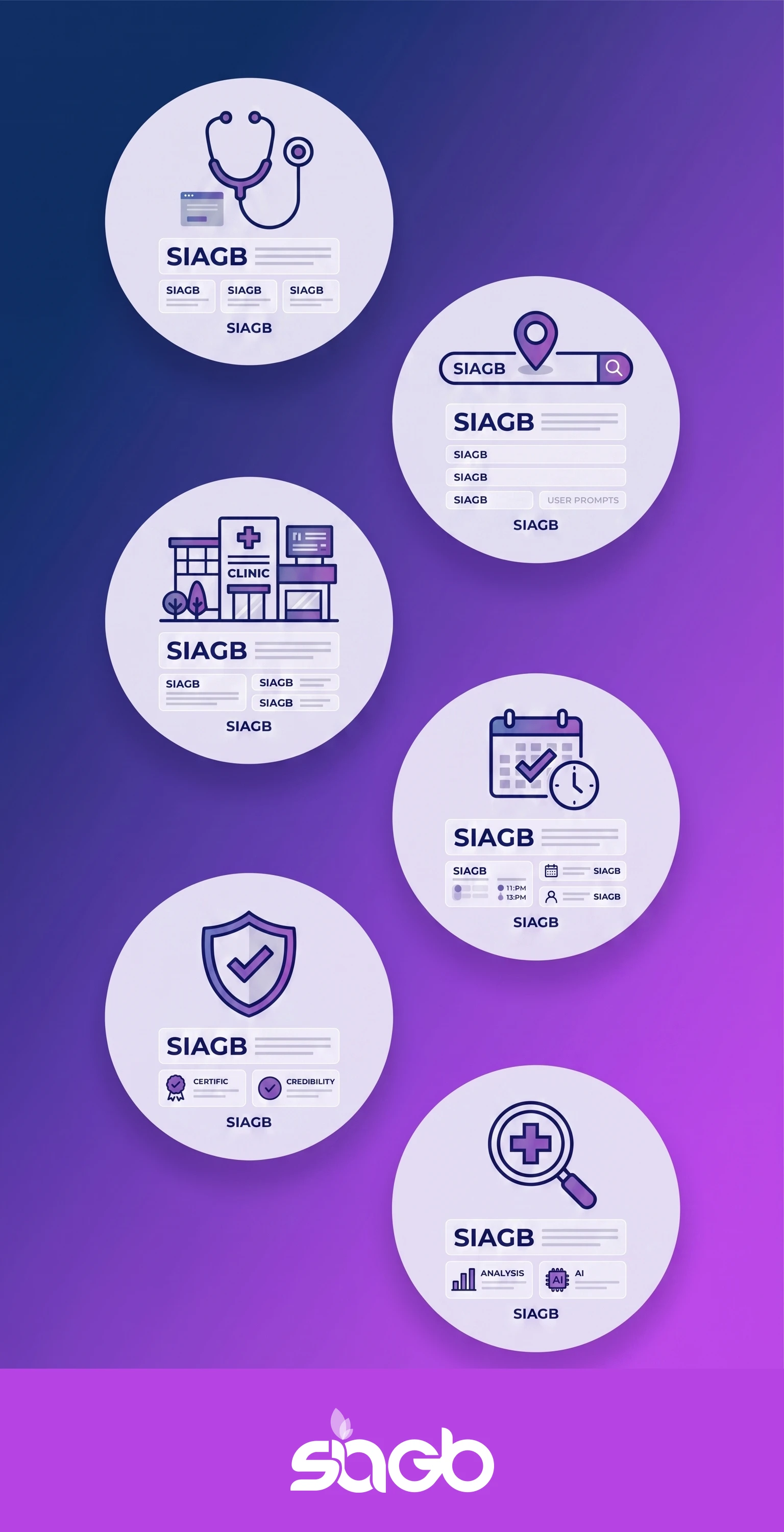
This infographic shows how medical SEO connects content, local SEO, compliance, AI, and reputation. Each part supports the patient journey. Weak links increase risk. Strong systems drive sustainable growth and healthcare SEO strategy success.
Frequently Asked Questions
How long does medical practice SEO take to work?
Medical SEO usually shows early signs within three to four months, with strong results at six to twelve months. While you wait, watch leading indicators like search impressions, map views, and calls from your profile. Those move before bookings do, and they tell you the work is taking hold.
Is SEO safe for healthcare providers?
SEO is safe when done correctly. It must follow healthcare rules, accessibility standards, and data security laws. Ethical medical SEO focuses on accuracy and patient trust.
Do small clinics need healthcare SEO services?
Yes. Small clinics rely heavily on local search and patient reviews. A single well optimised Google Business Profile, for example, can outperform a large group’s neglected one. A focused SEO service helps smaller providers compete for local patients in their area.
How do reviews affect patient trust?
Reviews are often the first impression a patient gets of your clinic. Recency matters as much as the star rating, so keep feedback flowing rather than chasing one big push. And when you reply, thank the reviewer without confirming they were a patient or mentioning any treatment details.
Can AI replace human SEO experts?
AI supports SEO experts but doesn’t replace them. Healthcare SEO needs judgement, compliance awareness, and strategy. AI works best as a tool, not the driver.
Key Takeaways and Final Thoughts
Medical SEO works when it balances trust, compliance, and visibility. It isn’t about chasing algorithms. It’s about serving patients well online.
A strong healthcare SEO strategy covers local SEO, content, accessibility, and security. AI and advanced SEO add power, but only when used carefully.
Practices that invest in steady, ethical SEO see better patient acquisition over time. Sustainable growth comes from systems that respect healthcare complexity and support medical professionals doing real work.
Sources

Thinking about how this applies to your business?
Start a Conversation