
Medical practice website design is the process of building a secure, accessible, and trustworthy website for clinics and doctors. A well designed medical website helps patients book appointments, trust your care, and find clear medical information. It also reduces legal risk and supports long term growth across the medical industry.
Introduction
Medical website design now sits at the centre of patient trust, compliance, and growth. Patients decide fast, sometimes in under 5 seconds, often before they call or book an appointment. Australian clinics also face higher expectations from regulators such as AHPRA and the Office of the Australian Information Commissioner, plus search engine systems and AI answer tools like Google AI Overviews, ChatGPT, and Perplexity. Design choices affect accessibility, SEO, and even legal exposure under the Disability Discrimination Act 1992 and the Privacy Act 1988. And yes, all of that shows up in website results.
This guide breaks down how smart web design supports patients, protects the practice, and drives steady growth without hype. In our work at SIAGB, a Sydney consultancy (ABN 16 659 507 178) that has built AI-powered patient scheduling for medical groups, we track how medical website solutions help both new patient enquiries and existing patients who already trust your care. The same platform thinking sits behind Marvel PTE, a product we built that now serves 85,000+ users across 900+ institutes, so we know what holds up when real traffic arrives.
What Are the Fundamentals of Medical Website Design?

Medical website design starts with clarity. Patients want to find medical services, book an appointment, and feel safe doing it. When navigation is clear, confusion drops and so do patient enquiries. A strong doctor website uses simple menus, readable fonts, and calm colours. Those small signals build confidence fast for every prospective patient.
Mobile use matters. Over 60 percent of patients browse a healthcare website on a phone, according to data shared by organisations like Mayo Clinic. Mobile first web design and responsive design keep buttons large (a minimum 44 by 44 pixel tap target, per Apple and WCAG guidance), forms short, and pages quick to load. Speed is not just cosmetic. Google measures it through Core Web Vitals, and the passing thresholds are concrete: Largest Contentful Paint under 2.5 seconds, Interaction to Next Paint under 200 milliseconds, and Cumulative Layout Shift under 0.1. When we rebuilt a clinic homepage that loaded in 4.8 seconds, dragging it under 2.5 was the single change that lifted mobile bookings the most.
Professional web design also supports credibility. Photos of real health professionals, clear credentials, and consistent branding help people feel at ease. Structured data helps too: marking up pages with schema.org types such as MedicalOrganization, Physician, and LocalBusiness tells both Google and AI answer engines exactly who you are and where you practise. This applies whether the site is for a general practitioner, urgent care centre, or specialist clinic. It is not about flashy effects. It is about trust, patient care, and smooth appointment booking from the first click.
Not every feature deserves the same priority:
| Feature | Priority | Why it matters |
|---|---|---|
| Online appointment booking | Must-have | Patients expect to book without phoning |
| Mobile responsive design | Must-have | Most patients arrive on a phone |
| WCAG accessible layout and forms | Must-have | Removes barriers and reduces legal risk |
| Secure contact and intake forms | Must-have | Patient data needs protection from the start |
| Clear services and location pages | Must-have | Supports local SEO and patient decisions |
| AI chatbot for basic questions | Nice-to-have | Helpful once core pages and booking work |
| Patient education blog | Nice-to-have | Builds authority over time, not needed at launch |
Healthcare Website Accessibility and Compliance
Healthcare website accessibility is both ethical and practical. Around 1 in 5 Australians lives with disability, according to the Australian Bureau of Statistics, so patients routinely include people with vision loss, hearing issues, and limited mobility. A wcag healthcare website removes barriers through good contrast (WCAG 2.2 AA requires at least a 4.5:1 ratio for normal text and 3:1 for large text), readable text, keyboard access, and clear labels that support real patient needs. We audit against WCAG 2.1 AA as the baseline and the newer 2.2 AA criteria, such as the target size and focus visibility rules added in October 2023.
Accessibility improves usability for everyone. Older patients, stressed carers, and busy families all benefit. For example, a strong contrast ratio and a 16 pixel minimum body font help a 70-year-old reading on a bright verandah just as much as a screen-reader user. Search engine systems also favour accessible medical web design because it is easier to understand and index.
From what I have seen, clinics that treat accessibility as part of core website design get fewer complaints and stronger patient engagement. It also supports healthcare marketing and medical marketing by widening reach. Accessibility is not a bolt on. It belongs in quality medical website design.
Each design choice carries a different weight for patient trust:
| Design element | Patient trust impact |
|---|---|
| Strong contrast and readable fonts | Older and low-vision patients can read your content |
| Real doctor photos with credentials | Patients see who will treat them before booking |
| Simple, labelled forms | Bookings get completed, not abandoned |
| Fast page loading | Slow sites feel neglected |
| Visible privacy and security cues | Patients feel safe sharing health information |
ADA Website Lawsuits and Risk for Doctors
ADA website lawsuit claims against doctors are rising, and ADA.gov’s web guidance makes clear that medical websites fall under ADA obligations. Many cases begin with simple issues like missing form labels or poor colour contrast, which the WebAIM Million report finds among the most common failures on the web. An ada compliance medical website reduces this risk.
Proactive web design lowers exposure and improves patient experience. It also shows the healthcare provider takes inclusion seriously. That matters to patients. And to regulators.
Implementing WCAG Standards in Real Clinics
The W3C’s WCAG standards focus on content that is perceivable, operable, and understandable. In real clinics, this means accessible menus, readable medical information, and clear forms. An ada compliant patient portal must work with screen readers and keyboards.
Testing matters. Automated checks help, but real users and assistive tools catch issues early. Fixing problems before launch saves time and stress later, especially during ongoing website maintenance.
HIPAA Compliant Website Architecture and Security
A hipaa compliant website protects patient data from end to end. In Australia the equivalent baseline is the Privacy Act 1988 and the 13 Australian Privacy Principles, plus the Notifiable Data Breaches scheme that requires reporting eligible breaches to the OAIC within 30 days. Design and security need to work together. Secure hosting, TLS 1.3 encryption in transit, encryption at rest, and role-based access controls are essential parts of medical website solutions and safe web development.
Healthcare cybersecurity threats are growing. Healthcare is consistently one of the most breached sectors in the OAIC’s half-yearly Notifiable Data Breaches reports. Phishing, weak passwords, and outdated plugins expose clinics to risk. For example, an unpatched WordPress plugin or a reused admin password is often all it takes. Cybersecurity for doctors is not just an IT issue. It affects patient trust and patient care.
Good website architecture separates public pages from secure systems like a patient portal, in line with the secure-by-design approach the Australian Digital Health Agency promotes for digital health services. It limits access and logs activity. In my experience, practices that plan security during web development avoid costly fixes later. Hipaa cybersecurity is much easier when it is built in from day one.
Healthcare SEO Strategy Beyond Keywords

Medical practice seo has changed. It is no longer about stuffing keywords into pages. A strong healthcare seo strategy focuses on clarity, trust, and structure, the same E-E-A-T signals (Experience, Expertise, Authoritativeness, Trust) Google names in its Search Quality Rater Guidelines. Search engine systems now assess how well a website answers real patient questions, and so do AI answer engines such as Google AI Overviews, ChatGPT, and Perplexity.
Local SEO ties web design to demand. A verified Google Business Profile, consistent name-address-phone details, clear suburb-level location pages, fast loading, and accessible content help a healthcare provider appear in the local map pack when patients search nearby, for example “GP near Parramatta” or “after hours clinic Bondi”. Reviews, service pages, and FAQs all play a part in patient acquisition.
Design supports SEO. Clean layouts, proper headings, and accessible content improve crawlability. This is where website design and healthcare marketing meet. And they really should work together.
Answer Engine Optimisation and Agentic SEO
Answer engine optimisation medical content helps clinics appear in AI generated answers. These systems pull clear, factual information from well structured pages. Agentic seo uses automated seo agents to adjust content based on performance.
In healthcare, caution is key. Ai agents for seo need rules, reviews, and human oversight from a medical professional. Agentic ai for marketing can help, but it must respect compliance and clinical accuracy. Used well, it keeps content current without risking trust.
AI Optimised Website Features for Healthcare
An ai optimised website healthcare setup supports staff and patients. AI chatbots help with bookings, directions, and basic questions. They do not replace people. They reduce wait times and support appointment booking.
AI content medical practice tools support patient education. Content still needs review by a healthcare professional. Accuracy matters. So does tone, especially for a new patient visiting the site for the first time.
Secure patient portals give access to results and messages. Good web design keeps them simple and accessible. When AI supports these features safely, patient engagement improves. Slowly, but it does.
Online Reputation and Google Reviews for Doctors
Website design influences reviews more than many clinics expect. Clear prompts and simple navigation make it easier for patients to leave feedback. Google reviews medical practice visibility plays a big role in local search and trust, especially for urgent care and general practitioner services.
Reputation management doctors rely on must respect privacy. You cannot disclose medical details. The right medical website solutions manage requests and alerts without exposing data.
Online reputation healthcare is fragile. A calm, professional doctor website supports positive perception. It sets expectations before the visit even starts, which helps both prospective patient confidence and existing patients.
Patient Recall Systems and Engagement Tools

A patient recall system reduces missed appointments. It supports follow ups and ongoing care. When integrated into the website, reminders feel natural and seamless for both new patient and returning visitors.
Consent matters. Automation must follow privacy laws. Done right, recall tools support patient engagement and steady revenue. Done poorly, they frustrate website visitors. Balance is everything.
What Are the Biggest Healthcare Website Redesign Pitfalls?
Healthcare website redesign often breaks things. SEO drops. Forms stop working. Accessibility issues creep in. Planning helps prevent this, especially during web development changes.
Security is another risk. Redesigns that ignore data protection increase the chance of breaches. Compliance checks and website maintenance plans should happen before launch. Not after.
A modern medical website respects what already works. It improves medical website design without losing trust or traffic. That is harder than it sounds.
How Do You Measure ROI From a Medical Website?
ROI connects website traffic to bookings and patient retention. AI seo healthcare analytics show where patients drop off or convert. Chatbot analytics consultants Australia often use can reveal issues no one noticed.
Data supports better decisions. Which pages drive appointments? Which appointment forms fail? Measuring answers these questions. And it guides smarter investment across the medical industry, including newer models like Maven Clinic style digital care platforms.
Infographic: How Design, SEO, AI, and Compliance Connect
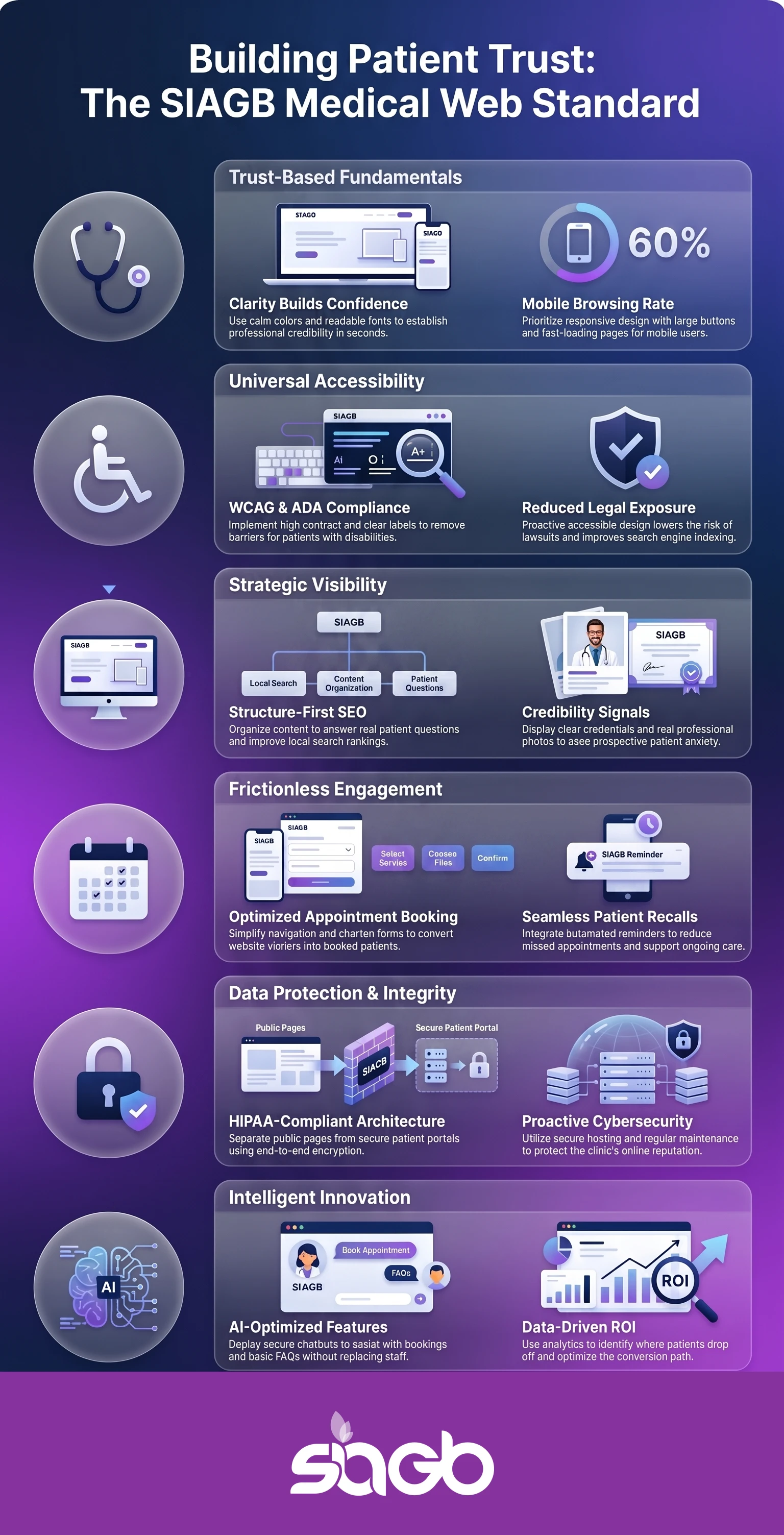
Visual map of ai optimised website healthcare from search to booking.
Frequently Asked Questions
What makes good medical website design?
Good medical website design is clear, accessible, secure, and patient focused. A quick test: can someone find your phone number, services, and booking form within ten seconds on a phone?
Do Australian clinics need ADA and WCAG compliance?
Yes. While ADA is US law, Australian clinics face similar obligations under the Disability Discrimination Act, and WCAG is the standard regulators reference in both countries.
How does SEO fit into medical website design?
SEO works best when built into web design from the start. Retrofitting structure, headings, and speed onto a finished site costs far more than planning them early.
Are AI chatbots safe for healthcare websites?
They can be, with privacy controls and human oversight from a medical professional. Keep them scoped to bookings and basic questions, and make sure they hand off to staff rather than attempt clinical advice.
How often should a medical website be reviewed?
Most practices do a full review every 12 to 18 months, but security patches and content accuracy checks should happen quarterly. Put it on the calendar like equipment servicing.
Key Takeaways
Medical website design affects trust, risk, and growth. Accessibility, SEO, AI, and security need to work together. Partnering with siagb helps clinics reduce guesswork and build compliant, high performing websites that patients trust and use to book appointments.
Sources

Ready to put this into practice?
Let's Talk