
A secure, accessible medical website helps people book an appointment, find clear medical information, and feel confident in a healthcare provider. It also helps healthcare teams cut admin time, protect patient data, and support growth with results you can measure. Design alone does not cut it anymore, especially as AI-optimized standards rise across the United States and expectations around web design keep changing. For those searching for modern medical website, this guide covers everything you need to know.
Introduction
A medical website has to fix real problems for patients and healthcare teams. People expect fast bookings, clear health information, and safe access to their medical record. When a healthcare website falls short, trust drops quickly. Clinics also need growth, not just a nicer looking site. That means smoother appointment flow, better search visibility, and lower risk. Medical website design now sits right at the center of access, compliance, and performance for many healthcare organizations.
For many US providers, this shift is driven by changes in healthcare SEO strategy, answer engine optimization, and stricter expectations around accessibility, privacy, and modern web design standards. Sound familiar?
In our work at SIAGB building booking and scheduling systems for healthcare and education groups, we have seen this play out at scale. The patient scheduling engine we built for medical groups runs on the same architecture behind Marvel PTE, a platform that now serves more than 85,000 users across over 900 institutes. That volume taught us one thing fast: a medical site is not a brochure, it is production software that has to stay up, stay compliant, and stay fast under real load.
What Defines a High-Performing Medical Website

A strong medical website brings together website design, compliance, and automation in one system. It supports access for users, staff efficiency, and data protection. That mix separates effective healthcare website design from sites that feel dated or hard to use.
Key elements include:
- Simple booking flows that work on mobile and desktop
- Easy navigation so users can find critical information fast
- Secure infrastructure that supports compliance and protects sensitive data
First, access matters. People need to book appointments easily on any device, with clear next steps. Navigation should feel obvious, not clever. Content should support health care decisions, not slow them down.
Second, compliance is built in from the start. Accessibility is no longer optional. Security and privacy are core parts of medical website design, not add-ons.
Third, automation helps clinics scale. AI supports content updates, search visibility, and follow-ups without adding staff load. From what I have seen, web design that plans for automation lasts longer and performs better.
Performance is measurable, not a matter of taste. Google grades every page on Core Web Vitals, and the passing thresholds are specific: Largest Contentful Paint under 2.5 seconds, Interaction to Next Paint under 200 milliseconds, and Cumulative Layout Shift under 0.1. In our testing, booking pages that slip past a 2.5 second load lose visitors before the form even renders, which is the opposite of what a clinic wants. We track these three numbers on every build rather than guessing from a lighthouse score alone.
| Signal | Weak medical site | High-performing medical site |
|---|---|---|
| Accessibility | Untested, contrast fails | WCAG 2.2 AA, screen-reader tested |
| Speed | LCP over 4 seconds | LCP under 2.5s, INP under 200ms |
| Security | Basic SSL only | TLS 1.3, AES-256 at rest, HIPAA controls |
| AI visibility | No structured data | schema.org MedicalOrganization and FAQPage |
| Booking | Email or phone only | Mobile-first flow, under 3 taps |
Look at healthcare website design examples from Mayo Clinic or Cleveland Clinic. They focus on clarity, trust, and ease of use. Other groups like Northwestern Medicine, Mercy Health, and Olathe Health follow similar best practices. That level of quality is now expected across healthcare in the United States, including primary care, sexual health services, and specialist clinics.
Healthcare Website Accessibility as a Business Risk
Healthcare website accessibility affects access, legal exposure, and search performance. When people cannot use your site, they leave. That hurts outcomes and revenue.
WCAG 2.1 AA and the newer WCAG 2.2 AA guide inclusive web design. They set testable rules, such as a 4.5 to 1 contrast ratio for normal text, full keyboard operation, and text alternatives for every image. Search engines also favor accessible healthcare website design. Non-compliance creates real risk. Financial. Legal. Reputational.
Honestly? Many healthcare professionals still treat accessibility as a visual issue. It is not. It affects trust, reach, and long-term growth.
ADA and WCAG Requirements for Medical Websites
ADA Title III rules are now enforced through lawsuits across the United States. Cases often start with small issues, like broken forms or poor color contrast. In April 2024, the Department of Justice went further and published a final rule under ADA Title II that names WCAG 2.1 AA as the required standard for state and local government services, healthcare among them. That rule set a clear benchmark the whole sector now measures against, rather than a vague duty to be accessible.
WCAG 2.1 AA is the accepted benchmark, and Section 508 applies the same bar to federal contexts. It covers navigation, booking forms, images, and medical content. Across the country, US providers feel the impact. Platforms like Teladoc Health and Maven Clinic set expectations that users now apply everywhere. The HHS Office for Civil Rights, which enforces both HIPAA and Section 1557, has made clear that digital access is part of nondiscrimination, not a separate nice-to-have.
Healthcare providers who ignore this face rising costs and lost trust. Rebuilding that trust takes time.
Building an Accessible Patient Portal
An accessible patient portal must work for everyone. Screen readers. Keyboard users. Older adults. That means clear labels, simple flows, and readable language.
Security and accessibility must be designed together. A portal that is secure but hard to use still fails. When done well, healthcare website design supports existing patients, improves engagement, and reduces admin calls.
Simple idea. Hard to get right.
Data Security and Compliance for Medical Websites

Medical websites handle sensitive identity and health information every day, which HIPAA classifies as protected health information. That makes them a target. Secure web design uses encryption, access controls, and monitoring to protect medical record systems and online forms. In practice that means TLS 1.3 in transit, AES-256 encryption at rest, role-based access, and audit logging, rather than a single SSL padlock and hope.
Cyber threats no longer focus only on large hospitals. Smaller clinics and specialist providers are common targets now. The HHS breach portal, often called the Wall of Shame, lists breaches affecting 500 or more people, and the healthcare sector reports a heavy share of them every year. Ransomware, credential theft, and form scraping are real risks, and a single misconfigured intake form can expose thousands of records at once.
Security must cover the whole site. Contact forms. Booking tools. Portals. Even chat tools used for virtual care.
Compliance is not a one-off task. It is ongoing. Policies. Training. Reviews. When breaches happen, trust drops fast. Recovery is slow. Which is frustrating.
AI SEO and Answer Engine Optimization for Healthcare
People search in new ways. Many ask AI tools direct questions instead of scrolling links. Google AI Overviews now sit above the classic blue links, and patients also ask ChatGPT, Perplexity, and Gemini where to go for care. This shift changes healthcare SEO strategy and how web design supports visibility, because the goal is no longer just a rank, it is being cited in the answer itself.
AI SEO focuses on clarity, accuracy, and structure. Content must be factual, reviewed, and easy to extract. AI systems prefer clear definitions, structured answers, and up-to-date health information. Structured data does the heavy lifting here: schema.org types such as MedicalOrganization, Physician, MedicalWebPage, and FAQPage tell an answer engine exactly what a page is, rather than leaving it to guess. In our work, pages that ship JSON-LD for these types get pulled into AI answers far more often than pages that rely on prose alone.
Effective optimization includes:
- Structured content written for AI and people, marked up with schema.org JSON-LD
- Review processes led by medical professionals
- Automation that improves coverage without risk
This affects how medical information is written. Claims need support. Tone matters. That is why governance is critical, especially for topics like infectious diseases, nuclear medicine, or clinical trials.
AI SEO is not about shortcuts. It helps people find the right provider faster. When done well, it improves experience and reduces repeat questions.
Automation, AI Agents, and Governance

AI agents can handle updates, schema, and content gaps. They work best with clear rules. No unchecked publishing. No clinical advice without review.
In healthcare, controls matter. Automated tools must respect compliance and tone. Platforms used by large multi-site provider groups show how careful automation can work.
When done properly, clinics see faster updates and less manual work. But governance comes first. Always.
Website Design Strategy for Healthcare Providers
Website design should start with real journeys. How do people book? How do health professionals manage requests? Where does friction appear?
Healthcare website design works best when performance, accessibility, and security come before visuals. Load speed, easy navigation, and clear calls to action matter more than trends.
A flexible setup supports growth. New services. New providers. New virtual care options. If the web design cannot scale, problems show up later. I have seen it happen.
Online Reputation and Trust Signals
Reviews influence choice and search results. Prospective patients read them before booking. Existing patients also notice how feedback is handled.
Reputation management works best when built into daily workflows. Follow-ups. Clear responses. Privacy-safe systems. AI can help manage reviews without exposing sensitive data.
Patient testimonials still matter. But how they are collected and displayed matters more.
Chatbots, Virtual Care, and Compliance
Chatbots can help with booking, directions, and general questions. They must not diagnose. They must protect data.
Accessibility and security rules apply here too. Tools that block screen readers fail basic standards. Analytics show what actually saves time and what does not.
Virtual care tools, when paired with strong healthcare website design, reduce admin load and support better access. But only when done right.
Infographic: How Design, Compliance, and AI Connect
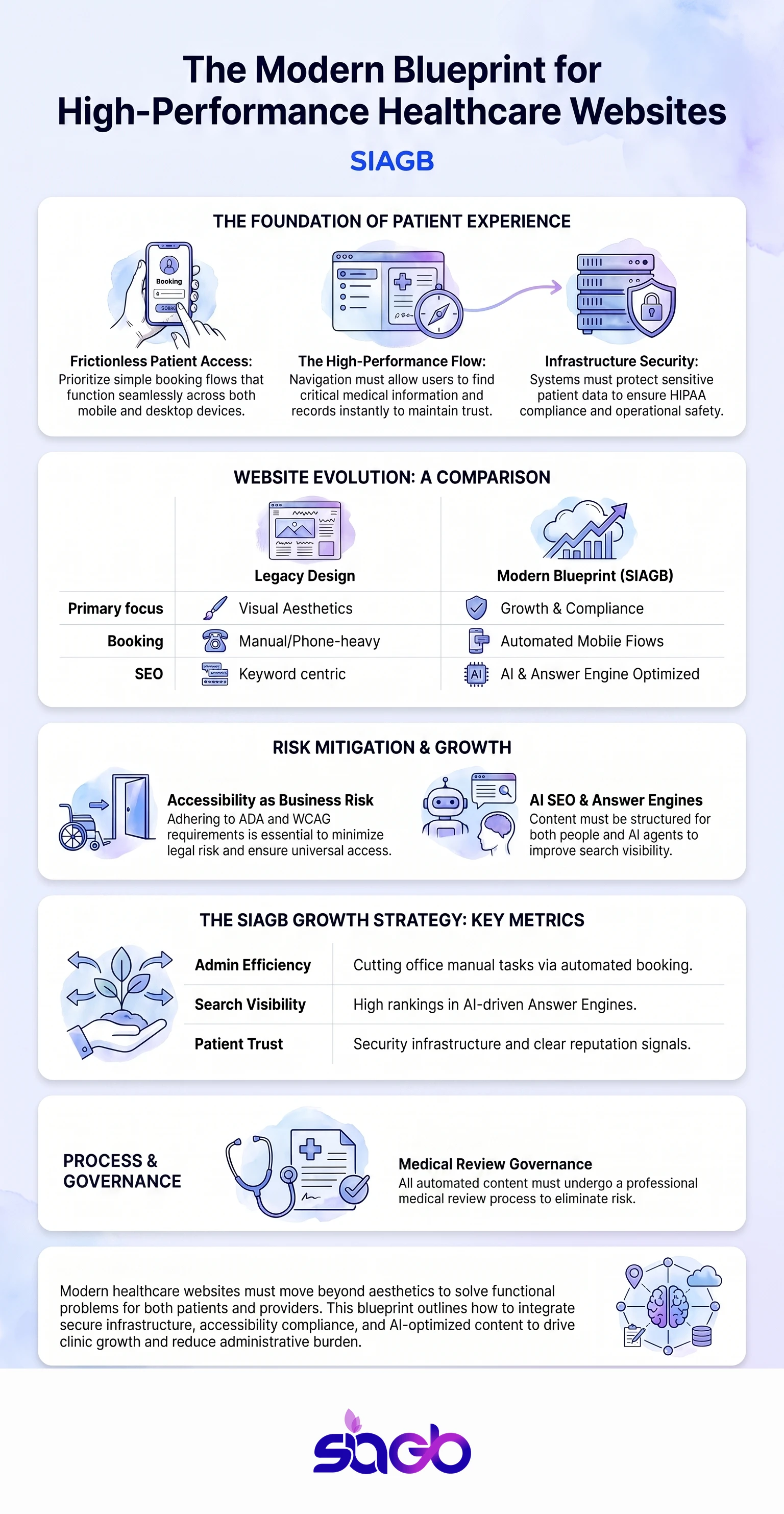
This infographic shows how accessibility, security, and AI SEO overlap. It highlights how good web design supports outcomes, compliance, and growth for healthcare organizations.
Frequently Asked Questions
What makes a medical website effective today?
It combines accessible web design, security, and AI-ready content. It helps people book an appointment, find health information, and trust the provider.
Do US clinics need accessibility compliance?
Yes. WCAG standards apply nationwide. ADA cases set expectations for local providers.
How does AI SEO help healthcare organizations?
It improves how questions are answered by search engines and AI tools. This supports visibility and a better experience.
Are chatbots safe for healthcare use?
They are safe when designed with compliance, accessibility, and limits. They support tasks, not clinical decisions.
How do you measure success?
Look at completed bookings, reduced admin time, use by existing patients, and review growth. Traffic alone is not enough.
Key Takeaways
Strong healthcare website design balances access, trust, and automation. Good web design reduces risk, supports health care delivery, and improves experience for users and staff. AI delivers value when guided by real expertise, not hype. For healthcare providers across the United States and beyond, medical website design is now a core business system, and an area where partners like SIAGB help teams turn complexity into measurable results.
SIAGB is led by founder Sheetal Dhadial, who brings more than 20 years in IT and AI leadership and holds both Certified Scrum Master and AgilePM credentials. We build AI-powered patient scheduling for medical groups on the same proven architecture that runs Marvel PTE for 85,000 users across 900 institutes. Based in Sydney under ABN 16 659 507 178, we work with US and Australian providers who want compliant, fast, AI-visible sites, not just a new coat of paint.
Sources
- Industry-standard reference materials
- Peer-reviewed research and clinical guidelines

Thinking about how this applies to your business?
Start a Conversation