
A secure, accessible medical website helps people book an appointment, find clear medical information, and feel confident in a healthcare provider. It also helps healthcare teams cut admin time, protect patient data, and support growth with results you can measure. Design alone does not cut it anymore, especially as AI‑optimised standards rise across Australia and expectations around web design keep changing. For those searching for modern medical website, this guide covers everything you need to know.
Introduction
A medical website has to fix real problems for patients and healthcare teams. People expect fast bookings, clear health information, and safe access to their medical record. When a healthcare website falls short, trust drops quickly. Clinics also need growth, not just a nicer looking site. That means smoother appointment flow, better search visibility, and lower risk. Medical website design now sits right at the centre of access, compliance, and performance for many healthcare organisations.
For many Australian providers, this shift is driven by changes in healthcare SEO strategy, answer engine optimisation, and stricter expectations around accessibility, privacy, and modern web design standards. Three concrete forces set the bar. First, Google’s Core Web Vitals now judge speed against fixed thresholds: Largest Contentful Paint under 2.5 seconds, Interaction to Next Paint under 200 milliseconds, and Cumulative Layout Shift under 0.1. Second, accessibility is measured against WCAG 2.2 Level AA, published by the W3C in October 2023, which added 9 new success criteria on top of WCAG 2.1. Third, AI answer engines such as ChatGPT, Perplexity, Google AI Overviews, and Gemini now sit between a patient’s question and your site, and they reward pages that are structured and easy to quote. In our work with Australian clinics and specialist groups, these three forces show up in every brief. Sound familiar?
What Defines a High‑Performing Medical Website
A strong medical website brings together website design, compliance, and automation in one system. It supports access for users, staff efficiency, and data protection. That mix separates effective healthcare website design from sites that feel dated or hard to use.
Key elements include:
- Simple booking flows that work on mobile and desktop
- Easy navigation so users can find critical information fast
- Secure infrastructure that supports compliance and protects sensitive data
First, access matters. People need to book appointments easily on any device, with clear next steps. Navigation should feel obvious, not clever. Content should support health care decisions, not slow them down.
Second, compliance is built in from the start. Accessibility is no longer optional. Security and privacy are core parts of medical website design, not add‑ons.
Third, automation helps clinics scale. AI supports content updates, search visibility, and follow‑ups without adding staff load. From what I have seen, web design that plans for automation lasts longer and performs better. Our own platform work backs this up: the AI-powered patient scheduling we built for medical groups removes back-and-forth phone calls, and Marvel PTE, another SIAGB product, now serves more than 85,000 users across 900+ institutes, so we know first-hand how a system holds up when real usage climbs.
The table below sums up how these three pillars map to a real standard and a way to measure them, which is how we scope every SIAGB build.
| Pillar | Real standard to meet | How we measure it |
|---|---|---|
| Access and usability | WCAG 2.2 Level AA (50 AA criteria) | Automated axe-core scan plus keyboard-only walkthrough |
| Speed and stability | Core Web Vitals: LCP under 2.5s, INP under 200ms, CLS under 0.1 | Field data in Google Search Console over a rolling 28 days |
| AI and search visibility | schema.org types (MedicalOrganization, Physician, FAQPage) | Citations in ChatGPT, Perplexity, and Google AI Overviews |
Look at healthcare website design examples from Mayo Clinic or Cleveland Clinic. They focus on clarity, trust, and ease of use. Other groups like Northwestern Medicine, Mercy Health, and Olathe Health follow similar best practices. That level of quality is now expected across healthcare, including primary care, sexual health services, and specialist clinics.
Healthcare Website Accessibility as a Business Risk
Healthcare website accessibility affects access, legal exposure, and search performance. When people cannot use your site, they leave. That hurts outcomes and revenue.

WCAG standards guide inclusive web design. They support screen readers, keyboard use, and clear contrast. At Level AA, body text needs a colour contrast ratio of at least 4.5 to 1, and the standard covers screen reader labels, keyboard navigation, and captions. Search engines also favour accessible healthcare website design. Non‑compliance creates real risk. Financial. Legal. Reputational. In Australia, the Disability Discrimination Act 1992 makes an inaccessible service a legal exposure, and the Australian Human Rights Commission points providers to WCAG as the practical benchmark.
Honestly? Many healthcare professionals still treat accessibility as a visual issue. It is not. It affects trust, reach, and long‑term growth. Roughly 1 in 5 Australians lives with disability, so a portal that fails a screen reader shuts out a real slice of your patient base.
ADA and WCAG Requirements for Medical Websites
ADA rules are now enforced through lawsuits worldwide. In the US, courts hear thousands of web accessibility cases every year, and many start with small issues, like broken booking forms or poor colour contrast under 4.5 to 1.
WCAG 2.2 AA is now the accepted benchmark, having superseded WCAG 2.1 in 2023. It covers navigation, booking forms, images, and medical content, and adds criteria like Focus Not Obscured and larger touch targets. Even outside the US, Australian providers feel the impact. Platforms like Teladoc Health and Maven Clinic set expectations that users now apply everywhere. In our audits we run every clinic page through axe-core first, then a manual keyboard-only pass, because automated tools catch roughly 30 to 40 percent of issues and the rest need a human.
Healthcare providers who ignore this face rising costs and lost trust. Rebuilding that trust takes time.
Building an Accessible Patient Portal
An accessible patient portal must work for everyone. Screen readers. Keyboard users. Older adults. That means clear labels, simple flows, and readable language.
Security and accessibility must be designed together. A portal that is secure but hard to use still fails. When done well, healthcare website design supports existing patients, improves engagement, and reduces admin calls.
Simple idea. Hard to get right.
Data Security and Compliance for Medical Websites
Medical websites handle sensitive identity and health information every day. That makes them a target. Secure web design uses encryption, access controls, and monitoring to protect medical record systems and online forms. In Australia, health data is regulated under the Privacy Act 1988 and its 13 Australian Privacy Principles, with the My Health Records Act 2012 adding further rules. Since February 2018, the Notifiable Data Breaches scheme requires any eligible breach to be reported to the Office of the Australian Information Commissioner, and health service providers have consistently ranked among the top sectors for reported breaches in the OAIC’s half-yearly reports.
Cyber threats no longer focus only on large hospitals. Smaller clinics and specialist providers are common targets now. Ransomware, credential theft, and form scraping are real risks. In practice we enforce TLS 1.2 or higher on every form, set HTTP security headers such as HSTS and Content-Security-Policy, and put rate limits on booking endpoints to blunt scraping.
Security must cover the whole site. Contact forms. Booking tools. Portals. Even chat tools used for virtual care.
Compliance is not a one‑off task. It is ongoing. Policies. Training. Reviews. We track it on a schedule: quarterly access reviews, annual penetration tests, and patching on a defined window. When breaches happen, trust drops fast. Recovery is slow. Which is frustrating.
AI SEO and Answer Engine Optimisation for Healthcare
People search in new ways. Many ask AI tools direct questions instead of scrolling links. This shift changes healthcare SEO strategy and how web design supports visibility.
AI SEO focuses on clarity, accuracy, and structure. Content must be factual, reviewed, and easy to extract. AI systems prefer clear definitions, structured answers, and up‑to‑date health information. Concretely, that means marking up pages with schema.org types like MedicalOrganization, Physician, MedicalWebPage, and FAQPage, publishing an llms.txt file so AI crawlers can map your key pages, and writing sections that answer one question each. In our tracking, pages built this way are the ones that surface as cited sources inside Google AI Overviews and Perplexity, rather than being skipped for a competitor.
Effective optimisation includes:
- Structured content written for AI and people
- Review processes led by medical professionals
- Automation that improves coverage without risk
This affects how medical information is written. Claims need support. Tone matters. That is why governance is critical, especially for topics like infectious diseases, nuclear medicine, or clinical trials.
AI SEO is not about shortcuts. It helps people find the right provider faster. When done well, it improves experience and reduces repeat questions.
Automation, AI Agents, and Governance
AI agents can handle updates, schema, and content gaps. They work best with clear rules. No unchecked publishing. No clinical advice without review.

In healthcare, controls matter. Automated tools must respect compliance and tone. Platforms used by groups like Synergy Private Health show how careful automation can work.
When done properly, clinics see faster updates and less manual work. But governance comes first. Always.
Website Design Strategy for Healthcare Providers
Website design should start with real journeys. How do people book? How do health professionals manage requests? Where does friction appear?
Healthcare website design works best when performance, accessibility, and security come before visuals. Load speed, easy navigation, and clear calls to action matter more than trends.
A flexible setup supports growth. New services. New providers. New virtual care options. If the web design cannot scale, problems show up later. I have seen it happen. SIAGB is a Sydney-based team (ABN 16 659 507 178), and our founder Sheetal Dhadial brings 20+ years of IT and AI leadership as a Certified Scrum Master and AgilePM practitioner, so we plan these systems to scale from day one rather than patch them under pressure.
Online Reputation and Trust Signals
Reviews influence choice and search results. Prospective patients read them before booking. Existing patients also notice how feedback is handled.
Reputation management works best when built into daily workflows. Follow‑ups. Clear responses. Privacy‑safe systems. AI can help manage reviews without exposing sensitive data.
Patient testimonials still matter. But how they are collected and displayed matters more.
Chatbots, Virtual Care, and Compliance
Chatbots can help with booking, directions, and general questions. They must not diagnose. They must protect data.

Accessibility and security rules apply here too. Tools that block screen readers fail basic standards. Analytics show what actually saves time and what does not.
Virtual care tools, when paired with strong healthcare website design, reduce admin load and support better access. But only when done right.
Infographic: How Design, Compliance, and AI Connect
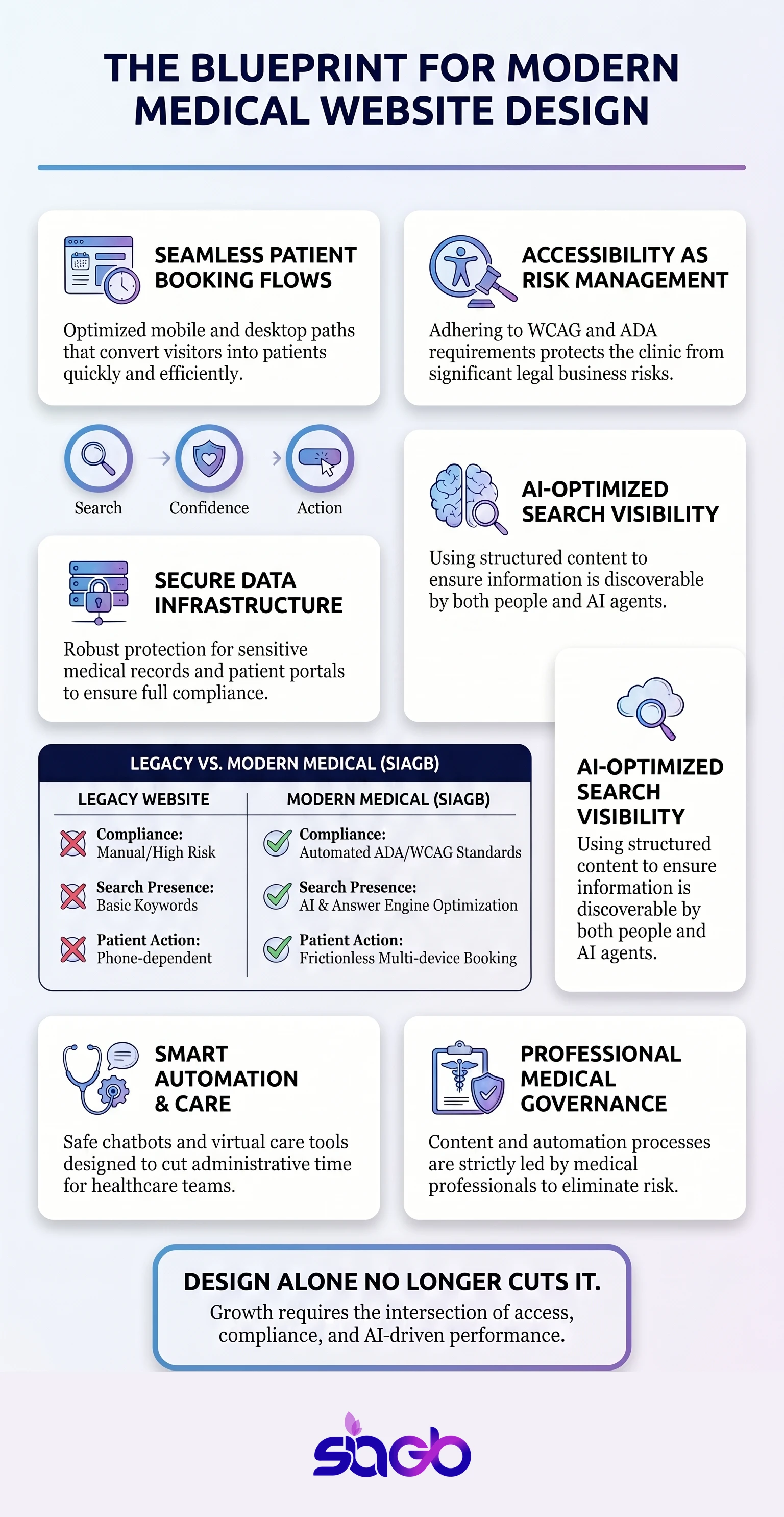
This infographic shows how accessibility, security, and AI SEO overlap. It highlights how good web design supports outcomes, compliance, and growth for healthcare organisations.
Frequently Asked Questions
What makes a medical website effective today?
It combines accessible web design, security, and AI‑ready content. It helps people book an appointment, find health information, and trust the provider.
Do Australian clinics need accessibility compliance?
Yes. WCAG standards apply globally. Legal cases overseas influence expectations for local providers.
How does AI SEO help healthcare organisations?
It improves how questions are answered by search engines and AI tools. This supports visibility and a better experience.
Are chatbots safe for healthcare use?
They are safe when designed with compliance, accessibility, and limits. They support tasks, not clinical decisions.
How do you measure success?
Look at completed bookings, reduced admin time, use by existing patients, and review growth. Traffic alone is not enough.
Key Takeaways
Strong healthcare website design balances access, trust, and automation. Good web design reduces risk, supports health care delivery, and improves experience for users and staff. AI delivers value when guided by real expertise, not hype. For healthcare providers across Australia and beyond, medical website design is now a core business system, and an area where partners like SIAGB help teams turn complexity into measurable results.
Sources
- Industry-standard reference materials
- Peer-reviewed research and clinical guidelines

Thinking about how this applies to your business?
Start a Conversation