Introduction
Australian businesses face a tough mix of rising labour costs, missed after-hours leads, and growing compliance pressure. Healthcare providers feel this daily. Retail feels it too. Australian customers expect instant answers, day or night, and they won’t wait around. Roughly a third of enquiries now arrive outside the 9-to-5 window, and a receptionist who clocks off at 5pm cannot catch a booking request that lands at 9:40pm.
Multichannel chatbots address this by handling customer service across websites, search, voice, and secure portals. One system. One source of truth. Fewer gaps in customer interaction. This guide explains how consultants deliver outcomes that matter, not just bots. We’ll look at healthcare and retail examples, compliance realities under the Privacy Act 1988 and the 13 Australian Privacy Principles, and how AI automation connects with SEO, analytics, and marketing automation. And yes, we’ll cover SIAGB and why AI-native delivery makes a difference.
At SIAGB we build these systems from Sydney (ABN 16 659 507 178). In our work on Marvel PTE, a single conversational layer now serves more than 85,000 users across 900-plus institutes, so the numbers below are not theory. They come from shipping automation at scale.
What Are Multichannel Chatbots?
A multichannel chatbot is a conversational AI system that works across several channels at the same time. It answers questions on your website, Google Business Profile, voice assistants, Microsoft Teams, and patient or customer portals. The same logic runs everywhere. When a patient starts a booking on a phone at 8pm and finishes it in Microsoft Teams the next morning, the context follows them.
Single-channel bots live in one place, usually a website. Multichannel chatbots share data, conversation history, and workflow automation across channels. That means consistent answers and a smoother user experience for every customer conversation. The table below shows why the difference is not cosmetic.
| Factor | Single-channel bot | Multichannel chatbot |
|---|---|---|
| Channels covered | Website only | Web, Google Business Profile, voice, Microsoft Teams, secure portals |
| Context retention | Resets each session | Persists across channels and devices |
| Analytics | Fragmented per bot | One dashboard, one source of truth |
| After-hours capture | Website form only | Live booking on any channel, 24/7 |
| Compliance controls | Bolt-on, inconsistent | Built in: encryption, audit logs, APP alignment |
| Typical integrations | 0 to 1 | EHR, scheduling, CRM, review platforms |
Common channels include websites, messenger apps, voice AI, search results, secure portals, and internal tools like Microsoft Teams. The chatbot keeps context as people move between them. That’s conversational AI done properly, with intelligent conversation instead of scripted replies.
The goal isn’t to replace staff. It’s to support them with automation. A human agent steps in when needed. Everything else is handled by the AI chatbot, quickly and accurately, improving customer support without burning out teams. A useful rule we apply: route anything with clinical or financial risk to a person, and let the bot own the repetitive 70 to 80 percent.
Why Single-Channel Chatbots Fail
Single-channel chatbots fail because customers don’t stick to one channel. They search first, often inside Google AI Overviews or ChatGPT. Then they call. Then they message. A website-only ai chatbot misses most of that interaction and breaks the customer conversation.
Data becomes fragmented too. Each bot works alone. Analytics don’t match up. Optimisation turns into guesswork. In healthcare, that’s risky. Disconnected bots create security and compliance gaps, and under the Notifiable Data Breaches scheme a single unlogged leak can trigger a mandatory report to the Office of the Australian Information Commissioner.
Over time, customer service teams lose trust in the chatbot. Staff revert to manual work. Automation stalls. In our work we have seen a clinic run three separate bots that gave three different answers to the same recall question. Frustrating, honestly, and avoidable.
Business Problems Multichannel Chatbots Solve
Multichannel chatbots solve practical problems. They reduce staff workload while speeding up responses to customer queries. They capture leads and bookings after hours. And they deliver accurate answers at scale.

For retail, ai consulting for retail businesses often begins with the three enquiries that fill inboxes: stock checks, returns, and order tracking. Together these routinely make up more than half of all incoming messages. One ai powered chatbot manages them across web and messenger. Fewer emails. Fewer calls.
Automation also lifts customer engagement. People get fast replies, typically in under two seconds rather than the hours a support queue takes. Staff focus on complex issues. Workflows stay tidy. Customer data stays consistent. This is where customer service chatbots move from novelty to real infrastructure. We track resolution rate, first-response time, and after-hours capture, because those three numbers tell you whether the bot is actually paying for itself.
Healthcare Use Cases with Compliance Reality
Healthcare chatbots need to do more than chat. They book appointments. Send recalls. Answer patient FAQs. And they integrate with EHRs and patient portals through secure web application development, including links to My Health Record and practice systems used by RACGP-accredited clinics.
A compliant ai powered chatbot connects to scheduling systems and secure portals. Patients can ask questions any time through a virtual assistant. Staff see fewer calls. Clinics see fewer no-shows, and since no-shows commonly run at 10 to 15 percent of booked appointments, an automated SMS and portal recall that trims even a third of them protects real revenue. That’s measurable ROI and better customer service. We built exactly this pattern for a medical group: AI-powered patient scheduling that lets people self-serve a booking without ever reaching the front desk.
Healthcare website accessibility matters here. An ada compliant patient portal and accessible chatbot support all patients, including those using screen readers or voice input. This isn’t optional anymore. It’s expected.
ADA, WCAG, and Healthcare Website Accessibility
ADA website lawsuit doctors face is a real concern. Clinics in Australia and overseas are under growing legal pressure. In Australia the relevant baseline is the Disability Discrimination Act 1992, and the practical yardstick is WCAG 2.2 Level AA. Accessibility failures lead to complaints and lost trust.
WCAG healthcare website standards guide how chat interfaces should work. Text contrast of at least 4.5:1 for body copy. Full keyboard navigation with a visible focus state. Touch targets of 24 by 24 CSS pixels or larger under WCAG 2.2. Simple language. Chatbot responses must support intelligent conversation that everyone can use, including patients on screen readers such as NVDA or VoiceOver.
Accessibility-first chatbot development reduces risk. It also improves the experience for patients. We test every chat widget against the four WCAG principles (perceivable, operable, understandable, robust) and against Core Web Vitals, aiming for Largest Contentful Paint under 2.5 seconds and Cumulative Layout Shift under 0.1 so the widget never shoves content around as it loads. Clinics stay compliant. Patients feel supported. This should be the default, not a bolt-on.
AI SEO, AEO, and Chatbots Working Together
Chatbots now play a key role in AI SEO healthcare strategies. They capture real patient questions and customer inquiries. Those questions shape content. That’s answer engine optimisation medical teams rely on, the work of getting cited inside ChatGPT, Perplexity, and Google AI Overviews rather than just ranking in blue links.
An ai chatbot reveals what people actually ask, not what teams guess they ask. That insight feeds healthcare seo strategy and medical practice seo. We turn those real questions into FAQPage and MedicalClinic schema.org markup, so an answer engine can lift a clean, structured response straight from the page. Content improves. Search visibility improves.
This is where ai bots and automation support smarter optimisation. Chatbots don’t just answer questions. They guide optimisation. Conversation drives discovery. It’s smart. And it works.
Automated AI Agents Supporting SEO
Automated systems use ai agents for seo tasks. These agents update FAQs, schema, and content based on real chatbot interactions and customer queries. No endless manual updates.
For medical practices, this matters. Guidelines change. Patient questions change. Automated systems keep content current. That’s ai seo automation done properly.
This approach reduces workload. It improves accuracy. And it keeps teams focused on patient care, not constant content edits.
Modern Medical Website Design and Redesign
Modern medical website design starts with patient intent. Not pages. Not menus. An ai optimised website healthcare teams trust treats chatbots as a core layer of the user experience.
A healthcare website redesign should include secure chatbot integration from day one. HIPAA compliant website architecture matters. Hosting choices matter. Data flow matters. Access controls matter too.
Chatbots guide users through the site. They answer questions. They reduce friction. Web design, software development, and ai chatbot development now work together. They have to.
Patient Reviews and Online Reputation Automation
Online reputation healthcare teams manage is fragile. One poor experience can spread quickly. Chatbots help by triggering Google reviews medical practice owners depend on.
After appointments, chatbots request feedback as part of marketing automation. Patient review management becomes automated. Sentiment tracking flags problems early.
This protects trust. It also supports reputation management doctors need. Automation here saves time and improves outcomes. Simple. Effective.
Healthcare Cybersecurity and Data Protection
Healthcare cybersecurity threats target chatbots as well. Data leaks. Prompt injection. Weak access controls. These risks are real.
HIPAA cybersecurity applies for US-facing work, while Australian practices answer to the Privacy Act 1988, the Australian Privacy Principles, and the Notifiable Data Breaches scheme. Medical practice data security must be built in from the start of chatbot platform design, not patched on later.
Secure chatbot solutions use encryption in transit and at rest (TLS 1.3 and AES-256), audit logs, and role-based access control. Generative AI runs in controlled environments with retention limits and prompt-injection guards. In our work we treat every stored transcript as personal information under the APPs, which means a defined retention window, an access log, and a breach-notification path from day one. No shortcuts. Ever.
Chatbot Analytics and ROI Measurement
Chatbot analytics consultants Australia wide focus on outcomes. Bookings. Revenue impact. Cost savings. Not vanity metrics. We report on five numbers: resolution rate, average handle time, after-hours capture, escalation rate to a human, and cost per resolved conversation.
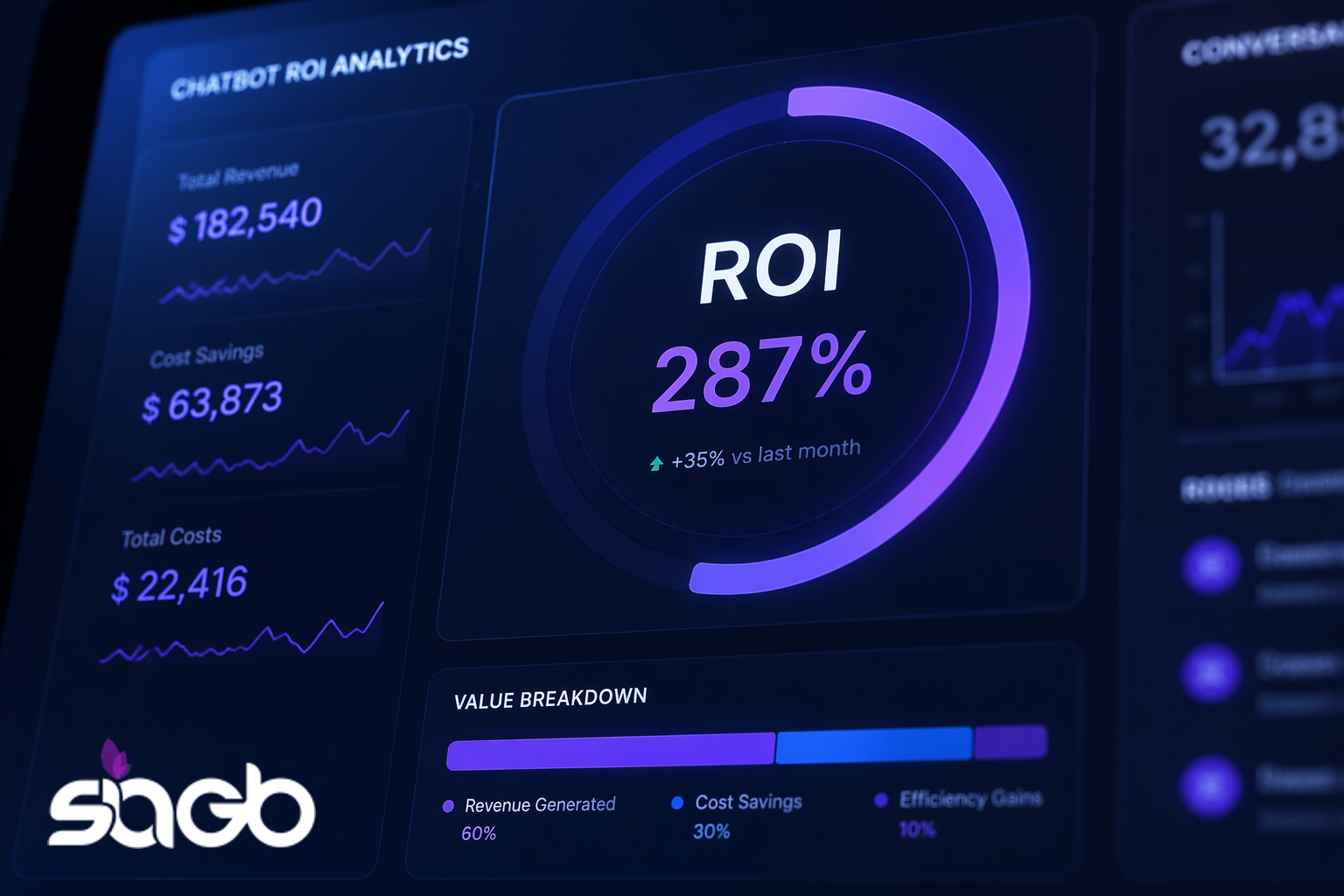
Multichannel analytics show performance across every channel. One dashboard. One source of truth. Optimisation becomes straightforward.
Data also feeds workflow improvements. Workflow automation adapts responses, routing, and handover to a human agent when needed. That’s how ROI stays visible over time.
Infographic: Multichannel Chatbot Ecosystem
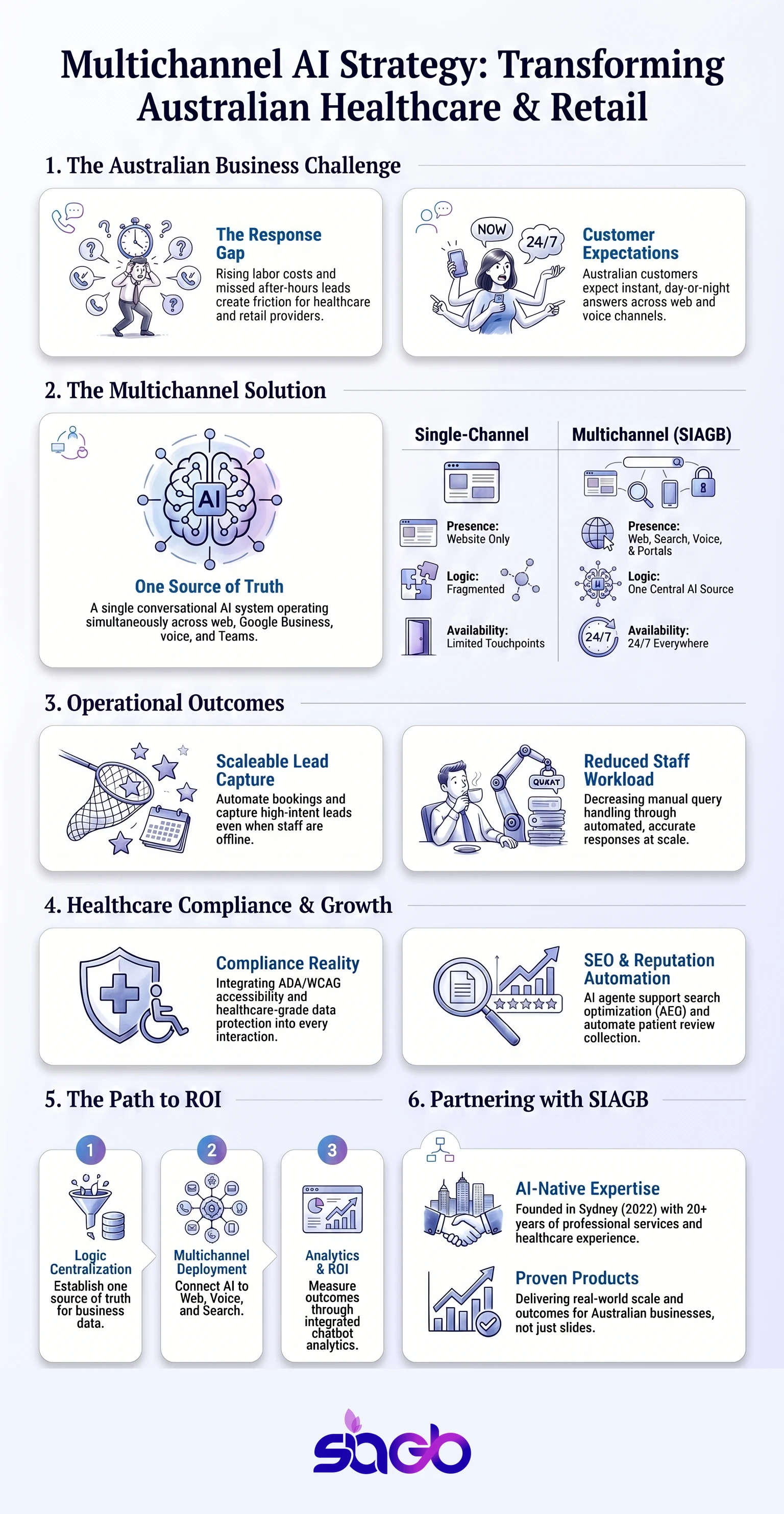
This infographic shows how chatbot channels connect. Website. Search. Voice. Portals. Microsoft Teams. SEO, AEO, analytics, and compliance all flow through one system. End to end. No silos.
How to Choose a Multichannel Chatbot Consultant in Australia
Choosing the right partner matters. Look for AI-native teams with deep experience in chatbot builder tools and chatbot platform architecture. End-to-end delivery matters. No handoffs.
Healthcare compliance and security experience is critical. Ask about accessibility against WCAG 2.2 AA. Ask about data governance under the Australian Privacy Principles. Ask to see real metrics from customer support and customer interaction use cases, not a demo that only works on a slide.
SIAGB fits this approach. We are based in Sydney (ABN 16 659 507 178) and led by founder Sheetal Dhadial, who brings more than 20 years in IT and AI leadership and holds Certified Scrum Master and AgilePM credentials. Our proof is shipped: Marvel PTE serves 85,000-plus users across 900-plus institutes, and we have built AI-powered patient scheduling for a medical group. Proven products. Real scale. Not just slides.
Frequently Asked Questions
What is a multichannel chatbot?
A multichannel chatbot is a single AI chatbot that works across websites, search, voice, Microsoft Teams, and portals. It shares data and workflows across every channel.
Are chatbots safe for healthcare use?
Yes, when built correctly. Healthcare chatbots must meet privacy, security, and accessibility standards. Poorly built bots increase risk.
How do chatbots improve SEO for medical practices?
Chatbots capture real patient questions and customer inquiries. That data strengthens AI SEO healthcare content and answer engine optimisation medical strategies.
Can chatbots help with patient reviews?
Yes. Chatbots can request feedback after visits and automate online reputation healthcare management.
How is ROI measured for chatbot projects?
ROI is measured through reduced staff time, increased bookings, and better customer service outcomes across channels.
Key Takeaways and Final Thoughts
Multichannel chatbots are business systems, not just tools. They connect artificial intelligence, automation, and compliance in one place.
Healthcare needs accessibility, security, and SEO alignment. Retail needs speed and scale. Both need ROI you can measure.
The right consultant delivers that. With a strong ai assistant mindset and practical ai chatbot development, chatbots become a growth engine. Not just another bot.
Sources
- MIT Technology Review (technologyreview.com)
- Stanford HAI - Human-Centred AI (hai.stanford.edu)

Thinking about how this applies to your business?
Start a Conversation