
Online reputation in healthcare is the trust signal people see before they ever book. It blends reviews, search results, accessibility, and data security into one visible story shaped by healthcare website accessibility and online reputation signals. For US healthcare providers, that story shapes confidence, compliance risk, and long term growth, especially as AI search and answer engines influence perception across the healthcare industry. For those searching for online reputation healthcare, this guide covers everything you need to know.
Introduction
Online reputation in healthcare is about confidence, not promotion. For a healthcare practice, perception shapes how people feel before they call, click, or walk through the door, or even read an AI generated answer from ChatGPT, Perplexity, or a Google AI Overview. Many leaders still ask why reputation management matters when care quality is already high. Fair question.
Here is the thing. Healthcare is not like retail or hospitality, or even digital marketing for retail businesses where feedback loops are fast. A cafe can recover from a bad review with a free coffee. A doctor cannot. Trust takes years to earn and moments to lose, something I have seen more than once with experienced doctors and clinics across the United States.
Healthcare reputation management focuses on how systems, behavior, and visibility combine. It goes beyond marketing. It is about how a healthcare organization shows reliability, safety, and respect online. In our work with clinics and medical groups, that combination is what helps build trust before the first appointment.
This article looks at the full picture. Reviews, accessibility, local SEO signals, cybersecurity, and AI systems. All linked. No hype. Just what shapes a strong reputation for US healthcare organizations. The reference points here are concrete: WCAG 2.2 AA, the Core Web Vitals thresholds Google uses, ADA Title III case law, and HIPAA obligations that date back to 1996.
What Online Reputation Means in Healthcare

Online reputation management in healthcare brings many signals into one judgment. It includes patient reviews, search visibility, social media mentions, website usability, and security posture. People do not separate these parts. They experience them as one story, tied closely to trust.
Healthcare reputation management is regulated and confidence driven. You cannot exaggerate outcomes. You cannot freely respond to every online review. And you cannot ignore compliance tied to healthcare website redesign, accessibility, or cybersecurity. One misstep can affect patient satisfaction and long term loyalty.
Each of these signals feeds a different judgment, and each one has a concrete way to measure it. Here is how we map them:
| Reputation signal | What patients notice | How to measure or verify it |
|---|---|---|
| Google reviews | Star average and recency on the map pack | AggregateRating schema, review velocity per month |
| Website accessibility | Can they book, read, and navigate | WCAG 2.2 AA audit, keyboard and screen reader tests |
| Site speed | Pages that load before they leave | Core Web Vitals: LCP under 2.5s, INP under 200ms, CLS under 0.1 |
| Data security | Confidence that records stay private | HIPAA safeguards, breach history via the HHS portal |
| AI search visibility | How ChatGPT and AI Overviews describe you | Cited facts, MedicalOrganization schema, consistent NAP |
People do not separate these parts. Problems in any row show up quickly.
- A slow or outdated healthcare clinic website frustrates visitors, for example when an appointment page takes 6 seconds to load rather than under 2.5.
- An inaccessible form blocks access to services, such as a booking field with no label a screen reader can announce.
- A data issue raises concerns about health care privacy, specifically the kind of breach that lands on the HHS “Wall of Shame” for incidents affecting 500 or more patients.
Each issue leaves a public trail that influences online review conversations and social media.
Healthcare providers need to treat healthcare reputation management as a system, not a campaign or a single piece of reputation management software. Connected controls protect people, support clinicians, and help a healthcare organization maintain a strong online presence.
We have seen this happen. Great care. Weak systems. And trust suffers anyway.
Google Reviews and Patient Review Management Risks
Google reviews are often the first thing people see, even before a website loads. Star ratings get scanned before bios get read. In particular, the Google Business Profile star average and the 3 most recent reviews carry outsized weight in the local map pack. These online reviews shape patient sentiment fast and strongly influence perception of a doctor or clinic.
Patient review management in healthcare carries risk. Responding to an online review can reveal protected information. Even confirming someone saw a doctor can breach HIPAA rules, which the HHS Office for Civil Rights enforces with civil penalties that in serious cases reach into six figures per violation. Doctors and healthcare practitioners need clear processes to manage feedback safely.
A structured approach helps. Unlike a restaurant that can name the guest in a reply, a clinic must respond in the third person and never confirm a care relationship. Healthcare providers can invite feedback without incentives. They can monitor review sites such as Google, Healthgrades, and Zocdoc alongside social media channels. They can reply using neutral language that supports healthcare reputation management while protecting standards of care.
Positive reviews build confidence over time. As a rough benchmark, most patients want to see a rating at or above 4.0 and more than 20 reviews before they trust a new provider. Multiple positive reviews signal reliability and help build trust. Negative comments need calm handling. Sometimes silence is the safest option, rather than a reply that risks exposing protected health information.
A strong online presence grows when satisfied patients feel heard and respected, and when positive reviews appear consistently.
Accessibility Failures and Reputation Damage
Healthcare website accessibility is now a visibility issue, not just a technical one. People expect to book, read, and engage online. When they can’t, frustration turns into complaints, feedback, and poor reviews.
WCAG healthcare website standards guide accessible design. The current benchmark is WCAG 2.2 Level AA, published in October 2023, which most US courts and the Department of Justice treat as the practical yardstick for ADA compliance. Clear text with a color contrast ratio of at least 4.5:1 for body copy. Keyboard navigation. Screen reader support. These directly affect access and patient satisfaction.
Accessibility complaints spread faster than most negative comments. In our testing of clinic sites, the failures that trip up screen readers most often are unlabeled form fields, images with no alt text, and contrast below 4.5:1. They also surface in search results and social media, affecting healthcare reputation management and local SEO signals.
From a reputation view, accessibility signals respect. It shows the healthcare organization considered every patient. Miss this, and trust erodes. Even happy patients notice when others are excluded.
Accessibility isn’t just compliance. It’s visible care that helps build trust.
ADA Website Lawsuits and Doctors’ Reputation Fallout
ADA website lawsuits doctors face often start small. A missing label. A broken booking form. Then legal notices follow. Federal ADA Title III filings have run into the thousands each year, and healthcare sites are a frequent target because booking and patient portals are public facing.
These cases surface in search results. News articles appear. Reviews and social media discussions link a doctor’s name to legal action, even after fixes are made. In contrast to a private billing dispute, an accessibility complaint is often public from day one.
The cost isn’t just legal fees. It’s loss of patient trust. Prospective patients hesitate. Referrers pause. Damage lingers long after technical issues are resolved.
Ignoring accessibility risks long term loyalty and growth.
Patient Portals, Chatbots, and Confidence Breakdown
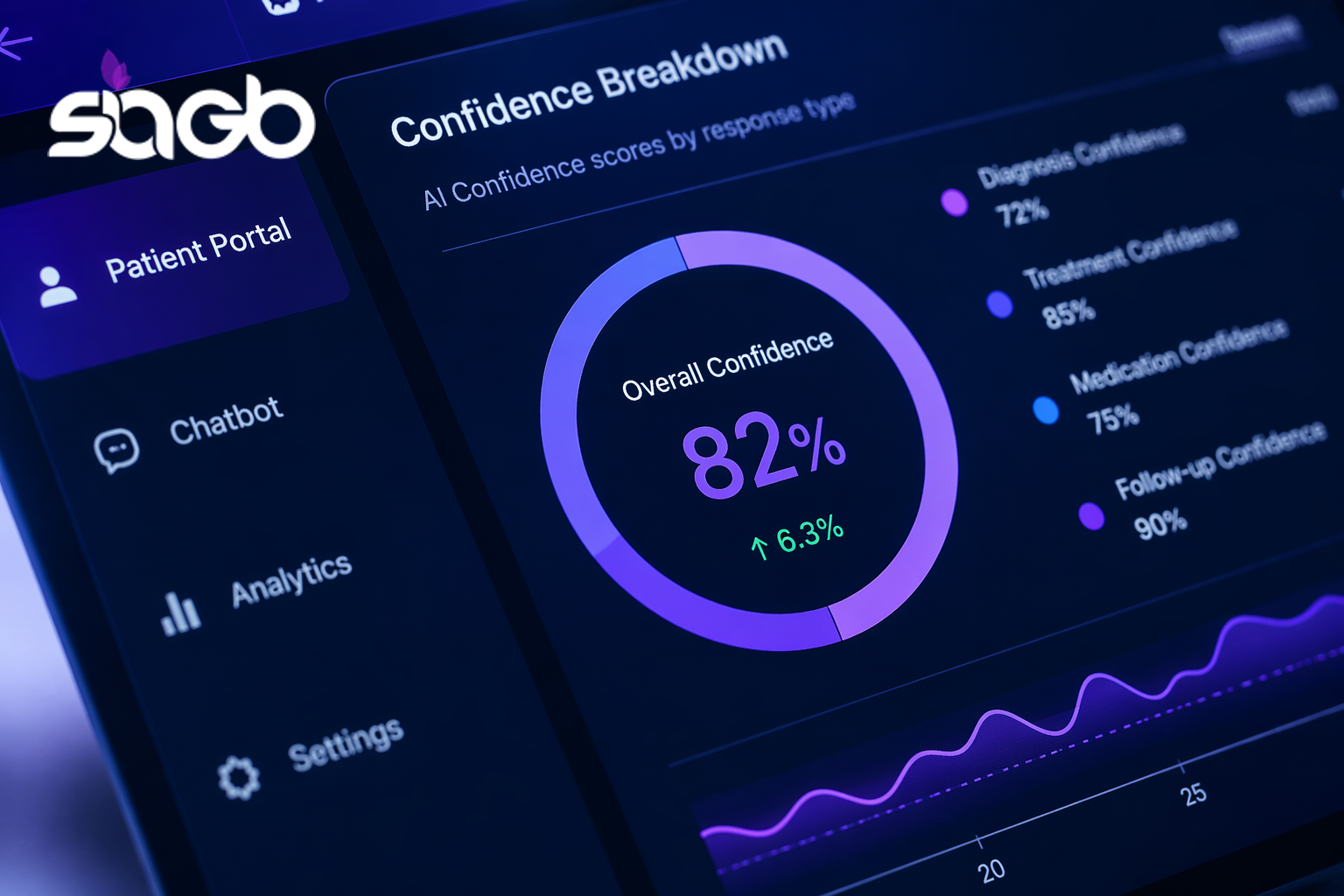
Patient portals and chatbots shape everyday patient experience. When they fail, satisfaction drops fast and healthcare reputation management suffers.
An accessible portal needs to work for everyone. Login steps. Appointment views. Messages. When users struggle, they blame the healthcare provider, not the technology or vendor. We build AI-powered patient scheduling for medical groups, and the pattern is consistent: for instance, a portal that fails a keyboard-only test or times out on a 3G connection drives more support calls than the clinical workflow itself.
Chatbots can support or harm healthcare reputation management. A broken bot frustrates users. A clear, secure bot supports engagement and reinforces a positive experience with the doctor or clinic. Rather than answering medical questions freely, a compliant bot should stay inside scheduling, directions, and general FAQ, and hand off anything clinical to a human.
These tools also handle sensitive data. One outage or leak spreads quickly on social media. Under the HIPAA Breach Notification Rule, any incident affecting 500 or more people must be reported to HHS and often to local media within 60 days. Trust takes a hit, often amplified by reviews.
Portals and bots need testing and monitoring. Otherwise, they quietly erode loyalty.
Healthcare Cybersecurity Threats and Reputation Risk
Healthcare cybersecurity threats continue to rise. Ransomware, phishing, and outages affect clinics of every size. Healthcare has carried one of the highest average breach costs of any US sector for more than a decade, and reported breaches routinely expose millions of patient records each year.
When breaches happen, public perception shifts. People worry about their data and overall care quality. Media coverage amplifies concern. Because HIPAA requires public disclosure for breaches over 500 records, the story rarely stays quiet. Damage often outlasts the technical issue.
People assume strong data security is part of basic health care delivery. Basic safeguards, for example multi-factor authentication, TLS encryption in transit, and role-based access, are now table stakes rather than extras. A single incident can trigger negative feedback and poor online reviews across review sites.
Cybersecurity is now part of healthcare reputation management. Strong systems support trust. Weak ones undermine years of good work by doctors and healthcare professionals.
AI SEO, Limited Local SEO, and Answer Engine Visibility
AI SEO changes how people find information. Search engines and AI tools such as ChatGPT, Perplexity, Gemini, and Google AI Overviews answer questions directly, often without a click, but still shaping trust. We track how these engines describe our clients, and the answer they give is only as good as the structured data and consistent facts they can find.
Local SEO signals still matter. Accurate listings, reviews, and consistent information influence how prospective patients find a healthcare clinic nearby, including across major US cities such as Dallas, Atlanta, and Salt Lake City. In particular, a matching name, address, and phone number across your Google Business Profile, website, and directories is what keeps AI answers from contradicting themselves.
Answer engine optimization content must be accurate and compliant. Structured markup helps: MedicalOrganization, Physician, FAQPage, and Review schema from schema.org give engines clean facts to cite instead of guessing. Errors damage trust and healthcare reputation management quickly.
A modern digital marketing approach in healthcare focuses on authority, not volume.
- Clear answers aligned with clinical reality.
- Consistent facts across platforms.
- Human oversight of AI generated content.
Lose control here, and your online presence gets shaped by others.
Medical Practice Website Design and Reputation Signals
Website design sends instant signals. Clean layouts. Clear information. Secure forms. These shape confidence before an appointment is booked with a doctor. Speed is part of that first impression: Google flags a page as slow when Largest Contentful Paint runs past 2.5 seconds or Interaction to Next Paint past 200 milliseconds.
Healthcare website redesign often fails when visuals come before usability. Fancy designs can hurt accessibility and healthcare reputation management. Instead of a hero video that pushes the appointment button below the fold, a booking path that loads in under 3 seconds does more for trust.
A modern site should reflect strong privacy and data handling. Secure hosting on HTTPS, clear consent flows, and a visible privacy notice support a strong online presence and patient satisfaction.
People judge credibility fast. A broken page or warning message damages trust, even when care quality is high.
AI Chatbots, Recall Systems, and Patient Experience
Recall system failures lead to missed care. Missed care leads to complaints. Complaints affect healthcare reputation management and patient confidence.
AI chatbots can support recalls and reminders. Used well, they improve engagement and reduce admin load for doctors and healthcare professionals.
Analytics often reveal hidden issues. Confusing messages. Drop off points. Frustration that leads to negative feedback and online reviews.
Used thoughtfully, AI supports a positive experience. Used carelessly, it creates noise and distrust.
Building an End-to-End Reputation Strategy
Online reputation management works when systems connect. Reviews link to accessibility. Accessibility links to SEO. SEO links to security.
Fragmented vendors increase risk. Gaps appear. No one owns the full journey, from search to portal to follow up.
A problem first approach matters. That is how SIAGB works. Our founder, Sheetal Dhadial, brings more than 20 years in IT and AI leadership and holds Certified Scrum Master and AgilePM credentials, and our team has built platforms at scale, for example Marvel PTE, which serves 85,000+ users across 900+ institutes. That same systems thinking, rather than a scattered set of point tools, is what we bring to healthcare reputation. Healthcare reputation management only makes sense when tied to real issues, measurable outcomes, and regulated environments across the healthcare industry.
Reputation management becomes simpler when one team sees the whole picture. Trust grows when systems align and help build trust at every step.
This isn’t about tools. It’s about outcomes for patients and providers.
Infographic: How Healthcare Reputation Systems Connect
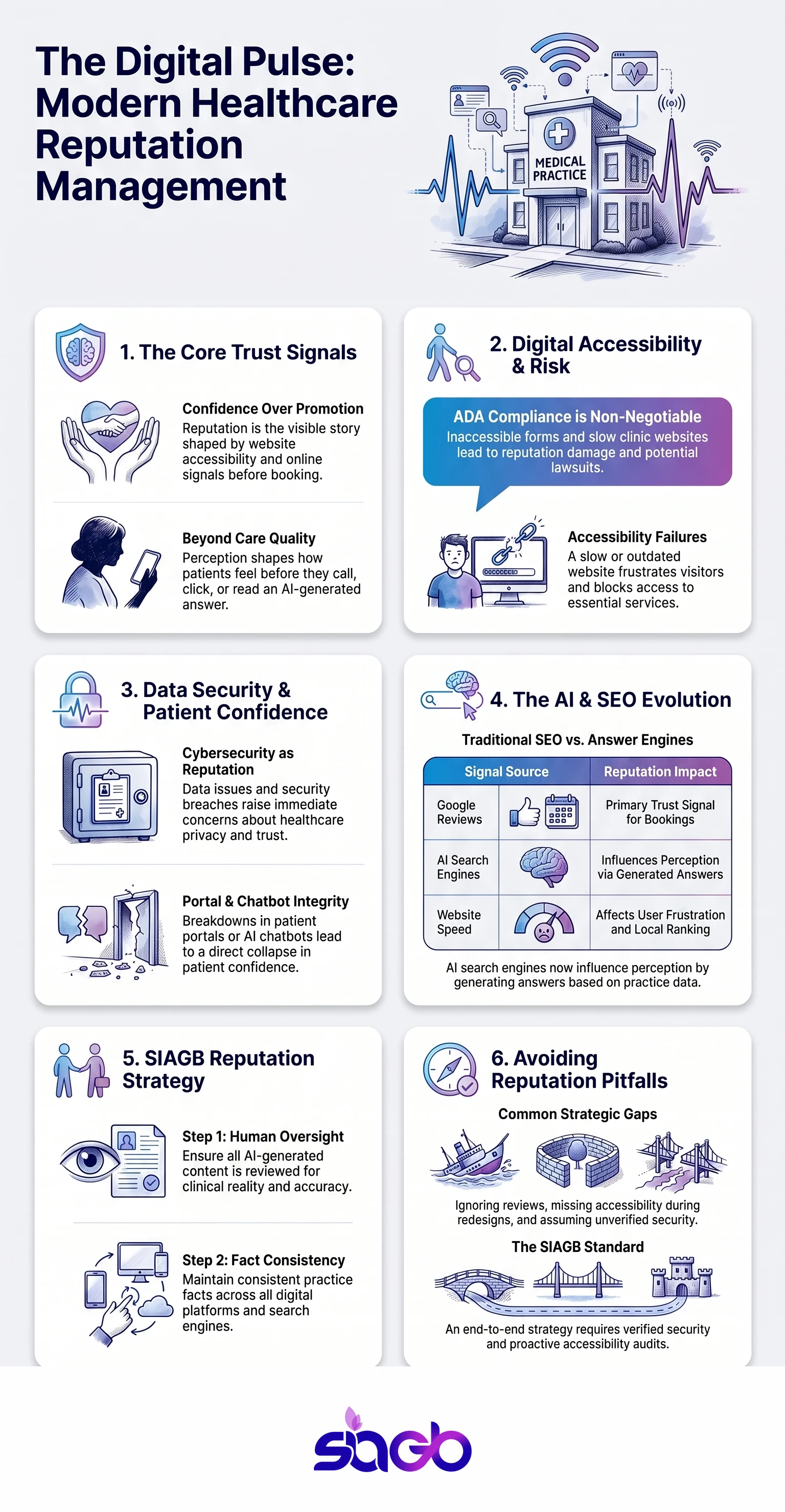
This infographic shows healthcare reputation management across the journey. From search and social media to booking, portal access, and follow up.
It highlights common break points.
- Online reviews ignored or mishandled.
- Accessibility missed during redesign.
- Security assumed but not verified.
Seeing the system helps leaders fix the right problems.
Frequently Asked Questions
Why is online reputation management important for healthcare providers?
Online reputation management shapes how prospective patients judge a healthcare provider before contact. Reviews, AI summaries, and social media influence trust.
How do online reviews affect patient acquisition?
Online reviews and patient reviews influence decisions quickly. Positive reviews attract new patients, while negative feedback can slow patient acquisition.
How does patient feedback improve patient care?
Patient feedback highlights gaps in access, communication, and systems. Acting on it improves care quality and patient satisfaction.
Does social media really impact healthcare reputation?
Yes. Social media amplifies feedback and reviews. It also affects how a doctor or clinic is perceived publicly.
Are AI tools safe for healthcare online reputation management?
AI tools help when guided by humans. Without oversight, they can create errors that harm trust and overall healthcare reputation management.
Key Takeaways and Final Thoughts
Healthcare reputation management is a system, not a star rating or a single post.
Reviews, accessibility, digital marketing, limited local SEO signals, and security all shape trust and loyalty.
Healthcare leaders should take a joined up view. Fix root problems. Listen to feedback. Use AI with care.
That’s how a strong reputation lasts, supported by satisfied patients, positive reviews, and consistent care from every doctor in the organization.
Sources
- Industry-standard reference materials
- Peer-reviewed research and clinical guidelines

Ready to put this into practice?
Let's Talk