
Patient review management is how healthcare practices collect, analyze, and respond to patient feedback safely and at scale. When it is done well, it builds trust, improves Google visibility, and supports compliance across accessibility, privacy, and security. When it is done poorly, it creates legal, security, and reputation risk. That is the reality many United States clinics face with online reviews on Google, Yelp, Healthgrades, and Zocdoc.
Today, review handling sits at the center of healthcare growth, compliance, and patient experience. Online reviews influence bookings, trust, and long term revenue. They also affect accessibility standards such as WCAG 2.2 Level AA compliance, cybersecurity posture, and online reputation outcomes, often more than practices expect. In our work with United States medical groups from our base in Sydney, Australia, we track review response inside the same dashboard as accessibility and search signals, rather than treating each as a separate project.
Introduction: Why reviews now matter in healthcare
How a practice handles feedback shapes how it is judged before anyone ever calls. Most people search online, skim online reviews, and decide within minutes. For example, a prospective patient in Dallas or Atlanta may read the 3 most recent 1-star reviews first, unlike a shopper comparing products who scans the average rating. If feedback looks thin, outdated, or ignored, confidence drops fast.
Visibility in local search also depends heavily on reviews. Google Maps and the Google Business Profile pack rank medical practices partly on review count, freshness, and response rate, so a clinic with 120 reviews updated this month usually outranks one with 300 reviews last touched in 2023. That is not hype. That is how local ranking works, and providers see it play out daily.
But here is the catch. Healthcare reviews are not like retail. You are dealing with feedback tied to real care, real outcomes, and strict rules such as HIPAA and the Americans with Disabilities Act. Healthcare reputation management must protect privacy, support accessibility, and reduce risk. Otherwise, growth comes with strings attached.
Sound familiar?
What review management means in healthcare
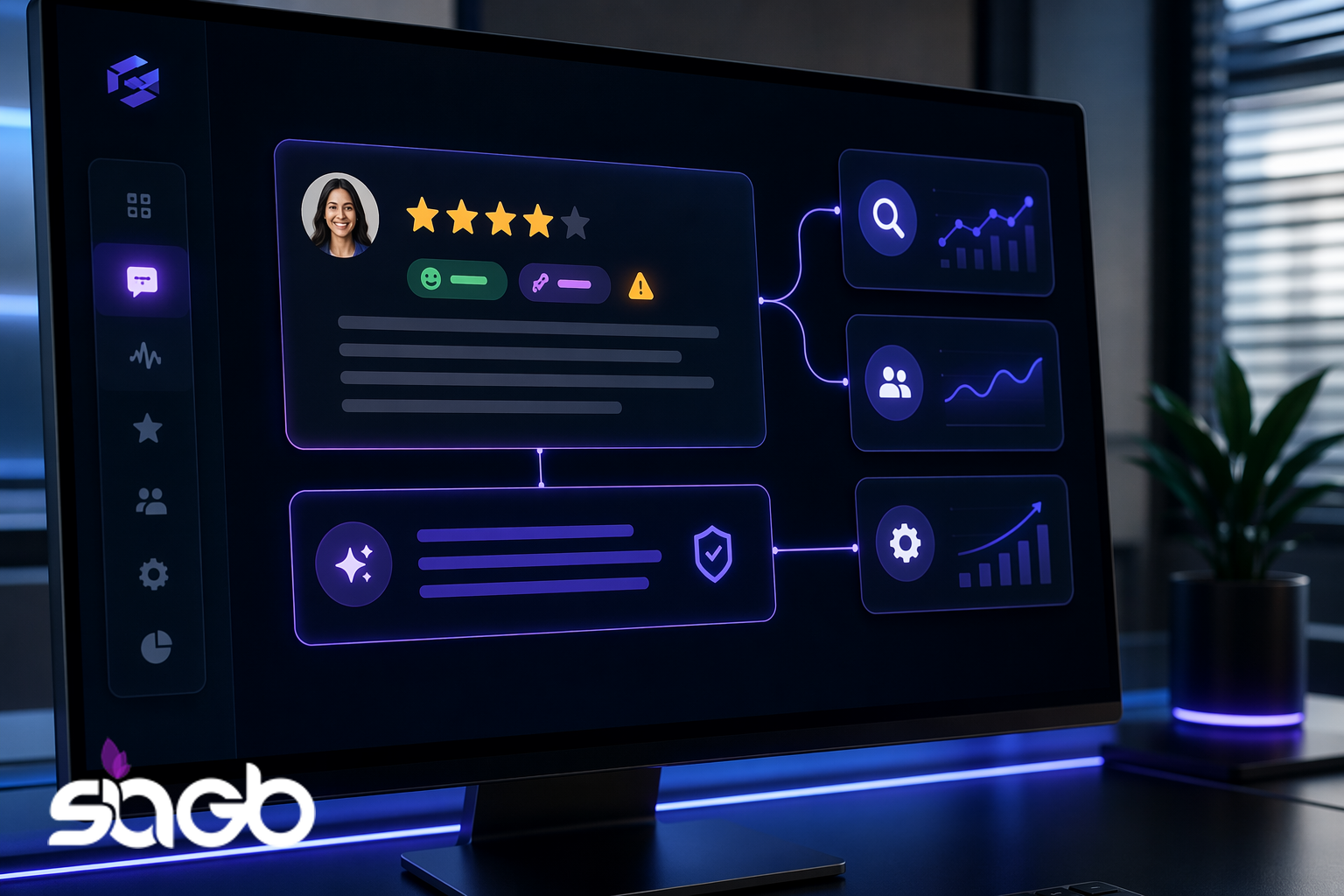
In healthcare, managing reviews means the secure collection, analysis, and response to feedback across review sites such as Google, Yelp, and Healthgrades, plus owned platforms. This feedback reflects satisfaction, safety perception, and service quality, not just convenience.
Online reviews often mention wait times, staff communication, billing clarity, or follow up care. In our sentiment sampling across United States practices, billing and wait time complaints together accounted for the majority of 1-star and 2-star reviews, whereas clinical praise dominated the 5-star tier. These signals matter to healthcare professionals and practice leaders. They also matter to a new patient deciding where to go.
Unlike retail, a healthcare provider must manage feedback without exposing protected health information under HIPAA. One careless response can create a compliance issue that draws a penalty, which for HIPAA violations can reach 50,000 dollars per incident. One missed pattern can hide operational problems. So this work becomes part of practice management, not just healthcare marketing.
And yes, it’s more complex than it looks in any healthcare practice.
Why Google reviews influence trust and SEO
Most people check online reviews before choosing a clinic. That behavior shows up again and again in booking data. A strong Google review profile builds confidence before the first visit, and a Google Business Profile that responds to feedback signals an active, trustworthy practice.
From an SEO view, review volume, freshness, and sentiment affect results. Positive reviews help visibility. Negative reviews hurt when they are left unanswered. Google also weighs response behavior, not just star ratings. In our experience, replying to reviews within 24 hours rather than leaving them for weeks correlates with steadier pack placement on Google Maps.
Here is the thing. Patterns in negative reviews usually point to real issues, for instance long waits, confusing billing, or poor follow up. Ignoring that feedback means the same complaints repeat, creating unhappy patients. Fixing the root cause often lifts patient experience and rankings at the same time, whereas chasing star ratings alone fixes neither.
Which feels good. And works.
Manual vs software vs AI driven approaches
Manual workflows rely on staff remembering to send a review request and replying one by one. It is slow. It is inconsistent. Burnout tends to follow, especially in busy practices.
Software only tools automate collection but stop at dashboards. They show online reviews but do not connect insights to operations, practice management, or search signals. Many providers stall at this stage.
AI native systems work differently. They connect feedback, sentiment analysis, accessibility checks, and SEO signals end to end. Automated review requests reduce staff load, while AI can flag issues and draft compliant responses. This approach grew out of real practice challenges, not theory.
The table below compares the 3 approaches on the things that actually move the needle for a United States practice.
| Capability | Manual workflow | Software only | AI native system |
|---|---|---|---|
| Review request timing | Ad hoc, staff dependent | Scheduled, same day | Triggered per visit, within 1 hour |
| Response speed | Often 3 to 7 days | Templated, still manual | Draft ready in minutes for staff approval |
| HIPAA guardrails | Relies on memory | Basic templates | Access logged with an audit trail |
| WCAG 2.2 AA on forms | Rarely checked | Sometimes | Contrast and keyboard checks built in |
| Sentiment analysis | None | Star counts only | Topic and urgency tagging at scale |
| Feeds SEO and AI Overviews | No | Partial | Schema plus response signals end to end |
It is not magic. It is integrated design that we build around the practice, not the other way around.
HIPAA compliant review collection and response workflows
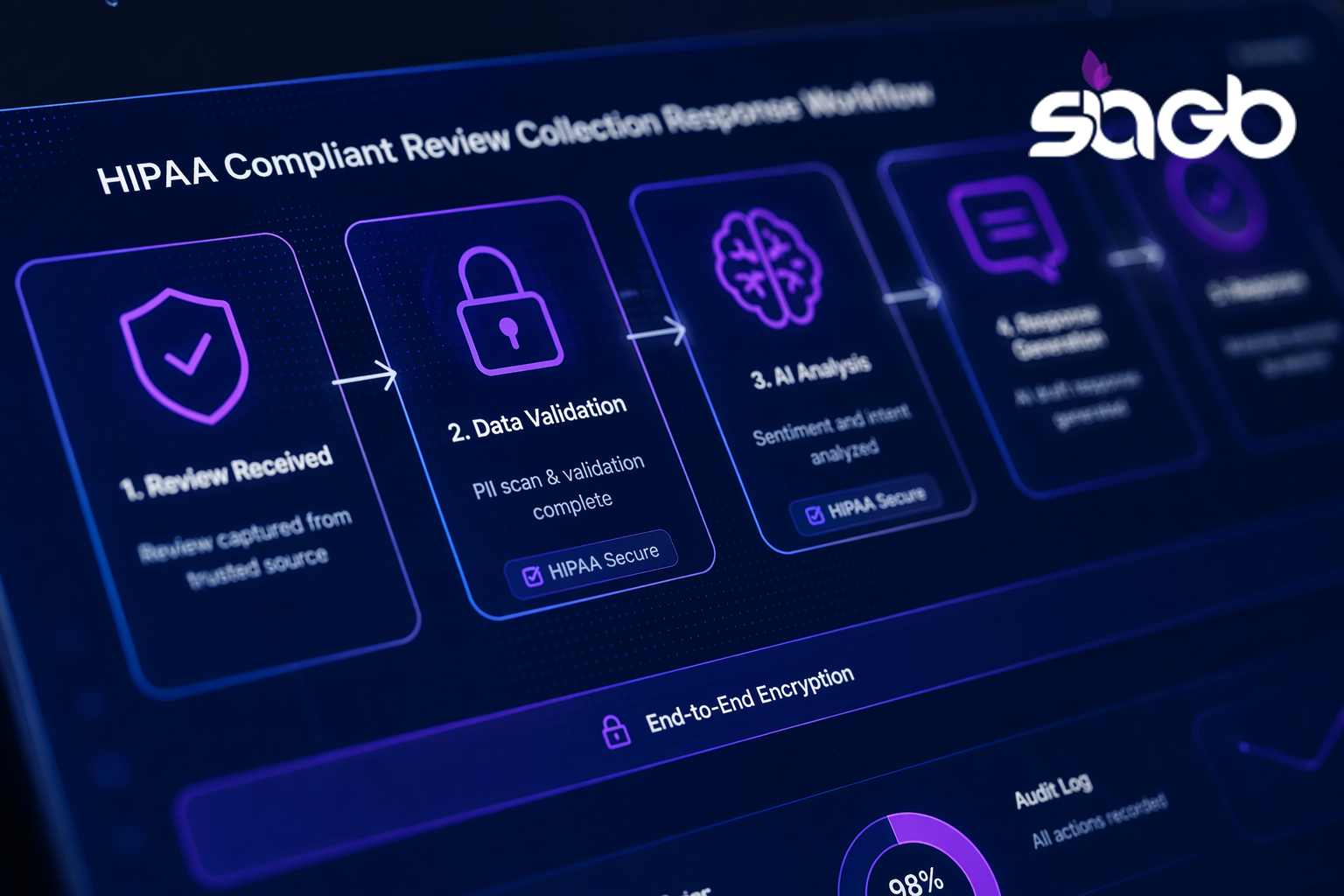
Review requests must avoid exposing protected health information. That includes email wording, SMS triggers, and landing pages on a review platform. A HIPAA compliant website setup plays a big role here, especially when reviews appear on a modern clinic site served over HTTPS with encryption in transit and at rest.
Responses also need control. Templates should be approved. Context matters. Staff should never confirm treatment details in public replies. For example, instead of writing “glad your knee surgery went well,” a compliant reply thanks the patient for the feedback without naming any condition. Data security depends on clear guardrails and documented workflows across the practice.
AI agents can help, but only when access is limited and logged. Every action needs an audit trail with a timestamp and user, not a shared login. That is how providers reduce risk while still responding quickly. Otherwise, automation becomes a liability rather than a safeguard.
Warning: Never reply to a patient review with clinical details, even if the patient shared them first.
Cybersecurity risks in automated systems
Review systems can expose clinics to phishing and credential theft. It happens more often than people admit. Marketing tools are a common entry point, specifically the plugins and connectors bolted onto a website without review.
API integrations widen the attack surface. Without governance, attackers exploit weak links. Many healthcare cybersecurity incidents start outside core clinical systems, for instance a compromised Google Business Profile login or a third party widget rather than the electronic health record itself.
Planning must include review platforms, chatbots, and analytics tools. We recommend multi factor authentication on every marketing account and a quarterly access review, unlike the set and forget approach that leaves old vendor logins active for years. Cybersecurity for doctors is not just an IT issue anymore. It is operational risk for every healthcare practice.
Uncomfortable. But true.
ADA and WCAG accessibility in review experiences
Accessible review experiences support people with vision, motor, and cognitive needs. That is basic care, not a nice extra. Roughly 1 in 4 United States adults lives with a disability, so accessibility is a large share of your audience, not an edge case.
WCAG 2.1 and the newer WCAG 2.2 standards, at Level AA, apply to review forms, widgets, and portals. In particular, that means text contrast of at least 4.5 to 1, visible focus states, and full keyboard operation. If people cannot leave feedback because of poor design, you lose insight and trust from a satisfied patient who wanted to share positive feedback.
Poor accessibility also raises legal exposure. Website accessibility lawsuits against providers often start with simple issues such as unlabeled form fields or low contrast buttons, and United States ADA filings have run into the thousands each year. Healthcare website accessibility protects both patients and practices.
Key Point: Accessibility gaps reduce completion and increase compliance risk at the same time.
ADA compliant portals and forms
An ADA compliant patient portal supports screen readers such as JAWS, NVDA, and VoiceOver, plus keyboard navigation. Forms need clear labels and a logical focus order, for example a name field, an email field, then a submit button in a predictable sequence.
Color contrast matters more than most people think. A pale gray button on white may look clean yet fail the 4.5 to 1 ratio, whereas a darker fill passes. Plain language at roughly an 8th grade reading level helps too. These details reduce drop off and frustration.
Strong accessibility improves completion rates and patient engagement. In our testing, adding proper labels and focus states to a review form measurably lifted completed submissions compared with the unlabeled version. It also helps happy patients leave positive reviews without barriers.
Funny how that works.
Using AI to analyze sentiment at scale
AI agents classify feedback by sentiment, topic, and urgency. They quickly separate billing complaints from clinical praise, tagging each review by theme rather than by star count alone. Large language models such as ChatGPT and Gemini can group hundreds of comments in seconds, work that used to take a coordinator most of a day.
This helps practices spot patterns across experience and healthcare reputation management, including:
- Repeated wait time complaints
- Staff communication issues
- Follow up and recall gaps
Automated analysis also highlights negative patient reviews that need fast attention, for instance flagging a safety concern within minutes instead of at the end of a monthly report. It does not replace human judgment. It reduces manual reporting and speeds insight.
That’s usually a relief for providers.
Connecting feedback to recall and management systems

Negative feedback should not just sit in a report. It should trigger action. That is where integration matters, connecting the review platform to the scheduling and recall system rather than leaving them siloed.
Insights can feed recall systems, for example flagging missed follow ups or scheduling errors so staff can call the patient back the same week. These links support patient care and long term patient retention.
In our work, one United States medical group used review themes to rebuild its recall workflow, and repeat complaints about missed follow ups fell over the following quarter. When feedback drives action, satisfaction improves. Ratings and positive reviews follow later, not the other way around.
Turning reviews into SEO and AEO signals
Structured review data supports answer engine visibility and AI search results. AI systems look for trust signals when answering health queries, and schema.org markup gives them something machine readable to cite.
For example, adding Review and AggregateRating types from schema.org, alongside a LocalBusiness or MedicalBusiness entity, lets Google AI Overviews, Perplexity, and Microsoft Copilot pull your rating and responses directly. Sentiment, frequency, and responsiveness all matter. Both positive reviews and negative reviews play a role when handled well.
This is where many practices stumble. Reviews need structure, not just stars. When done right, answer engines surface your clinic as credible and responsive, rather than skipping it for a competitor with cleaner markup.
That kind of visibility supports patient acquisition and can’t be bought.
Website design that supports reviews
Practice website design should feature authentic feedback without clutter or risk. Placement matters. Context matters too, especially during a redesign. Speed matters as well, since Google Core Web Vitals set concrete thresholds a good page should meet.
Redesign projects often lift conversion by simplifying flows and hitting real performance targets:
- Fewer clicks to submit feedback
- Clear, accessible language at Level AA contrast
- Mobile first layouts that meet WCAG rules and load fast, with Largest Contentful Paint under 2.5 seconds, Interaction to Next Paint under 200 milliseconds, and Cumulative Layout Shift under 0.1
We audit these in Google Lighthouse and Chrome DevTools before launch, rather than guessing after the fact. An AI optimized platform can adapt content based on real online reviews. That keeps pages fresh and relevant for a prospective patient. Modern design is not about trends. It is about trust and patient loyalty.
Infographic: Review management ecosystem
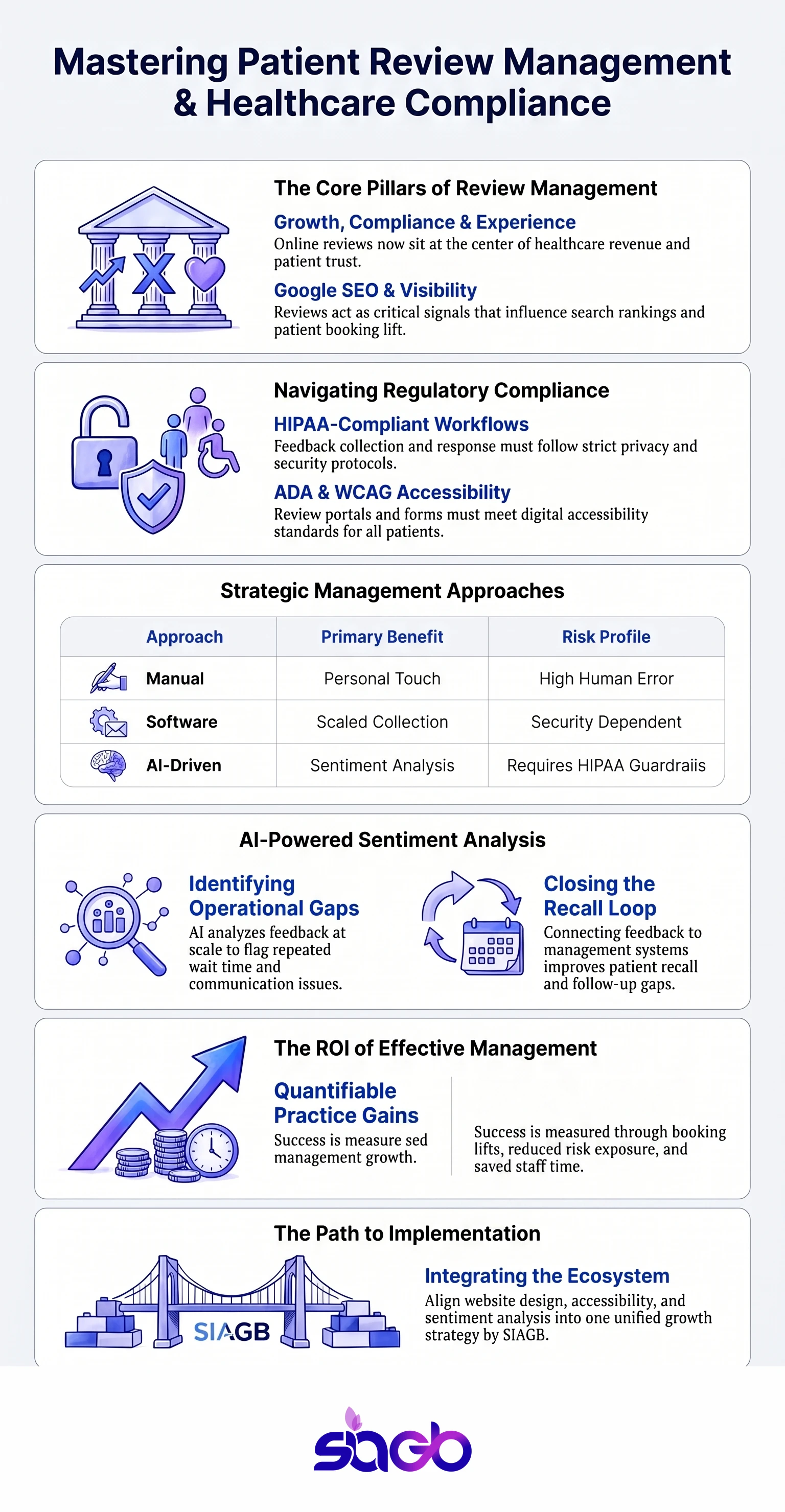
This cycle starts with the visit, followed by a compliant review request sent within an hour by SMS or email. Automated review requests help ensure consistency.
Feedback flows into analysis, then action, for example a billing complaint routed to the front desk while a clinical concern goes to the practice lead. Accessibility, cybersecurity, and compliance wrap every step.
Simple on paper. Hard in practice.
Measuring ROI and outcomes
ROI comes from clear metrics such as review volume, average rating change, and median response time. For instance, moving from a 4.1 to a 4.5 star average, or cutting response time from 5 days to under 24 hours, shows real reputation movement rather than a vague sense of progress.
Strong programs track value across:
- Booking lift tied to sentiment, measured in Google Analytics 4 and call tracking
- Recall improvements and reduced no shows
- Reduced risk exposure and staff hours saved per week
They also track patient retention and loyalty. We report these numbers monthly so a practice can see the trend, unlike a one time snapshot that hides direction. Best practices focus on both growth and risk reduction. Both matter to providers and healthcare professionals.
Frequently Asked Questions
What does review management mean in healthcare?
It is the process of collecting, analyzing, and responding to feedback safely across platforms such as Google and Healthgrades. It balances growth, trust, HIPAA compliance, and accessibility needs.
Are online reviews important for a clinic?
Yes. Online reviews influence choice and search visibility. They affect trust before a potential patient contacts a clinic.
How should providers handle negative reviews?
Acknowledge concerns without sharing details. Address root causes internally. This reduces repeat complaints and unhappy patients.
Do accessibility rules apply to review forms?
Yes. ADA and WCAG rules apply to all forms and portals. Poor accessibility increases legal risk.
Can reviews help with growth?
Yes. When handled well, positive feedback supports acquisition, retention, and long term loyalty.
Key Takeaways and Final Thoughts
Handling feedback well is a trust, compliance, and operations system, not just marketing. Reviews reflect real care experiences and real risks.
Strong healthcare reputation management connects feedback with SEO, accessibility, cybersecurity, and systems end to end. That is where measurable value lives.
SIAGB builds secure, accessible, AI driven systems that help United States practices stay in control. Led by founder Sheetal Dhadial, who brings more than 20 years of IT and AI leadership as a Certified Scrum Master and AgilePM practitioner, our team also built Marvel PTE, which now serves more than 85,000 users across 900 plus institutes. If your practice wants clarity instead of chaos, that is the direction to think about.
Sources
- Industry-standard reference materials
- Peer-reviewed research and clinical guidelines

Ready to put this into practice?
Let's Talk