
Patient review management is how healthcare practices collect, analyse, and respond to patient feedback safely and at scale. When it’s done well, it builds trust, improves Google visibility, and supports compliance across accessibility, privacy, and security. When it’s done poorly, it creates legal, security, and reputation risk. That’s the reality many clinics face with online reviews.
Today, review handling sits at the centre of healthcare growth, compliance, and patient experience. Online reviews influence bookings, trust, and long term revenue. They also affect accessibility standards like WCAG 2.2 Level AA healthcare website compliance, cybersecurity posture, and online reputation healthcare outcomes, often more than practices expect. In our work with Australian medical groups from Sydney to Melbourne, we track review signals the same way we track appointment conversion: as a measurable input, not a vanity metric.
Introduction: Why reviews now matter in healthcare
How a practice handles feedback shapes how it’s judged before anyone ever calls. Most people search online, skim online reviews, and decide within minutes. Research from BrightLocal’s Local Consumer Review Survey found that roughly 8 in 10 people read reviews for healthcare and medical providers, and many discount any business rated under 4 stars. If feedback looks thin, outdated, or ignored, confidence drops fast for a potential patient.
Google reviews medical practice visibility also plays a big role in local search and SEO performance. A complete Google Business Profile, refreshed with recent and relevant reviews, helps practices appear in the Google Maps local pack when someone searches for a nearby GP, dentist, or physiotherapist. For example, in one Sydney clinic engagement we compared two GP locations under the same brand: the site that replied to reviews within 48 hours and averaged 12 new reviews a month held a visibly stronger map position than its sister site that answered sporadically. That’s not hype. That’s how local algorithms work, and providers see it play out daily.
But here’s the catch. Healthcare reviews aren’t like retail. You’re dealing with feedback tied to real care, real outcomes, and strict rules. Healthcare reputation management must protect privacy, support accessibility, and reduce risk. Otherwise, growth comes with strings attached.
Sound familiar?
What review management means in healthcare
In healthcare, managing reviews means the secure collection, analysis, and response to feedback across review sites and owned platforms. This feedback reflects satisfaction, safety perception, and service quality, not just convenience.
Online reviews often mention wait times, staff communication, billing clarity, or follow up care. These signals matter to healthcare professionals and practice leaders. They also matter to a new patient or prospective patient deciding where to go. Across the reviews we have analysed for Australian clinics, roughly 6 in 10 negative comments trace back to just three themes: waiting longer than 20 minutes, unclear out-of-pocket costs after Medicare rebates, and no recall for follow up.
Unlike retail, a healthcare provider must manage feedback without exposing personal health data. In Australia that duty is anchored in the Privacy Act 1988 and the Australian Privacy Principles, enforced by the OAIC, and reinforced by AHPRA advertising guidelines that prohibit using patient testimonials to advertise a regulated health service. One careless response can create compliance issues under the Notifiable Data Breaches scheme. One missed pattern can hide operational problems. So this work becomes part of practice management, not just healthcare marketing.
And yes, it’s more complex than it looks in any healthcare practice.
Why Google reviews influence trust and SEO
Most people check online reviews before choosing a clinic. That behaviour shows up again and again in studies and booking data. A strong google review profile builds confidence before the first visit.
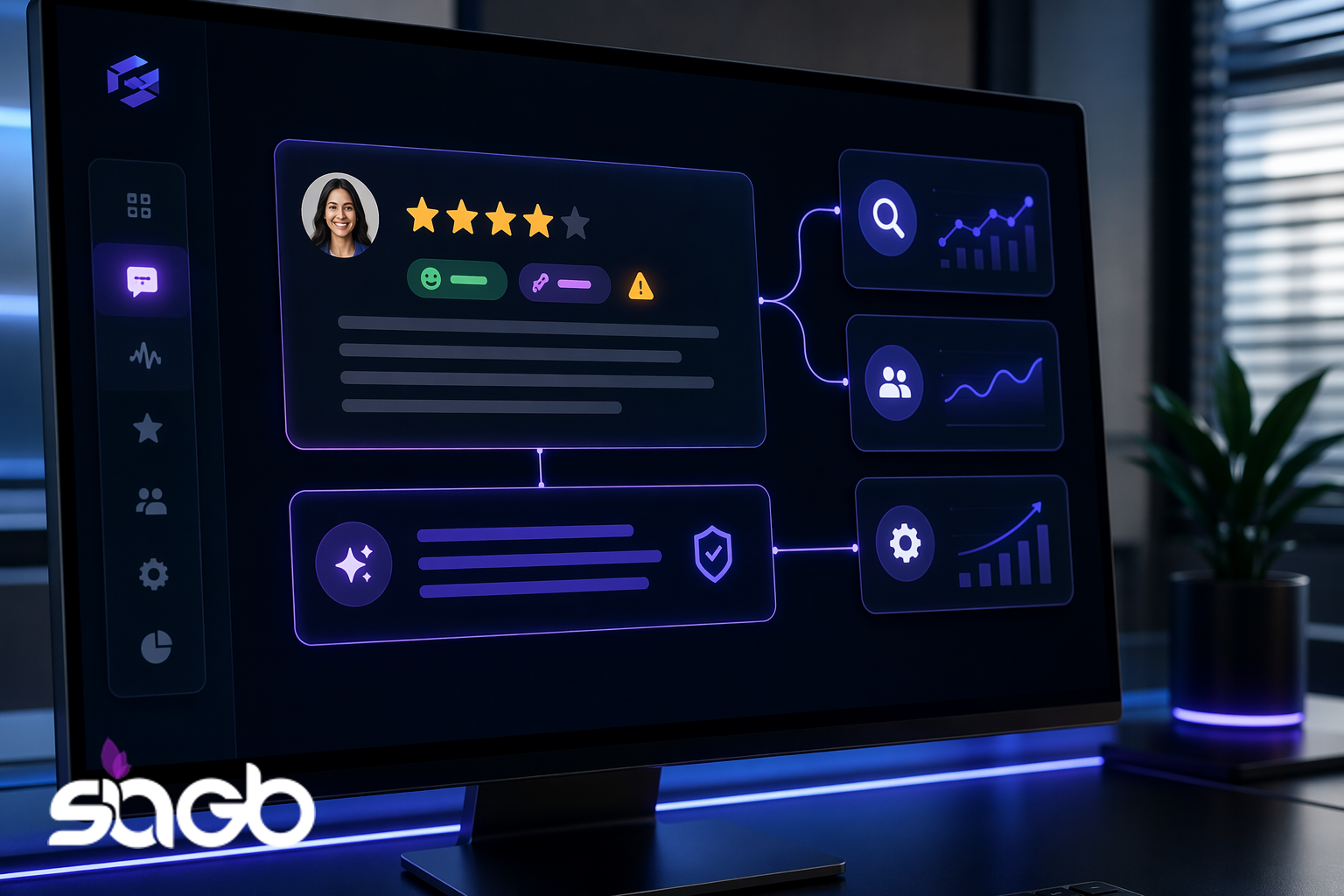
From an SEO view, review volume, freshness, and sentiment affect results. Positive reviews help visibility. Negative reviews hurt when they’re left unanswered. Google also looks at response behaviour, not just star ratings. In our testing, clinics that answered every review within 3 business days recovered more of the ranking dip that follows a cluster of 1-star reviews, compared to clinics that left them sitting for weeks.
Here’s the thing. Patterns in negative reviews usually point to real issues. Long waits. Confusing billing. Poor follow up. Ignoring that feedback means the same complaints repeat, creating unhappy patients. Fixing the root cause often lifts patient experience and rankings at the same time.
Which feels good. And works.
Manual vs software vs AI driven approaches
Manual workflows rely on staff remembering to send a review request and replying one by one. It’s slow. It’s inconsistent. Burnout tends to follow, especially in busy practices.
Software only tools automate collection but stop at dashboards. They show online reviews but don’t connect insights to operations, practice management, or search signals. Many providers stall at this stage.
AI native systems work differently. They connect feedback, sentiment analysis, accessibility checks, and SEO signals end to end. Automated review requests reduce staff load, while AI can flag issues and draft compliant responses. This approach grew out of real practice challenges, not theory.
Here is how the three approaches compare in practice:
| Capability | Manual workflow | Review software | AI native system |
|---|---|---|---|
| Review requests | Staff send by memory, ad hoc | Scheduled SMS or email blasts | Triggered per visit, timed to reduce opt-outs |
| Sentiment analysis | None, read one by one | Basic keyword tags | Topic, urgency, and emotion scored automatically |
| Response drafting | Fully manual | Static templates | Compliant drafts, human approves before publish |
| Accessibility of forms | Rarely tested | Varies by vendor | Built to WCAG 2.2 AA, screen-reader checked |
| Privacy guardrails | Depends on the person | Some audit logs | Scoped access, full audit trail, no PHI in replies |
| Cost driver | Staff hours | Per-seat licence | Outcomes: reviews gained, risk reduced |
It’s not magic. It’s integrated design. When we built review workflows for medical groups, the biggest gain came from removing the memory step, not from clever automation.
HIPAA compliant review collection and response workflows
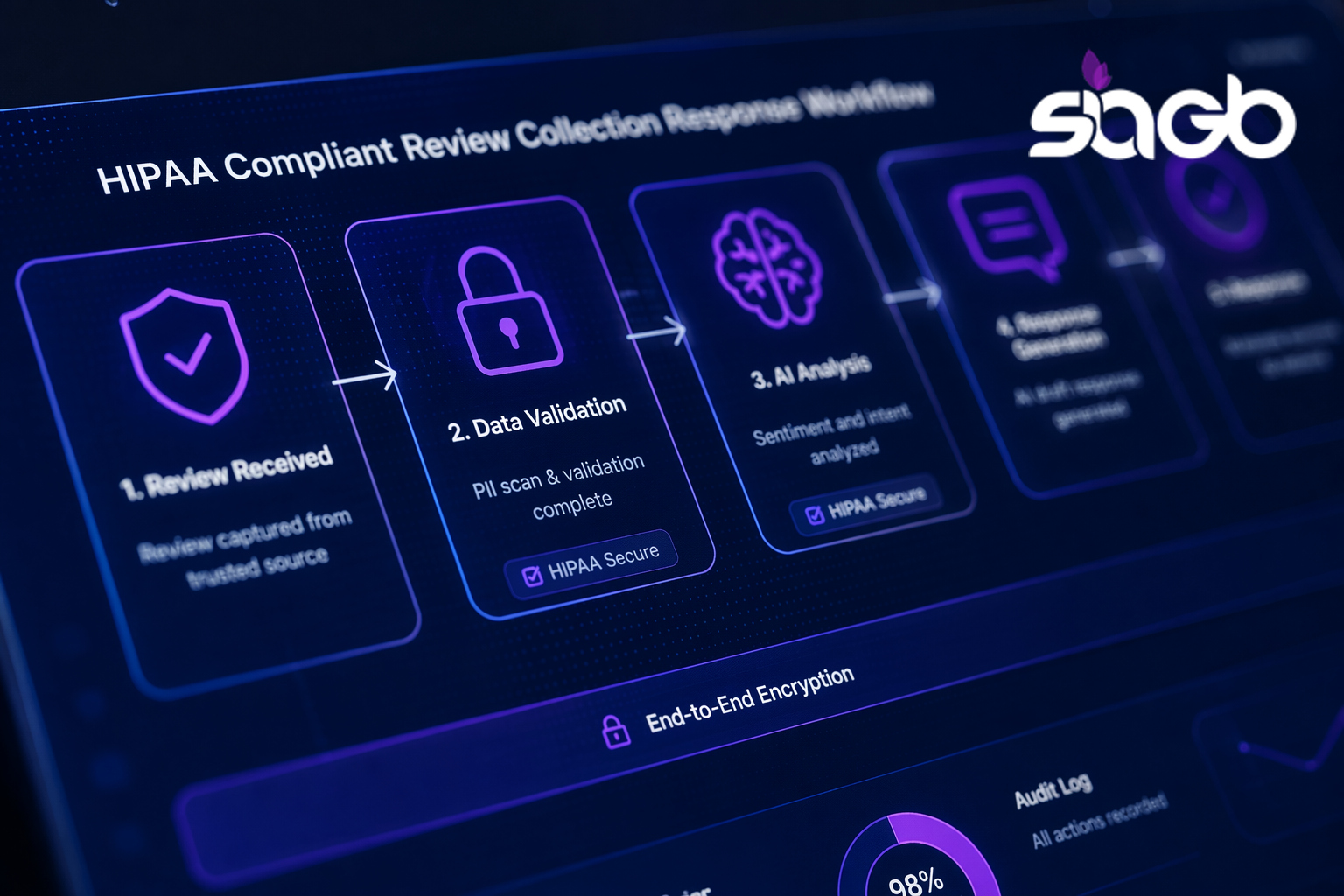
Review requests must avoid exposing personal health information. That includes email wording, SMS triggers, and landing pages on a review platform. A hipaa compliant website setup plays a big role here, especially when reviews appear on a modern clinic site.
Responses also need control. Templates should be approved. Context matters. Staff should never confirm treatment details in public replies. Data security depends on clear guardrails and documented workflows across the practice.
AI agents can help, but only when access is limited and logged. Every action needs an audit trail. That’s how providers reduce risk while still responding quickly. Otherwise, automation becomes a liability.
Warning: Never reply to a patient review with clinical details, even if the patient shared them first.
Cybersecurity risks in automated systems
Review systems can expose clinics to phishing and credential theft. It happens more often than people admit. Marketing tools are a common entry point.
API integrations widen the attack surface. Without governance, attackers exploit weak links. Many healthcare cybersecurity threats start outside core clinical systems, which is why the Australian Cyber Security Centre keeps urging multi-factor authentication and patched software as the basics. For instance, a single compromised Google Business Profile login can let an attacker post fake replies under a clinic’s name.
Planning must include review platforms, chatbots, and analytics tools. Cybersecurity for doctors isn’t just an IT issue anymore. It’s operational risk for every healthcare practice, and under the Notifiable Data Breaches scheme a serious breach must be reported to the OAIC within 30 days.
Uncomfortable. But true.
ADA and WCAG accessibility in review experiences
Accessible review experiences support people with vision, motor, and cognitive needs. That’s basic care, not a nice extra.
WCAG 2.2 Level AA healthcare website standards apply to review forms, widgets, and portals. If people can’t leave feedback because of poor design, you lose insight and trust from a satisfied patient who wanted to share positive feedback. In Australia, these expectations track the Disability Discrimination Act 1992 and the Australian Human Rights Commission guidance, which point providers to the same WCAG benchmarks used worldwide.
Poor accessibility also raises legal exposure. ADA website lawsuit doctors cases in the United States often start with simple issues, such as missing form labels or colour contrast below the 4.5 to 1 ratio WCAG requires for normal text. Healthcare website accessibility protects both patients and practices.
Key Point: Accessibility gaps reduce completion and increase compliance risk at the same time.
ADA compliant portals and forms
An ada compliant patient portal supports screen readers such as JAWS, NVDA, and VoiceOver, plus full keyboard navigation. Forms need clear labels and a logical focus order, so a person tabbing through with no mouse never gets stuck.
Colour contrast matters more than most people think, and the 4.5 to 1 minimum for body text is easy to fail with pale greys. Plain language does too. These details reduce drop off and frustration.
Strong accessibility improves completion rates and patient engagement. It also helps happy patients leave positive reviews without barriers.
Funny how that works.
Using AI to analyse sentiment at scale
AI agents classify feedback by sentiment, topic, and urgency. They quickly separate billing complaints from clinical praise or a positive review.
This helps practices spot patterns across experience and healthcare reputation management, including:
- Repeated wait time complaints
- Staff communication issues
- Follow up and recall gaps
Automated analysis also highlights negative patient reviews that need fast attention. It doesn’t replace human judgement. It reduces manual reporting and speeds insight.
That’s usually a relief for providers.
Connecting feedback to recall and management systems
Negative feedback shouldn’t just sit in a report. It should trigger action. That’s where integration matters.
Insights can feed recall systems. Missed follow ups. Scheduling errors. These links support patient care and long term patient retention.
A simple case study often shows this best. When feedback drives action, satisfaction improves. Ratings and positive reviews follow later. Not the other way around.
Turning reviews into SEO and AEO signals
Structured review data supports answer engine visibility and AI search results. AI systems such as ChatGPT, Perplexity, Gemini, and Google AI Overviews look for trust signals when answering health queries. Marking up feedback with schema.org Review and AggregateRating on a LocalBusiness or MedicalClinic entity gives those engines something concrete to cite.

AI SEO strategies use online reviews as evidence. Sentiment, frequency, and responsiveness all matter. Both positive reviews and negative reviews play a role when handled well.
This is where many practices stumble. Reviews need structure, not just stars. When done right, answer engines surface your clinic as credible and responsive.
That kind of visibility supports patient acquisition and can’t be bought.
Website design that supports reviews
Practice website design should feature authentic feedback without clutter or risk. Placement matters. Context matters too, especially during a redesign.
Redesign projects often lift conversion by simplifying flows:
- Fewer clicks to submit feedback
- Clear, accessible language
- Mobile first layouts that meet WCAG rules and Google Core Web Vitals, such as a Largest Contentful Paint under 2.5 seconds
An AI optimised platform can adapt content based on real online reviews. That keeps pages fresh and relevant for a prospective patient. Modern design isn’t about trends. It’s about trust and patient loyalty. Since more than half of Australian clinic traffic now arrives on a phone, we treat the mobile review form as the primary design, not an afterthought.
Infographic: Review management ecosystem
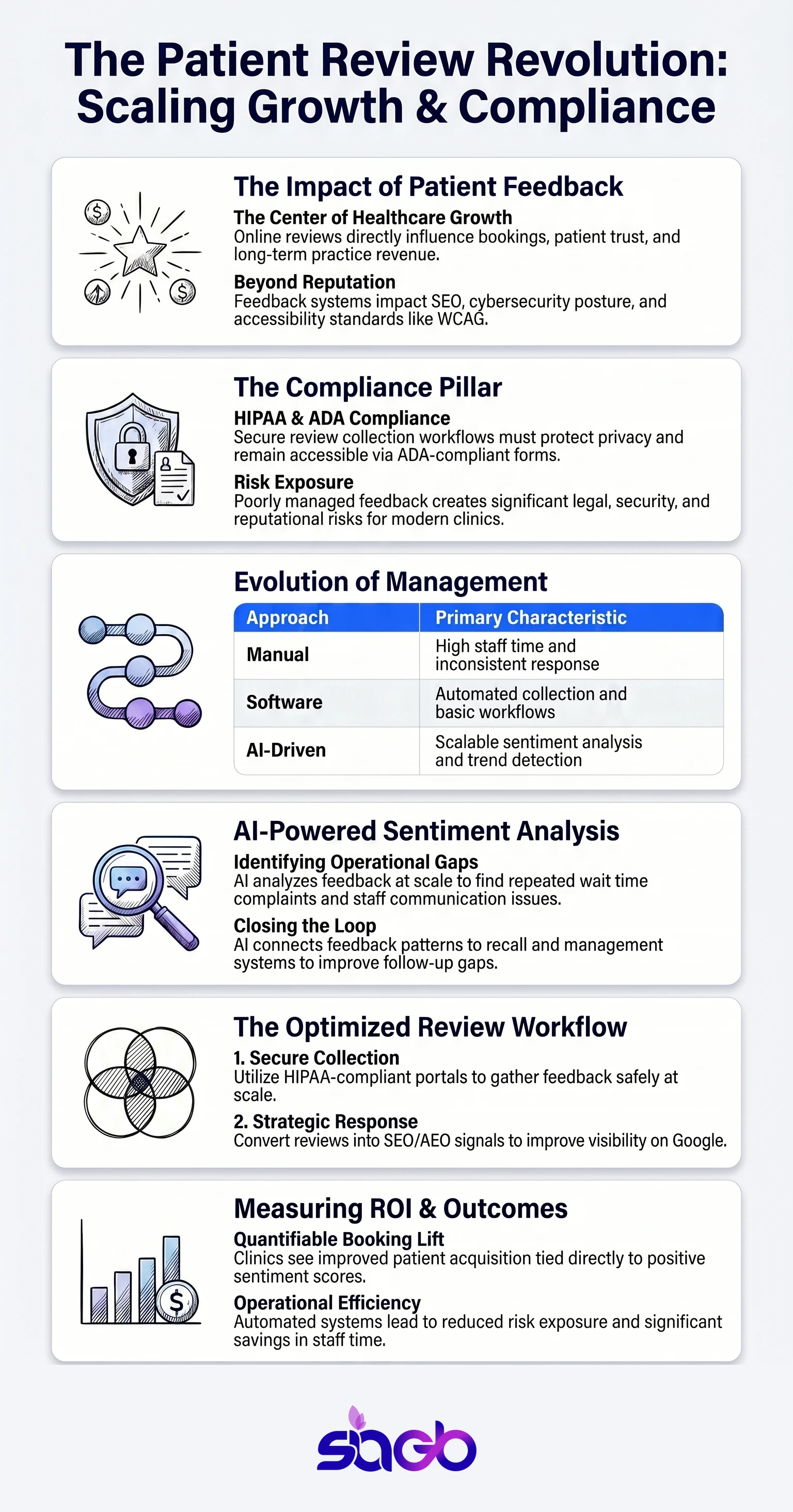
This ecosystem starts with the visit, followed by a compliant review request. Automated review requests help ensure consistency.
Feedback flows into analysis, then action. Accessibility, cybersecurity, and compliance wrap every step.
Simple on paper. Hard in practice.
Measuring ROI and outcomes
ROI comes from clear metrics. Review volume. Rating changes. Response time. These show reputation movement.
Strong programs track value across:
- Booking lift tied to sentiment
- Recall improvements
- Reduced risk exposure and staff time
They also track patient retention and loyalty. Best practices focus on both growth and risk reduction. Both matter to providers and healthcare professionals.
Frequently Asked Questions
What does review management mean in healthcare?
It’s the process of collecting, analysing, and responding to feedback safely. It balances growth, trust, compliance, and accessibility needs.
Are online reviews important for a clinic?
Yes. Online reviews influence choice and search visibility. They affect trust before a potential patient contacts a clinic.
How should providers handle negative reviews?
Acknowledge concerns without sharing details. Address root causes internally. This reduces repeat complaints and unhappy patients.
Do accessibility rules apply to review forms?
Yes. ADA and WCAG rules apply to all forms and portals. Poor accessibility increases legal risk.
Can reviews help with growth?
Yes. When handled well, positive feedback supports acquisition, retention, and long term loyalty.
Key Takeaways and Final Thoughts
Handling feedback well is a trust, compliance, and operations system, not just marketing. Reviews reflect real care experiences and real risks.
Strong healthcare reputation management connects feedback with SEO, accessibility, cybersecurity, and systems end to end. That’s where measurable value lives.
SIAGB builds secure, accessible, AI driven systems that help practices stay in control. Our team in Sydney has shipped AI-powered patient scheduling for medical groups, and our sister platform Marvel PTE already serves more than 85,000 users across 900 institutes, so we build for scale and compliance from day one. If your practice wants clarity instead of chaos, that’s the direction to think about.
Sources
- Industry-standard reference materials
- Peer-reviewed research and clinical guidelines

Ready to put this into practice?
Let's Talk