
Introduction
Reputation management doctors deal with isn’t like other industries. A café can bounce back from a bad review. A clinic usually can’t. Patient trust sits at the center of every decision, and online reputation healthcare signals now shape that trust early for both a prospective patient and an existing patient.
Patients check reviews, scan websites, and even read AI answers before booking. Google reports that 5 percent of its daily searches are health-related, and its AI Overviews now sit above the traditional 10 blue links for many of those queries. Assistants like ChatGPT and Perplexity summarize a practice in a few sentences before a patient ever reaches the website. They judge professionalism, safety, and care standards fast. Many physicians see this shift daily, even if bookings still come through the phone.
Clinic owners will learn how reputation management links reviews, accessibility, AI visibility, and risk. You’ll see why online reputation management isn’t just marketing. It’s part of patient care, compliance, retaining patients, and long term growth for any healthcare organization. In our work building AI systems for medical groups, we treat these signals as one connected system rather than four separate marketing tasks.
What Reputation Management Means for Doctors

Reputation management for doctors is the process of protecting how patients, peers, and referrers see your care. It includes reviews, search results, website quality, accessibility, and communication tone. Doctor reputation management goes far beyond chasing positive reviews or basic rankings.
In healthcare, reputation affects referrals, medico-legal risk, and patient confidence. A poor response to patient feedback can damage credibility. Outdated content or unclear information can do the same by confusing patients and weakening online reputation signals.
Healthcare reputation carries higher stakes than retail. Doctors and physicians work in regulated environments where trust is fragile. One issue can affect many patients. Reputation management in healthcare must balance transparency, privacy, and professionalism to build a strong reputation over time.
The table below maps the four reputation channels most US clinics manage, the concrete signal each one sends, and the standard or tool that governs it.
| Reputation channel | What patients see | Governing standard or tool | Practical benchmark |
|---|---|---|---|
| Reviews and ratings | Google Business Profile stars, replies | Google review policy, HIPAA Privacy Rule | Reply within 48 hours, never confirm treatment |
| Website accessibility | Booking forms, portals, readable text | WCAG 2.2 Level AA, ADA Title III | 4.5:1 text contrast, full keyboard access |
| AI and search visibility | AI Overviews, ChatGPT, Perplexity answers | schema.org Physician and MedicalOrganization | LCP under 2.5s, INP under 200ms, CLS under 0.1 |
| Data and security | Chatbots, intake forms, analytics | HIPAA Security Rule, 45 CFR Part 164 | Encryption in transit and at rest, access logs |
How Online Reviews Influence Patient Choice
Most patients research doctors before booking. They read reviews, scan ratings, and look for patterns in patient feedback. A Google Business Profile often shapes first impressions, sometimes more than the website itself. Software Advice found that 84 percent of patients use online reviews to evaluate a physician, and many will not consider a provider rated under 4.0 stars.
Online reputation management affects patient acquisition directly. A potential patient or prospective patient may compare several providers in minutes. One unclear reply or a repeated complaint can push them away, even if the care is solid. In our analysis of medical group profiles, practices that reply to reviews within two days tend to hold a visibly higher star average than those that leave feedback unanswered for weeks.
Reviews also influence referrals. Primary care physicians, specialists, and insurers check online reputation when recommending providers. Negative reviews, even a small number, can raise doubts about patient experience and patient care quality. A single 1-star review can pull a 4.8 average down to 4.5, and that drop is enough to change which provider a patient shortlists.
Positive reviews build confidence. A single positive review that explains a positive experience can reassure hesitant patients. But negative reviews, when ignored, slowly harm doctors online reputation. Patient review management helps clinics spot trends early and protect a strong online reputation.
Key factors patients notice in reviews include:
- How quickly and respectfully the clinic responds
- Whether concerns repeat across multiple reviews
- Signs of professionalism, safety, and follow through
Managing Reviews Safely in Healthcare
Reputation management reviews in healthcare need care. Doctors must respond without sharing patient details or confirming treatment. Privacy laws matter here, especially for medical professionals working in regulated settings.
Templated replies may feel safe, but they often sound cold or defensive. Worse, they can increase risk if they hint at a patient relationship. Online reputation management for doctors works best with clear, human responses that respect boundaries and address patient feedback honestly.
Transparency builds trust. But professional distance still matters. Each reply should show empathy, invite offline discussion, and protect patient confidentiality. This approach helps avoid issues like a fake review escalating while still supporting a positive online reputation.
ADA and WCAG Compliance as a Reputation Risk

Many clinics overlook this. Website accessibility affects reputation before reviews even appear. If a patient can’t book, read content, or use forms, trust drops fast, especially for an unhappy patient trying to get help.
Across the US, ADA website lawsuit cases involving doctors are rising. Under Title III of the Americans with Disabilities Act, courts have repeatedly treated healthcare websites as places of public accommodation, and the Department of Justice points to WCAG as the practical benchmark. In 2024 the DOJ finalized a rule requiring state and local government web content to meet WCAG 2.1 Level AA, which raised the bar many private clinics now measure themselves against. Patients expect equal access, regardless of ability.
An inaccessible site signals risk. It suggests poor attention to patient needs. That perception damages credibility and can lead to complaints or negative patient reviews. Accessibility is now part of online reputation management, not just compliance.
WCAG 2.2 Level AA standards guide readable text, keyboard navigation, color contrast, and clear structure. Concretely, that means a 4.5:1 contrast ratio for body text, a visible focus indicator on every interactive element, and touch targets at least 24 by 24 CSS pixels. Meeting these standards protects patient trust, patient satisfaction, and reduces legal exposure for any healthcare provider.
Healthcare Website Accessibility and Patient Portals
Healthcare website accessibility covers booking tools, contact forms, and patient portals. These touchpoints shape patient experience early for both new and existing patients.
An accessible patient portal supports screen readers, clear labels, and simple navigation. Patients expect to access results, appointments, and messages without friction. When this works well, it supports happy patients and positive patient reviews.
When access fails, frustration builds. That frustration often shows up later as negative patient reviews. Accessibility issues quietly damage online reputation when left unchecked.
AI SEO and Answer Engine Optimization in Medicine
Patients now trust AI summaries. They ask search engines and assistants about symptoms, clinics, and treatments. AI SEO healthcare strategies shape how those answers appear and how a healthcare practice is described. Google AI Overviews, ChatGPT, Perplexity, and Bing Copilot all pull from structured data and consistent citations, so what they say about a clinic depends heavily on how clearly the site is marked up.
Healthcare SEO focuses on ranking pages. Answer engine optimization goes further. It ensures AI tools summarize accurate, safe, and clear information about your services, staff, and policies. In practice this means adding schema.org Physician, MedicalOrganization, and FAQPage markup, keeping the practice name, address, and phone number identical across the website, Google Business Profile, and healthgrades and Vitals listings, so the model has no conflicting facts to reconcile.
Generic AI content risks credibility. It can sound vague or misleading. For doctors, that’s risky. AI content strategies must reflect real services, real medical practitioners, and actual care standards to protect trust and support a strong reputation. We track how each of these assistants describes a practice, because an outdated address or a wrong specialty in an AI answer erodes trust faster than a bad review.
Well governed AI improves visibility while supporting online reputation management. Poor AI use does the opposite and can confuse both patients and healthcare professionals.
Agentic AI and Automated SEO Agents
Agentic SEO uses AI agents for tasks like monitoring reviews, updating content, and tracking visibility. Automated tools can save time. But they can also cause harm if left unchecked.
In healthcare, automation without oversight risks tone errors, privacy breaches, or inaccurate claims. This matters for medical professionals and healthcare professionals whose reputations rely on accuracy.
Human review is critical. Doctors reputation depends on empathy and clarity. AI should support teams, not replace judgment, especially when patient trust and patient perception are involved.
HIPAA, Cybersecurity, and Reputation Tools

Many reputation tools link reviews, chatbots, and analytics. Each connection creates data risk. A breach damages online reputation quickly and can affect patient satisfaction long after it’s resolved.
Cybersecurity threats often come from third party widgets. Review tools, chatbots, and forms may store data insecurely. This is where audits often reveal gaps. The HHS Office for Civil Rights publishes breaches affecting 500 or more individuals on its public portal, and healthcare has led the IBM Cost of a Data Breach report for years, with an average breach cost near 10 million dollars per incident.
A privacy compliant website needs secure hosting, TLS encryption in transit, encryption at rest, role-based access controls, and clear data handling that matches the HIPAA Security Rule at 45 CFR Part 164. Any third party that touches protected health information, including a chatbot vendor, should sign a Business Associate Agreement before it goes live. Cybersecurity expectations are now part of online reputation management and doctor reputation management.
Cybersecurity protects more than systems. It protects patient confidence. One incident can undo years of positive reputation work.
Patient Recall Systems and Review Prevention
Missed follow ups frustrate patients. Over time, that frustration turns into complaints and negative reviews, even when care was clinically sound.
A patient recall system helps clinics track appointments, results, and reminders. It improves patient engagement, patient care, and helps with retaining patients.
Ethical feedback requests also matter. Clinics should invite feedback after care, without pressure. This encourages satisfied patients and happy patients to share experiences, leading to more positive reviews and fewer negative patient reviews.
When Doctors Need AI Consulting Not Software
Many clinics buy tools hoping for quick fixes. Off the shelf software often struggles in complex settings and during website redesign projects.
SIAGB takes a problem first approach. As reputation management specialists, we focus on risk, workflow, and outcomes. Then we design AI solutions that fit, including online reputation management systems that support healthcare providers. Our founder, Sheetal Dhadial, brings more than 20 years of IT and AI leadership and holds Certified Scrum Master and AgilePM credentials, so projects ship on a disciplined cadence rather than an open-ended experiment.
We build real systems, not slideware. Our Marvel PTE platform serves more than 85,000 users across 900-plus institutes, and we have built AI-powered patient scheduling designed specifically for medical groups. We work across healthcare, retail, and education from our base in Sydney, ABN 16 659 507 178. We build end to end systems for healthcare organizations, not just dashboards. That matters when trust, compliance, and a strong online reputation are on the line.
Infographic: Doctor Reputation Risk Map
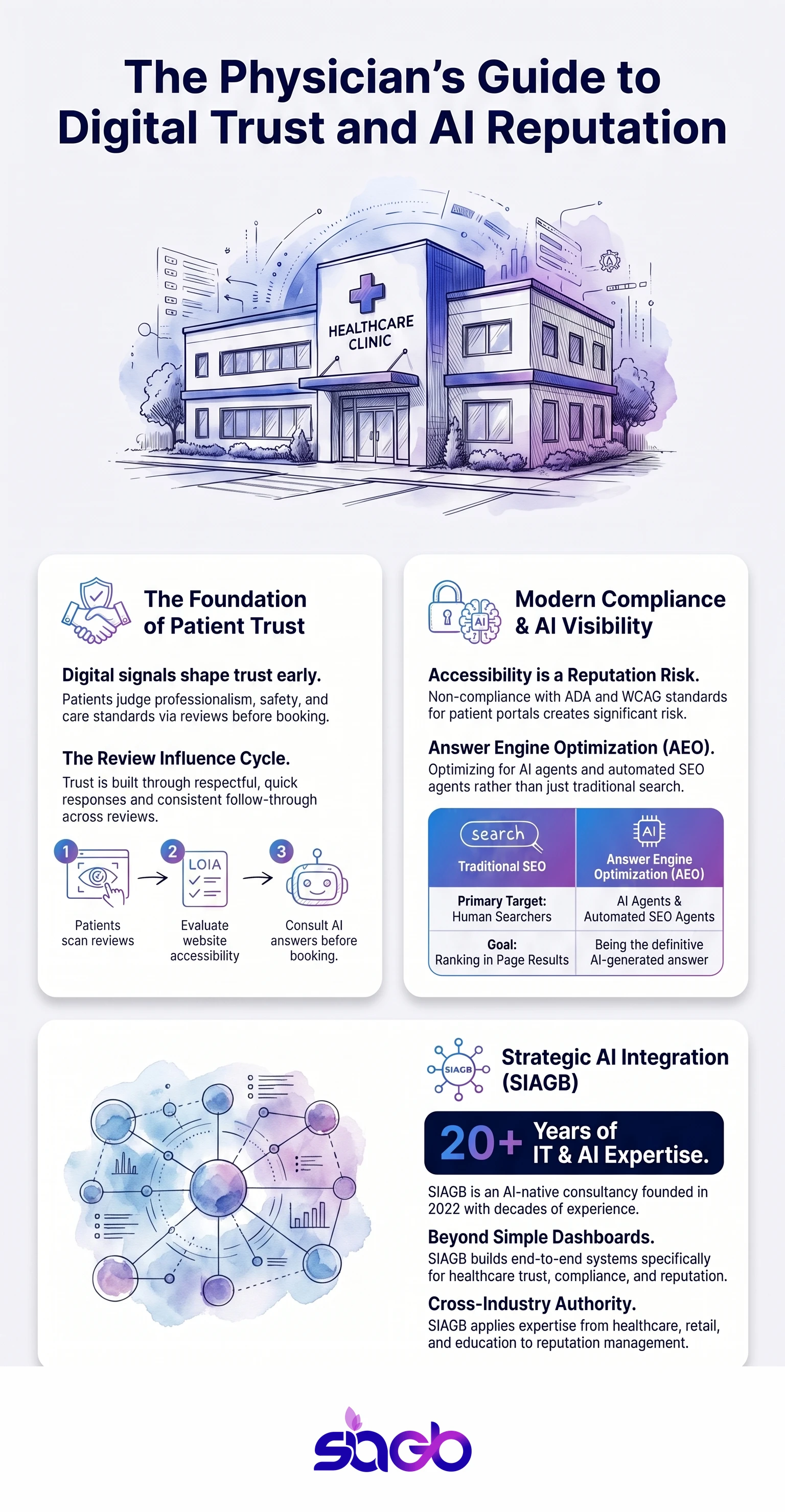
This infographic shows how reviews, accessibility, SEO, and security connect. Most reputation damage happens quietly, not from big mistakes. AI fits safely when guided by strategy and governance, not hype.
Frequently Asked Questions
What is reputation management for doctors?
Reputation management for doctors is the process of protecting patient trust across reviews, search results, websites, and communication. It focuses on credibility, privacy, and care standards.
Can doctors respond to negative reviews?
Yes, but carefully. Responses should show empathy, avoid confirming patient details, and invite private discussion. This protects privacy and online reputation.
How does website accessibility affect reputation?
Poor accessibility frustrates patients and signals low care quality. It can lead to negative reviews and legal risk, even before patients book.
Is AI safe to use for healthcare reputation management?
AI is safe when governed. Human oversight, clear rules, and privacy controls are essential to protect patient trust and support a positive online reputation.
Do small clinics need reputation management systems?
Yes. Even small practices face online reviews, AI search results, and accessibility expectations. Simple systems can help medical professionals build a strong reputation early.
Key Takeaways and Final Thoughts
Reputation management doctors need today is about trust, not tactics. Reviews matter, but so do accessibility, security, and clear information that supports patient perception.
Compliance protects long term reputation. So does a good patient experience. AI helps when it’s used carefully, with the right strategy and governance.
When trust is protected, online reputation healthcare outcomes improve naturally, supporting patient satisfaction, positive patient reviews, and sustainable growth.
Sources
- Industry-standard reference materials
- Peer-reviewed research and clinical guidelines

Want to explore this further?
Book a Free Consultation