
Introduction
Reputation management doctors deal with isn’t like other industries. A café can bounce back from a bad review. A clinic usually can’t. Patient trust sits at the centre of every decision, and online reputation healthcare signals now shape that trust early for both a prospective patient and an existing patient.
Patients check reviews, scan websites, and even read AI answers before booking. In 2025 the Australian Health Practitioner Regulation Agency (AHPRA) regulated more than 900,000 registered practitioners, and a growing share of those patients arrive after reading a Google Business Profile or an AI summary rather than a phone recommendation. They judge professionalism, safety, and care standards in seconds. Many physicians see this shift daily, even if bookings still come through the phone.
Clinic owners will learn how reputation management links reviews, accessibility, AI visibility, and risk. You’ll see why online reputation management isn’t just marketing. It’s part of patient care, compliance under the Privacy Act 1988 and the National Law, retaining patients, and long term growth for any healthcare organisation.
What Reputation Management Means for Doctors
Reputation management for doctors is the process of protecting how patients, peers, and referrers see your care. It includes reviews, search results, website quality, accessibility, and communication tone. Doctor reputation management goes far beyond chasing positive reviews or basic rankings.

In healthcare, reputation affects referrals, medico-legal risk, and patient confidence. A poor response to patient feedback can damage credibility. Outdated content or unclear information can do the same by confusing patients and weakening online reputation signals. In our work with medical groups, the surfaces we audit fall into four buckets: review platforms such as Google and Healthengine, the website and its schema.org markup, accessibility and page speed, and data handling across every third party widget.
Healthcare reputation carries higher stakes than retail. Doctors and physicians work in regulated environments where trust is fragile. One issue can affect many patients. Reputation management in healthcare must balance transparency, privacy, and professionalism to build a strong reputation over time.
How Online Reviews Influence Patient Choice
Most patients research doctors before booking. They read reviews, scan ratings, and look for patterns in patient feedback. A Google Business Profile often shapes first impressions, sometimes more than the website itself. Star ratings, review recency, and response rate are the three signals patients scan first, usually within the first five listings Google returns.
Online reputation management affects patient acquisition directly. A potential patient or prospective patient may compare several providers in minutes. One unclear reply or a repeated complaint can push them away, even if the care is solid.
Reviews also influence referrals. GPs, specialists, and insurers check online reputation when recommending providers. Negative reviews, even a small number, can raise doubts about patient experience and patient care quality.
There is a critical Australian constraint that US guidance ignores. Under Section 133 of the Health Practitioner Regulation National Law, using testimonials in advertising regulated health services is prohibited. A five star quote pulled onto your homepage can trigger an AHPRA breach, with penalties reaching $60,000 for a body corporate. Reviews left on Google are treated differently from testimonials you publish yourself, so the safe path is to earn reviews on third party platforms and never republish clinical praise as marketing copy.
Positive reviews build confidence. A single positive review that explains a positive experience can reassure hesitant patients. But negative reviews, when ignored, slowly harm doctors online reputation. Patient review management helps clinics spot trends early and protect a strong online reputation.
Key factors patients notice in reviews include:
- How quickly and respectfully the clinic responds
- Whether concerns repeat across multiple reviews
- Signs of professionalism, safety, and follow through
Managing Reviews Safely in Healthcare
Reputation management reviews in healthcare need care. Doctors must respond without sharing patient details or confirming treatment. Privacy laws matter here, especially for medical professionals working in regulated settings.
Templated replies may feel safe, but they often sound cold or defensive. Worse, they can increase risk if they hint at a patient relationship. For example, a reply that reads “we’re glad your knee surgery went well” confirms both a condition and a procedure, which breaches confidentiality even though the review invited it. Online reputation management for doctors works best with clear, human responses that respect boundaries and address patient feedback honestly.
Transparency builds trust. But professional distance still matters. Each reply should show empathy, invite offline discussion, and protect patient confidentiality. A safer template acknowledges the feedback, gives a practice contact number, and moves the conversation offline within one reply. This approach helps avoid issues like a fake review escalating while still supporting a positive online reputation.
ADA and WCAG Compliance as a Reputation Risk
Many clinics overlook this. Website accessibility affects reputation before reviews even appear. If a patient can’t book, read content, or use forms, trust drops fast, especially for an unhappy patient trying to get help.

Globally, ADA website lawsuit cases involving doctors are rising, with US federal digital accessibility filings running past 4,000 a year. In Australia, the Disability Discrimination Act 1992 makes inaccessible websites a legal exposure, and government and health services are expected to meet WCAG 2.1 Level AA. Patients expect equal access, regardless of ability.
An inaccessible site signals risk. It suggests poor attention to patient needs. That perception damages credibility and can lead to complaints or negative patient reviews. Accessibility is now part of online reputation management, not just compliance.
WCAG standards guide readable text, keyboard navigation, colour contrast, and clear structure. The concrete thresholds matter: a contrast ratio of at least 4.5:1 for body text and 3:1 for large text (Success Criterion 1.4.3), full keyboard operability (2.1.1), and, under WCAG 2.2, a minimum target size of 24 by 24 CSS pixels (2.5.8) so patients with tremor or low vision can tap a booking button. Meeting these standards protects patient trust, patient satisfaction, and reduces legal exposure for any healthcare provider.
Here is how the two markets we serve line up on the rules that most affect reputation:
| Reputation factor | Australia | United States |
|---|---|---|
| Publishing patient testimonials | Prohibited for regulated services (National Law s133) | Permitted with HIPAA-safe authorisation |
| Privacy law | Privacy Act 1988, 13 Australian Privacy Principles | HIPAA Privacy and Security Rules |
| Data breach reporting | Notifiable Data Breaches scheme, notify OAIC promptly | HHS breach notification within 60 days |
| Accessibility benchmark | WCAG 2.1 AA under DDA 1992 | WCAG 2.1 AA under ADA Title III |
| Review platforms patients trust | Google, Healthengine, HotDoc | Google, Healthgrades, Zocdoc |
Healthcare Website Accessibility and Patient Portals
Healthcare website accessibility covers booking tools, contact forms, and patient portals. These touchpoints shape patient experience early for both new and existing patients. Speed counts too: Google’s Core Web Vitals set a Largest Contentful Paint under 2.5 seconds, Interaction to Next Paint under 200 milliseconds, and Cumulative Layout Shift under 0.1, and a portal that misses these frustrates patients before accessibility is even tested.
An accessible patient portal supports screen readers, clear labels, and simple navigation. Patients expect to access results, appointments, and messages without friction. When this works well, it supports happy patients and positive patient reviews.
When access fails, frustration builds. That frustration often shows up later as negative patient reviews. Accessibility issues quietly damage online reputation when left unchecked.
AI SEO and Answer Engine Optimisation in Medicine
Patients now trust AI summaries. They ask ChatGPT, Perplexity, and Google AI Overviews about symptoms, clinics, and treatments. AI SEO healthcare strategies shape how those answers appear and how a healthcare practice is described.
Healthcare SEO focuses on ranking pages. Answer engine optimisation goes further. It ensures AI tools summarise accurate, safe, and clear information about your services, staff, and policies. In practice that means marking up your site with schema.org types like Physician, MedicalClinic, and FAQPage so an assistant can extract hours, location, and services without guessing.
Generic AI content risks credibility. It can sound vague or misleading. For doctors, that’s risky. AI content must reflect real services, real medical practitioners, and actual care standards to protect trust and support a strong reputation. We track how the major assistants describe a clinic by running the same prompts across ChatGPT, Perplexity, and Google AI Overviews each month, then correcting the source pages the models draw from.
Well governed AI improves visibility while supporting online reputation management. Poor AI use does the opposite and can confuse both patients and healthcare professionals.
Agentic AI and Automated SEO Agents
Agentic SEO uses AI agents for tasks like monitoring reviews, updating content, and tracking visibility. Automated tools can save time. But they can also cause harm if left unchecked.
In healthcare, automation without oversight risks tone errors, privacy breaches, or inaccurate claims. For example, an unsupervised agent that auto-replies to a one star review could confirm a treatment and breach the National Law in a single sentence. This matters for medical professionals and healthcare professionals whose reputations rely on accuracy.
Human review is critical. Doctors reputation depends on empathy and clarity. AI should support teams, not replace judgement, especially when patient trust and patient perception are involved.
HIPAA, Cybersecurity, and Reputation Tools
Many reputation tools link reviews, chatbots, and analytics. Each connection creates data risk. A breach damages online reputation quickly and can affect patient satisfaction long after it’s resolved. HIPAA governs this in the United States, but an Australian clinic answers to the Privacy Act 1988 and its 13 Australian Privacy Principles, with serious breaches now carrying penalties above $50 million for a body corporate.

Cybersecurity threats often come from third party widgets. Review tools, chatbots, and forms may store data insecurely. This is where audits often reveal gaps, and under the Notifiable Data Breaches scheme an eligible breach must be reported to the Office of the Australian Information Commissioner (OAIC) and affected patients as soon as practicable.
A privacy compliant website needs secure hosting, TLS encryption, role based access controls, and clear data handling. Cybersecurity expectations are now part of online reputation management and doctor reputation management.
Cybersecurity protects more than systems. It protects patient confidence. One incident can undo years of positive reputation work.
Patient Recall Systems and Review Prevention
Missed follow ups frustrate patients. Over time, that frustration turns into complaints and negative reviews, even when care was clinically sound.
A patient recall system helps clinics track appointments, results, and reminders. In our own build for medical groups we use AI-powered patient scheduling to flag overdue recalls automatically, which improves patient engagement, patient care, and helps with retaining patients.
Ethical feedback requests also matter. Clinics should invite feedback after care, without pressure and without offering incentives, which keeps requests within AHPRA guidance. This encourages satisfied patients and happy patients to share experiences, leading to more positive reviews and fewer negative patient reviews.
When Doctors Need AI Consulting Not Software
Many clinics buy tools hoping for quick fixes. Off the shelf software often struggles in complex settings and during website redesign projects.
SIAGB takes a problem first approach. As reputation management specialists, we focus on risk, workflow, and outcomes. Then we design AI solutions that fit, including online reputation management systems that support healthcare providers.
Founded in Sydney in 2022, SIAGB (ABN 16 659 507 178) brings over 20 years of IT and AI leadership under founder Sheetal Dhadial, a Certified Scrum Master and AgilePM practitioner. We build systems that scale: our Marvel PTE platform now serves more than 85,000 users across 900 plus institutes. We work across healthcare, retail, and education, building end to end systems for healthcare organisations, not just dashboards. That matters when trust, compliance, and a strong online reputation are on the line.
Infographic: Doctor Reputation Risk Map
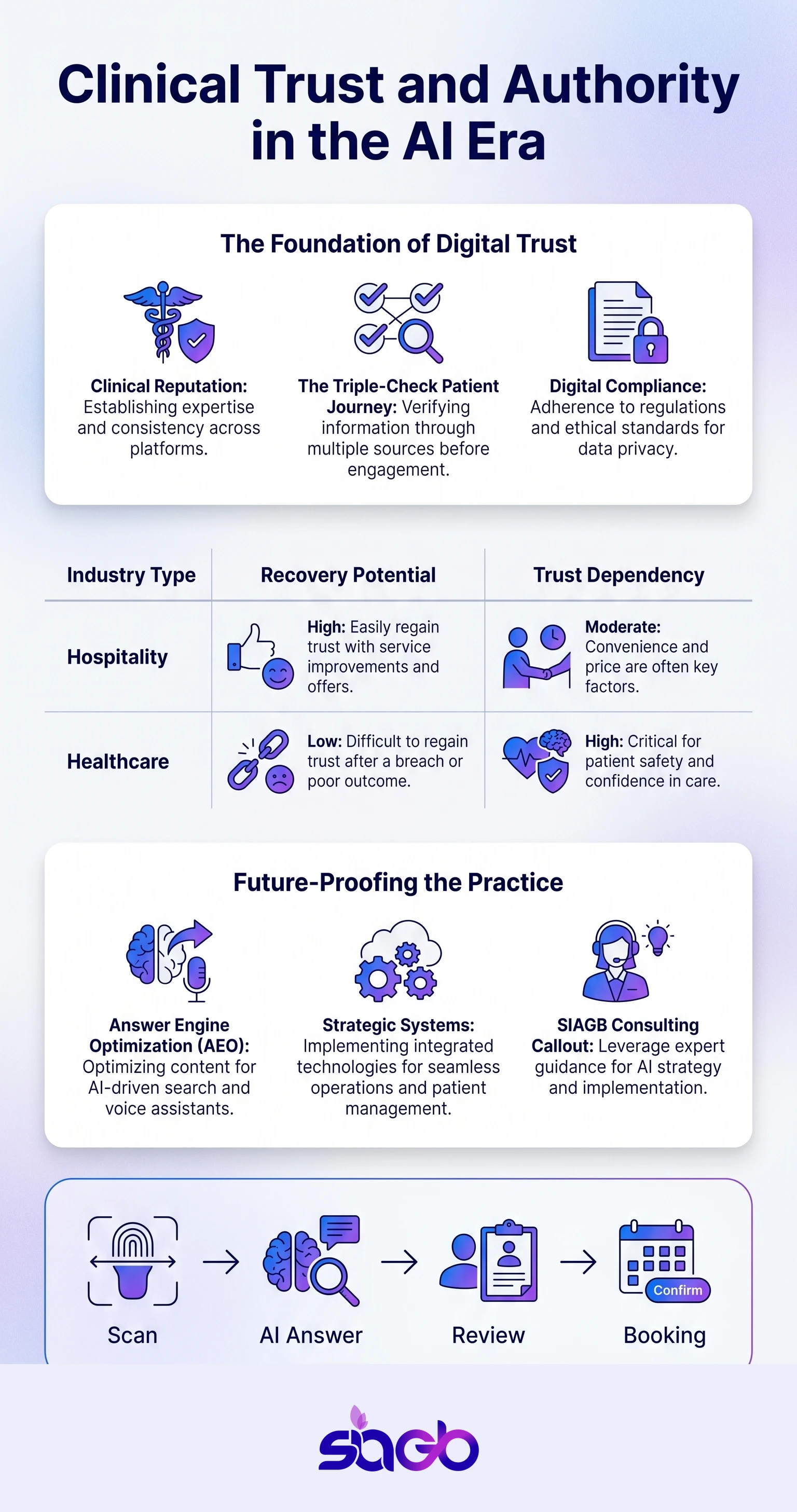
This infographic shows how reviews, accessibility, SEO, and security connect. Most reputation damage happens quietly, not from big mistakes. AI fits safely when guided by strategy and governance, not hype.
Frequently Asked Questions
What is reputation management for doctors?
Reputation management for doctors is the process of protecting patient trust across reviews, search results, websites, and communication. It focuses on credibility, privacy, and care standards.
Can doctors respond to negative reviews?
Yes, but carefully. Responses should show empathy, avoid confirming patient details, and invite private discussion. This protects privacy and online reputation.
How does website accessibility affect reputation?
Poor accessibility frustrates patients and signals low care quality. It can lead to negative reviews and legal risk, even before patients book.
Is AI safe to use for healthcare reputation management?
AI is safe when governed. Human oversight, clear rules, and privacy controls are essential to protect patient trust and support a positive online reputation.
Do small clinics need reputation management systems?
Yes. Even small practices face online reviews, AI search results, and accessibility expectations. Simple systems can help medical professionals build a strong reputation early.
Key Takeaways and Final Thoughts
Reputation management doctors need today is about trust, not tactics. Reviews matter, but so do accessibility, security, and clear information that supports patient perception.
Compliance protects long term reputation. So does a good patient experience. AI helps when it’s used carefully, with the right strategy and governance.
When trust is protected, online reputation healthcare outcomes improve naturally, supporting patient satisfaction, positive patient reviews, and sustainable growth.
Sources
- AHPRA advertising guidelines, Health Practitioner Regulation National Law s133
- Office of the Australian Information Commissioner, Privacy Act 1988 and Notifiable Data Breaches scheme
- W3C Web Content Accessibility Guidelines (WCAG) 2.1 and 2.2, Level AA

Want to explore this further?
Book a Free Consultation