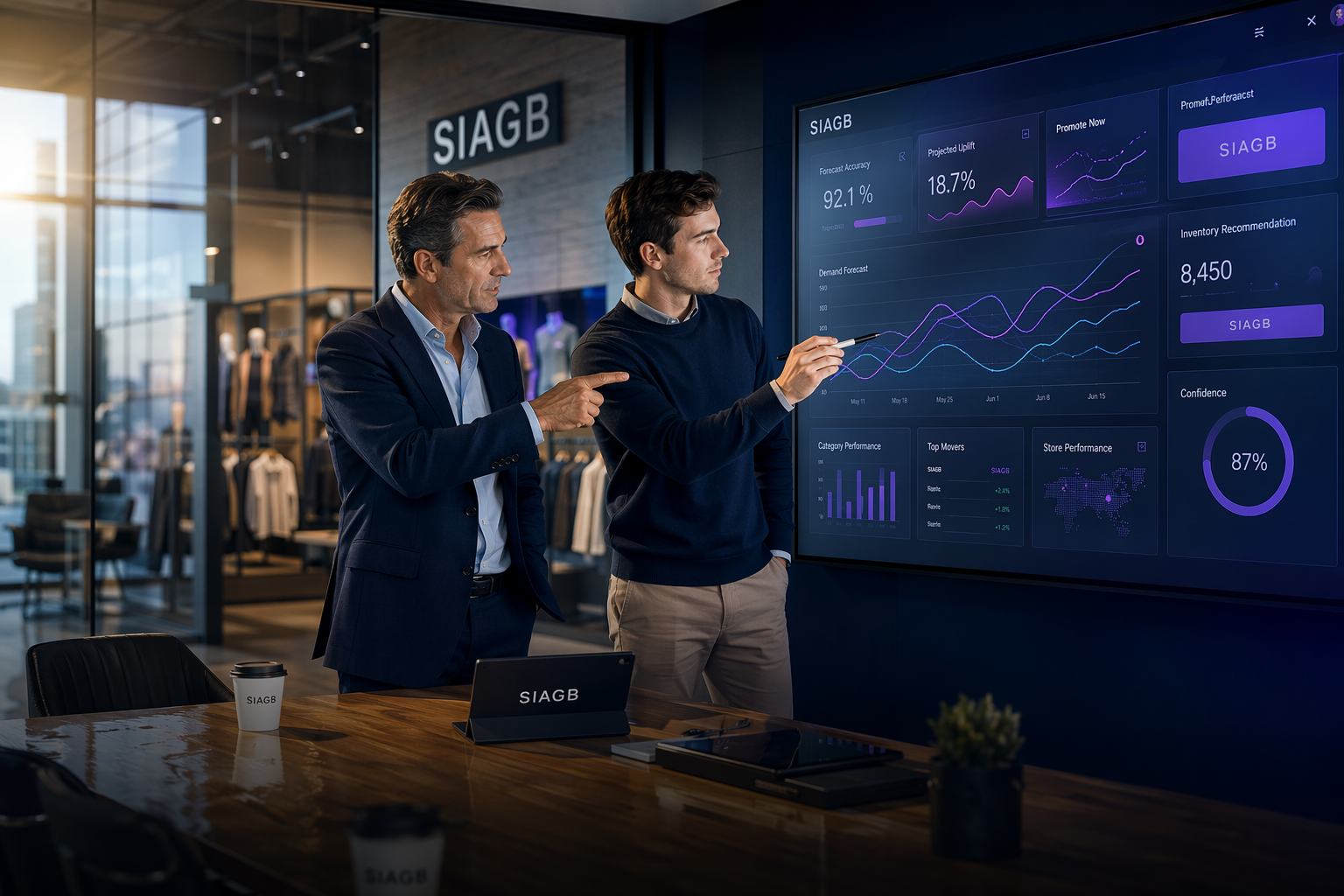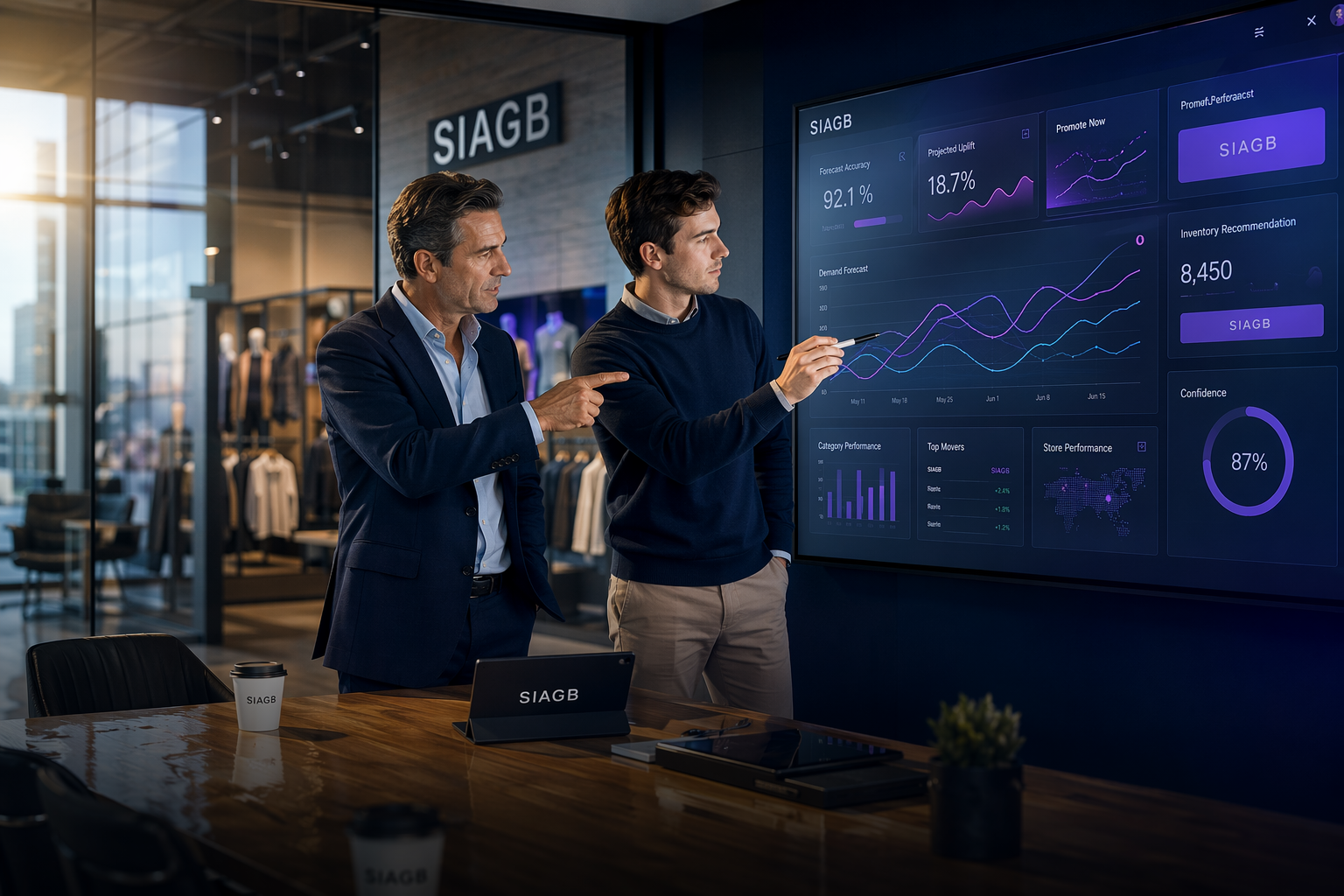
Retail AI analytics helps retailers make smarter decisions using data, not just reports. It predicts demand, flags risks, and recommends actions like reorder less or promote now. For Australian retail businesses, this approach cuts waste, improves margins, and delivers measurable ROI when done right.
Retail leaders are sceptical for a reason. Too many analytics projects stop at dashboards. A true retail ai analytics solutions company focuses on decisions and outcomes, not charts that sit unused. That same problem shows up in other sectors, from medical practice seo to healthcare website redesign projects that never move past reports.
Introduction: Why Retail Analytics Needs More Than Dashboards
Retail margins are under pressure. Costs keep rising. Stock waste hurts cash flow. Customers expect better experiences every visit. Sound familiar?
Most retail analytics tools show what already happened. They look backward. A dashboard might say inventory is high or sales dropped last week. But it doesn’t say what to do next.
Retail AI analytics shifts the focus. It turns data into clear actions. Order less. Move stock. Change price. Promote now. These recommendations are actionable insights, not just numbers on a screen.
For Australian retailers, this really matters. The Australian Bureau of Statistics reports monthly retail turnover of roughly 37 billion dollars, and even a one percent swing in stock accuracy moves real money at that scale. Local seasons, mixed systems, and tight labour mean every decision counts. In our work with retail clients, the pattern is consistent: a retail ai analytics solutions company should help leaders act faster, not stare at charts longer. And it should support the full retail operation, from the loading dock to head office reporting.
What Is Retail AI Analytics and How Does It Differ From Reporting?
Retail AI analytics uses artificial intelligence to predict outcomes and recommend actions. It isn’t the same as business intelligence reporting.
Traditional retail analytics answers questions like what sold, where, and when. AI analytics answers what will happen next and which decision will improve results. This shift relies on advanced analytics and ai algorithms that learn patterns over time.
Here’s the difference in plain terms. Reporting shows last month’s sales. AI analytics suggests how much inventory to order next week. Reporting tracks KPIs. AI analytics supports decisions across merchandising, pricing, and store operations.
A quick way to see how each analytics type maps to the decision it supports:
| Analytics type | Question it answers | Decision it supports |
|---|---|---|
| Descriptive (reporting) | What happened last week? | Review past performance |
| Predictive | What is likely to happen next? | Plan inventory and staffing |
| Prescriptive | What should we do about it? | Set pricing, reorders, promotions |
As coverage in MIT Technology Review on applied machine learning makes clear, the value comes from prediction, not just description. This works by applying data science models to customer data, POS feeds, and inventory systems. In our deployments we typically start with a gradient-boosted forecasting model such as XGBoost or Prophet on 24 months of daily sales, then layer in weather and promotion features before touching anything more exotic. Strong data engineering makes sure inputs are clean and reliable. The output is simple guidance, not complex graphs. The same decision-first logic underpins ai seo healthcare and answer engine optimisation work, where a Product or Offer entry in schema.org markup earns a citation in Google AI Overviews, ChatGPT, or Perplexity only when the underlying answer is genuinely useful.
Examples include predicting demand, flagging shrinkage risk, estimating customer lifetime value, and improving product recommendations. These are practical ai applications powered by modern ai technology. They turn analytics into action. That’s the real shift.
Retail Problems AI Analytics Solves First
Retail AI analytics works best when it targets clear problems. Not everything at once.

Demand forecasting is usually first. Poor forecasts cause overstock or stockouts. Predictive analytics uses sales, seasonality, and promotions to improve accuracy. We track forecast error with MAPE (mean absolute percentage error), and moving a category from 35 percent error down to under 20 percent is a realistic first-season target. Many retailers cut excess inventory within months, which also improves inventory management and cash flow.
Shrinkage is another common issue. By analysing transaction data and inventory movement, AI can flag unusual patterns. Video analytics can add more signals, but even basic data helps spot risk early across retail stores.
Customer churn often comes next. AI models analyse customer behaviour and buying history. They highlight which customers may leave and what offers could retain them. Over time, this lifts customer satisfaction, customer loyalty, and the overall customer experience. Similar retention logic powers patient recall system design and patient review management in healthcare.
Each problem links directly to revenue or cost. That’s why they come first in the retail industry.
Common Early Wins From Retail AI Analytics
- Improved demand forecasting accuracy within one season
- Reduced excess inventory and fewer stockouts
- Clearer promotion ROI at SKU and store level
These wins deliver consumer insights that teams can actually use.
Integrating AI Analytics With POS, ERP, and Inventory Systems
Most Australian retail businesses run mixed systems. Legacy POS. Custom ERP. Separate inventory tools. Integration is rarely clean.
Retail AI analytics doesn’t replace these systems. It sits on top. Models pull data from existing sources and return recommendations into daily workflows used by store managers and merchandising teams.
Data quality matters here. Inconsistent product codes or missing updates reduce accuracy. In our experience integration and data cleaning eat 60 to 70 percent of a project timeline, far more than the modelling itself. We usually pull data through connectors to systems like Shopify, Lightspeed, MYOB, or a SQL Server ERP, then reconcile SKUs against a single master catalogue before any model runs. Strong data engineering and data governance reduce this risk.
A good partner plans for this. They map data early. They test feeds. They fix gaps. Without this step, analytics fails, no matter how smart the model is. Supply chain data is especially critical, since delays upstream affect every store.
Problem-First AI Consulting Versus Tool-First Projects
Many AI projects start with a tool. Buy software. Add dashboards. Hope value appears.
Problem-first AI consulting flips this approach. It starts with one business decision to improve. For example, reduce excess inventory by 15 percent or improve promotional optimisation for slow-moving products.
SIAGB takes this path. Working with retail businesses, we define success metrics before any model is built. Forecast accuracy. Stock turns. Promotion ROI. Sheetal Dhadial, who founded SIAGB and brings more than 20 years in IT and AI leadership as a Certified Scrum Master and AgilePM practitioner, runs projects in short two-week sprints so leaders see progress they can measure. This mirrors how SIAGB approaches healthcare seo strategy, ai content medical practice work, and modern medical website projects.
Only then does the team design analytics to support that decision. This avoids wasted spend and unused tools. It also builds trust with retail teams who want proof, not hype. Retailers and every retailer involved can see progress week by week.
Real Retail AI Use Cases With Measurable Outcomes
Retail leaders want numbers. Fair enough.
In Australian retail projects, forecast accuracy often improves within 8 to 12 weeks. That leads to better inventory planning, smoother supply chain coordination, and fewer emergency orders.
Stock holding reductions in the double digits are common when AI recommendations guide replenishment. Cash flow improves fast, and store operations become more predictable.
Promotion analytics is another clear win. AI tracks ROI at SKU and store level. Retailers quickly see which offers lift sales and which don’t. These insights support better merchandising decisions across the retail sector.
The table below maps common retail use cases to the KPI each one tends to move first.
| Retail use case | KPI improved | Typical first window |
|---|---|---|
| Demand forecasting | Forecast accuracy and stock turns | 8 to 12 weeks |
| Replenishment guidance | Excess stock holding (lower) | One season |
| Promotion analytics | Promotion ROI at SKU and store level | First major promo cycle |
| Churn prediction | Customer retention and loyalty | Two to three buying cycles |
These outcomes don’t come from generic reports. They come from analytics designed for specific decisions, measured weekly, not annually.
Should You Choose Custom AI Models or Off-the-Shelf Analytics Tools?
Off-the-shelf solutions work for averages. They don’t know your constraints.
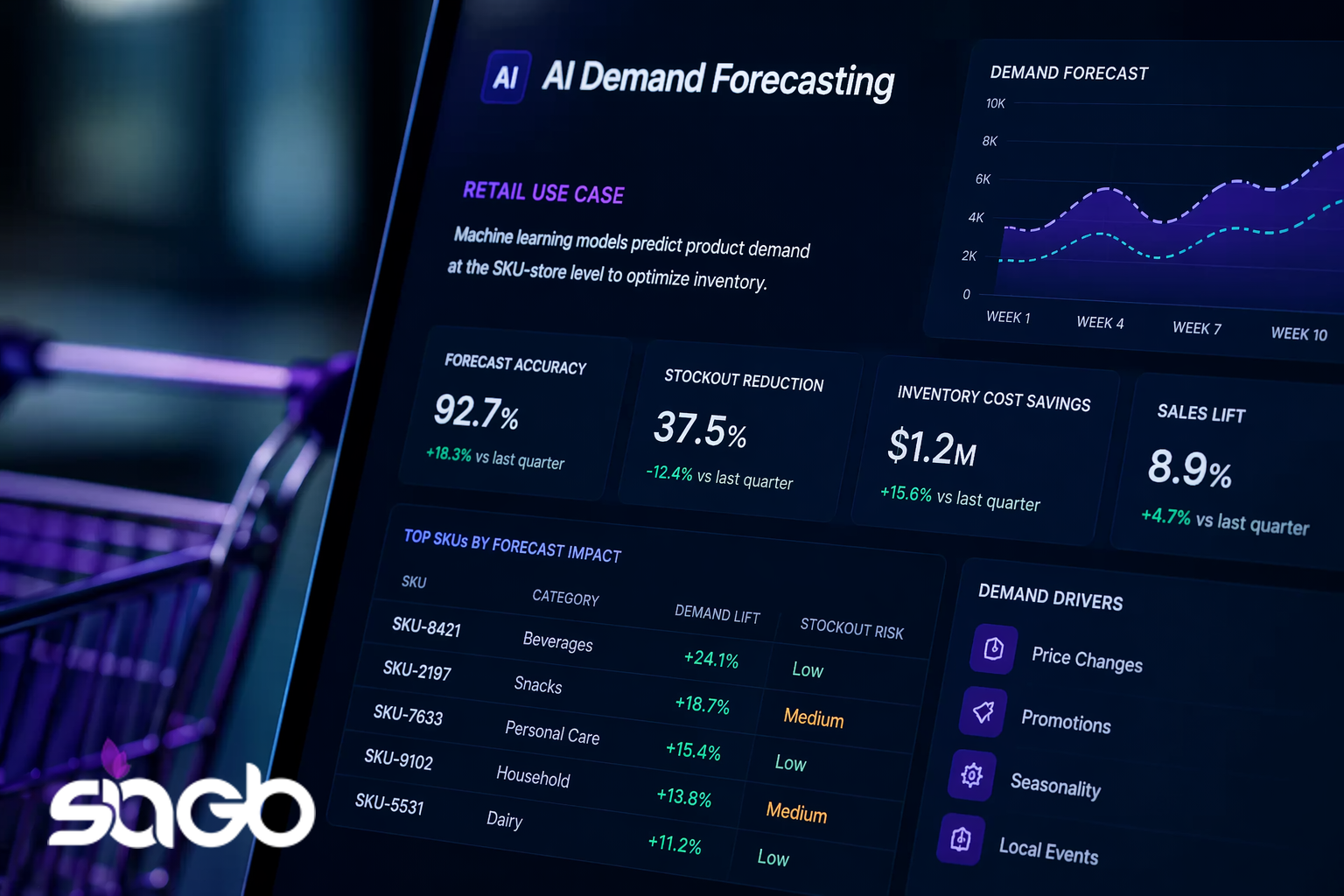
Custom AI models reflect your stores, your supply chain, and your customers. They factor in local demand, weather, location intelligence, and supplier limits. That matters in Australia, where a heatwave across Sydney and Melbourne can spike beverage and cooling sales in the same week that a wet summer flattens them in Brisbane. An off-the-shelf tool trained on Northern Hemisphere seasonality gets the Australian calendar backwards, missing the reality that the Boxing Day sales, back-to-school in late January, and the June end-of-financial-year rush drive very different demand curves.
Generative AI adds another layer. It can explain recommendations in plain language to improve customer service and internal adoption. But the core model still needs to be right. This is also true in agentic seo and ai agents for seo, where explanation builds trust.
Ownership is key. When you own the model, you avoid vendor lock-in. You can adapt as the retail operation changes. That flexibility is often worth more than a cheaper tool for any retail business.
Operational Risks in Retail AI Projects
AI analytics isn’t magic. There are real risks.
Poor data leads to poor recommendations. If counts are wrong, decisions will be wrong too. Fixing data comes first, especially across supply chain systems.
Staff adoption is another challenge. Retail teams must trust the output. Simple workflows help. Clear explanations help even more. Showing how insights improve customer engagement builds confidence.
Change management often decides success. Even accurate analytics fails if no one uses it. This is why AI consulting for retail businesses must cover people, not just models. The same lesson applies to medical practice website design and healthcare website redesign efforts.
Data Governance, Security, and Compliance
Data includes payments, staff details, and customer records. Security matters, and in Australia it is a legal obligation, not just good practice.
Retailers handling personal data fall under the Privacy Act 1988 (Cth) and the 13 Australian Privacy Principles, plus the Notifiable Data Breaches scheme that requires reporting eligible breaches to the OAIC within 30 days. Card data adds PCI DSS on top. The controls often overlap with healthcare cybersecurity: role-based access control, immutable audit logs, and encryption at rest and in transit (AES-256, TLS 1.2 or higher). We track who touched which record, keep customer data inside Australian data centres where residency is required, and set retention windows rather than holding data forever.
SIAGB applies HIPAA-style controls where needed, especially when data links to healthcare services or regulated products. Medical practice data security, hipaa cybersecurity, and cybersecurity for doctors set strong benchmarks. These practices also support responsible ai and protect against healthcare cybersecurity threats.
How AI Analytics Supports Pricing and Promotions
Pricing decisions are hard. Change too often and customers get annoyed. Change too slowly and margin suffers.
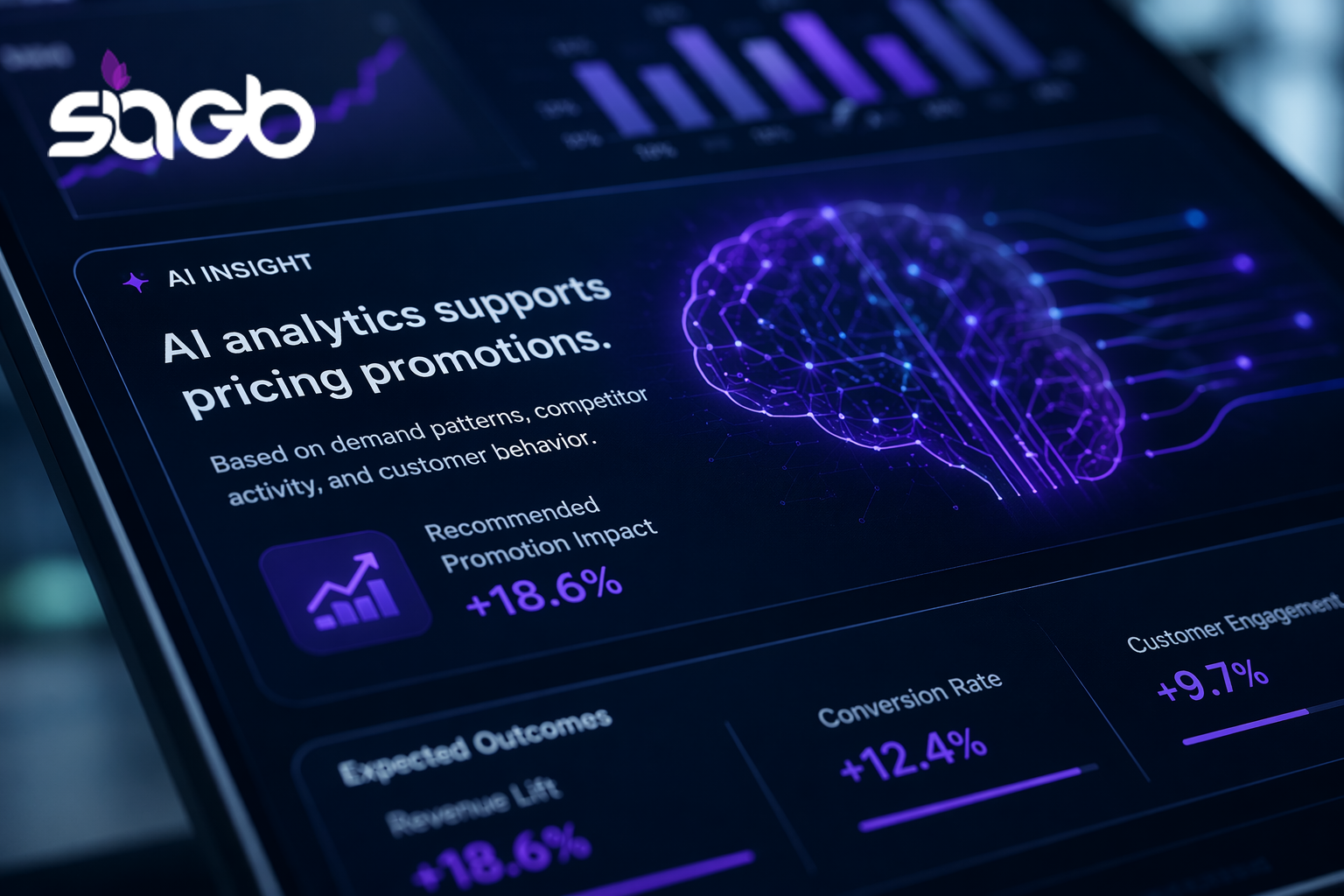
AI analytics tests price elasticity by product and region. It uses data analytics to suggest where small changes matter. This supports better promotional optimisation without hurting trust.
Promotion timing improves too. Analytics aligns offers with demand signals and inventory levels. Less guesswork. More control.
Reviews happen weekly. Not quarterly. That speed helps teams respond to market shifts without panic. Similar review cycles drive google reviews medical practice growth and online reputation healthcare outcomes.
How Do You Choose a Retail AI Analytics Partner in Australia?
Choosing a partner is a risk decision.
Look for end-to-end delivery. Strategy alone isn’t enough. You need build, deploy, and optimise support across the supply chain and store operations.
Ask for Australian examples with numbers. Not global slides. Not promises. Industry bodies like the Australian Retailers Association point to the same gap between technology hype and proven local outcomes.
Cross-industry experience helps. A team that also handles healthcare website accessibility to WCAG 2.2 AA, holds Core Web Vitals inside the good thresholds (LCP under 2.5 seconds, INP under 200 milliseconds, CLS under 0.1), and manages ada compliance medical website work, ada compliant patient portal delivery, and ada website lawsuit doctors risk tends to handle complexity better. SIAGB fits this profile: our team built Marvel PTE, an AI-driven platform serving more than 85,000 users across 900-plus institutes, and AI-powered patient scheduling for medical groups. We are a Sydney business (ABN 16 659 507 178) and operate as chatbot analytics consultants Australia-wide.
Future-Ready Retail Operations With AI-Native Platforms
Retail analytics is moving toward automation.
Agentic AI runs checks, sends alerts, and triggers actions. Less manual reporting. Faster response across the retail operation.
Automated seo agents, ai seo automation, and agentic ai for marketing already work this way. Retail operations follow next, just as ai optimised website healthcare platforms now blend analytics with delivery.
The goal is simple. Fewer dashboards. More decisions made on time. Better consumer behaviour understanding, better customer segmentation, and stronger customer loyalty.
Infographic: Retail AI Analytics From Data to Decision
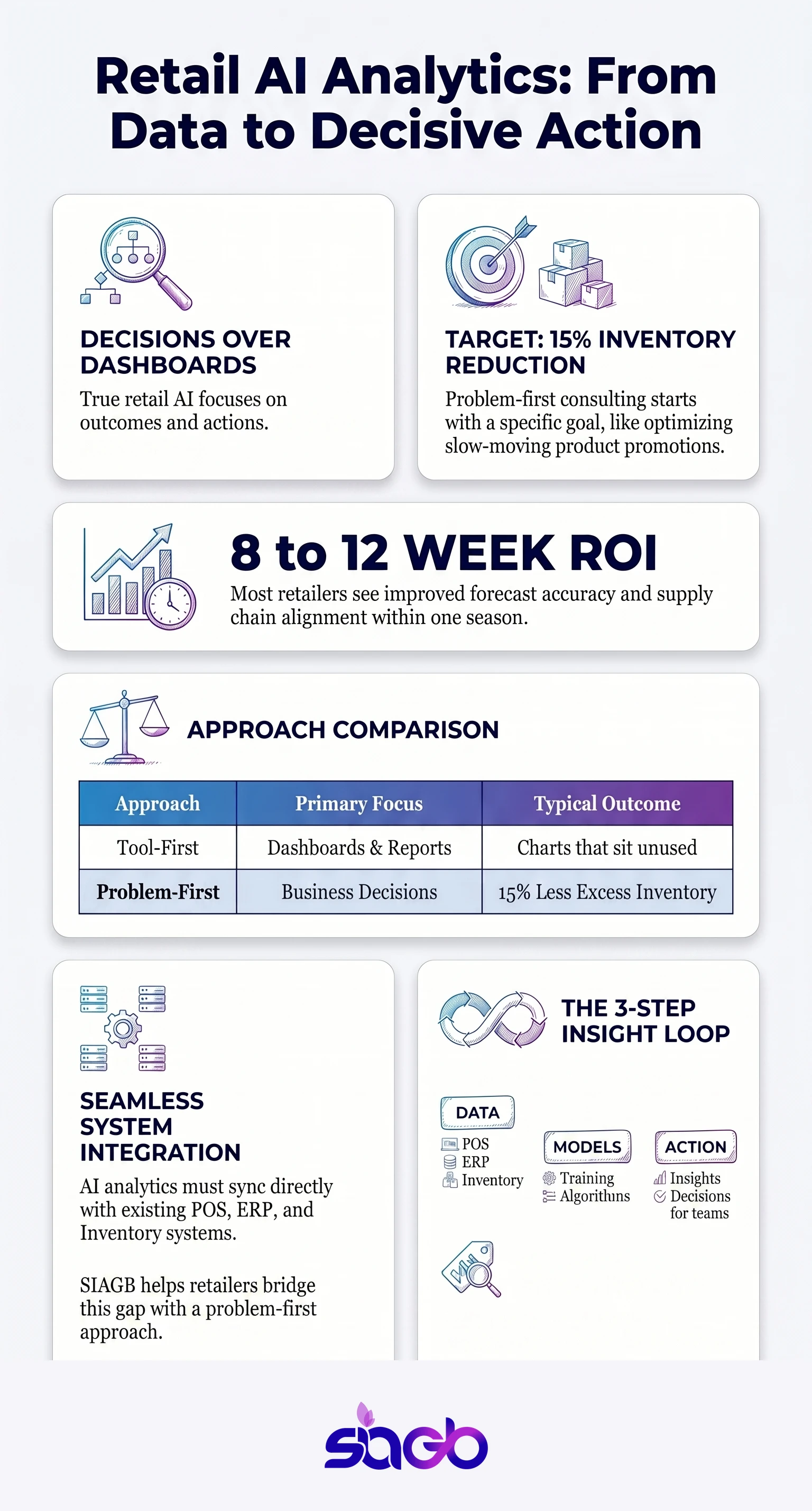
Retail AI analytics follows a loop.
- Data flows from POS, ERP, and inventory systems
- Models train, validate, and adjust using advanced analytics
- Outputs deliver actionable insights teams act on
Results feed back into data. Then the loop repeats. Simple. Powerful.
Frequently Asked Questions
What is retail AI analytics?
Retail AI analytics is the use of artificial intelligence to analyse data and recommend actions. The practical test is whether the output tells a store manager what to do next, such as reorder less or shift a price, rather than just showing another chart to interpret.
How long does it take to see ROI from retail AI analytics?
Most retailers see early results in 8 to 12 weeks. Forecast accuracy, supply chain alignment, and inventory improvements usually come first.
Can AI analytics work with my existing POS and ERP systems?
Yes. AI models sit on top of existing systems. Integration quality, data engineering, and data accuracy are critical for success.
Is retail AI analytics secure for customer and payment data?
It can be, provided security is designed in rather than bolted on. Beyond encryption and access controls, ask a partner how they segment payment data, log access, and handle data retention, since those operational details decide whether governance holds up in practice.
How does retail AI analytics relate to healthcare and medical websites?
The same AI foundations support healthcare website accessibility, medical practice seo, ai seo healthcare, and reputation management doctors rely on. Decision-first design reduces risk and improves outcomes.
Can agentic AI be used beyond retail analytics?
Yes. Agentic AI powers agentic seo, ai agents for seo, customer service automation, patient recall system workflows, and patient review management across industries.
Key Takeaways for Retail Leaders
Retail AI analytics must drive action, not reports. Clear ROI builds trust fast. Inventory, pricing, merchandising, and promotions benefit first. Choose a retail ai analytics solutions company like SIAGB that stays accountable, handles data properly, understands Australian retail reality, and applies lessons from healthcare website accessibility, hipaa compliant website delivery, and online reputation healthcare management.
Sources
- MIT Technology Review (technologyreview.com)
- Stanford HAI - Human-Centred AI (hai.stanford.edu)

Ready to put this into practice?
Let's Talk