
Introduction
IRS guidance keeps piling up. The Internal Revenue Bulletin (IRB) ships almost every week, and each issue can carry revenue rulings, revenue procedures, notices, and announcements. On top of that, IRS.gov posts web updates and FAQ revisions that never make it into the Bulletin at all. For an accounting practice, this creates real pressure on partners and senior accountants who must review, interpret, and explain changes to clients. Speed matters. Accuracy matters more.
Many US accountants are cautious about artificial intelligence and ai technology in general. And honestly, that makes sense. A quick summary that misses a threshold, an exclusion, or an effective date can create audit problems later. The same risk appears in healthcare and education when automation skips nuance. This article explains how can a us accounting firm use ai to summarise irs guidance and still protect trust, professional judgment, and clients.
In our consulting work at SIAGB, we treat this as a governance problem first and a tooling problem second. That order matters, and we will come back to why throughout this piece.
The Real Business Problem With IRS Guidance Overload
The Internal Revenue Service updates guidance often. Public rulings, draft guidance, and web content shift as policy changes, especially after major reforms such as the Tax Cuts and Jobs Act of 2017 and the Inflation Reduction Act of 2022, which are still generating follow-on guidance today. A single revenue procedure can run past 40 pages, and a Treasury decision can touch several sections of the Internal Revenue Code at once. Each update needs attention from finance teams and accounting professionals. Manual review takes hours. Sometimes days.
Senior accountants often read full documents just to spot what changed between two versions. That slows advice to clients and business owners. It also raises audit risk when details slip through. In a US practice, missed context can affect financial processes, financial data handling, and reputation. We have watched teams spend two hours diffing a 30-page notice by eye when the substantive change was a single dollar threshold on page 18.
Automation sounds appealing. But generic automation without controls creates new risks. US accounting firms don’t need faster reading. They need faster understanding, with confidence and clear IRS compliance guardrails.
What AI Summarisation Means In A Compliance Context
AI summarisation in compliance work isn’t the same as summarising a blog post. In accounting, meaning matters. Scope matters. Conditions matter.
Generative AI uses ai models trained on large datasets to produce summaries. General purpose tools like ChatGPT, Claude, Perplexity, and Google AI Overviews are built for broad language tasks, not for preserving the exact scope of a tax notice. In a compliance setting, an ai system must preserve what the IRS actually intended. Thresholds, exclusions, and effective dates must stay clear. A loose summary is risky. So is a confident hallucination: a general chatbot will happily invent a citation to a revenue ruling that does not exist.
Human accountability still sits at the centre. Accountants sign off on advice. Not machines. AI supports professional judgment. It doesn’t replace it. That principle applies whether you’re using an ai assistant, ai powered tools, or a generative ai tool inside an accounting workflow. In our builds we cap the model to summarising and flagging, never to giving a final position, and we route the output through retrieval that quotes the source paragraph verbatim so a reviewer can check it in seconds.
IRS Content Suitable And Unsuitable For AI Summarisation
Not all IRS content should be treated the same. Some material works well with AI summarisation. Some doesn’t.
High level guidance pages, update notices, and explanatory content are good candidates. For example, a Frequently Asked Questions revision on a credit, or an announcement of an inflation adjustment, summarises cleanly. AI accounting tools can pull out key changes, dates, and impacted taxpayers. That helps teams quickly see what matters and make informed decisions, in contrast to reading every page cold.
Legislative text, detailed examples, and edge cases need extra care. These usually require a CPA to interpret intent. Clear rules should be set before automation begins. When US accounting practices define boundaries early, risk drops fast.
Manual Review Versus Basic AI Tools Versus Agentic AI Workflows
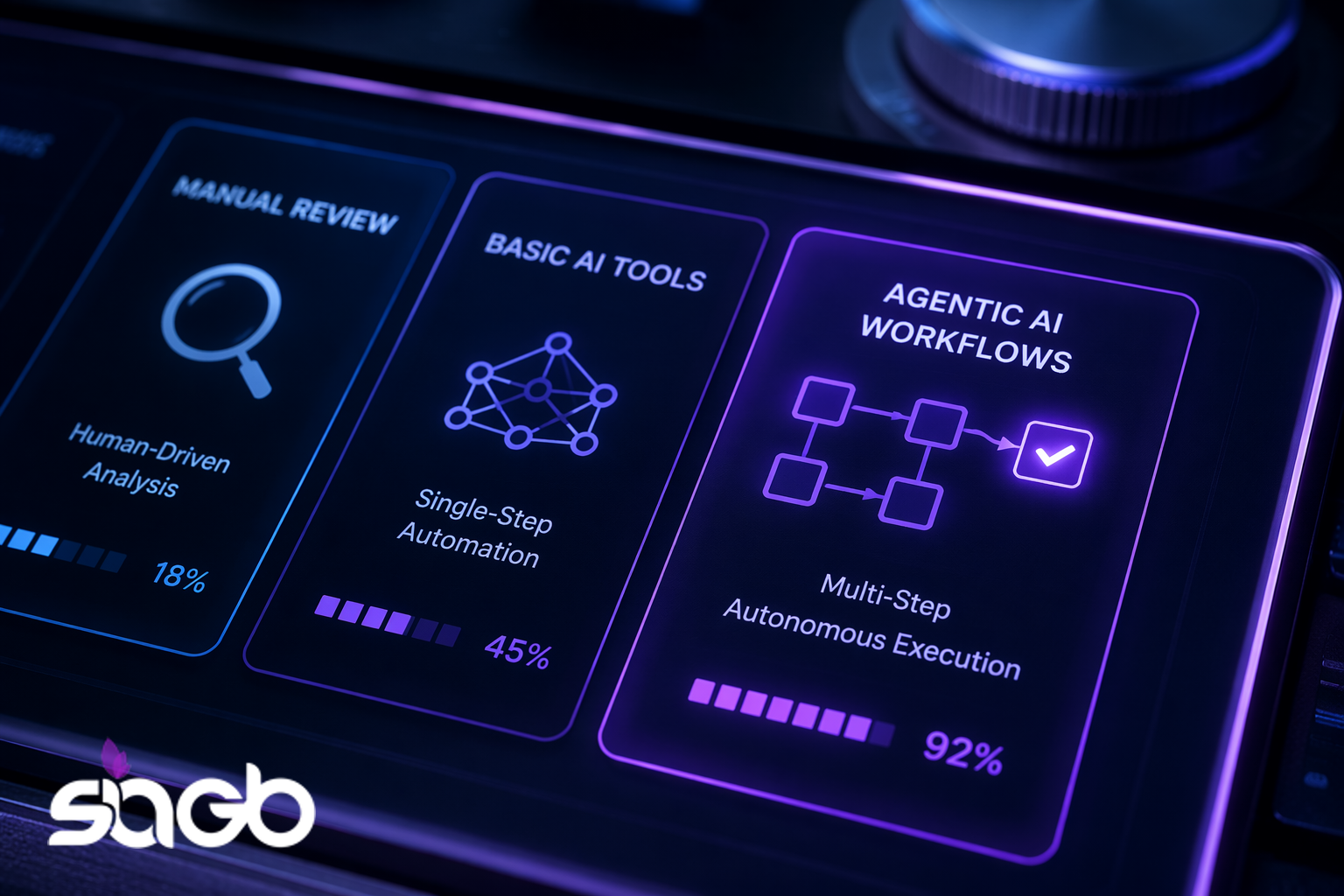
Manual review offers control. Accountants read everything and write notes. But it doesn’t scale as data entry and guidance volume grow.
Basic AI tools save time. Paste content in. Get a summary out. But governance is thin. There’s no audit trail and no validation. Trust is low. Mistakes happen. A pasted summary from a consumer chatbot, for instance, cannot tell you which paragraph it drew from, unlike a retrieval system that cites the source line.
Agentic AI workflows sit in between. AI agents ingest IRS updates, compare versions, summarise changes, and flag risks. Automation is controlled. Review steps are enforced. Audit logs are built in. This respects accounting standards, ai governance, and human oversight.
Comparison Framework For IRS Guidance Summarisation
| Approach | Speed | Accuracy | Audit Trail | Staff Trust |
|---|---|---|---|---|
| Manual review | Slow | High | Manual notes | High |
| Basic AI tool | Fast | Variable | None | Low |
| Agentic AI workflow | Fast | High with review | Built in | Growing |
This framework helps leaders assess risk realistically. It also shows why ai strategy matters more than chasing tools.
Governance is not a slogan. It maps to named controls that a US firm can point to during a peer review. Here is how we tie the AI workflow to standards clients already recognise.
| Control area | Standard or framework we map to | What it means for IRS summarisation |
|---|---|---|
| AI risk governance | NIST AI Risk Management Framework (AI RMF 1.0) and ISO/IEC 42001 | Documented risk tiers for each guidance type, with human sign-off required on high-risk items |
| Taxpayer data safeguards | IRS Publication 4557, the FTC Safeguards Rule, and the Gramm-Leach-Bliley Act (GLBA) | Written Information Security Plan, access logging, and encryption for any client data touched |
| Vendor and hosting assurance | SOC 2 Type II, plus US data residency | No taxpayer data leaves US-hosted infrastructure; sub-processors are reviewed before use |
| Professional conduct | AICPA Code of Professional Conduct and Statements on Standards for Tax Services | A CPA remains the responsible party for every position advised to a client |
We walk clients through this table in the first workshop, because it turns a vague fear of AI into a concrete checklist a partner can defend.
Risk Controls And Human In The Loop Review
Risk controls decide whether AI works in ai accounting. Without them, firms shouldn’t proceed.
Every AI summary should link back to the source IRS content. Paragraph level references matter. Review checklists help accountants confirm scope, dates, and exclusions. Audit trails record who reviewed what, and when. These controls support IRS compliance and AICPA expectations.
At SIAGB, AI consulting starts with governance. Automation comes after. That approach suits US accounting practices that value standards set by the AICPA and other professional bodies. It is the same discipline we bring to regulated builds outside accounting. Marvel PTE, an education platform we support, now serves more than 85,000 users across 900+ institutes, and every summarised update in that system links to its source so an examiner can verify it. We built AI-powered patient scheduling for medical groups under the same rule: the model proposes, a human confirms, and the trail is logged. Financial data deserves at least that level of care.
Key Point: If you can’t audit the AI output, don’t use it for client work.
Example Workflow For Summarising New IRS Guidance
Here’s a workflow many teams follow.
First, the system monitors releases from the Internal Revenue Service. New or updated guidance is ingested with version tracking. No manual data entry.
Next, ai models create a structured summary. Key changes, impacted taxpayers, and risk flags are highlighted. Each point links back to the source text, quoting the exact paragraph and effective date. Built in analytics help track accuracy and usage over time. We tag each summary with the IRB citation and the code section it affects, so a later search returns the right advice in one query.
Then, a senior accountant reviews the summary using a checklist. Once approved, it’s shared internally or with finance teams supporting clients. This is responsible ai use in practice.
Infographic: AI Summarisation Workflow For Accounting Firms
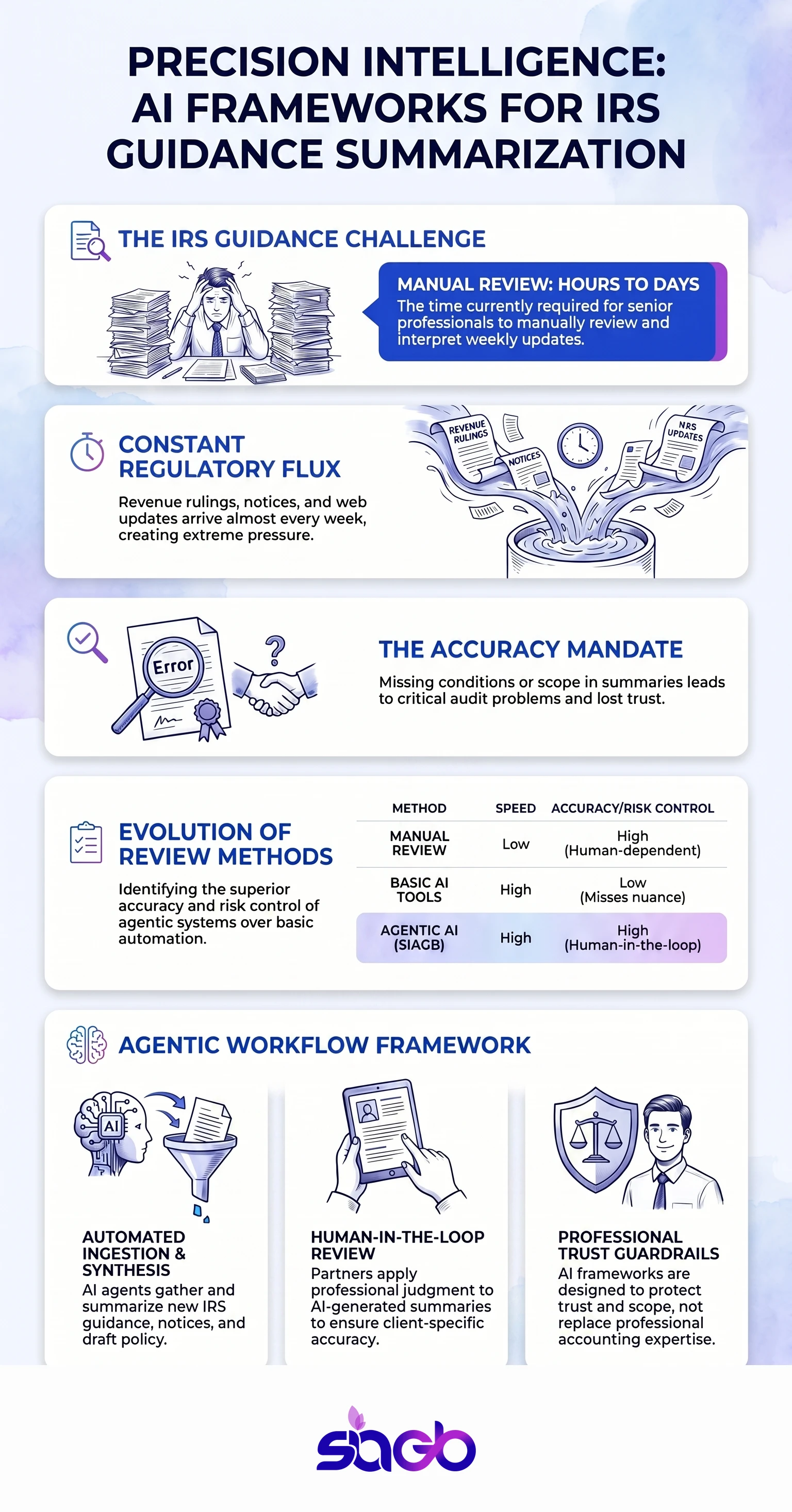
This infographic shows the path from IRS release to client advice. It highlights automation steps, human review points, and audit checks. Partners often use it to explain artificial intelligence and ai capability to staff.
Data Security And US Regulatory Considerations

Security matters. Accounting professionals handle sensitive financial and client data. Any ai solution must meet confidentiality obligations.
Data residency matters. Access controls matter. Often, these matter more than the ai accounting software itself. Under the FTC Safeguards Rule and IRS Publication 4557, a tax firm needs a written security plan, role based access, encryption in transit and at rest, and a named person accountable for it. A public chatbot rarely meets any of that. Lessons from regulated healthcare and education environments apply here too, where we have worked under HIPAA-style confidentiality and student data rules.
If the AI touches a client-facing web experience as well, the same rigour extends to accessibility and performance. We hold client sites to WCAG 2.2 AA and to Core Web Vitals thresholds (Largest Contentful Paint under 2.5 seconds, Interaction to Next Paint under 200 milliseconds, Cumulative Layout Shift under 0.1), and we mark up FAQ and article content with schema.org FAQPage and Article types so AI search surfaces it correctly.
Warning: Free AI tools often lack clear data controls. That’s a risk most US businesses should avoid.
Managing Change For Partners And Staff Skeptical Of AI
Skepticism is healthy. Many accountants have seen automation promises fall short before.
Start small. Use AI on low risk IRS updates, for example FAQ revisions and web content, before going near revenue rulings. Measure results. Show reduced review time and lower pressure on staff. Analytics help demonstrate value beyond hype. In our pilots we track the minutes saved per notice and the number of changes caught before a human missed them, and we share those two numbers with partners every fortnight.
Involve staff early. Let them shape review steps. Over time, ai accounting becomes just another trusted tool.
Measuring Success Beyond Time Saved
Time saved is easy to count. But it’s not the full picture.
Track error rates found during human review. Monitor adoption across teams. Measure how quickly guidance reaches clients and business owners. These analytics show whether AI actually improves quality and supports informed decisions.
In our dashboards we watch five numbers: minutes saved per notice, percentage of changes caught before human review, review turnaround time from IRB release to client note (we aim for under 48 hours), the share of summaries with a verifiable source link (target 100 percent), and the count of hallucinated citations, which must stay at zero. Two of those, the source-link rate and the zero-hallucination rule, are non-negotiable before any output reaches a client.
When To Engage An AI Consulting Partner
Off the shelf ai accounting tools rarely fit regulated work. Custom workflows matter.
An experienced partner understands accounting, audit, and compliance. End to end delivery avoids gaps. The same principle applies whether deploying an ai assistant, ai powered tools, or a full ai system.
SIAGB helps US accounting practices design practical ai strategy and measurable ai capability. Our founder, Sheetal Dhadial, brings more than 20 years of IT and AI leadership and is a Certified Scrum Master and AgilePM practitioner, so delivery stays disciplined from pilot to rollout. The focus stays on real problems, not demos. For many US businesses, that difference counts. We are based in Sydney (ABN 16 659 507 178) and work with firms across time zones.
Frequently Asked Questions
Can AI replace accountants when reviewing IRS guidance?
No. AI supports accountants by summarising and flagging changes. Human oversight and professional judgment remain essential.
Is it safe to use AI on IRS content?
Yes, if strong controls exist. Source links, review steps, and audit trails are required before relying on ai output.
What IRS guidance should not be summarised by AI?
Legislative text and complex edge cases need careful human review. AI works best on high level guidance and updates.
How long does it take to set up an AI summarisation system?
Most teams can pilot an ai solution in a few weeks. Full rollout depends on governance, security, and training.
Does the AICPA support the use of AI in accounting?
The AICPA encourages responsible AI use, with clear governance, ethics, and accountability.
Key Takeaways And Final Thoughts
AI can help manage IRS guidance overload. The value comes from controlled automation, not shortcuts.
When you ask how can a us accounting firm use ai to summarise irs guidance and still stay compliant, the answer is clear. Combine ai technology with human oversight, strong governance, and professional standards.
Used this way, artificial intelligence supports accountants, finance teams, and clients alike.
Sources
- MIT Technology Review (technologyreview.com)
- Stanford HAI - Human-Centred AI (hai.stanford.edu)

Thinking about how this applies to your business?
Start a Conversation