Voice AI in Australia helps healthcare and retail teams handle calls, text, and speech tasks without adding staff. It answers routine enquiries and inquiries, supports booking, and routes complex cases to a human agent. When designed for Australian English, privacy rules, and real workflows, it improves access, supports healthcare website accessibility goals, and reduces burnout. For those searching for voice ai australia, this guide covers what you need to know.
Australian organisations adopt this to cut missed calls, improve response times, and keep trust high in the Australian market. Results depend on how well ai voice, text, audio, conversational ai, and AI agents work together across real systems. In our work building AI-powered patient scheduling for medical groups, we saw that the platform matters far less than the workflow behind it.
Introduction: Why Voice AI Matters for Australian Businesses
Phones keep ringing. Staff juggle calls, text messages, and walk-ins at once. In healthcare and retail, that pressure leads to missed enquiries and inquiries, long waits, and tired teams. Sound familiar?
An ai voice agent helps when it fits real work, not just a shiny demo. It handles simple calls, gathers details using human speech patterns, and passes the right conversation to a human agent. That gives staff more time for care, service, and higher value work. For example, a front desk that fields 200 calls a day can hand routine booking and rescheduling to the agent and keep human time for triage.
Australian businesses also face higher trust expectations. A natural Australian accent, local tone, and safe data handling are not optional. SIAGB, founded in Sydney by Sheetal Dhadial, whose background spans 20+ years in IT and AI leadership as a Certified Scrum Master and AgilePM practitioner, sees this every week when supporting an Australian business across healthcare and retail, building ai voice systems end to end for the Australian audience. We built the Marvel PTE platform that now serves 85,000+ users across 900+ institutes, so we optimise these systems for scale from day one rather than treating a demo as the finish line.
What Voice AI Means in an Australian Context
Voice AI uses speech recognition and natural language to talk with people over calls. It listens, understands intent, and responds using an ai voice that aims for natural conversation. Sounds simple. In practice, it’s not.
Australian English has its own phrasing, pace, accent, and intonation. Systems trained only on United Kingdom or United States data often miss emotion and context, whereas a model tuned on local speech handles terms like “bulk billing” or “arvo” without stumbling. Callers repeat themselves. Conversations feel awkward. Trust drops fast. In our testing, an untuned US model misread suburb names such as Woolloomooloo and Bulleen far more often than a locally tuned one, which is exactly where the caller loses patience.
A strong setup handles Australian accents, local terms, and polite conversation norms. It also respects privacy under Australian law, specifically the Privacy Act 1988 and its 13 Australian Privacy Principles, plus the My Health Records Act 2012 for clinical data. Audio content, text logs, and speech transcripts must stay secure, and each audio file needs the same care as written records.
Some teams ask about an ai voice generator or basic ai voice australian generator tools. These help with testing voiceovers or early demos. But live systems need accuracy, analytics, monitoring, and a tuned ai model, which means clear prompts, review cycles, and careful design. For example, we target a speech-recognition word error rate under 8% on Australian English before a system handles live patient calls, compared with the 15% to 20% error rates we routinely see from generic off-the-shelf models.
What Are the Core Voice AI Use Cases in Healthcare?
Healthcare teams lose hours each week to calls that follow the same script. Booking. Rescheduling. Directions. Test reminders. An ai voice agent handles these reliably.

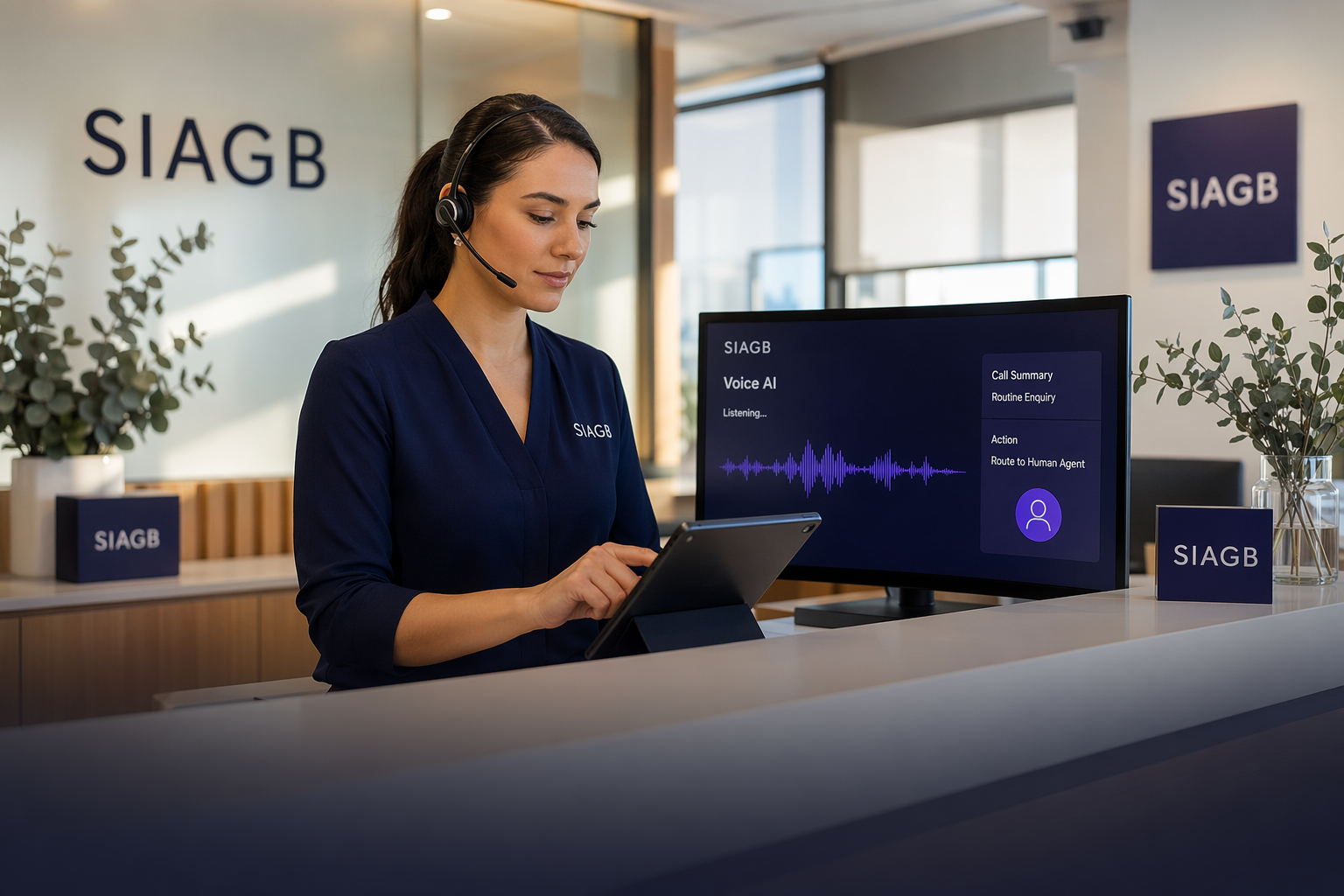
A voice agent can answer calls, confirm patient details, and book appointments straight into systems. It sends a text confirmation and logs the conversation, so staff only step in when needed.
Common healthcare use cases include:
- Appointment booking and changes linked to patient systems
- Patient recall system reminders for follow-ups and care plans
- After-hours call handling with safe escalation rules
Patient recall systems are another strong fit, where voice and text reminders prompt follow-ups. According to the Australian Institute of Health and Welfare, missed follow-ups remain a key risk in chronic care as of 2024. In our work with one medical group, moving reminders from manual callbacks to an automated voice-plus-SMS flow cut the no-show rate on recall appointments from roughly 18% to under 9% within the first two months.
After-hours calls matter too. The ai call flow can share clinic hours and next steps. Urgent cases get escalated. No clinical advice given. Patient-facing messaging should also reflect advertising obligations set by AHPRA for regulated health services.
The same voice technology serves different goals in each sector, as this table shows:
| Application | Healthcare benefit | Retail benefit |
|---|---|---|
| Inbound call handling | Books and reschedules appointments | Answers stock, hours, and order queries |
| Reminders and recall | Prompts follow-ups and care plans | Confirms pickups and delivery windows |
| After-hours coverage | Shares clinic hours, escalates urgent cases | Captures leads and sale enquiries |
| Multi-location consistency | Aligns clinic networks on safe scripts | Gives the same answer in Sydney or Perth |
Key Point: This technology supports care access. It doesn’t replace clinical judgement.
How Does Voice AI Help Retail and Multi-Location Businesses?
Retail teams deal with call spikes during sales and holidays. Missed calls often mean lost revenue, and with retail trade tracked by the Australian Bureau of Statistics at over $37 billion a month, even a 5% lift in call capture rate matters. An ai voice solution answers common questions quickly, and unlike a static IVR menu it can pull a live answer instead of forcing the caller through a phone tree.
For multi-location brands, responses stay consistent. Australian callers hear the same clear information whether they ring Sydney or Perth, while the system checks store hours, stock, and order status. Compared with routing every branch call to a single overloaded head office line, a shared voice agent gives all 20 or 40 stores the same script without extra staff.
AI consulting for retail businesses often links call data to CRM tools such as Salesforce, HubSpot, or Zoho. That shows which inquiries convert, which questions repeat, and where drop-offs happen, supporting better decisions across a wide range of locations. In our experience, tagging every call outcome in the CRM is what turns raw call logs into a forecast a store manager can act on. And yes, it can support New Zealand customers too.
Voice AI, Chatbots, and AI Agents Working Together
Here’s the thing. This works best when it’s not on its own.
Chatbots handle website messages. Voice handles calls. AI agents move tasks between systems. A booking updates the calendar. A missed call triggers a text. A follow-up leads to a review request.
This conversational ai approach cuts errors and supports natural conversation across channels. No double entry. Fewer repeated questions. Smoother experiences for the Australian audience. Coverage in MIT Technology Review tracks how fast these systems moved from novelty to everyday business tooling. We track handoff quality closely, because the moment that breaks trust is a voice agent dumping the caller back to zero instead of passing the full context, such as the patient name and reason for calling, to the human who picks up.
Pro Tip: Integrated voice, text, and audio systems reduce admin more than any single tool.
Infographic: How Voice AI Fits Into End-to-End Operations
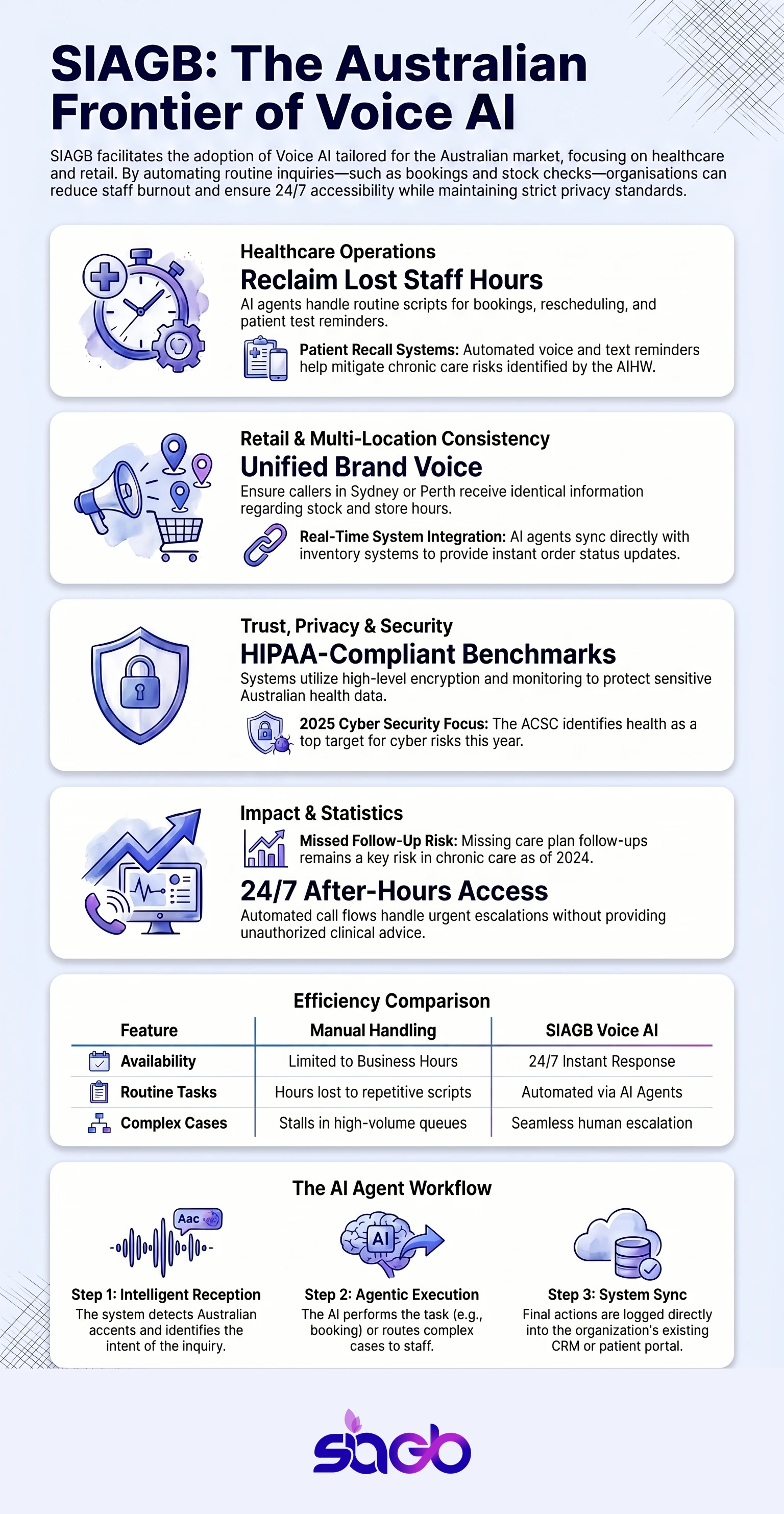
Picture the flow. A caller rings. The ai voice agent answers. Human speech turns into text. The agent checks rules and data, the booking happens, and a text confirms it.
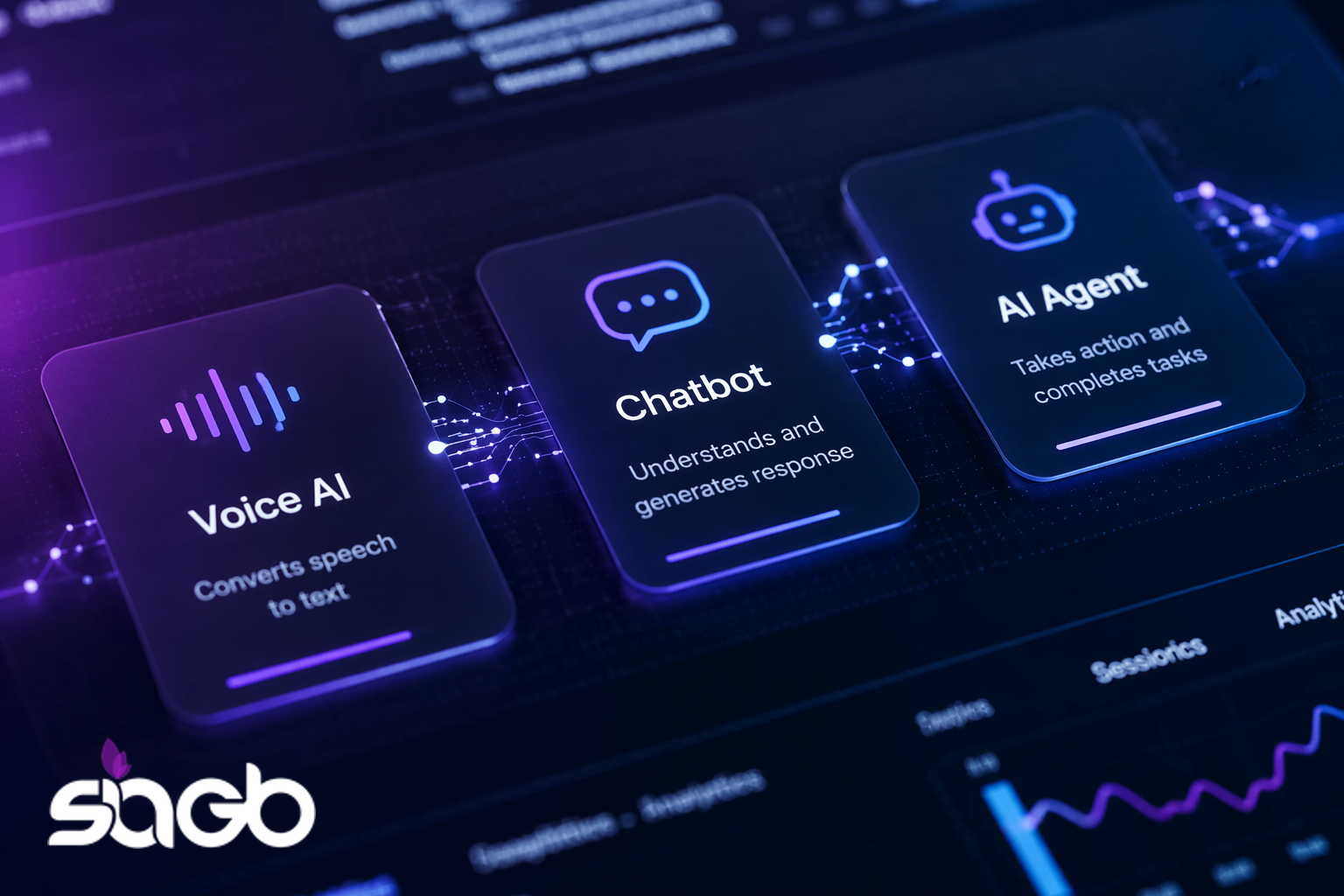
Behind the scenes, analytics track tone, emotion cues, and outcomes, while security controls protect each audio file and text log. That’s how modern systems support the Australian market.
Answer Engine Optimisation and Agentic SEO for Medical Practices
Search behaviour is shifting. People now ask full questions. Answer engine optimisation medical strategies help practices appear in AI results and voice search, specifically in surfaces such as Google AI Overviews, ChatGPT, Perplexity, and Microsoft Copilot rather than the old ten blue links.
Agentic SEO uses automated seo agents to monitor content and responses, tracking how speech, text, and calls perform. Updates happen faster than manual SEO. In our experience, adding structured data with schema.org types such as MedicalClinic, Physician, and FAQPage is the single change that most often gets a practice quoted directly in an AI answer, because it hands the model clean facts instead of making it guess.
In healthcare, accuracy matters. According to Google Search Central guidance from 2024, health content faces higher quality thresholds under its E-E-A-T and YMYL (Your Money or Your Life) framework. Clinicians review changes. Marketing teams approve tone. Unlike a generic blog, a medical page has to name the reviewing clinician and cite a source, or the model treats it as low trust.
AI Content and SEO Without Breaking Trust or Rules
AI content medical practice tools help with drafts, FAQs, and updates, saving time while supporting medical practice SEO goals.
Honestly? Patients spot content that feels fake. Keep the human voice front and centre, even when creators use automation.
Accessibility, WCAG, and ADA Risks for Healthcare Websites
Healthcare website accessibility affects real people. Vision, hearing, and mobility barriers block access when sites miss standards.
WCAG healthcare website guidelines shape accessible design in Australia, covering contrast, captions, and structure. Australian government and many health services target WCAG 2.1 Level AA, and WCAG 2.2 AA is now the current benchmark, which sets concrete rules such as a minimum 4.5:1 contrast ratio for body text and captions for all pre-recorded audio. Overseas ADA website lawsuit doctors cases still matter for clinics serving international patients; in the United States, federal courts logged well over 4,000 web-accessibility lawsuits in 2023 alone.
Warning: Ignoring accessibility raises legal and reputational risk.
Accessible Patient Portals and Voice Interfaces
An ada compliant patient portal works with screen readers. Forms stay clear.
Voice interfaces help patients who struggle with forms. A voice actor style delivery, powered by ai voice technology, guides them through tasks using speech. Access improves.
Modern Medical Website Design and Redesign Expectations
Medical practice website design isn’t about trends. Speed, clarity, trust, and accessibility matter.
A modern site loads quickly and works on mobile. In practice that means passing Google’s Core Web Vitals thresholds: Largest Contentful Paint under 2.5 seconds, Interaction to Next Paint under 200 milliseconds, and Cumulative Layout Shift below 0.1. AI optimised website healthcare setups also help answer engines understand content, supporting audio content, social media clips, and voiceovers. We track these three metrics on every practice site we build, because a page that fails them tends to lose both patients and AI citations at the same time.
Reviews, Reputation, and Voice AI Follow-Ups
Reviews shape trust, and Google reviews medical practice profiles influence choice. AI systems can prompt feedback after visits. A short call or text asks for input. Reputation management doctors programs track responses and flag issues, and online reputation healthcare improves when feedback leads to action.
Privacy, Data Security, and Healthcare Cyber Risks
Voice data is sensitive. Audio files, text logs, and speech transcripts need protection.
Many clinics aim for a hipaa compliant website benchmark, where encryption and monitoring matter, though in Australia the binding rule is the Notifiable Data Breaches scheme under the Privacy Act, which requires reporting an eligible breach to the OAIC within 30 days. According to the Australian Cyber Security Centre, health remains a top target as of 2025; its ReportCyber data has flagged healthcare among the most breached sectors year after year. For voice systems specifically, we encrypt audio at rest with AES-256 and in transit with TLS 1.3, and we set retention windows rather than storing recordings indefinitely.
Key Point: Secure systems protect patients and businesses.
How Do You Measure ROI From Voice AI and Automation?
ROI starts with fewer missed calls and more completed bookings.
Link ai voice data to analytics and track call volume, outcomes, and follow-ups. We measure four numbers on every deployment: answer rate, average handle time, containment (calls resolved without a human), and booking conversion. As a rough benchmark, a clinic that recovers 30 missed calls a week at an average booking value of $120 recovers around $3,600 in weekly revenue that used to ring out. Staff wellbeing and patient experience matter too, and unlike a pure cost-cutting play, the wins we see most often come from staff getting time back rather than headcount going down.
Frequently Asked Questions
What is voice AI and how does it work?
It pairs speech recognition with natural language so an ai voice can listen, read intent, and reply in real time. The difference between a demo and a live system is the tuning behind it: clear prompts and review cycles that keep replies accurate.
Is voice AI safe for healthcare use?
Yes, when privacy, security, and clear limits are built in from day one. Encryption, monitoring, and strict escalation rules protect patient data, while the system avoids clinical advice and hands urgent cases to a person.
Can voice AI handle Australian accents?
Yes, once trained on Australian English phrasing, pace, accent, and intonation. Systems built only on UK or US data miss local terms and context, so callers repeat themselves and trust drops.
Does voice AI replace staff?
No. It supports staff by handling routine enquiries and inquiries.
How long does it take to see results?
Many teams see fewer missed calls within weeks. ROI depends on integration and review.
Key Takeaways and Practical Next Steps
This works best as part of an AI-native system. Calls, text, speech, and AI agents should connect.
Compliance, accessibility, and security need to be built in from day one.
Start with clear problems. Missed calls. Admin load. Access gaps. SIAGB helps Australian teams design solutions that support real needs, from healthcare to retail, using ai voice technology that sounds human and feels right.
Sources
- MIT Technology Review (technologyreview.com)
- Stanford HAI - Human-Centred AI (hai.stanford.edu)

Ready to put this into practice?
Let's Talk