
WCAG AAA compliance means a full web page meets every Level A, AA and AAA success criterion in the WCAG guidelines. That’s the short definition.
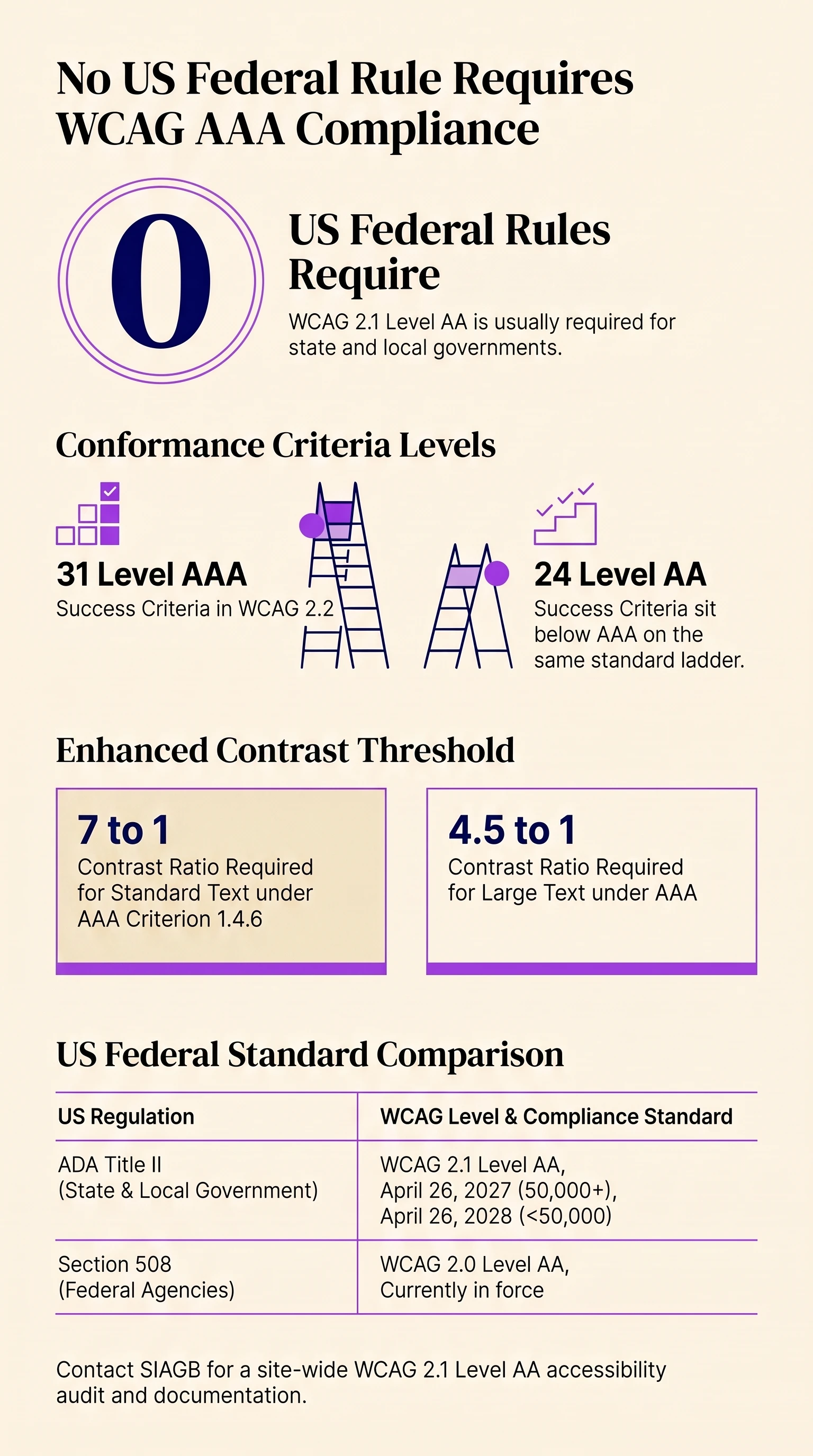
The part most US organizations actually need is the next one: no US federal rule requires AAA. The ADA Title II web rule for state and local governments names WCAG 2.1 Level AA, and Section 508 names WCAG 2.0 Level AA for federal agencies. W3C, which writes these accessibility guidelines, also advises against requiring AAA for entire sites. So the working WCAG standard for most teams is AA, plus the AAA criteria that help their own users.
What Is WCAG AAA Compliance?
WCAG stands for Web Content Accessibility Guidelines, published by the World Wide Web Consortium (W3C). People say “WCAG compliance”. W3C says “conformance”. They mean the same thing here.
The current version is WCAG 2.2, published October 5, 2023 and updated December 12, 2024. It’s also an international standard, ISO/IEC 40500:2025. US rules, though, still name older versions: 2.1 for state and local governments, 2.0 for federal agencies. That gap confuses a lot of procurement language.
AAA is the top of three levels, and it includes A and AA underneath it. A page at AAA meets all three.
In the US, the phrase tends to show up in three places. An RFP asks for “WCAG AAA compliance”. A vendor pitches a product as “AAA certified”. Or a demand letter mentions WCAG without naming a level. The certification claim is the easy one to test. W3C publishes AAA conformance logos, but according to the logo page itself, claims are not verified by W3C, and content providers are solely responsible for how they use them. Nobody issues an official AAA certificate.
What you can get is evidence. Our ADA compliance service audits sites against WCAG 2.1 Level AA and documents what was tested and what passed. We start with a page-by-page audit, then fix every issue we can reach.
Does US Law Require WCAG AAA?
No. Three rules matter for most US organizations, and none of them names Level AAA.
ADA Title II (state and local governments). The Department of Justice rule under the Americans with Disabilities Act says web content and mobile apps of state and local governments usually need to meet WCAG 2.1 Level AA. On April 20, 2026, an Interim Final Rule moved the compliance dates. Public entities of 50,000 or more people now have until April 26, 2027, and those under 50,000, plus special district governments, have until April 26, 2028.
ADA Title III (businesses open to the public). This is where the accessibility law gets loose. DOJ guidance says “The Department of Justice does not have a regulation setting out detailed standards” and that businesses “have flexibility in how they comply.” It names WCAG and the Section 508 Standards as existing standards that give helpful guidance. That guidance page predates the April 24, 2024 Title II rule, so read its Title II parts with that in mind. The Disabilities Act doesn’t set WCAG 2.1 Level AA as a fixed rule for businesses, whatever a demand letter implies.
Section 508 (federal agencies). The Revised 508 Standards incorporate by reference the WCAG 2.0 Level AA Success Criteria and apply them to federal agencies’ web and non-web electronic content.
| US rule | Who it covers | WCAG level it names | Dates or flexibility |
|---|---|---|---|
| ADA Title II web rule (DOJ) | State and local governments | WCAG 2.1 Level AA | April 26, 2027 (50,000+); April 26, 2028 (under 50,000, special districts) |
| ADA Title III (DOJ guidance) | Businesses open to the public | No detailed regulation; WCAG named as helpful guidance | Flexibility in how they comply |
| Revised Section 508 Standards | Federal agencies | WCAG 2.0 Level AA, by reference | In force |
| Any of the above | Anyone | Level AAA is not named | None |
If you also sell into Europe, W3C notes that most organizations addressing the European Accessibility Act use WCAG and the European standard EN 301 549. That’s still not AAA.
For the ADA compliance checklist itself, see what ADA compliance means for a website. Healthcare teams may also want our piece on ADA website lawsuits and doctors in the US.
This isn’t legal advice. If you’ve received a specific demand letter and it has you worried, talk to counsel about it.
How Do WCAG Level A, AA and AAA Compare?

The three levels stack. Under section 5.2.1 of WCAG 2.2, Level A means a page meets all Level A success criteria. Level AA means it meets all A and AA criteria. Level AAA means it meets all A, AA and AAA criteria, or offers a conforming alternate version.
By count, WCAG 2.2 lists 31 Level A, 24 Level AA and 31 Level AAA success criteria. Criterion 4.1.1 Parsing is now obsolete and removed.
Think about everyday US pages. A county building permit form needs Level A basics: every field reachable by keyboard. A state benefits page at WCAG level AA also needs text contrast of at least 4.5:1, so applicants with low vision can read the eligibility rules. A retail checkout at Level AAA would go further still, down to the reading level of its terms.
| Conformance level | Includes | One example success criterion | Typical US use |
|---|---|---|---|
| Level A | All Level A criteria | 2.1.1 Keyboard | Minimum; no US rule stops here |
| Level AA | All A and AA criteria | 1.4.3 Contrast (Minimum), 4.5:1 | Level named by the Title II rule (2.1) and Section 508 (2.0) |
| Level AAA | All A, AA and AAA criteria, or a conforming alternate version | 3.1.5 Reading Level | Chosen page by page, never required by a US rule |
So when people talk about WCAG A, WCAG AA and WCAG level AAA, they’re describing one ladder, not three separate standards. Each conformance level sits on the one below it. Most WCAG conformance levels questions come down to this: which rung does your rule name, and is any page worth taking higher?
What Does Level AAA Conformance Require on Each Page?
Level AAA conformance has four conformance requirements worth knowing before anyone writes “AAA” into a contract.
First, the page meets every A, AA and AAA success criterion, or provides a conforming alternate version (5.2.1). Second, conformance applies to full web pages only (5.2.2). You can’t claim AAA conformance for a header, a footer or a single widget while the rest of the page sits at AA.
Third, a claim can cover a named set of full pages. One part of a site can reach AAA while everything else stays at AA, as long as the claim says which pages are which.
Fourth, W3C’s Understanding Conformance guidance says authors “are encouraged to report (in their claim) any progress toward meeting success criteria from all levels beyond the achieved level of conformance.” That’s the honest middle ground. A site can claim AA and still list the AAA criteria it meets.
A US example makes the choice clearer. A city’s “pay a parking ticket” flow is a fair AAA candidate: a few pages, short text, a clear task. A recorded city council meeting archive isn’t, because every video would need sign language interpretation to meet AAA.
How pages are tested against each WCAG conformance level is a separate job. Our guide to a website accessibility audit covers it.
Which AAA Success Criteria Are Hardest to Meet?
Some AAA criteria are small changes. Three of them aren’t.
1.4.6 Contrast (Enhanced). At AAA, text needs a contrast ratio of at least 7:1, and large text at least 4.5:1. Those ratios are thresholds, and computed values aren’t rounded up, so a ratio just short of 7:1 fails. Plenty of US brand colors were tuned to pass AA at 4.5:1. Many of them fail at 7:1, and fixing it means a brand conversation, not just a CSS edit.
1.2.6 Sign Language (Prerecorded). This level AAA success criterion asks for sign language interpretation of prerecorded audio in synchronized media. For US audiences, that usually means American Sign Language. For a training video library or a years-deep archive of webinars, it’s a heavy load.
3.1.5 Reading Level. When text needs a reading ability above lower secondary education level, AAA asks for supplemental content or a simpler version. That’s hard on benefits rules, insurance terms, medical pages and legal notices, which are often the pages people most need to understand.
Who gains from these level AAA success criteria? Screen magnifier and low vision users gain from enhanced contrast. Deaf signers gain from sign language video. People with cognitive disabilities gain from plain reading levels. Assistive technology alone doesn’t solve any of the three. A screen reader can’t raise a contrast ratio or rewrite a policy in plain words, so the content itself has to change.
Why Does W3C Advise Against Requiring AAA Compliance Site-Wide?
Here’s the part people miss: the strongest warning against site-wide AAA doesn’t come from critics of the standard. It comes from the standard itself. According to Note 2 in W3C’s conformance requirements: “It is not recommended that Level AAA conformance be required as a general policy for entire sites because it is not possible to satisfy all Level AAA success criteria for some content.”
Take the council archive again. Captions for each recorded meeting are doable. Sign language video for every past meeting may not be. Some technical or legal content can’t drop to a lower secondary reading level without losing what it legally has to say.
That’s why an RFP clause or a vendor promise of “full AAA accessibility compliance” sets a bar W3C itself calls impractical for whole sites. It’s frustrating for everyone involved, because the buyer can’t really get it and the vendor can’t honestly promise it. When you see that phrase, ask two questions. Which pages? Which criteria? A specific answer is useful. A vague “all of it” is a warning sign about the rest of the proposal too.
Which WCAG Compliance Level Should a US Organization Set?

The right WCAG compliance level depends on what kind of organization you are.
State or local government. Set WCAG 2.1 Level AA conformance, met by the April 26, 2027 or April 26, 2028 date that applies to you. If you build to WCAG 2.2 AA instead, you still cover 2.1 AA, because the success criteria in 2.1 aren’t changed in 2.2.
Federal agency teams. WCAG 2.0 Level AA under Section 508 is the legal floor. Meeting 2.1 or 2.2 AA also meets it.
Business open to the public. DOJ has no fixed web standard for Title III, so AA conformance against a current WCAG version is the practical reference, and it’s the one DOJ guidance points toward. AA compliance gives you a clear, testable target and a clear record if a complaint arrives.
For all three, treat the level AA criteria as the floor, then add selected AAA criteria page by page:
- Enhanced 7:1 contrast on key flows, such as sign-up, payment and contact.
- Plain reading level on rules, eligibility pages and forms.
- A conformance claim that names the full pages at AAA and lists other AAA criteria met.
That’s WCAG level AA conformance with a real record of the extra work, and it holds up better in a proposal than a loose promise of “AA plus”.
This is the work our accessibility compliance service does: audits against WCAG 2.1 Level AA, remediation and documentation. We don’t sell an “AAA certified” badge, because none exists. If you’re weighing outside help, our guide to hiring a website accessibility consultant lists what to ask. Healthcare sites have extra pressure points, covered in WCAG compliance for healthcare websites.
Key Takeaways
- No US rule requires WCAG AAA compliance: Title II names WCAG 2.1 AA, and Section 508 names WCAG 2.0 AA.
- Title II compliance dates are now April 26, 2027 and April 26, 2028.
- Businesses under Title III have flexibility; DOJ points to WCAG as helpful guidance.
- W3C doesn’t recommend AAA as a whole-site policy, claims are per full page, and W3C doesn’t verify them.
- Set AA as the floor, then add AAA criteria where they help your users.
FAQ
Does the ADA require WCAG AAA compliance?
No. The Department of Justice rule for state and local governments under Title II names WCAG 2.1 Level AA. For businesses open to the public under Title III, DOJ has no regulation setting out detailed web standards and points to WCAG as helpful guidance. Neither one names Level AAA.
What WCAG level does Section 508 require for federal agencies?
WCAG 2.0 Level AA. The Revised 508 Standards incorporate the WCAG 2.0 Level AA success criteria by reference and apply them to web and non-web electronic content, including electronic documents, with a small set of exceptions.
When do the ADA Title II web accessibility deadlines start?
After the April 20, 2026 Interim Final Rule, the dates are April 26, 2027 for public entities serving 50,000 or more people, and April 26, 2028 for smaller public entities and special district governments.
Can a website claim AAA conformance for some pages only?
Yes. WCAG conformance is claimed per full web page, so you can name the pages that reach AAA and keep the rest of the site at AA. A part of a page, such as a header or a widget, can’t be claimed on its own.
Is there an official WCAG AAA certification?
No. W3C doesn’t verify conformance claims and doesn’t run a certification program. If a vendor says a site is AAA certified, ask for the audit report instead: which pages were tested, against which criteria, and what passed.
Sources
- W3C, Web Content Accessibility Guidelines (WCAG) 2.2
- W3C WAI, Understanding Conformance, WCAG 2.2
- W3C WAI, Understanding SC 1.4.6 Contrast (Enhanced)
- W3C WAI, WCAG 2 Overview
- W3C WAI, WCAG 2 Level AAA Conformance logos
- U.S. Department of Justice, Fact Sheet: New Rule on the Accessibility of Web Content and Mobile Apps
- U.S. Department of Justice, Guidance on Web Accessibility and the ADA
- Section508.gov (GSA), Applicability and Conformance Requirements

Thinking about how this applies to your business?
Start a Conversation