
WCAG AAA compliance means a full web page meets every Level A, AA and AAA success criterion in the WCAG guidelines. It’s the top of three levels, and the strictest by a long way.
Here’s the catch, though. W3C, the body that writes these accessibility guidelines, doesn’t recommend requiring AAA as a general policy for whole sites, because some content can’t meet every AAA criterion. And no Australian law names AAA. The Australian Government Style Manual tells agencies to meet level AA and aim higher. So for most organisations the practical WCAG standard is AA, plus the AAA criteria that genuinely help your users. If a tender has just landed on your desk with “AAA” in it, that should come as a bit of a relief.
What Is WCAG AAA Compliance?
WCAG stands for Web Content Accessibility Guidelines, published by the World Wide Web Consortium (W3C). Most people say “WCAG compliance”. W3C says “conformance”. Same idea, and you’ll see both words here.
The current WCAG standard is version 2.2. W3C published it on 5 October 2023 and updated it on 12 December 2024, and it’s also an international standard, ISO/IEC 40500:2025. The Style Manual names 2.2 as current too, so Canberra and W3C agree on that much.
AAA sits on top of A and AA. A page that reaches AAA also meets everything underneath it. That’s the whole structure, really.
What AAA isn’t: a certificate. W3C publishes AAA conformance logos, but claims are not verified by W3C and content providers are solely responsible for using them. So when a sales deck says “AAA certified”, ask who did the certifying. In the official sense, nobody can.
For Australian readers the term usually turns up in tender schedules, agency briefs and vendor pitches, often with no detail attached. Our ADA and AHRC compliance service audits sites against WCAG 2.1 Level AA, fixes what it finds and documents the work. AAA is something we talk through page by page. It’s not a badge we hand out.
What Is the Difference Between WCAG Level A, AA and AAA?
The three conformance levels stack, one on top of the other. Section 5.2.1 of the spec defines them, and it’s shorter than you’d expect. Level A: a page meets every Level A success criterion. Level AA: every Level A and AA criterion. Level AAA: all three sets, or the page has a conforming alternate version.
Think of WCAG Level A as the floor. It removes the worst barriers, like an image with no text alternative. WCAG Level AA is where most policies point, Australian Government guidance included. WCAG Level AAA adds the strictest criteria, the ones that take real design and content effort.
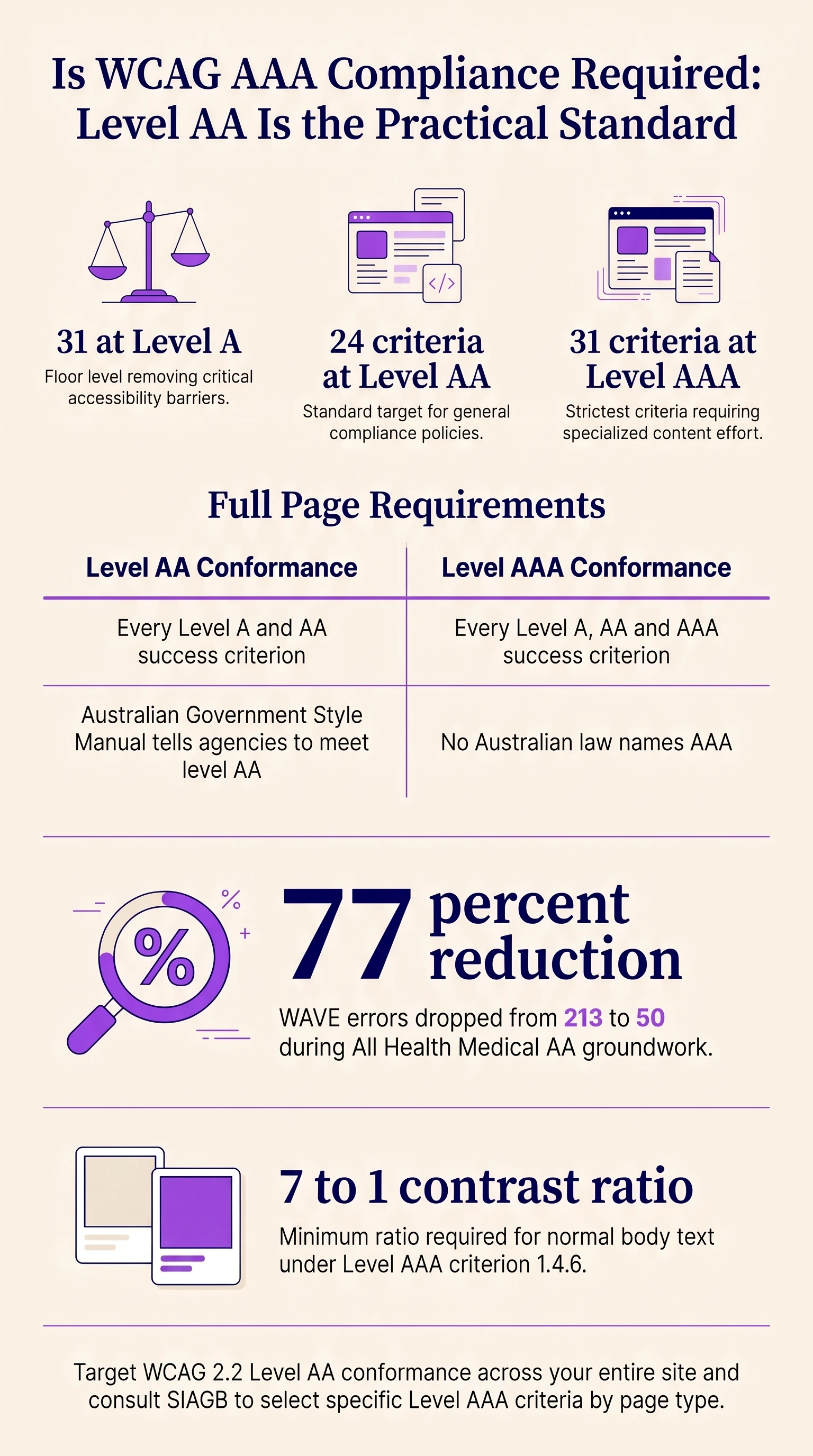
How many criteria sit at each level? Counted out, WCAG 2.2 lists 31 Level A, 24 Level AA and 31 Level AAA success criteria. (4.1.1 Parsing is now obsolete and removed, which is why older counts don’t match.) So AAA isn’t a small extra. It’s as many criteria as Level A.
| WCAG level | What a full page must meet (WCAG 2.2, 5.2.1) | Example success criterion | Where Australian guidance lands |
|---|---|---|---|
| Level A | Every Level A success criterion | 1.1.1 Non-text Content | Floor only; no AU guidance stops here |
| Level AA | Every Level A and AA success criterion | 1.4.3 Contrast (Minimum), 4.5:1 | Style Manual: agencies “Meet WCAG level AA” |
| Level AAA | Every Level A, AA and AAA success criterion, or a conforming alternate version | 1.4.6 Contrast (Enhanced), 7:1 | Style Manual: “aim higher”; related to some topics, not required site-wide |
One small gripe. People talk about “WCAG A” or “WCAG AA” as if each WCAG level were its own standard. It isn’t. Levels A, AA and AAA are WCAG conformance levels inside one standard. So when a brief asks which WCAG compliance level you meet, a good answer names the version as well as the conformance level, for example WCAG 2.2 AA. A WCAG conformance level with no version attached is only half an answer.
What Does Level AAA Conformance Actually Require?
Strip the conformance requirements back and Level AAA conformance comes down to three rules.
First, every Level A, AA and AAA success criterion is met on the page, or there’s a conforming alternate version (5.2.1). Every one of them. A page that meets 30 of the 31 AAA criteria is an AA page with extras, not an AAA page.
Second, conformance applies to full web pages only (5.2.2). You can’t claim AAA for a header, a footer or a single form. Sounds fussy? It makes sense once you remember that a person uses the whole page, not one widget on it.
Third, and this is the bit most people miss, a claim names the pages it covers. So a site can claim AAA conformance for some full pages, say a contact page, while the rest sits at AA. That’s legitimate WCAG conformance, as long as the claim spells out which pages.
W3C’s Understanding Conformance guidance goes a step further. It says “authors are encouraged to report (in their claim) any progress toward meeting success criteria from all levels beyond the achieved level of conformance”. Put simply, if you’re at AA and you’ve met a handful of AAA criteria, say so.
A quick example. A council-style service page with text, a form and no video is a realistic AAA candidate. A page built around a library of recorded webinars probably isn’t, for reasons the next section makes obvious. How each WCAG success criterion actually gets tested is a separate topic, covered in our guide to a website accessibility audit.
Which Level AAA Success Criteria Are Hardest to Meet?
There are 31 AAA criteria, and I’m not going to walk through all of them. Three cause most of the grief.
1.4.6 Contrast (Enhanced). Normal text needs a contrast ratio of at least 7:1 against its background, and large text at least 4.5:1. Those figures are thresholds. And according to W3C’s contrast guidance, computed ratios shouldn’t be rounded, so a ratio that falls even slightly short of 7:1 fails. Brand palettes built to scrape past AA at 4.5:1 tend to fall over here. Mid-grey body copy on white. Pale brand blues. That sort of thing. People with low vision gain the most from this level AAA success criterion.
1.2.6 Sign Language (Prerecorded). Prerecorded video with audio needs sign language interpretation. For an Australian audience that means Auslan. Each video needs an interpreter in the edit, so the effort grows with every clip you publish, and a big back catalogue becomes a project of its own. Deaf people who sign are the ones who benefit.
3.1.5 Reading Level. When text needs reading ability beyond lower secondary education level, you supply supplemental content or a simpler version. Easy to write in a policy. Hard to do for legal terms, technical documentation and clinical information, where the exact wording is the whole point. People with cognitive or reading disabilities benefit most.
Notice what these level AAA success criteria have in common? Assistive technology doesn’t fix any of them. A screen reader can’t raise a contrast ratio, film an Auslan interpreter or rewrite a dense paragraph. They’re content and design decisions, which is exactly why they’re hard.
Why Does W3C Advise Against Whole-Site AAA Compliance?
This one surprised me the first time I read it, honestly. The people who wrote AAA tell you not to require it everywhere. W3C says so twice, once in the WCAG 2.2 spec and again in its Understanding Conformance guidance. The wording is blunt: “It is not recommended that Level AAA conformance be required as a general policy for entire sites because it is not possible to satisfy all Level AAA success criteria for some content.”
Why? Go back to the criteria above. A site with hundreds of recorded videos would need sign language interpretation on every one. Some legal text can’t drop to lower secondary reading level without changing what it means. You can add a plain-English summary, sure. But every page, every criterion, every time? Some content won’t get there.
So what does this mean for accessibility compliance in practice? A tender that demands “AAA across the whole site” is asking for something W3C itself advises against. And a vendor that promises it should explain how, page by page and criterion by criterion. I’d want that in writing before anything gets signed.
Is WCAG AAA Required by Law in Australia?

Short answer: no. No Australian law or government standard requires AAA. Here’s how the pieces fit together.
The Disability Discrimination Act 1992. The DDA (Act No. 135, 1992, administered by the Attorney-General’s Department) is the accessibility law sitting underneath everything else here. But the Act itself doesn’t name WCAG or any conformance level. If someone tells you the DDA requires a particular WCAG level, ask them to point to the section.
The Australian Government Style Manual. For agencies, the Style Manual is direct. It says accessibility “is a mandatory standard for government agencies”, that “WCAG 2.2 is the current version”, and its heading reads “Meet WCAG level AA, but aim higher”. It also warns that failing to give equal access to government services “can be a failure of obligation under the Disability Discrimination Act 1992”. The Style Manual relates AAA to some topics. It doesn’t demand it site-wide. And notice the audience: Australian Government agencies, not private businesses.
Digital Service Standard Criterion 3. The Digital Transformation Agency’s “Leave no one behind” criterion says agencies must comply with the DDA, the latest version of WCAG and the Style Manual, along with the Disability Services and Inclusion Act 2023. That page doesn’t name a WCAG level at all.
Private businesses. The DDA applies to you. But no Australian standard tells a business which WCAG level to pick, and in practice AA is the common reference point.
These accessibility standards line up with practice overseas. In the US, the Americans with Disabilities Act, where the phrase ADA compliance comes from, points to AA as well. And W3C notes that most organisations addressing the European Accessibility Act use WCAG and the European Standard EN 301 549.
If you want the medical angle and the complaint side of the DDA, read ADA and AHRC compliance for medical websites in Australia. For a plain checklist, there’s what ADA compliance means.
Should You Target AA Conformance and Add Selected AAA Criteria?

Yes, for almost every Australian organisation. The Style Manual and W3C both point this way, and it’s what I’d recommend. Three steps.
Step 1: meet every Level AA criterion of WCAG 2.2. If you’ve already had a WCAG 2.1 Level AA audit, it isn’t wasted. W3C confirms the success criteria in 2.1 are unchanged in 2.2, so WCAG 2.1 AA work carries straight across and you check the newer criteria on top. WCAG 2.0 Level AA, published on 11 December 2008, is the oldest baseline you’ll still come across. Full AA conformance is the goal here. Partial AA compliance won’t satisfy a careful buyer.
Step 2: pick AAA criteria by page type. Enhanced contrast on text-heavy service pages. A plain reading level on public information. Sign language on the few prerecorded videos that matter most, maybe your “how to apply” explainer.
Step 3: record it. Put your progress beyond AA in the conformance claim, as Understanding Conformance encourages. A WCAG Level AA conformance claim that also lists six AAA criteria met tells a buyer far more than a vague “AAA-ready”.
Where do we fit? Our team audits against WCAG 2.1 Level AA and the level AA criteria, then fixes what fails, through the ADA and AHRC compliance service. I led the All Health Medical accessibility rebuild, which went from 213 WAVE errors to 50, a 77 percent reduction (details on my author page). That was AA groundwork, not AAA. In my experience that’s where the effort goes first. If you’re weighing outside help, here’s when to bring in a website accessibility consultant.
What Accessibility Standards Should an Australian Tender or Brief Ask For?
If you’re writing a tender, brief or contract, here’s wording you can adapt:
- WCAG 2.2 Level AA conformance for all pages in scope.
- Named AAA criteria for named page types (for example, 1.4.6 Contrast (Enhanced) on service pages), not “AAA site-wide”.
- Conformance claims made per full page, as WCAG requires.
- No “AAA certified” badge, since W3C doesn’t verify claims.
- Evidence: an audit report plus a fix list.
Answering an agency tender instead? The Style Manual and Digital Service Standard Criterion 3 are what the agency is working to, so mirror their accessibility standards in your response. Spell out the level AA criteria you meet and any AAA criteria you’ve added. If you’d like a second pair of eyes on a brief before it goes out, our compliance team can help with that.
Key Takeaways
- WCAG AAA compliance means every A, AA and AAA success criterion on a full page, and W3C doesn’t recommend requiring it for whole sites.
- No Australian law requires AAA. The Style Manual tells agencies to meet level AA and aim higher.
- The hardest AAA criteria: 7:1 contrast, sign language for prerecorded video, and a lower secondary reading level.
- Claims are per full page and self-declared, so nobody can certify AAA.
- The sensible target is WCAG 2.2 AA plus selected AAA criteria per page type.
FAQ
Is WCAG AAA compliance required by law in Australia?
No. The Disability Discrimination Act 1992 doesn’t name any WCAG version or level. Government agencies work to the Style Manual, which says to meet level AA and aim higher, and to Digital Service Standard Criterion 3, which points to the latest WCAG without naming a level.
Can a website claim AAA conformance for some pages only?
Yes. WCAG conformance is claimed per full web page, so you can list the pages that reach AAA, such as a contact page or a single service page, and leave the rest of the site at AA. Part of a page can’t be claimed.
Should an Australian business aim for WCAG AA or AAA?
Aim for AA across the whole site, then add the AAA criteria that help your own users on the pages where they matter. W3C itself says Level AAA shouldn’t be required as a general policy for entire sites.
Can anyone certify a website as WCAG AAA compliant?
Not officially. W3C doesn’t verify conformance claims and doesn’t run a certification scheme. An audit report shows what was tested and what passed, which is useful evidence, but it isn’t a certificate.
Which WCAG version should an Australian website follow?
WCAG 2.2, which both W3C and the Style Manual name as current. If your last audit was against WCAG 2.1 AA, that work still counts, because the 2.1 success criteria carry over into 2.2 unchanged.
Sources
- W3C, Web Content Accessibility Guidelines (WCAG) 2.2.
- W3C WAI, Understanding Conformance, WCAG 2.2.
- W3C WAI, Understanding SC 1.4.6 Contrast (Enhanced).
- W3C WAI, WCAG 2 Overview.
- W3C WAI, WCAG 2 Level AAA Conformance logos.
- Australian Government Style Manual, Agency responsibilities and commitments.
- Digital Transformation Agency, Digital Service Standard Criterion 3. Leave no one behind.
- Federal Register of Legislation, Disability Discrimination Act 1992.

Want to explore this further?
Book a Free Consultation